Alan Steffert with the city’s Engineering and Public Works department fields questions at an informational meeting about utility rates at Thunder Mountain Middle School on Thursday, Dec. 19, 2024. (Clarise Larson/KTOO)
At an informational meeting at Thunder Mountain Middle School Thursday evening, residents reacted to the news. Jesse Hay, a Mendenhall Valley resident, said he understood the need for repairs, but he’s disappointed with the city’s overall approach to spending.
“The utilities are definitely a requirement. But I think people just get frustrated that every time we turn around, the city’s asking for more and more,” he said. “The residents are just kind of getting tired of it because it’s getting too damn expensive to live here.”
Juneau’s utility rates have gone up 2% each year since 2020. The last time rates were increased was this summer.
Now, the division proposes increasing the flat residential water rate by 10.25% starting next July. Then, another 10.25% each July until 2029. The proposed sewer increase is between 12 to 13% each year.
At the meeting, city staff said it could have been much higher. In October, Juneau voters approved a wastewater bond to borrow $10 million to replace critical infrastructure at the Juneau Douglas Wastewater Treatment Plant.
Alan Steffert with the Engineering and Public Works department said the bond helped shave off a significant amount of repair costs – but there are still a lot of upgrades that need to happen beyond that.
“We’re actively replacing our infrastructure, be it wastewater or water, be it treatment, be it collections, be it distribution,” he said. “There’s no end of products or projects we can spend on and it’s a matter of prioritizing.”
Some residents, like Shawn Lovell, wanted to know how much cruise ship traffic takes a toll on the city’s wastewater infrastructure, and if residents will be the only ones paying if rates increase.
“How much are we actually getting from the cruise industry to offset that? Because it seems like we, as the locals, are the ones that are footing that excess bill, where maybe a little bit more should be twisted or pushed on to help them pay for it,” he said.
His comments, and many others from residents who attended the meeting, will be passed on to the Juneau Assembly. Residents may also submit comments about the proposals online. The Assembly will vote on the rate proposal before July.
The Serenade of the Seas in Sitka on July 21, 2021, the first port call of the curtailed 2021 cruise season. (Tash Kimmell/KCAW)
After three previous failed attempts, a fourth application to put a cruise limit question before Sitka voters has passed the city’s initial legal review.
Organizers now have a few months to collect 613 signatures in support of their ballot proposition. If they get enough signatures, it could go before the voters in a special election next spring.
The advocacy group Small Town SOUL wants to limit cruise traffic in Sitka, following several years of growth in the industry that’s more than doubled the community’s pre-pandemic cruise traffic numbers.
The proposed ballot initiative would limit cruise traffic in Sitka to 4,500 cruise passengers per day, and 300,000 annually. It would establish a permitting process for cruise ships that the city would oversee, and would fine cruise ships if they dock without a permit or exceed the number of scheduled passengers. The new initiative also removes language requiring a Sitka port facility permit and considers “passengers” ashore instead of persons, meaning cruise ship crew members would not count toward the cap.
It’s the first time a cruise limit ballot question has advanced this far in the process. The last three petition applications were denied by the city’s legal department because they were deemed unenforceable, and included confusing or misleading provisions.
Anchorage law firm Jermain, Dunnagan & Owens prepared the legal opinion on the proposal. In their letter, they note that opponents have called into question a number of legal concerns around the initiative. But the bar is very high for proving a ballot initiative is unconstitutional before it has been enacted.
While they say the ordinance invites “a variety of possible constitutional challenges,” none are clear-cut enough to warrant the city’s rejection of the application at this stage in the process. The clerk can only reject an application if the law leaves “no room for argument about its unconstitutionality.” In their recommendation that the city approve the application, they write, “At this point, any legal challenges to the proposed initiative are best addressed by a court.”
Organizers now have to collect signatures amounting to one-third of the number of votes in the last regular municipal election. In a statement, Larry Edwards, one of SOUL’s organizers wrote, “Sitka’s home rule charter allows ninety days for us to get the signatures. But we aim to get them in weeks, not months, toward having the special election in early spring.”
Once they’ve collected signatures, the petition will be submitted to the city clerk’s office for a signature review. If enough signatures are collected for a special election, one must be held between 40 to 90 days later. If the ballot proposition is approved by the voters, it would go into effect in 2026.
Alyson Cooper of Meander Way testified in favor of the flood barriers and local improvement district. (Photo by Anna Canny/KTOO)
The debate over the City and Borough of Juneau’s controversial plan to fight glacial outburst floods continued during Monday’s Assembly meeting.
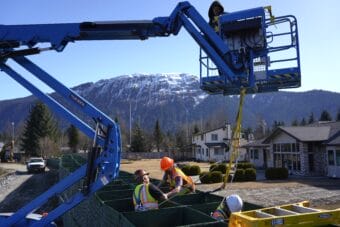
The proposal to install military-grade HESCO flood barriers along key sections of the Mendenhall River, at a cost of $7.83 million for the first phase, has received mixed reception from residents in the Mendenhall Valley’s flood-prone neighborhoods.
More than 20 people testified on Monday. Some expressed frustration and anger with the city’s approach. Others, like Brandi Tolsma, championed it as the best way to safeguard homes before next summer’s flood season. Tolsma’s home on Sharon Street was among the nearly 300 properties damaged during this August’s record-breaking outburst.
“Over four and half months later, my family and I are still piecing our home back together, trying to rebuild what we lost,” she said. “This choice is clear. These barriers are not a permanent fix. They are a bridge to a more comprehensive solution.”
Glacial outburst floods have become an annual summer occurrence in Juneau, though the 2023 and 2024 floods were uniquely catastrophic. The city has maintained that the flood barriers, which were recommended by the U.S. Army Corps of Engineers, are the only viable flood prevention that could be quickly installed by next spring or summer.
To cover the cost of installing the barriers and reinforcing the riverbank to support them, the city would provide some funding via Juneau taxpayer dollars, while the rest would be split among nearly 500 flood-prone homes through the creation of a local improvement district, or LID.
But before the district is created, more than half of those affected homeowners must support the plan. If they approve, homeowners at the greatest risk of flooding would have to pay a share over the course of the next 10 years. But many, like Molly Zaleski of Meander Way, have already said they’ll object.
“I feel like we’re being forced into this position,” Zaleski testified on Monday. “I feel like if you guys want to push forward with these HESCO barriers, then the city should pay for it.”
The cost has been a sticking point in the plan’s rollout. The Assembly attempted to address that concern on Monday. The original plan outlined a 50/50 split for the project budget between the city and homeowners like Zaleski, who would have to pay nearly $8,000 each. The Assembly amended the plan to a 60/40 split, which would bring the cost for homeowners down to just over $6,000.
Still, some said they’d vote against the project even if it came at no cost to them. Residents raised a variety of objections on the basis of liability if the barriers fail, sacrifice of personal property along the riverfront or concern that the installation of barriers might distract from a more long-term solution at the source of the flood, either by proactively draining Suicide Basin or building a levee, dam or dike at Mendenhall Lake.
While waiting for a long-term solution, riverfront homeowners like John Cooper of Meander Way would have to host the flood barriers on private property for up to 10 years. In his testimony, Cooper said he’s willing to do it.
“I’m going to lose a significant portion of my backyard to do so,” Cooper said. “But I’m ready to do that for the good of other people that are inside this flood area.”
City manager Katie Koester has said that the city is committed to more permanent flood fighting too. The Assembly has already set aside $3 million in funding to develop that plan, and this week, the U.S. Forest Service committed an additional $1 million. But any long-term fix won’t come quickly.
“I can’t tell you how long it will take to find a long-term solution. I can tell you that it will require persistence on all of our parts to keep our federal partners feeling the same sense of urgency that we do” Koester said Monday. “Large expensive projects take a long time to design, engineer and, most importantly, find funding for.”
In previous meetings, Koester has indicated that a failure to install the barriers may jeopardize federal support for a long-term fix down the line.
In testimony as a private citizen, recently retired Assembly member Michelle Hale implored the Assembly to support the city’s plan. Hale, who lives in the Mendenhall Valley outside of the proposed improvement district, previously called the flood an “existential threat” to Juneau.
“The Army Corps of Engineers are the experts at flood control, and their recommendation right now is to install the HESCO barriers,” Hale said. “A dike is a great idea, but there is way too much at risk to try and push through and install a dike this year, before the 2025 jokulhaup.”
The time-sensitive nature of this flood, which could return with similar or larger magnitude next summer, has repeatedly been stressed as the reason for the barriers. If the local improvement district fails to pass, the city has stated in writing that they would not have time to pursue an alternative flood mitigation project.
Sam Hatch, who lives on the riverfront on Meander Way, said that stance has contributed to anger and resistance across the Mendenhall Valley. Hatch said he is supportive of short-term flood fighting, but he’ll refuse to host the flood barriers on his property if the local improvement district is approved. He asked the city to consider alternatives
“If the LID fails, will the city and Assembly take no action — as these documents indicate — and abandon our neighborhoods to the flood waters,” Hatch said, referring to written statements in the Assembly meeting packet.
Hatch, and the 465 other homeowners in the proposed improvement district, will receive a mailer this week with more information about the plan. The city will also host a neighborhood meeting in January to share more information.
Affected homeowners must object in writing or they will be considered in favor of the plan. They have until Feb. 3 to object. If more than 50% do, then the plan fails, though there’s a slim chance that the Assembly could override that decision at its Feb. 3 meeting.
Water rushes past homes and reinforced riverbanks along the Mendenhall River during Juneau’s annual glacial outburst flood on Monday, August 5, 2024. (Photo by Eric Stone/Alaska Public Media)
Since the record-breaking glacial outburst flood damaged hundreds of homes in August, the City and Borough of Juneau has been focused on its short-term plan to install flood barriers along the Mendenhall River in hopes of holding back the next glacial outburst.
It’d be a temporary measure, but city leaders have maintained that it’s imperative. Some residents from flood-prone neighborhoods don’t see it that way. Starting next week, residents in Juneau’s Mendenhall Valley will be asked to weigh in on the proposal, and some, like Noah Teshner of Lakeview Court, said they’ll vote against it.
Teshner is part of a small group of well-organized homeowners that are calling themselves the Juneau Flood Solution Advocates. They’ve held community meetings attended by more than a hundred residents from flooded neighborhoods. Teshner said many would rather see a long-term solution to flooding, and they feel rushed by the city’s plan.
“It doesn’t give people the opportunity to make an educated decision,” he said. “It’s like a drowning man. You’re going to reach out and cling to the first thing that you can that you think is going to save you.”
City Manager Katie Koester said she wants a more permenant flood prevention plan too, and earlier this month she visited Washington, D.C., along with other representatives from the city and from the Central Council of Tlingit and Haida Indian Tribes of Alaska to seek funding for it. But she said its success will depend on more immediate action, and the barriers are a critical way to buy time before next summer’s glacial outburst flood.
“We’re really concerned that if we don’t have a temporary, short-term solution, we won’t have much to protect,” she said.
The barrier installation would cost homeowners nearly $8,000 each over the next 10 years. A long-term solution would almost certainly be more–but homeowners might be less likely to have to foot the bill.
Juneau Flood Solution Advocates released a video earlier this month to draw attention the August flood and a Fairbanks project that they believe is a good example for Juneau. After a devastating city-wide flood in 1967, the U.S. Army Corps of Engineers took on the massive Chena River Lakes Flood Control Project. Teshner wants something like that to control the flow of water at Mendenhall Lake.
And Koester said the Corps might be interested in pursuing that, but any long-term flood prevention project will require a lot of study, permitting and funding. For instance, it took six years for Chena River Lakes Flood Control Project to break ground and more than a decade to complete construction.
Koester says the Army Corps suggested the barrier plan as a first step.
“We really need to follow their advice, because they are our partner in finding a long term solution to this problem,”
For Debbie Penrose Fisher, president of the Juneau Flood Solution Advocates, the city’s focus on the barrier plan has been scary. She worries that if she and her neighbors don’t go along with it, they won’t receive any help at all. And she said she’s willing to wait for a long-term solution, even if that means flooding again.
“I choose not to be told scare tactics, and ‘It’s this or nothing,'” she said. “I think if I’ve seen from the community that we’re strong and we can come together and until they solve this in a long term way.”
She wants the city to develop a plan that makes the flood season easier on her and her neighbors–something with details for a better warning system, evacuation plan and sandbag deployment ahead of next year’s flood.
Penrose Fischer and nearly 500 other homeowners will weigh in on the barrier proposal over the next few weeks. They’ll have the opportunity for public comment at the regular Assembly meeting on Monday, Dec. 16th.
The downtown seawalk on Thursday, Nov. 21, 2024. (Clarise Larson/KTOO)
A plan to extend Juneau’s downtown waterfront walking path, also known as the seawalk, crossed a major hurdle earlier this week.
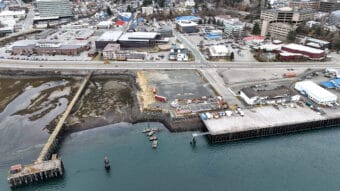
The city has long planned to develop a continuous, mile-and-a-half-long path from the Douglas Bridge to the AJ Dock. That’s the cruise ship dock farthest from downtown. The city has developed the seawalk in sections over the years, and this new section will extend a quarter mile south towards Thane.
Alix Pierce, the city’s visitor industry director, presented on the project in May. She said it will make Juneau more welcoming — and accessible – for tourists.
“We would need to get further along in the design process to have a more accurate estimate, but we can assume it’s a $20 to $25 million project,” she said.
But, the project can’t move forward unless the city can negotiate a land swap deal with the private owners of the Franklin Dock — where the seawalk currently ends.
The city would essentially swap a small piece of city-owned land near the Franklin Dock, called the National Guard Dock, in exchange for a land easement and a tidelands lease. On Monday, the Juneau Assembly voted to let the city manager start those negotiations.
Right now, the AJ dock is isolated from the rest of the ships. Tourists coming off ships there have to shuttle into town or walk roughly 10 minutes through an industrial area to get there. The extension will allow them to walk directly to Juneau along the waterfront. But a lot of residents use the seawalk too — whether that’s walking their dogs or simply sitting on a bench to look out at the channel.
Karla Hart, a longtime activist against the growth of tourism in Juneau, said those locals should have more say in how this project moves forward. She spoke about it at the meeting on Monday.
“There’s no public urgency, and delaying this will not impair existing use and scale of the cruise industry. Rushing it will have unknown consequences,” she said.
She asked the Assembly to table the negotiations to gather more input.
The city already has close to $6 million set aside for the project from marine passenger fees. The Assembly will need to determine how to pay for the rest, but passenger fees will likely pay for most of it.
The Assembly will still need to give the final stamp of approval on the negotiated land swap before anything can move forward. The city will also have to work out a deal for a land easement with Petro Marine, another landowner in the area, and go through a permitting process.
Amanda Neyenhouse pours a beer at Devil’s Club Brewing Company in downtown Juneau on Tuesday, Jan. 2, 2024. (Clarise Larson/KTOO)
Residents might be able to order a glass of beer or wine at more restaurants in Juneau soon.
On Monday, the Juneau Assembly approved petitioning the state to increase the number of alcohol licenses in town.
Restaurant or Eating Place Licenses allow restaurants in the state to serve beer and wine. Some restaurant owners say the licenses will help attract more visitors to their businesses and create more venues for local artists.
Right now, Juneau technically has more licenses than the state limit for a town of its size. But, that number doesn’t necessarily take into account how many visitors come to Juneau, especially in the summer cruise season.
A growing number of restaurant owners, like Mar y Sol co-owner Richard Bloomquist, say they want a license – but they’re all taken. He said not having one means their eatery loses business.
“Multiple times per week customers come to our restaurant, sit down, look at the menu, and later leave because we do not carry beer or wine,” he said. “This happens more in the summer than in the winter, since many locals are aware of the menu. But this points to the loss for us in terms of business.”
Though Juneau is at its capacity, a recent change to Alaska’s alcohol laws allows for cities to petition to add more licenses by getting approval from their local governing body. The change was made in part to recognize the surplus of non-residents coming into local communities, like tourists or seasonal workers.
At Monday’s meeting, the Juneau Assembly approved petitioning the Alaska State Alcoholic Beverage Control Board to add eight new licenses in the capital city.
Zach Pease, the technical director for the Juneau Arts and Humanities Council, testified that the additional licenses will increase the number of venues in Juneau for local artists.
“More beer and wine licenses would allow restaurants and similar establishments to host events, and provide affordable, accessible venues for small groups and emerging artists on tight budgets,” he said.
Pease said right now, popular venues like Centennial Hall are often booked months to a year in advance, and they can be too big or too spendy for smaller artists to afford. That often leaves local bars as their only performing option. But, that’s not ideal for families or people who don’t drink.
“New licenses would not only foster more inclusive event spaces for under-served groups but also support a broader range of affordable, creative events,” Pease said.
Taylor Vidic, a well-known musician and event producer in Juneau, agreed. She said allowing more places in Juneau to sell beer and wine can help offset the costs of renting spaces and make sure artists can get paid well for their work.
“The best way to create sustainable arts events is by utilizing a wide range of revenue streams, and that’s what this resolution is about for me,” she said. “Restaurants that can serve a glass of wine have another revenue stream to support and honor the artists in our town.”
But, not every local business wants to add more licenses. Some bars and restaurants paid high prices for them due to their scarcity – sometimes upwards of $50,000 – while the state only charges a $1250 fee.
Mitch Falk, the owner of Bullwinkle’s Pizza, asked the Assembly to keep the status quo. He argued there’s already enough out there and increasing the number of available licenses would devalue the current ones that can be sold from one business to another.
“If we’re trying to give these licenses, which it sounds like that’s what the intent is, you’re trying to put somebody in business in competition with somebody that had to buy a license – like myself, that bought two of them,” he said. “It seems like a little bit of unfair competition.”
The number of licenses approved on Monday could have been higher – the city originally proposed adding 20 more. That would have nearly doubled the amount currently available in Juneau.
The Alaska State Alcoholic Beverage Control Board still needs to approve the petition before the licenses can be distributed.
Close
Update notification options
Subscribe to notifications
Subscribe
Get notifications about news related to the topics you care about. You can unsubscribe anytime.