Local Government

Tidal action and fierce winds flood low-lying areas of Kwigillingok

Flooding in Kwigillingok on Jan. 10, 2025. (Courtesy Lewis Martin)

Strong tidal action and fierce southerly winds inundated low-lying areas of the Kuskokwim Delta coastal community of Kwigillingok on Friday evening.

Michael Brown, with the National Weather Service in Anchorage, said that wind gusts as high as 55 miles per hour pushed waters well above the normal high tide line.

“When you combine 3 to 4 feet of extra water with a tide that’s already 2 feet above the normal high tide, we’re looking at 5 to 6 feet all of a sudden above the average high tide line. And that’s what we had,” Brown said.

According to Native Village of Kwigillingok Tribal Administrator Gavin Phillip, multiple boardwalks were submerged in the lower part of the community and water levels were on par with severe flooding seen in August 2024.

Phillip did not report any significant damage as of Sunday afternoon, but said that he had to act quick Friday to move his snowmachine and boat to higher ground.

“While me and my son were moving that boat, the tide was incoming and it was very swift. Maybe on a matter of half hour I almost lost my trail to home,” Phillip said. “Roughly maybe 27 homes were isolated.”

Phillip said that on Friday evening, the tribe put out the word on VHF radio and social media to residents of the low-lying areas to shelter in place until waters receded.

Phillip said that dozens of Orthodox followers observing Slaviq starring and feasting, including his wife, had to wait out the high waters in one community member’s home for around three hours. He said that both Slaviq celebrations and Moravian church services are on hold until a coastal flood advisory expires late Monday.

The community of roughly 600 people has grappled for decades with flooding, permafrost thaw and erosion of as much as 15 feet per year of the banks of the Kwigillingok River, which empties into the Bering Sea just below the community.

On Saturday Kwigillingok’s tribe joined Kipnuk in being among the first Alaska tribes ever to receive a federal disaster declaration from the Federal Emergency Management Agency for damage wrought by the August 2024 floods.

Consultant lays out ways to improve Anchorage Police’s use of force policies

Anchorage Police Chief Sean Case (left) and Mayor Suzanne LaFrance speak to reporters on Aug. 15, 2024 at APD headquarters. (Wesley Early/Alaska Public Media)

A consultant hired by Anchorage’s municipal attorney has nearly a dozen recommendations to improve police de-escalation and use of force policies, after officers fatally shot a local teenager last year.

Anchorage police shot and killed 16-year-old Easter Leafa after they responded to a domestic disturbance at her home. Leafa had reportedly threatened one of her sisters with a knife, and she had the knife on her when officers killed her. State prosecutors later deemed the shooting as legally justified.

The killing sparked outrage in Anchorage, and concerns over how the police department handles use of deadly force. Shortly after Leafa’s death, Mayor Suzanne LaFrance announced a series of reforms, including a third-party review of the shooting.

The review was completed in November by Christopher Darcy, a former Las Vegas police officer and now consultant on law enforcement. The city just released Darcy’s report to the public on Thursday.

Darcy said he couldn’t speak to the specifics of his report for legal reasons. But broadly, he said, he’s found that police departments across the country often tailor how they respond to critical incidents when they arrive on the scene, and he thinks they should be more proactive.

“We need to start at the very moment the call is received,” Darcy said. “So the tactics and the training and the subsequent policies that reinforce that and the accountability aspect is really all focused on the actions that are starting before we arrive.”

Anchorage’s municipal attorney declined to release Darcy’s full report, citing legal concerns, but requested he compile a separate public report citing his recommendations for training and policy changes.

In the report, Darcy listed 11 recommendations, ranging from better management of high-risk responses and incorporating less lethal options into use of force training to improving interactions with both diverse communities and witnesses of police shootings.

Municipal attorney Eva Gardner said in conversations she’s had with the police department, the recommendations seem doable.

“I was pleased when I spoke with the chief about these recommendations, some of them were things that were already in progress,” Gardner said.

As part of the reforms announced by LaFrance, Gardner said the city of Anchorage has also put out a bid for a third-party group to take a holistic look at APD.

“That is for the more comprehensive look, where we will bring in fresh eyes to look at all aspects of APD training, supervision, policy that relate to de-escalation, use of force and cultural awareness,” Gardner said.

The deadline for contractors to submit bids to the city is Feb. 13.

Juneau Assembly votes to oppose Board of Fish proposition to limit hatchery numbers by 25%

Douglas Island Pink and Chum Inc., or DIPAC, on Jan. 6, 2025. (Photo by Yvonne Krumrey/KTOO)

The Juneau Assembly voted this week to formally oppose an Alaska Board of Fisheries proposition that would limit Southeast Alaska hatchery production of pink and chum salmon by 25%.

The proposition is intended to address the effects of hatchery salmon on wild salmon. Studies show that hatchery fish that return to other spawning areas may be competing for resources with wild fish. 

The Assembly’s resolution says that more than half of Southeast Alaska’s 2024 commercial harvest value came from hatcheries, and a reduction would negatively impact the region’s economy. 

Assembly member Alicia Hughes-Skandijs objected to the resolution, saying she felt the city lacks the scientific expertise to weigh in on this issue, and that she would rather the Board of Fisheries use their knowledge to rule on the proposition. 

“I care about our wild stock tremendously, and I want to make sure fish are going to be here,” she said. “And if there’s any question that the hatchery fish are impacting wild fish and affecting genetic diversity, then I wouldn’t want to jump in and say, ‘Don’t do that.’ I would want them to review the data and make an informed decision, which I can’t do with this.”

The head of Juneau’s local hatchery attended the meeting to answer questions about the resolution. When asked about the impact of the Assembly not adopting it, Douglas Island Pink and Chum (DIPAC) Executive Director Katie Harms said the city would be out of alignment with other Southeast communities whose municipal governments already opposed the resolution.

“And then if this proposal at the Board of Fish were to pass, it would lead to significant economic harm in the Juneau community,” she said. “A 25% reduction in chum salmon production would lead to a likelihood of potential for the two seafood processors in town to be unable to operate year round.” 

Harms said that a reduction in hatchery fish would impact DIPAC’s future, and a “worst case scenario” would be DIPAC closing.

The Assembly passed the resolution seven to one, with Hughes-Skandijs opposing. 

Juneau Assembly approves rezoning over 200 acres of city land for denser housing

North Douglas Highway near Grant Creek on Thursday, Oct. 24, 2024. (Photo by Clarise Larson/KTOO)

Cars zoomed past the wooded land that surrounds Grant Creek off North Douglas Highway on Tuesday morning. It’s located just a few minutes beyond the bridge from downtown Juneau. 

The area was quiet — nothing but a few single-family homes sat nearby and only a handful of people walked past on the shoulder of the highway. But soon — that could all change. 

On Monday, the Juneau Assembly approved rezoning more than 200 acres of city-owned property to increase the housing density in those areas. It includes land north and south of Grant Creek and west of the Bonnie Brae and Blacktail Subdivisions on North Douglas. They also approved rezoning some land in the Auke Bay area.

“These resolutions today are actionable steps that will help address the housing shortage in Juneau and allow the community to grow into the cultural and economic hub that’s needed to create lifelong residents in Juneau,” said Michael Riederer, a North Douglas resident.

Riederer lives adjacent to one of the rezoned lots and testified in favor of all the rezoning approved by the Assembly at the Monday night meeting.

“As a member of a long-time North Douglas family, I have no concerns about the possible additional traffic burden and look forward to seeing new families in the neighborhood,” he said. 

Rezoning the land to have a higher density means more units can be built there than what was authorized before, so more people can live there. 

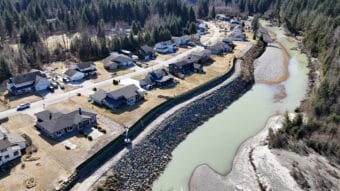
It’s just one way the Assembly and city are trying to incentivize developers to build more housing in the borough. That’s especially needed as a U.S. Coast Guard Icebreaker is slated to be homeported in Juneau, bringing more residents to town in the coming years, and as annual glacial flooding of the Mendenhall River threatens homes in the Mendenhall Valley. 

“The market is stuck,” said Dan Bleidorn, the city’s lands and resources manager, at a previous meeting on the topic. “Part of this like a multiple-zone-change scenario is to try to get multiple types of city property ready for development or disposal at a future time when plans can be worked on.”

Not everyone is on board with the idea. 

Auke Bay resident Heather Marlow said she was concerned about landslides and whether people in the rezoned lots could get insurance for their homes if they happened. 

“As many of you are aware, the area in Southeast Alaska has seen landslides yearly for several years,” she said. “If this area is rezoned and developed, are we setting up an area that’s not considered for landslide coverage?”

During previous meetings on the topic, other residents expressed concerns about the increased traffic more housing could bring to the North Douglas area and the lack of access it has to emergency services. 

“I understand the need to increase housing, but if we do it and put people in harm’s way, that’s not a service to the community,” said North Douglas resident Gary Gillette during a Planning Commission meeting in October. 

He asked the rezones on North Douglas be stalled until a second crossing from Douglas Island to Juneau is built. That plan is likely years away from even breaking ground.

Though the Assembly approved the rezones, it doesn’t necessarily guarantee developers will want — or be able to afford — to build there. High interest rates and the cost of materials continue to be barriers for many developers from breaking ground on new projects.

After months in a stalemate, union employees at Juneau’s hospital have a contract

Bartlett Regional Hospital on Tuesday, March 26, 2024. (Photo by Clarise Larson/KTOO)

After months of stalemate, Juneau’s city-owned hospital and the employee union that represents roughly 70% of its staff have finally come to an agreement over a new contract. 

At a meeting Monday night, the Juneau Assembly unanimously approved it.  

The International Longshore and Warehouse Union Healthcare Unit 2201’s previous three-year contract expired on July 1. But negotiations for a new one had stalled over disagreements with Bartlett Regional Hospital administration on how much wages should increase. 

At the time, the union wanted to see a 12% pay bump over the next three years, but Bartlett was only willing to offer 8.25%. The difference between the two is about $5.2 million in the hospital’s annual budget. 

The contract approved by the Assembly on Monday gives an 11% pay increase for union employees over the next three fiscal years. They’ll get a retroactive lump sum of about .5% for the time they worked since July without an agreement. 

This comes as the hospital tries to recover after a difficult financial year. Last spring, hospital leaders shared it was facing a multimillion-dollar budget crisis that threatened bankruptcy. 

To get back on track, the hospital cut back staffing and closed programs like the Rainforest Recovery Center and its crisis care unit last summer and fall. 

A recent financial update shared by the hospital in late December showed it was now making steady positive income for the first time in years. 

In a statement shared with KTOO, union leadership said the hospital could be doing more to recruit and retain employees, but called the contract agreement a “good step in that direction.”

Potential new hurdles for Hoonah’s borough petition arise following state commission’s approval

The city of Hoonah on July 3, 2024. (Clarise Larson/KTOO)

A state commission issued a written decision last week affirming its approval of the City of Hoonah’s request to form a borough. 

But, a dissenting report and a potential motion for reconsideration may put some hurdles in front of plans for residents to vote on the proposed borough this summer. 

Advocates of the Xunaa Borough proposal say it would allow residents in the area to have more say in the future development of Southeast Alaska. That’s as cruise ship tourism continues to expand in the region.

Last month the state’s five-member Local Boundary Commission approved the Borough petition in a close 3-2 vote.

But, the two members who voted to deny the petition released a letter of dissent last week. They pointed to some “unintended consequences” they say could follow if the borough becomes a reality.

Their dissent hinges on the concern that the borough’s exclusion of some nearby communities like Gustavus, Pelican and Tenakee Springs would deny them a say in regional decision-making. Those communities make up roughly half of the Glacier Bay region’s population according to the dissent letter – and declined to be included in the borough.

The dissenting members also suggested the proposed borough may not satisfy state standards for borough formation. 

Meanwhile, the City of Gustavus may file a request for reconsideration of the commission’s decision. 

Gustavus city council members discussed a proposed resolution that would direct city administration to file for reconsideration at a meeting last week. The resolution pointed to concerns similar to those in the dissent letter. 

This isn’t the first time the City of Hoonah has attempted to create a borough. It’s a plan that has seen a few versions over the last 30 years. Last year, Hoonah proposed dissolving its city government and incorporating more than 10,000 square miles of nearby land and water — including Glacier Bay, Chichagof Island and more — to form one unified, regional government. 

Any Alaskan may ask the commission to reconsider a decision. Requests for reconsideration must be filed by Jan. 15. 

The state will hold a special election for registered voters in the proposed region to vote on it — as long as the commission’s decisions stand after all reconsideration requests have been assessed. If approved, it would be Alaska’s 20th borough and the newest since Petersburg was incorporated in 2013. 

Site notifications
Update notification options
Subscribe to notifications