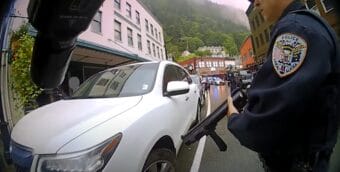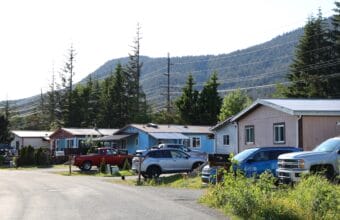
Students exit the Marie Drake building, which formally housed the Juneau School District’s alternative high school, Yaaḵoosgé Daakahídi, and Montessori Borealis, on Wednesday, April 24, 2024. (Clarise Larson/KTOO)
The city is considering a plan to demolish nearly all of the building between Harborview Elementary and Augustus Brown Swimming Pool to open up the area for parking downtown. The Marie Drake building once housed Juneau School District’s Montessori and alternative high school programs.
At a committee meeting Monday night, the Juneau Assembly moved forward with a plan to spend $150,000 to get more concrete cost estimates for the demolition and get more input from the public.
That’s despite some reluctance from members like Alicia Hughes-Skandijs. She argued the building could be used to serve other needs in Juneau, and wanted to explore other options.
“This, from a fiscal standpoint and just an operational standpoint, just doesn’t make sense to me, as presented as our best option,” she said. “Having a building that we could use for child care, which is been a top priority for ours and something that we know we need in the community, that is way more attractive for me.”
The building is named after a territorial educator who wrote the lyrics to the state song, “Alaska’s Flag.” The district gave the building to the city last spring as part of its school consolidation plan. It’s been empty of students since.
The Assembly briefly considered turning it into a new City Hall, but that plan fell through when cost estimates to renovate it came back high.
The proposed demolition plan would knock down about 80% of the building, including most of the former classroom spaces. Some of it would be left untouched though, like the planetarium and gym space.
City Manager Katie Koester said the plan is estimated to cost about $10 million, compared to $75 million to fully gut the building and renovate it. She said the Assembly will need to decide how the city would pay for the demolition if they choose to move forward with it.
“Really, there’s no version of demoing that doesn’t have a large price tag,” she said.
Assembly member Wade Bryson said demolition is the most fiscally responsible option for the space.
“Trying to keep things the same is going to cost us more in the long run than if we bite the bullet and make these historic changes right now,” he said.
The demolition would open up the space for 75 new parking spots. Koester said a portion of those may be used for city employees, but some could be set aside for students at the high school.
Pictured: The six shelter pets that were euthanized last September, according to the internal investigation from the City and Borough of Sitka. (Courtesy of FOSAS Newsletter)
The City and Borough of Sitka’s admission that a police officer euthanized several animals by gunshot at the local shelter last summer has generated a strong response from the community’s veterinarians.
Seven vets in the Southeast Alaska town – both practicing and retired – dispute the administration’s claim that shooting the dogs and cats was an acceptable practice under guidelines of the American Veterinary Medical Association.
In the meantime, everyone involved is hoping to ensure that the episode is never repeated.
Earlier this month Sitka’s municipal administrator, John Leach, published an investigation into animal shelter operations. It revealed that local police euthanized two dogs and four cats by gunshot last September after taking over day-to-day management of the shelter.
Sitka’s animal shelter is under the umbrella of the police department, but in years past, day-to-day operations have been managed by an animal control officer with the support of volunteers. But last July, the volunteer group, Friends of Sitka Animal Shelter or FOSAS, was barred from the building. When then-animal control officer Olivia Magni went missing in late August and did not return to work, pets were left in the care of police.
FOSAS President Kristina Tirman says the administrator’s investigation confirmed what her group feared.
“We had suspected that gunshot was the method of euthanasia for the dogs based on information we heard from community members, but we did not have confirmation on that until this report was released,” Tirman said. “Seeing that in writing was difficult, and we also did not have any information regarding the cats, so that was also new, and again, very hard to read.”
What frustrates Tirman and the volunteers is how preventable the situation was. She says when they found out Magni was not managing the shelter, they reached out to offer police their help, but the offer was declined.
“We had volunteers there ready to help,” Tirman said. “If we had known that this was going to be the outcome, and the police department didn’t have the time to care for these animals, we would have done everything we could to get them out of the shelter (and) adopted into homes. I think many people would have adopted them if they had known that this was going to be the outcome.”
Leach’s report was also hard to read for Sitka’s veterinary community – none of whom were consulted before the animals were euthanized. Like Tirman, Dr. Toccoa Wolf said if any of them had been contacted by police ahead of time, things would have been different.
“There’s practicing veterinarians that have always been available for help, we’re always here to support the city. We’re always here to support our community,” Wolf said. “And so I wonder why none of us were asked to help, and why that relationship has been, you know, severed?”
Wolf said she’s glad the report was released to the public and appreciates the transparency, but disagrees with some of its findings. Wolf and six other vets in Sitka penned a letter to the local Assembly on Thursday. The vets say the investigation’s conclusion that the pets were euthanized following AVMA guidelines is incorrect.
The association’s guidelines say (on page 42) that gunshot can be considered an acceptable form of euthanasia under some circumstances. But Arleigh Reynolds, another vet who signed the letter, says the Sitka situation never qualified.
“Those limited circumstances are if the animal is an immediate threat to someone,” Reynolds said. “Like if it’s aggressive or is a rabies suspect, or if it’s so injured that moving it would cause more harm than euthanizing it in place. But other than those two instances, it’s not okay.”
The vets’ letter points to another section of the AVMA regulations (on page 44) that says gunshot should not be used for routine euthanasia of animals in municipal pounds or shelters. A second letter from a local attorney also calls the legality of the euthanasia into question.
Reynolds has spent years working in rural communities around the state with limited access to veterinary care where the practice is more common.
“They call it culling, where they actually have dog kill days, and they will send a notice out to everybody, either tie up your dogs or put them inside, and any dog that’s found unattached is shot,” Reynolds said.
But in those remote communities, according to Reynolds, it takes a toll.
“And that is incredibly traumatic, of course to the dogs, but to the people doing the shooting,” Reynolds said. “A lot of those village safety officers leave their job because of that. It’s also really traumatic to the communities, you know, for just hearing the shots and knowing this is going on. And in several communities, there have been some really bad outcomes afterwards because of things like this.”
While the local vets disagree with the administrator’s interpretation of AVMA euthanasia guidelines, they do agree that Sitka is due for a code change and a restructuring of Sitka’s animal services.
“This was a house ready to crumble to begin with, because our code is so outdated,” Wolf said. “The city administrator does highlight in his report that code needs to change, I think that is one of the most urgent things. I think that a code needs to change that will prevent these from happening in the future.”
“The city has supported the shelter, but it’s not an official thing. It’s not in their code, and and the code was written back in the ’70s, right? So it’s 50 years old,” Reynolds said. “Times have changed. Our values have changed, and our ability to take care of animals has changed during that period of time. And so I think we need to update the code to really cover the way that folks here in Sitka would like to see animals cared for.”
In response to the vet’s letter and widespread concern over how police handled the euthanasia, Leach said he’s open to reinvestigating – and ensuring that the treatment of animals is consistent with community standards.
“If the Assembly desires to put an independent investigator on it, in terms of whether or not the AVMA standards were followed, that’s fine. We’re very open to that,” Leach said. “But my overall message is moving forward and making sure it doesn’t happen again. That’s really my focus at this point.”
Changing city code will take some time. In the interim, the city and FOSAS have reached a tentative agreement on shelter operations for the next year, pending Assembly approval. The timing lines up with the hiring of Sitka’s new animal control officer who starts work this month.
Visitors view Mendenhall Glacier on Friday, Feb. 21, 2025. (Photo by Clarise Larson/KTOO)
Most of the staff at the Mendenhall Glacier Visitor Center were fired earlier this month, leaving city tourism leaders worried that one of Juneau’s most popular visitor destinations may reduce services, or even close for the cruise season.
Listen:
Last week, Juneau’s Visitor Industry Director Alix Pierce said she’s been fielding calls from tour operators who want to know what the lack of staff at the glacier means for their businesses.
“Everybody has a lot of questions about what the next steps are,” she said. “I think the Forest Service staff that remain from what I understand are kind of in triage mode trying to figure out how to best allocate resources.”
The visitor center at the glacier sees about a million visitors per year. It’s run by the U.S. Forest Service, which saw about 2,000 job cuts nationwide in the last two weeks under a Trump administration plan to reduce the federal workforce.
The Tongass National Forest’s spokesperson is directing media requests to the U.S. Department of Agriculture, which says it doesn’t have location-specific information about staffing.
As it stands now, Pierce said the city isn’t getting information about how the glacier recreation area will operate. The dramatic staff reductions come after the city and the visitor center have spent a decade planning improvements to the visitor center. Pierce says there isn’t information about that either.
“We have no idea,” she said. “We have no idea whether those types of improvements will be funded. We have no idea about anything.”
Travel Juneau is the city’s destination marketing organization. Liz Perry is the director, and she said these firings come at an especially bad time as visitors are finalizing their plans for the summer. City leaders expect more than 1.6 million people will come to Juneau on cruise ships this summer.
“Knowing whether or not the Mendenhall Glacier Visitor Center is going to be able to operate, or how it’s going to operate, is going to be a key piece to a lot of those plans,” Perry said. “Because it’s one of the number one things for people to do when they get in town.”
Perry works with 260 businesses, many of which are permitted by the Forest Service to run tours at the glacier. She’s heard from tourism operators who say they’re worried about their business investments if the glacier is off-limits for the season.
Snow surrounds the Mendenhall Glacier Visitor Center on Friday, Feb. 21, 2025. (Photo by Clarise Larson/KTOO)
Other small business owners are worried as well. Shawn Eisele is the executive director of Discovery Southeast, a nonprofit that offers natural education programs for kids in Juneau and operates the bookstore in the visitor center. It stocks items from local artists and authors, and funds half of Discovery Southeast’s budget.
“It is, in my mind, one of the best success stories of local tourism in Southeast and in Juneau,” he said.
Eisele said the partnership between his organization and the Forest Service allows for locals to have a hand in educating tourists, and benefit from the high numbers of visitors who come to see the glacier.
Now, he’s not sure what the firings mean for the bookstore this summer and he’s worried about the broader implications too.
“It’s a scary and dire situation,” Eisele said. “That’s true for the individuals who are fired. It’s true for the individuals who remain. It’s true for Discovery Southeast, and I think it’s probably true for our community too.”
But some businesses aren’t as worried. Juneau Tours buses run to Mendenhall Glacier five to 10 times each day during cruise season. Serene Hutchinson said her company has the second largest tourism operations permit for the glacier.
“It is a foundation of our business, to bring people to the Mendenhall Glacier,” she said.
But Hutchinson has seen government shutdowns and other obstacles to the visitor center’s operations before, and she’s optimistic the Forest Service will have a plan for the season.
“This is not completely unfamiliar territory for us as an operator, and every other time it’s been figured out,” she said.
If the visitor center shuts down, she at least wants her customers to see the glacier from viewpoints near the parking lot.
“Obviously, we want full service, but if they have to, I hope that at the very least we can keep the views open,” she said. “And the bathrooms, because they’re just as important as the views.”
Juneau’s first cruise ship of the season is scheduled to arrive April 14.
City and Borough of Juneau Beth McEwen stamps paperwork for a proposed ballot initiative on Tuesday, April 9, 2024. (Photo by Clarise Larson/KTOO)
The City and Borough of Juneau’s longtime municipal clerk Beth McEwen is retiring from her position after nearly three decades with the city.
Juneau’s city clerk oversees municipal elections and public meetings and provides access to public records. McEwen announced her planned departure at the end of June at an Assembly committee meeting Monday night.
“I have formally given my letter of retirement to the city manager as of last week,” she said. “I have thoroughly enjoyed being clerk here, but there will be amazing clerks coming up behind me to take up elections in my place.”
McEwen started working at the city in 1997 as a legal secretary for the law department. She then transitioned to the clerk’s office in 2000. During her tenure, she received awards like Municipal Employee of the Year Award in 2015 and Municipal Clerk of the Year in 2023.
She helped the city navigate the pandemic, transition to a by-mail hybrid voting system and open a Juneau-based ballot processing center. With her free time, McEwen told KTOO she plans to travel.
City Manager Katie Koester said the city will begin the recruitment and hiring process for her replacement in the coming months.
Bartlett Regional Hospital CEO Joe Wanner speaks to the board of directors at a meeting on Wednesday, Feb. 19, 2025. (Photo by Clarise Larson/KTOO)
Bartlett Regional Hospital’s board voted on Wednesday to incrementally pay back $2 million to the City and Borough of Juneau over the next three years.
Last fiscal year, the Juneau Assembly transferred the money to the city-owned hospital when it was facing a multimillion-dollar financial crisis. It was not a loan, and the hospital was not required to pay any of it back.
But, Bartlett CEO Joe Wanner wants to pay the city back anyway and proposed the idea at the meeting. He said the hospital is currently in a much better place financially and can afford to do it. The hospital has been making steady positive income for the last eight months.
“I don’t see us going backwards from this point… barring some kind of disaster,” he said.
Last spring, hospital leaders announced that they needed to solve a multimillion-dollar budget deficit or the hospital would be forced to close its doors. The hospital’s board corrected course by cutting back on staff and controversially closing programs it said were draining money.
Wanner said the city is now facing its own issues like financing glacial outburst flood mitigation. He said giving back the money would show the hospital’s support to the community.
The board approved the pay-back plan unanimously, but some members were hesitant at first. Board member Lisa Petersen worried that the move could come back to bite the hospital if it finds itself in a tight spot again.
“I just don’t want us to be in a situation where six months later we’re asking for money back because we’re struggling,” she said.
The hospital’s financial outlook has improved, but there are still challenges to address. Last week at a summit, Wanner said it continues to struggle with recruiting and retaining staff. And, a recent survey shows staff lack confidence in management and leadership, and are experiencing burnout and turnover.
The hospital will begin its first of three payments of $667,000 when the next fiscal year starts in July.
Correction: This story has been updated to reflect that board member Lisa Petersen expressed some hesitation about the decision, not Deb Johnston.
Pictured: The six shelter pets that were euthanized last September, according to the internal investigation from the City and Borough of Sitka. (Courtesy of FOSAS Newsletter)
Four cats and two dogs were euthanized by the Sitka Police Department following a break-down of shelter operations last summer that left police supervising the facility without an animal control officer or volunteers. These details were included in an internal investigation emailed to the Sitka Assembly last weekend.
KCAW obtained a copy of the report from Municipal Administrator John Leach through a public records request.
The city’s operation of its animal shelter has been under scrutiny since July. That’s after the volunteer group, Friends of Sitka Animal Shelter, or FOSAS, was abruptly barred from entering the facility due to what police have called “security concerns” which the volunteer group has denied. A month later, the city’s animal control officer went missing for two days while looking for her dog on Katlian Bay Road. She was found safe, but had an accident on the trail and did not return to work.
Police then assumed animal care responsibilities at the shelter. The city’s investigation revealed that all six of the pets were euthanized by gunshot in September, confirming rumors that led to public outcry late last year. The euthanasia was carried out by Lt. John Achee under the direction of Police Chief Robert Baty, who was also present.
While the administrator found that the euthanasia was legal under Sitka General Code and carried out by trained personnel, the investigation noted that the, “lack of transparency, consultation, and clear policies regarding shelter operations contributed to significant public concern and eroded trust” between the city, police, shelter volunteers, and the public.
The release of the investigation comes as the city is continuing to negotiate a contract with animal shelter volunteers that would allow them back in the building. A draft contract is currently under review by FOSAS and will be presented at the February 25 assembly meeting.
In the report, Leach makes several recommendations, including establishing formal policies and communication structures between volunteers, police and the city, restoring volunteer access, and evaluating whether the city can ultimately transition shelter management to the volunteer group under a lease agreement.
Editor’s Note: This is a developing story and will be updated.
Close
Update notification options
Subscribe to notifications
Subscribe
Get notifications about news related to the topics you care about. You can unsubscribe anytime.