Local Government

Juneau Assembly mulls another multimillion-dollar wastewater bond to offset looming utility costs

City and Borough of Juneau’s Utilities Superintendent Brian McGuire walks across a bridge in the wastewater clarifier building at the Juneau Douglas Wastewater Treatment Plant on Friday, Sept. 13, 2024. (Clarise Larson/KTOO)

Juneau city officials have proposed a multimillion-dollar wastewater bond package to offset utility rate hikes. The Juneau Assembly will decide in the coming months whether the proposal will appear on October’s municipal ballot. 

This comes as Juneau residents could face a significant increase in water and sewer rates in July. On Wednesday night, the Assembly finance committee unanimously moved forward with a plan for either a $10 or $20 million bond question.

That’s despite hesitation from some members. Assembly member Wade Bryson said he thinks voters need a break. 

“I want to continue to have the cleanest water in Alaska. We need $20 million to do it. I just want to wait one year and not ask the citizens to have a bond question on this election,” Bryson said. “We’ve asked them year after year, and they are saying no.”

The potential bond would fund critical repairs to the city’s water and sewer systems as much of the infrastructure reaches the end of its lifespan. In December, municipal utility staff said the city would need to raise residents’ rates by more than 60% over the next five years to address those urgent repairs. 

Juneau’s Water Utilities Division proposed increasing the flat residential water rate by just over 10% starting this July. Then, the rate would increase another 10% each July until 2029. The proposed sewer increase would be 13% each year. 

Juneau’s utility rates have gone up 2% each year since 2020. The last increase was in July. According to the division’s website, those smaller increases are less than what’s recommended by studies and have left the division in a revenue deficit.

At Wednesday’s meeting, City Manager Katie Koester said passing a $10 million bond measure would help keep rates down  — and a $20 million bond could offset them even more.

She said the Assembly could also curb the rates by using sales tax dollars for street and transportation projects on utility infrastructure instead. She said doing that in tandem with a bond measure could make a significant dent in the proposed rate hikes. 

“We could buy down essentially the wastewater rate to 5.5% year after year, and the water rate to 0% year after year,” Koester said. 

She warned the Assembly that doing that could mean the city takes on fewer street and transportation projects.

Despite the initial approval, the plan still needs to go through a few committees before the Assembly votes on whether to put it on the ballot. The Juneau Assembly will also decide whether or not to increase utility rates. 

If the bond measure goes to voters, it would be the second one to do so in just two years. Last fall Juneau voters approved a different $10 million wastewater bond to replace infrastructure at the Juneau Douglas Wastewater Treatment Plant.

Juneau firefighters point to dangerous levels of understaffing as wage negotiations begin

Capital City Fire/Rescue responders arrive at an emergency in the Mendenhall Valley in March 2023. (Photo by Clarise Larson/KTOO)

Members of Juneau’s chapter of the International Association of Fire Fighters spoke out again about the lack of competitive wages leading to staffing shortages in Juneau.

Union members say firefighters are working mandatory overtime for pay that a recent study deemed below average. As contract negotiations with the city begin, first responders are asking the city for relief.

Dylan Hay testified at Monday’s Juneau Assembly meeting that after five years of firefighting in Juneau, the low wages have made the heavy workload unsustainable for him and his young family, so he’s moving to take a new job out of state.

“Not only has our call volume stretched us beyond a reasonable capacity, I’ve been on scene of multiple incidents where there was vastly inadequate staffing or volunteer response,” Hay said. “This leaves on-duty crews to shoulder a burden we are simply not adequately staffed to carry. And quite frankly, we are all tired.”

The majority of Juneau’s firefighters and EMTs are union members.

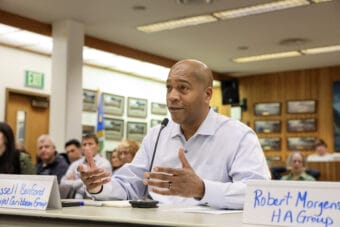
Logan Balstad is the chapter president. He said that none of the responses to the 18 structure fires in Juneau last year met the National Fire Protection Association’s standard for minimum number of staff responding.

“It is clear that our department struggles to assist the community on many small emergencies, let alone any of moderate to severe impact to the public,” he said.

Balstad said there simply aren’t enough firefighters to respond to emergencies. The department has been relying on mandatory overtime to staff response teams.

According to Juneau’s IAFF chapter, Capital City Fire/Rescue is down seven positions, and 20 emergency responders have resigned in the last few years.

And, Balstad said, the staffing issues are likely to get worse — multiple firefighters are planning to retire, resign or take a leave of absence to serve in the military.

But recent attempts to fill those positions haven’t been fruitful.

“In the past couple of years, we have had seven firefighter recruitment cycles where we had at best, one successful applicant,” he said. “In others, 14 job offers have been extended, yet none of [them] were accepted.”

According to a wage study released in December, starting salaries can be as low as $20 an hour for EMT positions in Juneau. Some starting positions are ranked in the 24th percentile for competitiveness in the Pacific Northwest. That means that if a firefighter applied to 100 jobs in the region, three-quarters of them would likely have higher salaries than the Juneau position.

The union and the city will begin contract negotiations this week, which they do every three years. This year, union members like Balstad say they hope it means Juneau will be able to offer salaries that attract more firefighters and keep current ones around.

Rachel Kelly is a family member of a firefighter in Juneau. She says she’s concerned about the long term impacts of the staffing shortages.

“We’re not putting more energy and effort into staffing that service, and so it’s the same people who are just doing more. And at some point that’s going to break,” she said. “To have so many fires back to back, like we have the last few months, and to have the response numbers on those fires be so low, it should be a really obvious red flag.”

And she’s worried this is further burdening responders who shoulder the physical and emotional load of Juneau’s emergencies.

Contract negotiations begin on Friday and will be finalized this summer.

Juneau officials say rumors about detained tribal citizens are unsubstantiated

The Andrew Hope Building, pictured here on Feb. 10, 2021, houses the headquarters of the Central Council of Tlingit and Haida Indian Tribes of Alaska.
The Andrew Hope Building, pictured here on Feb. 10, 2021, houses the headquarters of the Central Council of Tlingit and Haida Indian Tribes of Alaska. (Photo by Jeremy Hsieh/KTOO)

Rumors have been circulating on social media that U.S. Immigration and Customs Enforcement, or ICE, agents have detained tribal citizens in Juneau, but local officials say that is not true. 

City and Borough of Juneau Mayor Beth Weldon says some of the speculation is due to a miscommunication. 

“We as a collective, we – including the chief of police and the city attorney – we have not heard of anybody being detained or even questioned about their immigration status, for that matter, not to say that won’t change, but that’s what we know right now,” Weldon said. 

She said the city doesnʼt have information about ICE agents in town or anyone being detained by them.

Juneau Police Department Deputy Chief Krag Campbell said in an email that the department has received calls asking about ICE presence in Juneau, but they havenʼt received any reports of Juneau residents being detained. 

He said federal agencies not stationed in Juneau will usually notify the department when they are in Juneau. He asked residents to inform JPD if they encounter ICE officers in town.

Campbell says that U.S. Customs and Border Protection agents are in town for drug enforcement support. That agency is separate from ICE, though both are under the Department of Homeland Security. 

These agents could have been mistaken for ICE officers. 

The Central Council of the Tlingit and Haida Indian Tribes of Alaska President Chalyee Éesh Richard Peterson issued a statement saying that there is no substantiated evidence that tribal citizens have been detained in Juneau. 

Nevertheless, Peterson encouraged tribal members to make sure their tribal IDs have not expired and to carry them when out in public.

Financial report paints hopeful picture for gondola to make Eaglecrest Ski Area self-sustaining

Parts of the city-owned gondola sit outside at Eaglecrest Ski Area on Dec. 10, 2023. (Clarise Larson/KTOO)

As Eaglecrest Ski Area faces ongoing financial hardship, city officials continue to hope the gondola will one day make it self-sustaining — once it’s up and running. 

In the meantime, Eaglecrest may need to borrow more money from the city to fix a broken chairlift and increase wages. On top of that, low snowfall means it still hasn’t fully opened for the season. 

Kirk Duncan, a former Eaglecrest general manager, wrote a financial review of the city-owned ski area for the Juneau Assembly. He presented it at an Assembly Committee of the Whole meeting Monday. 

“I’ve made many assumptions and it’s up to the board to determine whether they’re going to modify those, accept them, not accept them, whatever,” Duncan said.

The report is part of a broader analysis to provide a timeline for how Eaglecrest could become self-sufficient, instead of relying on the city for financial support.

Duncan said the ski area has seen similar hardship before. Last year’s sudden change in leadership and the potential financial loss this winter are reminiscent of a rough few years Eaglecrest faced when he was manager 20 years ago. 

“That gives me a really good feeling of optimism, that there’s good potential for turning things around,” he said. “One of the questions is, how can we quit doing this, needing to turn things around?”

His report did suggest that, with a few different ticket price options — ranging from $45, $65 or $85 per ride — the gondola could eventually create year-round revenue the ski area could then reinvest in winter operations. 

Duncan’s report offered a myriad of recommendations for how to both cut costs and fund upcoming maintenance and operations. This season, the Black Bear lift is down and needs to be fixed or replaced. Along with other maintenance fees and services, Duncan estimates that the ski area could see an additional $750,000 added to this year’s budget.

He warned against raising user fees without knowing if that would drive down the number of people buying lift tickets and season passes. He said the ski area could instead add to their negative fund balance for now and hope to pay off the deficit later, which is a strategy that has worked in the past.

Eaglecrest Board Chair Mike Satre said he’s pleased that Duncan’s report matches many of the board’s earlier projections about the potential future revenue of the gondola. 

“It’s just great that the report justifies everything that we’ve done to purchase the gondola, get into a partnership with Goldbelt to install it, and make this happen,” Satre said.

While the costs may seem like a lot, Satre thinks it will pay off in the future.

“In a sense, this is like any business,” he said. “This is our startup expenses before revenue can be booked.”

The city spent about $3 million to purchase and import the used gondola in 2022. Since then, a $10 million investment from Goldbelt Inc. has paid for expenses — so far $5.8 million — but City Manager Katie Koester says $2.5 million in city funding is earmarked for the project. 

Satre said the board plans to start offering biweekly reports to the Assembly on the state of Eaglecrest’s finances. That’s after Duncan’s report said that many of the ski area’s issues can be traced back to a lack of oversight and communication.

Satre said the board will present their funding needs to the Assembly for consideration. Construction is still a moving target as Eaglecrest continues to secure the necessary permits. According to the city’s agreement with Goldbelt, the gondola must open by the end of May 2028.

Eaglecrest announced Tuesday that additional snow will allow it to open more of the ski area Wednesday and this weekend. 

Huna Totem’s cruise ship dock proposal heads to Juneau Assembly, with public comments in tow

Juneau residents write comments about the plan for Áak’w Landing, Huna Totem Corporation’s proposed cruise ship dock in Juneau at a public meeting on Jan. 22, 2025. (Photo by Yvonne Krumrey/KTOO)

Juneau residents had a chance to ask questions and offer comments on a proposed fifth cruise ship dock at two public meetings this week. The city will soon decide whether or not to approve a tidelands lease to Huna Totem Corporation for the project.

Juneau Tourism Manager Alix Pierce said these meetings give the city a sense of what the community wants and doesn’t want to see in a fifth cruise dock. 

“The lease is the Assembly’s ultimate opportunity to approve or deny the project,” she said. “And right now, our job and goal as staff is to bring something to the Assembly for final consideration that provides our best attempt at something that’s going to be good for the community.”

Huna Totem Corporation is an Alaska Native village corporation. The project is called Áak’w Landing, named after the original inhabitants of the Juneau area, the Áak’w Ḵwáan. 

On Wednesday at City Hall, the plan for the project was laid out with renderings of the proposed building, graphs of marine traffic in the area and a timeline of the project so far, including next steps. The dock would be built on the edge of the downtown area at the corner of Egan Drive and Whittier Street.

The proposal includes spaces for retail and a 40,000-foot Indigenous knowledge, science and cultural center. 

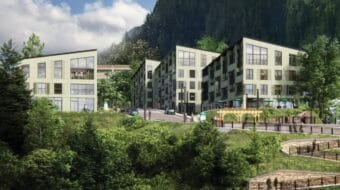
This rendering depicts Huna Totem Corp.’s proposed new downtown development project. (City and Borough of Juneau)

Attendees were given sheets with prompts like “how could the project support and create a more vibrant waterfront for Juneau?”

Concerns ranged from blocked views of the channel to the proposed dock’s distance from downtown businesses.

Attendee Kathy Coghill said it’s important that those leading this decision consider how the project affects the lives of Juneau residents.

“But I think there’s a lot of fear that we can’t ask for a fair shake, because we’re going to scare away the tourists,” she said. “We are not going to scare them away.”

Huna Totem’s Susan Bell said the meetings offered a chance for residents to get reacquainted with the proposal, after an appeal filed in the summer of 2023 stalled it for months. That appeal argued that the proposal didn’t do enough public outreach on the project, among other concerns — especially the availability of shore power.

In 2023, the planning commission approved permits for the dock and the waterfront development. 

“The pace of the project will be at the discretion of the city,” Bell said. “So I think having good turnout and good feedback, they’ll feel like they’re doing their job and making sure that the people have a chance to be informed and engaged.”

Next, the Assembly will review the proposed lease at a future Committee of the Whole meeting, using feedback given this week. There will be further opportunities to give public testimony at that meeting. Comments can also be emailed to assembly@juneau.gov.

Clarification: This story was updated to better reflect the scope of the 2023 appeal and the next steps in the process. 

Haines Assembly sticks with dock plan despite litigation with contractor

Haines Interim Borough Manager Alekka Fullerton addresses the borough assembly on Jan. 14. (Melinda Munson/KHNS)

After robust public comment, the Haines Borough Assembly voted to reconfirm the preferred design for the rebuild of its freight dock on Tuesday.

Assembly members who voted yes said the measure was necessary to meet grant deadlines and show that Haines was serious about the project.

Both the Planning Commission and the previous assembly voted in support of contractor Turnagain Marine Construction’s plan for the aging Lutak Dock in 2023. But community concerns about cost and environmental impacts, and legal problems with the contractor, have stalled the project.

The dock receives food and fuel for the remote town of Haines. The borough was awarded a $20 million grant in 2021 to update the infrastructure. The grant is overseen by the U.S. Department of Transportation – Maritime Administration, or MARAD.

Turnagain, the contractor, purchased approximately $10 million of steel piping for the project, but MARAD deemed those supplies ineligible for grant reimbursement. Turnagain billed the municipality for the steel and Haines declined to pay – then Turnagin sued the borough. The lawsuit triggered mediation between the two parties. They’re still working out who is responsible for the $10 million.

Alekka Fullerton is Haines’ interim borough manager. She says the guaranteed maximum price of $25 million for dock construction is still in place. It’s one of the issues contested by the contractor.

Fullerton told the assembly that the process has been confusing for many.

“I think I heard in a previous assembly meeting that there were questions coming from Southeast Conference, or maybe some other entities in Juneau, really unclear about what the Haines Borough is doing … I have even heard some of those questions from our congressional delegations and some of the people who have, in fact, made sure we have money available for this.”

While the assembly reconfirmed the design with a four to two vote, a majority of the Jan. 14 public comment was against the design.

Haines resident Katie Palmer testified about possible financial ramifications.

“Do not recommit the borough to a project we cannot afford,” she said. “Do not commit the citizens of Haines to pay for a project whose costs will exceed the grant monies. As Assembly member Gabe Thomas stated months ago, a bond is off the table.”

Kimberly Rosado was concerned about the cost of not fixing the dock.

“I want everybody to think what would happen if that dock failed right now, and the prices we would have to pay to ship it around,” she said. “We already pay so much for our groceries. To double or triple that, I don’t know who could afford to live here with that cost. So please get this back on track and fix our dock.”

While some residents testified that they hoped for a smaller design, one dock user said the space is necessary.

Haynes Tormey is a contractor who is intimately familiar with Lutak Dock.

“The existing footprint as it is right now at peak usage is barely enough,” he said. “There’s actually times when I’ve been forced to take freight that I’m not ready for so passing through freight can have a spot on the dock. So essentially, what needs to happen is the temporary guardrails that are in place need to be removed. So that way, the dock’s acreage could be expanded to its original footprint.”

Assembly member Kevin Forster wanted to delay the vote until mediation with Turnagain was complete. He and Assembly member Craig Loomis voted against the resolution.

Assembly member Cheryl Stickler said the borough should move forward with the project.

“We can’t afford the money. We can’t afford the time. And every day that we are stalled on this project, we are one day closer to dock failure,” Stickler said. “I just encourage us all to consider those things and to take steps to open up the conversations with Turnagain. This is our budget. This is our design. What can you do with this design within budget?”

The borough provided its environmental assessment of the dock plan to MARAD at the end of last year. That document is still confidential.

Site notifications
Update notification options
Subscribe to notifications