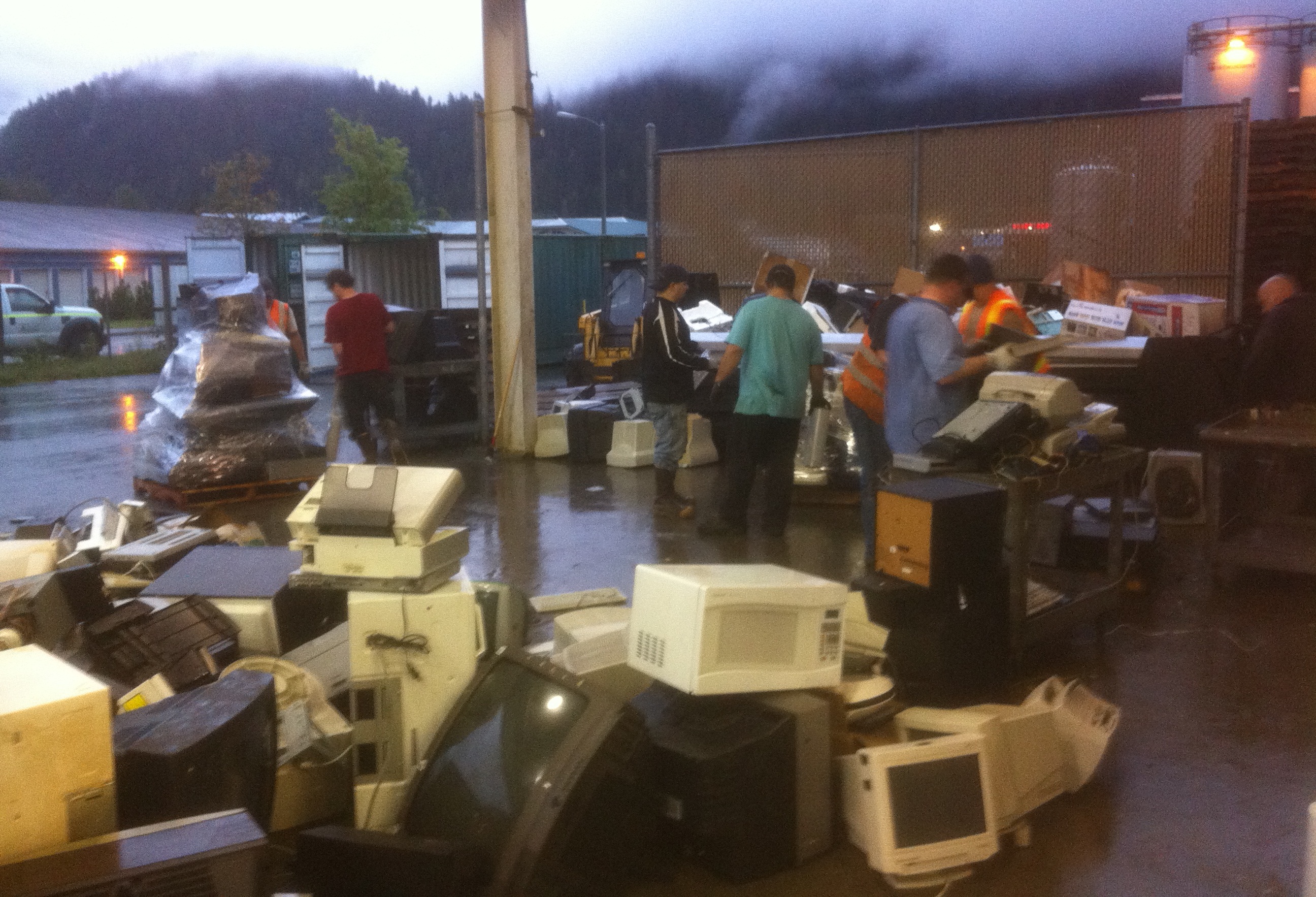
Juneau residents dropped off everything from old Apple computers, to big screen TVs at this week’s trial e-waste event. (Photo courtesy Dan Bleidorn/CBJ)
Fifteen tons – that’s how much the pile of old TVs, computers and other electronics weighed at the end of the City and Borough of Juneau’s trial e-waste event last night (Wednesday).
Public Works Director Kirk Duncan says traffic was steady through the Lemon Creek drop off area as hundreds of residents rid themselves of old junk.
“We saw some stuff that I hadn’t seen in a long time,” Duncan said. “Some original Apple computers, the one piece computers, then some huge TVs – just all kinds of different stuff.”
Some electronics components contain toxic PCBs and metals that can leach into the environment. So Duncan says the city and landfill operator Waste Management try to keep them out of the dump.
In the past the city has accepted one electronic item per household at its regular hazardous waste disposal days. But Duncan says this is the first time the CBJ has held a day specifically for those items.
“We’ll see how it affects the household hazardous waste program, and then we’ll talk about whether we’ll have the electronic waste event, whether we’ll do it once a year, twice a year, whatever,” Duncan said. “So we’re evaluating that at this point in time.”
The city did not charge a drop off fee. The fifteen tons worth of material will be sent to Total Reclaim, a Seattle-based company that specializes in the disposal of electronic waste.
Interested in your community? KTOO reminds you to vote in the upcoming Municipal Election, scheduled for Tuesday, October 2nd. Part of the responsibility of voting is finding out about the candidates and how they stand on the issues. The League of Women Voters-Juneau and KTOO invite you this year’s Municipal Candidate Forum, this Tuesday at 7 p.m. in the Assembly Chambers, moderated by Barbara Belknap. If you can’t make it to the Forum, tune in to KTOO-NEWS.
That’s the Municipal Candidate Forum, Tuesday night at 7, live from the Assembly Chambers, on KTOO-NEWS, 104.3 FM
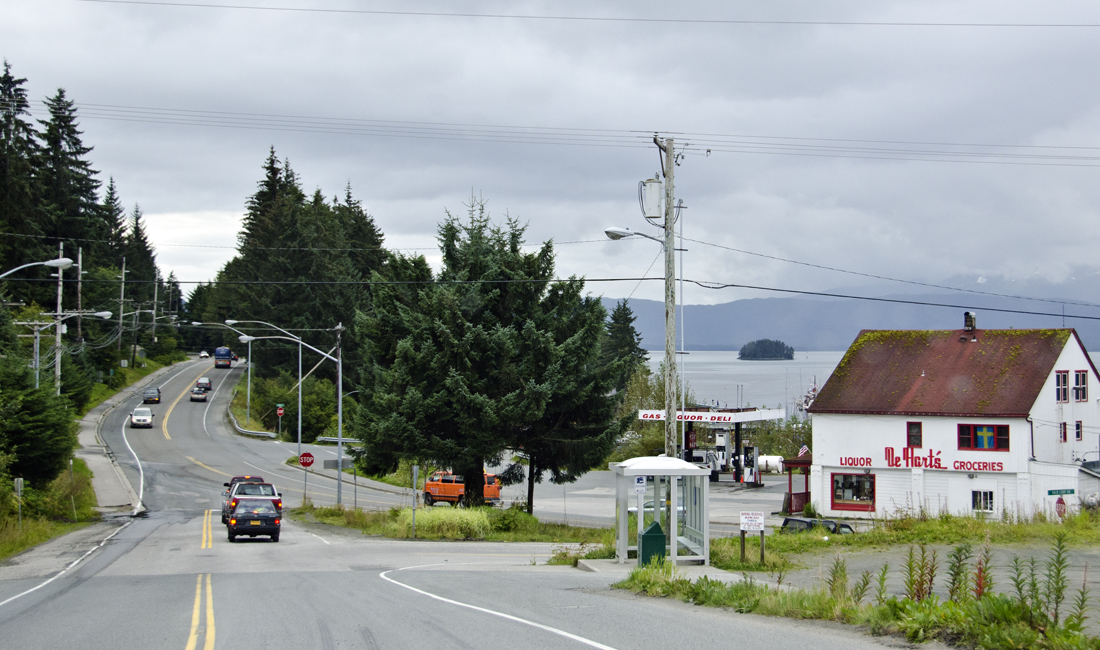
The intersection of Glacier Highway and Back Loop Road in front of De Hart’s. (Photo by Heather Bryant/KTOO)
The Juneau Assembly wants a say on the speed limit in the Auke Bay corridor. The panel last night (Monday) told state Transportation Department planners that the proposed speed limit – not a new roundabout – is a problem.
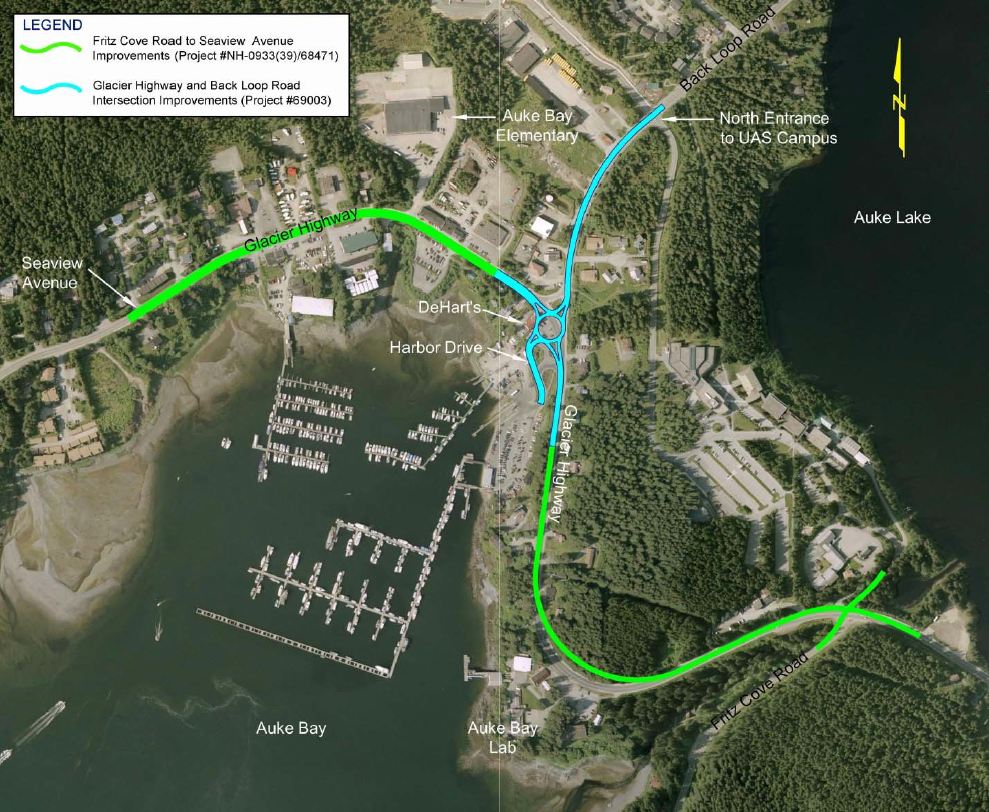
DOT proposes to build a circular intersection at Glacier Highway and the Back Loop Road. The project has gone through several iterations since DOT once proposed a controversial roundabout that would have eliminated DeHart’s store.
With the historic site – on Alaska standards – saved, the public is focusing on speed through the area.
The corridor is defined as an Urban Principal Arterial and it includes a U.S. Post Office, a city fire station, small businesses, Auke Bay Elementary School, and homes as well as major harbors.
Project consultant Nathan Leigh said the roundabout will be safer for pedestrians.
“As the roundabout goes around, it slows traffic down at that intersection,” Leigh said, “and there’s crosswalks at each leg of that, so as you’re crossing the roundabout you only have to look at one direction of traffic.”
The project includes other safety improvements, such as sidewalks on both sides of the road and improved access to the Auke Bay school and a school crossing.
DOT Manager Greg Lockwood said the speed limit will stay the same.
“We’re not changing the speed limit essentially; we’re designing to the current speed order. The 35-miles an hour that’s posted from Auke Lake to Harbor Drive doesn’t meet the current speed order. So what we’re doing on this project, we’re not changing any speed order we’re just designing the road to be safe at the speed order speed,” Lockwood said.
But much of the public that has already weighed in on the project – and most of those asking the Juneau Assembly to take a stand – believe that’s too fast.
Assembly member Carlton Smith – who used to live near the Auke Bay fire station – says a higher speed limit is not logical.
“The ferry workers that are going out, the ferry workers that are coming back, the mine workers changing shifts, plus the tour buses, I just don’t see the logic of doing anything more than 20 miles a hour through that entire area,” smith said. “But my perspective is having lived there.”
The highway engineers say it’s a balancing act to satisfy people driving out the road, pedestrians, bicyclists, and local businesses and residents.
State law requires the Department of Transportation consult with municipalities in determining safe speed limits and speed zones, and the Assembly has been lobbied heavily in recent months by people asking them to force the issue.
The Assembly last night directed city staff to draw up a formal resolution requesting a speed study in the Auke Bay corridor.
The project schedule calls for going out for bid on the Auke Bay Corridor improvements, with construction to start in the spring.
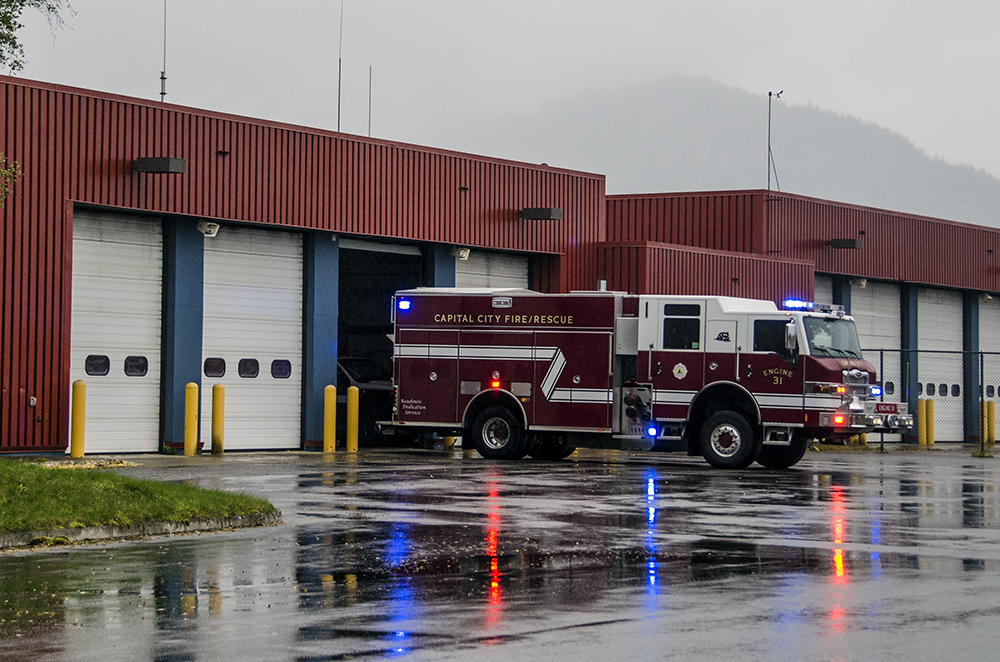
A fire truck returns to the Glacier Fire Station near the airport. (Photo by Heather Bryant/KTOO)
Some Juneau homeowners are seeing a huge spike in their fire insurance rates based on new industry estimates for how long it takes firefighters to respond to their homes.
Capital City Fire and Rescue Chief Rich Etheridge says the department’s not doing anything different. But he says the way insurance companies calculate the distance from your house to the closest fire station recently changed.
“Fire departments and communities are rated on their level of fire protection on a scale of 1-10,” Etheridge explains. “So, what they do is they look at the distance your structure is from the fire station and from a fire hydrant and if it’s beyond those distances, because of how quickly fires grow and multiply, they feel that your house is at a greater risk for much larger losses. So, the further away you are the more your insurance rates go up.”
Many insurance companies use the firm Insurance Services Office, Inc. to determine the distance from your home to the closest fire station. Previously, Etheridge says ISO drew circles around a station on a map to determine which nearby properties it would cover. But in the last year, he says the firm started using GPS coordinates.
For years, he says the Juneau fire service area, which includes Douglas Island and everything out to 20-mile Glacier Highway, received a rating of four — meaning all properties were within at least five air miles of the nearest station.
“In past years, the North Douglas area fell within that five mile circle of the Glacier Station. It wasn’t practical that they would be the ones serving them, but it met their rules,” Etheridge says. “And for Thane, that five mile circle was encompassed into the Douglas Fire Station.”
According to a quick Google Maps analysis, Etheridge says CCFR determined about 150 homes out North Douglas Highway and 46 homes out Thane Road no longer fall within the ISO’s four rating, and are subject to the higher rates.
“Some folks have said $600, and I’ve heard as high as $800 a year,” he says.
Etheridge says the department has been able to help some homeowners dispute the new rates by proving they are within five miles of a station.
“Some of them have been an error, to where the insurance company has got them listed at more than five miles away, when they are actually only two or three miles away from a station,” he says. “So, some of those errors we are able to help them get corrected.”
Etheridge says anyone who thinks their insurance company may have it wrong should contact the department for assistance.
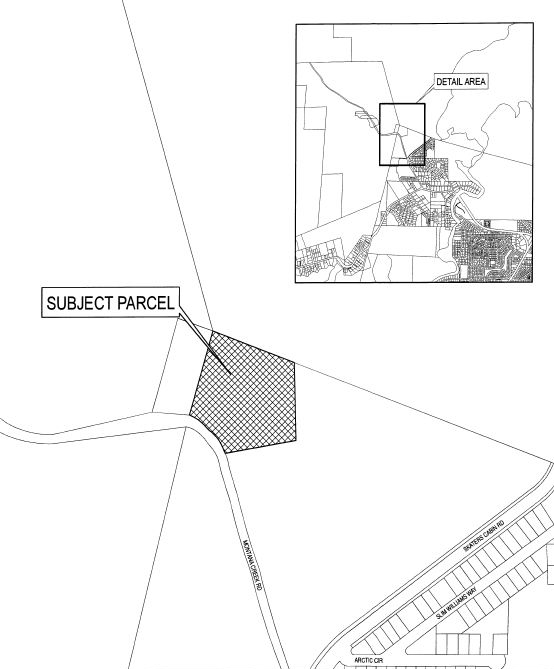
The Juneau Planning Commission has approved a cellphone tower along Montana Creek Road.
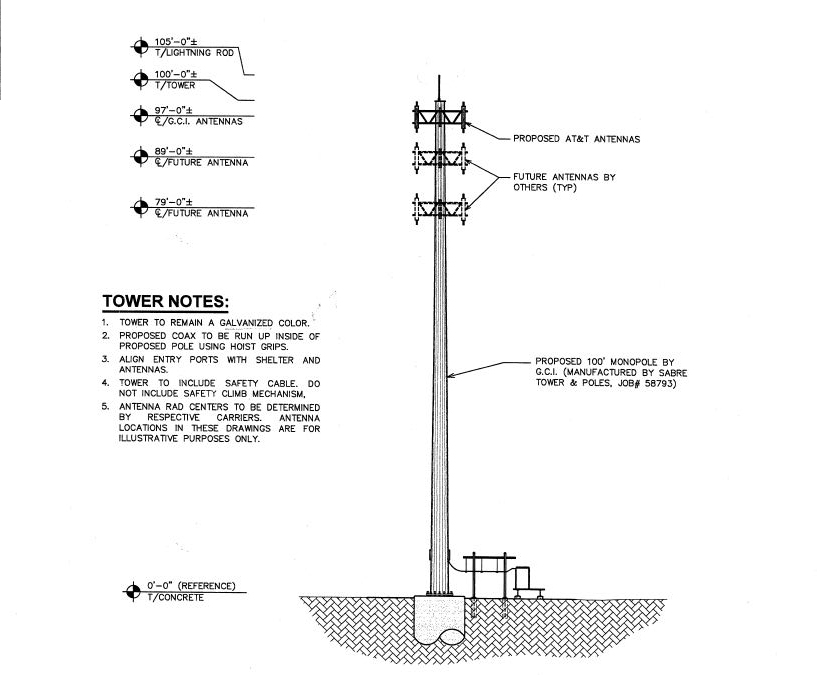
The 105-foot GCI tower will include a 5-foot lightning rod and antennas.
GCI representative Wayne Haerer said the site will enhance the signal strength for voice, digital data and text to the Mendenhall Valley, where the signal is inadequate. He says he hopes to have a contractor in place before the end of September.
CBJ Community Development planner Laura Boyce said the tower would be seen about 20 to 30 feet about the trees. It must be painted green or brown to blend into the vegetation as much as possible.
The proposed location for the tower.
Many Montana Creek area residents oppose the tower, including CBJ Assembly member Ruth Danner. In a letter to the Planning Commission, Danner said commissioners should delay their decision until the city has developed a cellphone town policy. She also cited the need to know the health effects of electromagnetic frequencies.
Deputy community Development Director Greg Chaney said municipalities cannot regulate based on health effects.
“Federal communications law prohibits local jurisdictions from regulating strictly on health effects. Planning commissions, it you want to take that on, you have to be ready to go to the Supreme Court, because it’s a clear provision in federal law,” Chaney said.
Danner has been fighting cellphone towers since before she ran for the Assembly three years ago. In this case delaying the decision any longer was not feasible, Boyce said, because federal law requires municipalities act on a complete application for a tower within 150 days.
Another piece of financing for Juneau’s controversial new cruise ship docks on the downtown waterfront is in place.
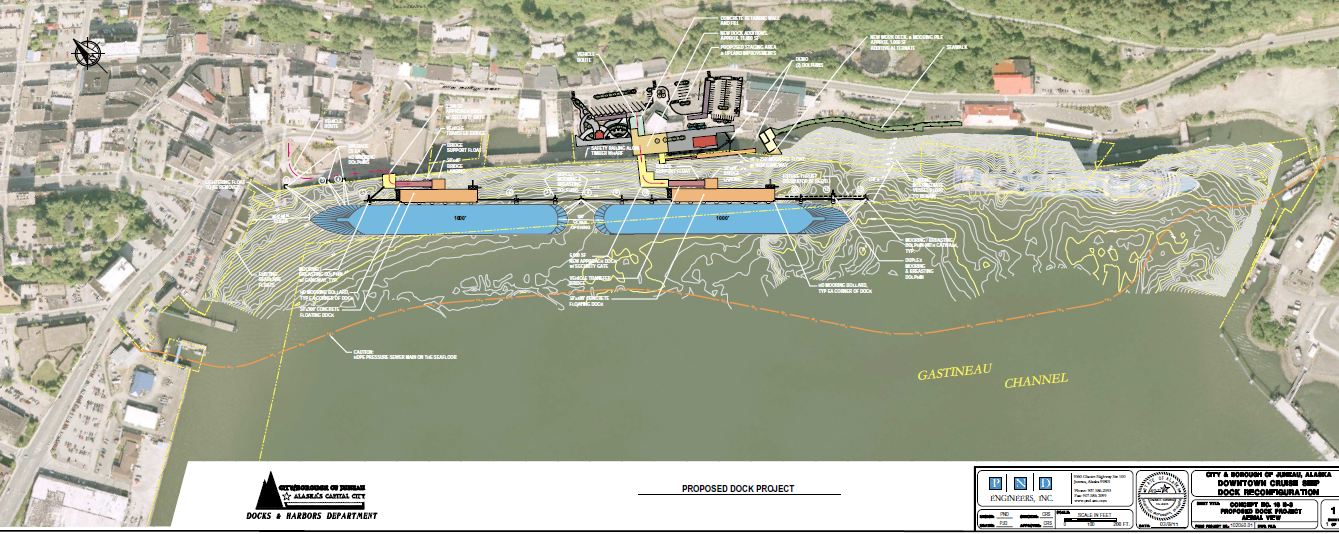
The Juneau Assembly last night (Monday) approved selling up to $29 million dollars in bonds for two floating Panamax berths.
The bonds would be issued for a term of 19 years, according to Deputy City Manager Rob Steedle.
“Terms required CBJ to pledge the Port Development Fee known as the PDF revenue, to fund the debt service. The debt service will be paid from FY 14 to FY 33 revenues,” Steedle said.
At an average interest rate of 4.37 percent, Steedle says debt service on the bonds is estimated at $42.37 million dollars. The total project is estimated at $88.1 million dollars. To date, the Assembly has appropriated about $42.6 million for the project. Other funding sources include grants and state marine passenger fees.
CBJ Finance Director Bob Bartholomew said the CBJ Port Development Fee is assessed only on the companies that use Juneau’s major public docks in the port — generally the cruise ship companies.
“If there anybody outside the cruise ship industry that uses the large public docks in the port, they would be subject to the fee,” Bartholomew said.
The fee is not assessed on commercial fishing vessel and private boat owners who use Juneau’s Aurora, Harris, Douglas or Auke Bay harbors.
Two members of the public testified on the bond issue. Larry Spencer, President of the Juneau Downtown Business Association, told the Assembly it’s time to get the project finished.
The project is controversial among the Fishermen’s Memorial board and some fishermen, concerned that it could block approach to the Taku Fisheries fisheries dock. Linnea Osborn represented those interests and complained the floating berths would obstruct the view of the water from the seawalk and destroy the annual blessing of the fleet.
Three Assembly members voted against the bond ordinance: Ruth Danner, Johann Dybdahl and Randy Wanamaker.
They cited four reasons for the no vote including the high cost of the project, the lack of support for the project by industry and the public in general and concern about the uncertainty of the funding mechanisms over the long term.
The proposed project has been under discussion for several years. Some cruise industry representatives have said the large floating berths that will accommodate thousand-foot long ships are not necessary.
Proposed changes to the Juneau docks. Drawing courtesy of CBJ.
Close
Update notification options
Subscribe to notifications
Subscribe
Get notifications about news related to the topics you care about. You can unsubscribe anytime.