Local Government

Police escort man from Juneau Assembly meeting after allegedly threatening city leaders

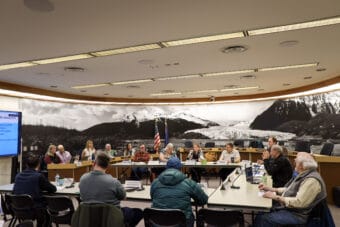
KC Kregar yells at Assembly members and City officials as he is escorted by Juneau police during an Assembly meeting on Monday, Oct. 27, 2025. (Photo by Clarise Larson/KTOO)

A man was escorted out of the Juneau Assembly meeting on Monday night by police officers due to safety concerns.

KC Kregar was asked to leave the meeting because of his alleged repeated harassment of city officials and Assembly members, said City Attorney Emily Wright. He was previously arrested for trespassing after refusing to leave City Hall on Oct. 16. But on Monday he left willingly with officers and was not arrested. 

“He was trespassed for a pattern of continuous harassment and threats towards staff,” Wright said. 

Kregar originally showed up to the meeting at Centennial Hall in a ski mask and goggles. He took the mask off while speaking to the press, saying he came to the meeting to testify and expose wrongdoings and corruption by the city and Eaglecrest Ski Area.

“They’re trying to bury me,” he said to the press prior to his removal. “They should be put in jail for what they are hiding.”

Kregar said he’s a whistleblower and has information about safety violations related to the ski area. 

The meeting was delayed an hour while police confronted Kregar. He shouted as he left. 

“This is wrong. I committed no crime,” he said. “You’re hiding, you’re non-transparent.”

Kregar said he plans to sue the city. 

Skagway gets first look at possible plans for expensive and complicated rock fall mitigation

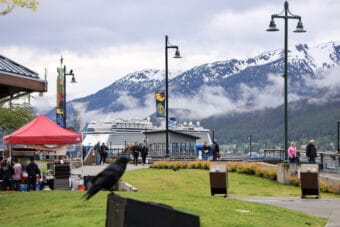
The Norwegian Jewel berths below the Railroad Dock in Skagway on Friday, Sept. 6, 2024. (Photo by Clarise Larson/KTOO)

A major rockslide has been threatening Skagway’s busiest cruise ship dock in recent years. Numerous industry experts were in town recently to present options for long-term mitigation. None of the choices were easy or cheap.

A rockslide above Railroad Dock in 2022 prompted a study by the geological firm Shannon & Wilson. That report stated the firm’s opinion that “the slide mass will eventually fail and the consequences of such failure will be catastrophic in nature with significant risks to life and property.”

Since then, the municipality has been doing routine scaling work, which is basically removing loose rock. Crews installed additional fencing and netting and instruments to measure ground movement. During tourist season, they send someone up the mountain each morning to take photographs. But, these are all admittedly short-term solutions.

“Nobody wants the big failure to happen and then not be ready for it,” said Kyle Brennan, project manager for Shannon & Wilson.

Brennan said the mountain needs long-term mitigation.

“We’re able to keep track of what’s happening up there. And right now, we have safe operation of the facility at the bottom,” he said. “But it’s time to move forward and take care of this larger hazard with these unstable rock masses at the top of the slope. Because predicting when that failure will eventually happen … is very difficult. And so right now, we have time. To be proactive about these things and take care of them is in the best interest of the community and everybody else.”

Shannon & Wilson presented four options. Option one concedes that the rock is too difficult to move and will therefore remain in place. The dock and everything below would be moved to a safer distance. Option two is excavating the unstable rock and sending it down the slope, where it is collected and hauled off-site. Option three leaves the rock mass in place and attempts to stabilize it. Brennan says this would be a “case study.” Option four would excavate the rock mass and move it up the slope, leaving it on the mountain.

The team wholeheartedly prefers option two.

“We’re looking at modifications to the dock,” Brennan said. “But for the most part, it’s just simply excavation and removal and letting gravity move the rock for part of it, and then picking it up and putting it somewhere else. This seems to be like our lowest risk option right now.”

The municipality was awarded a nearly $20 million grant for the project from the Federal Emergency Management Agency. But a majority of that money dissipated with President Donald Trump’s administration, leaving only the funds for the design portion of the project.

However, the municipality chooses to move forward, and however they manage to pay for the multi-million-dollar project, Brennan said it’s not going to be easy.

“It’s a tender site,” he said. “It’s going to take a lot of TLC to get that rock down. And so we want to make sure we’re doing it in a purposeful manner that’s safe, that’ll achieve the goal without catastrophe. The last thing I want to do is stand up here in front of you guys in a couple years and try to explain why everything went sideways…”

Skagway resident Lynne Davison was one of many intently listening to the presentation.

“And so I hear you talking about these alternatives and when the decision is made,” she said. “But how and who? How is that decision going to be made?”

“The decision, the ultimate decision is not one that Shannon & Wilson and our design team will make independently of anybody else,” Brennan answered. “The city will be involved with that decision. And ultimately will likely be the ones to make that decision based on our input and based on all of your input.”

Brennan said there will be at least two more public meetings before the construction phase. If funding is procured, that could start in 2026 and would take place between tourist seasons.

Project options can be found at Skagway.org.

Final Juneau election results show seasonal sales tax fails, tax cut measures pass

Assembly District 2 candidate Nano Brooks smiles as he waves signs in the Mendenhall Valley on Election Day on Tuesday, Oct. 7, 2025. (Photo by Clarise Larson/KTOO)

Voters chose not to implement a new seasonal sales tax system in Juneau next year, but approved two measures that aim to reduce the tax burden on individual residents. That’s according to the final results for Juneau’s municipal election released on Tuesday.

 Meanwhile, voters elected a new face to the Juneau Assembly over a two-term incumbent. 

Nano Brooks unseats incumbent Wade Bryson for Assembly District 2

Three seats were up for grabs on the Juneau Assembly this year, but only one was contested. 

District 2 Assembly candidate Nano Brooks ousted longtime incumbent Wade Bryson from his seat on the Assembly. Bryson was seeking reelection for his third and final term on the Assembly. Brooks ultimately won by 391 more votes.

Assembly member Wade Bryson speaks during a committee meeting on Monday, Aug. 4, 2025. (Photo by Clarise Larson/KTOO)

This will be Brooks’ first time serving in public office after two previous Assembly runs, and he said he’s excited to bring new energy and ideas to the Assembly. He said he hopes his successful campaign running against an incumbent will inspire others to put their hat in the ring. 

“It doesn’t have to be what everyone would consider the status quo — that you get your two terms and you’re guaranteed a third,” he said. “I just showed that that’s not always the case. So maybe that’ll help other people get more engaged and give things a shot in the future.”

Bryson declined an interview following the final results. 

Incumbent Assembly members Greg Smith and Ella Adkison ran unopposed for their seats. Smith will now serve his third and final three-year term on the Assembly, while Adkison will serve her first full term. She was originally elected to the Assembly in 2023 to fill the remaining two years in the term of a member who resigned. 

Tax cuts pass, seasonal sales tax fails

Voters passed Propositions 1 and 2, which were both put on the ballot by an advocacy group called the Affordable Juneau Coalition.

Proposition 1 caps the rate the city uses to determine how much residents pay in property taxes each year. Results show that yes votes narrowly led by 157 votes. Proposition 2 exempts essential food and residential utilities from local sales tax. Votes in favor of the proposition led handily by nearly 4,000 votes. 

Angela Rodell, the treasurer of the Affordable Juneau Coalition, said the results show that Juneau voters aren’t satisfied with the status quo. 

“We are thrilled with the turnout and the response and the engagement,” she said. “Voters have overwhelmingly spoken to focus on affordability and must-haves in Juneau.”

The Juneau Assembly put Proposition 3 on the ballot, which sought to implement a new seasonal sales tax system next year. 

Cruise ship visitors walk past the Alaska Shirt Company in downtown Juneau on Thursday, Sept. 18, 2025. (Photo by Clarise Larson/KTOO)

Assembly members argued the change would have allowed the city to take advantage of the 1.7 million cruise passengers that come to town each summer, while giving year-round residents a break during the winter. It was also meant to recoup some of the city revenue lost if voters passed the other propositions. 

However, the proposition failed by 1,488 votes. 

“I think it’s pretty unfortunate that there wasn’t more support for a seasonal sales tax,” said Assembly member Christine Woll. “I don’t think that people have a clear understanding about the deep, deep cuts to city services that we’re going to have to make as a result of these results.”

Woll said the final results mean the city is now estimated to face upwards of a $12 million revenue shortfall this year — and every year moving forward. She said that’s not going to be an easy fix and will require some tough community conversations. 

“People have suggestions on particular projects they don’t like, which can save a few million here and there, but we have to make those cuts to our operations so that every year we’re spending $10 to $13 million less,” she said. “I am concerned about the public’s reaction when they see the level of cuts that we’re really talking about.”

Rodell challenged that, saying she thinks the outcome presents an opportunity to the Assembly to focus on needs versus wants. She argued that cutting services is not the only answer. 

“There are things that the city can focus on to grow the tax base and to generate additional revenue that doesn’t involve raising taxes on the backs of residents and working families,” she said. 

New faces elected to school board

Steve Whitney, Melissa Cullum and Jenny Thomas won the top spots in the race for the three open seats on the Juneau Board of Education. Thomas surpassed Jeremy “JJJ” Johnson by 132 votes.

School board candidates Melissa Cullum and Jenny Thomas smile as they wave signs in the Mendenhall Valley on Election Day on Tuesday, Oct. 7, 2025. (Photo by Clarise Larson/KTOO)

Write-in candidate and current board president Deedie Sorensen trailed behind all other candidates. 

Voter turnout 

In total, 10,263 registered voters had their ballots counted in this year’s municipal election – that’s just under 37% of registered voters in Juneau compared to last year’s 38%, which was the highest voter turnout of the last 10 years.

The Juneau Assembly will meet for its reorganization meeting to swear in new members on Monday, Oct. 27. New school board members will be sworn in at its next regular meeting on Tuesday, Oct. 28. 

Will Juneau regulate short-term rentals any time soon? Probably not.

Downtown Juneau on Friday, Aug. 29, 2025. (Photo by Clarise Larson/KTOO)

The mayor’s task force on short-term rentals wrapped up four months ago. It was mostly made up of homeowners, not renters. And its findings offered no immediate recommendations on regulations or restrictions for the Juneau Assembly to consider. 

Juneau has been grappling with a housing shortage for decades — studies pointing to Juneau’s acute lack of it date back to the 70s. 

City officials have tried finding ways to create new housing for long-term renters. In recent years, there’s also been a push to crack down on short-term rentals, like Airbnbs and Vrbos. City data and other analyses suggest there are likely around 300 to 400 short-term rentals in Juneau, but that the number could be even higher.

“There is very distinct opinions on it — and some people are for them, and some people are against them,” said Mayor Beth Weldon.

Right now, short-term rentals are largely unregulated, although the city started requiring people to register them in 2023. Weldon launched a short-term rental task force in January to assess the market and make recommendations that improve housing availability.

Of the 11 members, only one was a renter. The group concluded its meetings in early June and offered some imprecise recommendations to the Assembly. But, Weldon said she had hoped for clearer direction. 

“They were pretty benign recommendations, and if that’s what the Assembly wants, that’s good. But I was hoping to see a little bit more,” she said.

Assembly member Wade Bryson, who chaired the committee, said one positive change that did come out of the task force was requiring rental sites to take care of sales taxes on behalf of local operators. The Assembly approved that change back in May.

The task force also recommended non-regulatory actions for the Assembly to take, like conducting an economic impact study on short-term rentals.

But members couldn’t agree on what else to implement, or when. Bryson said the committee faced a lot of hurdles. Not everyone on the 11-member task force showed up to every meeting. He says that made it hard to gauge a consensus and led to a lot of split votes. 

“It was difficult to get support to take such a hard stance one direction or the other,” he said. 

He said he thinks a better use of city time and resources is to focus on creating new housing opportunities, like the Telephone Hill redevelopment project. 

“The data says they’re not causing the housing crisis, and even if we restrict them, that’s not going to move the needle and get more houses into the market,” he said. 

The task force suggested basing its recommendations on Juneau’s rental vacancy rate — the overall number of vacant rental units. In a final report shared with the Assembly, it concluded that the current 3.9% vacancy rate is low — meaning there isn’t enough open housing to go around. But, they left it up to the Assembly to decide what rate would justify taking action.

The City and Borough of Juneau’s rental vacancy rate between 2010 and 2024. (City and Borough of Juneau)

If at some point the Assembly decides on what that threshold is and that it has been met, then the task force recommends two things: the city institute a fee for permits and cap the number of rentals permitted to a person or business. But, it also didn’t recommend a specific fee rate or cap to consider. 

Bryson said it’s unlikely that the Assembly will pick this topic back up any time soon. 

“It did not appear with the data that we were in a crisis mode because of short-term rentals,” he said. “It just isn’t making that level of impact.”

Assembly member Alicia Hughes-Skandijs also served on the task force. In a text message, she said she “wasn’t satisfied by the amount of outputs from the task force” and intends to take the topic back up in the coming years.

Timber company re-applies to store logs in Lutak Inlet after surveying sea floor

A view from a high hill looking across a copper-colored body of water toward steep mountains on the other side.
The log storage facility would be located in Haines’ Lutak Inlet, pictured above in August 2025. (Avery Ellfeldt/KHNS)

A company under contract for a major timber sale in Haines is trying again to secure a permit to store harvested logs in Lutak Inlet, a key piece of its proposed operation.

As part of that process, the company conducted a required survey this spring that says the storage site is appropriate and would not affect sensitive marine habitat.

But some community members remain unconvinced. The area Fish and Game Advisory Committee submitted a comment letter on Friday that says the intertidal area of the inlet is a “sensitive habitat” for species including salmon, eulachon, or hooligan, and crab.

The committee argues the permit should not be granted absent more information about potential repercussions.

“These species provide an essential source of food security as well as cultural continuity for local residents who rely on the Inlet for subsistence harvests,” the committee wrote. “Any degradation of these habitats would directly impact the community’s ability to access traditional and sustainable food resources.”

Oregon-based Northwest Forest Products Inc. won a contract years ago to carry out the Chilkat Valley’s largest timber sale in decades, known as Baby Brown.

The timber harvest hasn’t begun. But last spring, the company’s local operator, NSEA Inc., applied for a five-year permit for log storage with the Alaska Department of Natural Resources.

Then, the agency pulled the application after realizing it skipped a crucial step: requiring a survey of the sea floor.

“We don’t have a ton of log transfer facilities anymore. So I believe that kind of just slipped through the cracks,” said natural resource manager Tony Keith. “And that was our bad, so that’s why we did pull it.”

NSEA conducted the survey in April. That entailed using a device with underwater GPS, video and mapping software to examine current ocean floor conditions.

The survey report, which was submitted with the new permit application, concludes that the site is “suitable” for the facility. And it says no sensitive or critical habitat was documented.

Then NSEA re-applied for the permit in late September. The application proposes a log transfer facility and storage area on a 12-acre site about four miles out of town, off Lutak Road. The facility would be used to transfer logs into the inlet, near the shore, where they would be stored until they’re loaded onto ships.

The survey report explains that those ships will head overseas to the export log market “because there are no in-state purchasers for logs in the northern part of southeast Alaska.”

The company has indicated it plans to begin logging the timber sale in the spring of 2026 and wrap it up before the end of 2028.

Area management biologist Nicole Zeiser said the proposed facility would directly interfere with local fishing.

“Especially with the mooring buoys that may be installed. I’m not sure how many or exact location, but that would significantly reduce access for both subsistence and commercial gillnet fishermen, but crab fishermen as well,” she said.

State Forester Greg Palmieri previously told KHNS the storage site would be about 1,700 feet long. The new permit application says it would take up about 2,500 feet parallel to the shore. In an email on Friday, he said log rafts have been used in the Lutak Inlet historically – and that facility use can easily be managed to avoid fishing impacts.

NSEA President Polly Johannsen did not respond to a request for comment.

The public has until Oct. 13 to comment on the permit application. Comments can be submitted to muriel.walatka@alaska.go.

Juneau voters continue to favor affordability measures, oppose seasonal sales tax in updated results

Candidates and residents wave election signs in the Mendenhall Valley on Election Day on Tuesday, Oct. 7, 2025. (Photo by Clarise Larson/KTOO)

The outcome of Juneau’s municipal election is beginning to take shape as preliminary results continue to roll in. The city clerk’s office released another batch of results that include ballots cast on Election Day on Friday evening. 

The results paint a similar picture compared to the first round results shared earlier this week. More voters appear to be in favor of Propositions 1 and 2, but oppose Proposition 3. 

Proposition 1 seeks to cap the rate the city uses to determine how much residents pay in property taxes each year. “Yes” votes narrowly outpace “no” votes by less than 200 votes. 

Proposition 2 would exempt essential food and residential utilities from local sales tax. Nearly 70% of voters are in favor of it passing so far. 

Proposition 3 would implement a new seasonal sales tax system next year to take advantage of cruise tourists. “No” votes lead by more than 1,500 votes. 

District 2 Juneau Assembly candidate Nano Brooks continues to grow his lead over incumbent Wade Bryson for his seat. Brooks now leads by more than 400 votes. 

Steve Whitney, Melissa Cullum and Jenny Thomas are now leading in the race for the three open seats on the Juneau Board of Education. Thomas surpasses Jeremy “JJJ” Johnson by 127 votes after trailing behind in previous results. 

Write-in candidate and current board president Deedie Sorensen continues to trail behind all other candidates. 

Voter turnout as of Friday’s results was just over 35%. The results shared are subject to change and more preliminary results will be shared in the coming weeks. The city will certify results on Oct. 21. 

Site notifications
Update notification options
Subscribe to notifications