Government

Harbor board to give input on possible memorial move

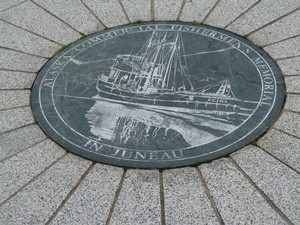
Alaska Commercial Fishermen's Memorial. (Photo by Casey Kelly/KTOO)

The Docks and Harbors Board is expected to make a recommendation to the Juneau Assembly tonight on the location of the Alaska Commercial Fishermen’s Memorial, now that a floating cruise ship berth is to be built in front of it.

The memorial’s board of directors believes it should be left where it is, but not with a dock there, citing concerns over impeding the annual Blessing of the Fleet.

Port Engineer Gary Gillette says there would be enough room for fishing vessels to pass in front of the memorial once the dock is built, though it will be tight. But Juneau commercial fisherman Dick Hoffman told the Assembly on Monday the new dock will make it difficult for commercial fishing vessels that participate in the May blessing ceremony.

“We all gather, we’re drifting around out front. We’ve got the whole harbor to float in,” Hoffman said. “That’s now going to have this dock in it. The area that we’re going to be allowed is going to be very limited. We’ll have some little keyhole that we can look through to see what is being performed right in front of the memorial. And we’re going to have wait our turn to go into that cul-de-sac, instead of having a sort of a parade of vessels following fairly close together and keeping a continuous flow going.”

The memorial board says if the monument does move it should go to Marine Park. But the Parks and Recreation Advisory Committee recently recommend the memorial stay at its current location.

The Docks and Harbors Board meets at 7 o’ clock tonight in Assembly Chambers.

The Assembly will make the final decision, probably at next week’s Committee of the Whole meeting.

USPS polls Douglas Post Office users

Douglas Post Office customers are being asked what postal services they use at the island store and how often.

The U.S. Postal Service has sent out a survey to help gauge the importance of small post offices across the country.

While the Postal Service had targeted 36 in Alaska for closure, Alaska district officials announced on Monday that 25 remote stations will remain open. Eleven are still being reviewed, including Douglas.

Letters and surveys went out to Douglas customers on Monday. The letter says their input – from the survey and a public meeting — will be considered in the final decision. The survey deadline is September 11. The letter lists no date for the meeting.

The survey asks how often people buy stamps, mail letters or packages and use other postal services at the Douglas Third Street station, versus online or at other Juneau outlets. It also asks if the post office assists senior citizens or people with disabilities, if it’s a school bus stop, a public bulletin board, or a community gathering place.

While those types of activities separate many small rural from more urban post offices, workload is the key. The letter says mail volume and revenue at the Douglas station have steadily declined over recent years. If Douglas is closed, customers would use the Federal Station on Ninth Street in Juneau, 2 point 7 miles away; or the Mendenhall station, 11 miles away.

The Postal Service has recommended closing 3,700 post offices nationwide.

CBJ Assembly creates AJ Mine fund

The AJ Mine Capital Project Fund now holds $250,000 for a water system study and other issues to be resolved before city officials decide if they’ll promote the city-owned gold mine. The Assembly Monday night appropriated the money from the sales tax budget reserve.

The ordinance says nothing about what the funds would be used for, and that caught the attention of most of the public who testified.

“I’m opposed to allocating any money for anything without first knowing what exactly the money would be used for and what results CBJ would expect to receive,” said Juneau resident Tina Brown.

City Engineering Director Rorie Watt told the Assembly several weeks ago that a fund would be needed to explore AJ issues, particularly Juneau’s water supply.

The city and borough owns two-thirds of the AJ property and Alaska Electric Light and Power owns the rest. Juneau’s main water source is Last Chance Basin, which sits atop, adjacent to and beneath the ore body.

Protecting Last Chance Basin was the AJ Mine Advisory Committee’s top priority. The Assembly formed the task force to determine circumstances under which the city might promote the AJ. The group worked for three months last spring, presenting its report in May.

Assembly member Ruth Danner tried to amend the ordinance to specifically state a water study would be done.

“I believe this ordinance should be redirected to say an ordinance appropriating to the (city) manager $250,000 for a safe drinking water supply study, and staff and legal time necessary to provide for research into the costs and benefits of reopening the AJ Mine,” she said.

Danner lost her argument as well as one to add intent language calling for a public vote on the AJ before the Assembly would solicit or select a junior mining company to advance the mine.

“When we have public testimony we hear from people on both extremes,” she said. “We don’t hear from people in the middle,” which she believes a survey would reach.

Assembly member Merrill Sanford said it’s too early to call for a public vote.

“There’s no reason to do this right now,” Sanford said. “We’re just trying to deal with whether or not it is feasible, whether or not it is safe for our water system, to even begin to look at the AJ Mine.”

Both of Danner’s amendments failed. Then seven of the nine-member Assembly voted to seed the AJ Mine Capital Project account with the $250,000 appropriation. David Stone and Malcolm Menzies recused themselves from the discussion and vote, due to a financial interest with A-E-L & P.

Engineering Director Watt will direct the studies. He said he plans a public process.

“Starting out with advising the public of a draft outline of what issues ought to be studied and look for comment and input on whether we’re missing topics,” Watt said.

He said the public also would be asked to comment on the final report.

The AJ study would include legal issues, Watt said. Juneau is one of the few municipalities in the country that regulates mining.

Watt said the study also would look for municipal land that could be used as a mine portal.

Assembly puts bond issues on ballot

Juneau voters will be asked to approve two bond issues this fall to pay for school projects.

The CBJ Assembly Monday night agreed to use bonds for a ground source heat system at Auke Bay Elementary School and new artificial turf at Adair Kennedy Park. The questions will be on the October 4th municipal election ballot.

Auke Bay School is being renovated. While a ground source heat pump would initially cost more than the proposed heating oil system, it would save the school district money in the long run, as well as reduce carbon emissions.

To minimize the cost of the $1.4 million general obligation bond to taxpayers, the district plans to apply interest earned on completed elementary school renovation projects to the debt service. That means a small property tax reduction for 2012, according to city manager Rod Swope.

As for the impact on taxpayers over the life of the bond:

“Assuming an interest rate of 3.5 percent, the amount of debt service for this proposal would require an annual property tax levy of $1.21 per $100,000 of property tax value for a 10-year period,” Swope said.

The second ballot question is for a $1.9 million general obligation bond for new turf at Adair Kennedy Park. The school district also plans to put interest earnings toward the debt service.

Swope says it would cost property taxpayers $1.04 per $100,000 of assessed value for the 10-year life of the bond.

The Adair Kennedy field was the first artificial turf installed in Juneau. Swope says the city was told it would last about 20 years, but it’s reached the end of its useful life at 10. In addition, vandals burned the field in several spots earlier this summer.

Both school projects qualify for 70 percent reimbursement by the state’s School Construction Bond Debt Reimbursement Program.

25 rural post offices spared

The U.S. Postal Service says 25 rural Alaska post offices will remain open after all.

Douglas is not on that list, according to Senator Mark Begich’s office.

USPS Alaska District Manager Diane Horbuchuk says 25 post offices off the road system are in the clear. The agency last month targeted 3,700 post offices nationwide for possible closure, as a way to reduce costs and expenses. Thirty-six were in Alaska.

Begich arranged a meeting Monday so rural health care providers and other community groups could give postal service officials more information on the impact to rural communities. Horbuchuk announced the agency had already made the decision to spare Alaska’s most remote post offices.

Horbuchuk said those communities will receive letters to that effect this week.

She said the review of the remaining 11 sites, including Douglas, should be completed by the end of the week.

Site notifications
Update notification options
Subscribe to notifications