There’s less than a week for Alaskans to weigh in on the new Catch Sharing Plan for halibut. The deadline is next Wednesday, September 21st.
A final rule could be issued this fall on the proposal that allocates halibut between commercial longliners and charter operators. The Secretary of Commerce could approve it by December. That could put the plan in place for next year.
Rachel Baker, a fisheries management specialist for NOAA Fisheries, briefed members of the Juneau Chamber of Commerce on the players involved in halibut management and how the new Catch Sharing Plan would work on limiting growth in the charter sector.
Baker says the proposed Catch Sharing Plan was designed for its predictability and includes an initial allocation and a set of daily bag limits for the charter sector. There’s also a potential transfer of Individual Fishing Quota from commercial longliners to charter operators in the form of Guided Angler Fish, or GAF.
Here’s the first part of Baker’s presentation before the Chamber on Thursday:
Part two:
Part three:
More on information on the Catch Sharing Plan can be found at NOAA’s website. Scroll down to the section on Public Comment Periods
The state of Alaska will not appeal the Juneau Access case to the U.S. Supreme Court.
Instead, Gov. Sean Parnell says it’s time to get on with an Environmental Impact Statement that considers improved ferry service in Lynn Canal.
Two federal courts have sided with conservation groups that the state should have reviewed a “no-build” option to a highway out of Juneau. Chances the Supreme Court would take the case are probably less than one percent, according to the Department of Law. And if they did, it could be another two years before there’d be a decision.
Transportation Commissioner Marc Luiken says it’s too risky.
“I think we’ve got a pretty good mandate from the Ninth Circuit (Court) as to what they would expect us to do so that’s what we’re going to do,” Luiken says.
He says it will take about two years to complete an EIS. It means studying marine highway routes, schedules, and ships as well as reviewing and updating all the project alternatives. The state’s preferred alternative extends Glacier Highway about 50 miles to the Katzehin River, where vehicles would have to board a ferry for the last leg of the trip to Haines or Skagway.
The Southeast Alaska Conservation Council and other Lynn Canal environmental groups sued in 2006, saying the state and Federal Highway Administration should have taken into account better ferry service that did not require building new ferries, terminals, or roads. Luiken says the department will start the supplemental EIS process immediately.
“They had suggested we keep the old ferries and when we replace them use those to provide adequate additional shuttle ferry service in the Lynn Canal as well as pull ferry service from other SE communities, potentially, when the need arises,” Luiken says. “So that’s the direction we’re going to go with this supplemental EIS.”
SEACC Executive Director Lindsey Ketchel says she’s not surprised at the Parnell administration’s decision to conduct the EIS, but she’s disappointed the governor just doesn’t drop the highway completely.
“You know we think the governor has not been able to factor into his transportation vision a prudent and balanced approach,” Ketchel says. “We’re seeing just huge amounts of money going to studying the road to Umiak, tons of money going to studying the road to Nome and then you add the Juneau Access road. You know at some point in time you have to say there isn’t going to be this amount of federal dollars available to build this amount of extension of transportation in the state of Alaska.”
The supplemental Environmental Impact Statement could cost between $1 million and $2.5 million, according to the Request for Proposals, which went out yesterday (Wednesday).
The number of Alaska post offices being studied for possible closure is down to five – and Douglas is still on the list.
The others are Elmendorf, Fort Wainwright, Eielson and the Anchorage Postal Store. That’s according to a U.S. Postal Service internal study provided to Alaska’s Congressional delegation yesterday (Thursday), and shared with the media.
Originally 36 Alaska post offices were being considered for closure. Twenty-five remote locations were eliminated from consideration almost immediately, and six more came off the list in the last month.
As we reported yesterday (Thursday), three Postal Service officials from Anchorage got an earful from Douglas Post Office customers Wednesday night arguing that the station should stay open.
Alaska District Manager Diane Horbochuk says several factors will determine which offices make the final closure list, including the cost to run each location, access to other post offices, volume, customer demand, and public input.
Communities can appeal if their post office makes the closure list.
Thousands of post offices nationwide are being studied for possible closure by the financially strapped agency, which is facing a 10-billion dollar shortfall.
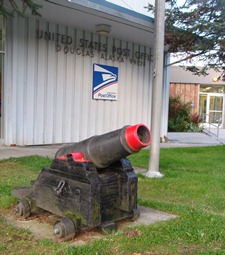
The Douglas Post Office. (Photo by Casey Kelly/KTOO)
Juneau residents turned out in force last night (Wednesday) to urge U.S. Postal Service officials NOT to close the Douglas Post Office.
The branch is on a list with thousands of other post offices nationwide being studied for possible closure by the financially struggling agency. But for the approximately 150 people who packed the Mt. Jumbo Gym Wednesday, it’s more than just a place to pick up mail and send packages. It’s a part of the community.
In fact, Douglas Post Office clerks Lee Kearney and Dean Ruby were grand marshals of the Douglas 4th of July parade last year, as pointed out by John Sandor and several others.
“I would be shocked if there’s another post office in the country whose postal workers served as grand marshals,” said Sandor.
Most of those who testified were Douglas residents, who like the convenience of having a post office nearby. But several said they live on the Juneau side of the bridge, but drive to into Douglas rather than use the federal building station downtown. Jack Cadigan gave three reasons why he prefers Douglas.
“Parking, parking and parking,” Cadigan said. “I counted, perhaps incorrectly, but 13 parking spaces 30 minutes each to service the main post office and the entire federal building – all seven stories and all the other agencies that are there. There’s 15 right down here on Douglas. We can come over here with packages, we can bring them in, we can get them shipped, we can get them mailed. And it’s great.”
Edwin Soto, president of the American Postal Workers Union Local 3323 in Juneau, said seniors, people with disabilities, and businesses in Douglas would take the biggest hit if the post office were to close. He argued the Postal Service’s savings would be modest at best, and said the real reason for the agency’s financial problems is a 2006 postal reform law that requires the U.S.P.S. to prefund future retiree health care benefits.
Juneau residents line up to tell U.S.P.S officials not to close the Douglas Post Office. (Photo by Casey Kelly/KTOO)
Soto called that “an obligation that no other federal agency or private business must bear.”
Diane Horbochuk, U.S. Postal Service District Manager for Alaska, was one of three Anchorage-based U.S.P.S. officials who heard the testimony. She said public input will be just one of the factors taken into consideration as the agency decides which post offices to shutter. Another factor she mentioned was the cost of running each location. If the Postal Service decides to close the Douglas branch, Horbochuk said there would be an opportunity for the community to appeal.
“At this point we have not made that decision,” stressed Horbochuk. “We’re going to go back and look at all our data, take into account the comments and make a decision. If we do make a decision that goes against what the community feels it should be, then you will be given the notice of what to do for what we would call an appeal. And that would be spelled out and we would post that in the post office.”
The Douglas office is one of 11 in Alaska still on the list for possible closure. The list originally included 36 post offices in the state, but 25 rural locations were spared after community groups voiced concerns.
Earlier this week Postmaster General Patrick Donohoe warned Congress that the Postal Service could lose 10-billion dollars in the fiscal year that closes at the end of this month, and the agency is in danger of defaulting as it reaches its borrowing limit.
The City and Borough of Juneau is considering a program that could increase the quality and availability of child care in the community.
The lack of child care in Juneau is notorious, says JEDC’s Meilani Schijvens.
“There’s a joke here in Juneau that if you wait until you think you might be pregnant you’re probably too late to sign up for child care, if you want an infant spot,” Schijvens quips. “You need to sign up when you think you might be in love.”
A recent study by the Juneau Economic Development Council indicates about half of children under age six in Juneau are in unknown child care situations. That means they are either cared for by parents splitting shifts or by unlicensed providers.
The turnover rate among licensed child care providers in the capital city is nearly 20 percent higher than the state average.
According to JEDC, the pay is so low that qualified child care providers quickly move on to other jobs for better wages and benefits.
The Association for Education for Young Children, or AEYC, has posed a solution, called the HEARTS program.
It stands for hiring, educating and retaining teaching staff. The program is similar to others around the country, which offer incentives for child care providers so they can earn credentials in early childhood education, increase their earnings and stay in the business.
AEYC’s Nikki Morris says the HEARTS program would award each licensed child care provider more per hour based on their level of education.
“They can see that as they increase their training there is compensation that goes along with that,” Morris says.
The HEARTS program also would offer providers incentives to stay in business by helping to offset costs like first aid and CPR certifications. It would waive some fees and taxes for licensed child care providers.
AEYC Executive Director Joy Lyon says the incentive program would result in better child care options in Juneau as well as provide working parents with the assurance that their young children have a quality day-care experience.
The HEARTS program will be reviewed by the CBJ Assembly Finance Committee. It would cost the CBJ just over $143,000 a year. Click here for the HEARTS Initiaitve.
A US Postal Service official will visit Douglas tomorrow (Wednesday) to hear from residents about the possible shuttering of their post office.
The Douglas branch is among thousands nationwide being considered for closure by the financially struggling agency. The unnamed official from the postal service’s Anchorage District Office will be at the Mt. Jumbo Gym Wednesday from 7 to 9 pm. Douglas Resident Susanne Williams hopes for a good turnout.
“It’s part of our identity – 99824,” Williams says. “And if it closes, what do we do then? We go to street delivery. But then for special needs, if you’re a senior, or if you do not have a car, it takes half a day. You either got to spend all morning getting over the federal building and back again, or you got to spend all afternoon.”
Postmaster General Patrick Donahoe warned Congress Tuesday that the Postal Service could lose 10-billion dollars in the fiscal year that ends this month. That puts the agency in danger of defaulting as it reaches its borrowing limit.
Donahoe is asking Congress to let it break union contracts to fire employees, change retiree health benefits, and end mail delivery on Saturdays.
He testified before the Senate Homeland Security and Governmental Affairs Committee, where Alaska Senator Mark Begich questioned how the plan to cut Saturday service would affect small businesses.
Donahoe says of all the possible places to cut, Saturday service makes the most sense. But he clarified that the change would only affect shipping and delivery of packages.
“Generally the volume is about 10-15 percent lower on Saturday than the rest of the week. We will keep post offices open on Saturdays. So people would have access to our 30,000 plus post offices,” Donahoe said.
“For shipping packages and so forth for small businesses?” Senator Begich asked.
“Right,” replied Donahoe. “We’d be able to provide that service. Now we will not be running outgoing mail that night, that would be Monday, but they would have access to our services.”
Begich’s office says the Congressional delegation is still awaiting a list of which post offices on the list for possible closure will be spared. The list was expected more than a week ago, but was delayed due to Hurricane Irene.
Close
Update notification options
Subscribe to notifications
Subscribe
Get notifications about news related to the topics you care about. You can unsubscribe anytime.