Government

Murkowski warns of decline in federal dollars for energy projects

Alaska Senator Lisa Murkowski says reducing the high cost of energy is the best way to promote economic growth in the state.

But she says the new focus on spending cuts in Washington, D.C. will mean less federal money to help build Alaska’s energy infrastructure.

“Federal support for R & D will continue,” Murkowski says. “But funding to actually help build out the facilities – like the government did when APA built the Snettisham and built the Eklutna hydroelectric projects – not going to come as easily as it has in the past.”

Murkowski was speaking this morning (Tuesday) at the Alaska Rural Energy Conference in Juneau.

She suggested the State of Alaska, which currently enjoys a budget surplus thanks to oil tax revenues, could make up for some of the decline in federal spending. She also urged private industry to invest in Alaska energy projects.

“The private sector is working on a lot of new technologies that will need to be demonstrated on a smaller scale before expanding into larger markets. So we can be viewed as an opportunity for them,” says Murkowski. “I’ve always said, let us be the pilot projects up here in Alaska. If we can make it pencil out here where our energy costs are higher than anywhere in the country, think about what that demonstrates for the success of the project.”

The seventh annual Rural Energy Conference is going on through Thursday at Juneau’s Centennial Hall.

Assembly repeals Atlin Drive zone change

The Juneau Assembly has repealed a controversial zone change on a small parcel of residential land in the Mendenhall Valley.

The Assembly last month overrode the Planning Commission and CBJ Community Development staff and zoned the area light commercial. Then the city attorney said it was illegal.

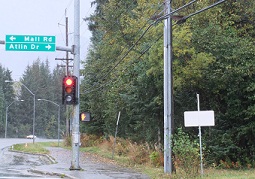
The heavily wooded corner of Atlin Drive and Mendenhall Loop Road was previously owned by the U.S. Forest Service. While the parcel is 2.68 acres, it’s also wetlands, reducing the usable land by 40 percent.

Developer Richard Harris and consultant Murray Walsh have been seeking the zone change since January. They weren’t successful until August, when they appealed a Planning Commission decision to the Assembly.

City attorney John Hartle said the zone change violates the city’s land-use code, but the developer’s attorney reads it differently. Walsh told the Assembly Monday night the turn of events was “horribly demoralizing.”

“I understand the yearning for clarity in these things. It would be a good idea to change the code so that we’re not faced with this kind of thing again,” Walsh said. “This has gone on eight months. Lots of emotion, lots of trial. And I just think that the assembly should stick with the decision it’s made, give us what we asked for, and give us a chance to earn our way into something the whole community will be proud of.”

The entire Atlin Drive neighborhood, including Saint Paul’s Catholic Church, has been against the zone change, primarily because Harris has no plan for the corner. He has said he just wants the flexibility that commercial zoning would give.

Linda Wild has testified several times on the issue. She told the Assembly it was time to get beyond dueling attorneys and emotional reactions and focus on a common goal – quality use and development of the property that’s compatible with the neighborhood.

“Mr. Harris would be well advised to remain in dialogue with the neighborhood to garner their support for a specific project rather than the ‘trust me’ of a blanket light commercial designation,” Wild said. “I’d sure hate to see 48 housing units or a Denny’s on that little corner.”

All but one Assembly member – Johan Dybdahl — voted to repeal their action. The corner remains medium density residential.

Juneau to file annexation petition

Juneau will file a petition with the Local Boundary Commission to annex lands proposed for a Petersburg borough.

The Assembly voted last night (Monday) to challenge Peterburg’s plan to incorporate an area previously identified for annexation to the City and Borough of Juneau. It includes all the territory from the southern CBJ boundary and east to the Canadian border; the Tracy Arm / Ford’s Terror Wilderness and Endicott Arm as well as Holkam, Windham and Hobart bays.

Thirty-thousand acres at Hobart Bay are owned by Goldbelt, Juneau’s Native Corporation.

Juneau previously did not file to annex the area, in deference to Goldbelt, which had said it preferred not to be in any borough.

The corporation says it’s currently neutral on the Petersburg petition. The Goldbelt Board of Directors is to decide its borough preference over the next couple of months.

There was no discussion last night on the Assembly’s resolution to file the annexation petition. It calls for all or a portion of the lands on the mainland south of Juneau’s southern boundary that were recommended years ago as a model borough.

October 26 is the deadline for filing competing petitions and opposing briefs with the Local Boundary Commission.

CBJ Remains in Tongass Futures Roundtable

The City and Borough of Juneau will remain part of the Tongass Futures Roundtable.

A resolution to repeal CBJ support for the group failed on a tie vote at last night’s (Monday) Assembly meeting. Mayor Bruce Botelho recused himself from the discussion and vote, because he currently serves as facilitator of the group.

Earlier this year, timber representatives pulled out of the roundtable. The Southeast Conference, and several other communities as well as the State of Alaska also quit, citing the group’s inability to increase logging in Southeast Alaska.

Assembly member Merrill Sanford proposed that Juneau do the same. He says roundtable members have done little to address timber supply.

“There should be enough in the Tongass National Forest to supply two, three or four sawmills in Southeast Alaska,” Sanford said, “and we have done nothing but hurt the economy of our small towns by not having an integrated resource available for them and this group is not working on that. They said that was one of their primary goals.”

The Tongass roundtable started five years ago in an attempt to find consensus among stakeholders of the nation’s largest national forest. It included the U.S. Forest Service, conservation groups, the timber industry, and Native organizations, including Sealaska Regional Native Corporation.

CEO Rick Harris told the Assembly the roundtable has been effective in improving communication among the users and residents of the national forest.
And while there has been less progress on timber, he says it goes beyond that to other Tongass resources.

“Kind of the moniker was timber and beyond so that’s what we’ve focused on. We can understand people’s frustration that we have not found a solution to timber but that’s been a 30 to 40 year fight as it is.” Harris said he believes the roundtable has made substantial progress.

The Parnell administration has formed a state Timber Jobs Task Force, which represents one side of the policy debate over Tongass issues. It has no representatives from the conservation community.

Legislators create Taku River Fact-Finding Task Force

Juneau lawmakers are looking for members to serve on a new Taku River Task Force.

The river is the most abundant salmon-producer in Southeast Alaska. It’s also one of the most studied in terms of biology, but with the renewal of mining at the headwaters, many other questions remain.

“We’re just trying to find out exactly who controls the Taku River,” says Juneau Sen. Dennis Egan.

He says it’s not even clear what agency is responsible for monitoring industrial vessel traffic on the river – the Alaska Department of Fish and Game, Natural Resources, or Environmental Conservation? Or the U.S. Coast Guard?

The task force will also look at the effectiveness of state and federal laws and regulations regarding the river as well as review the health of Taku River fish stocks, habitat and game resources.

A proposal to create a legislative task force to study the issues went nowhere during the last legislative session. But the meetings between sport and commercial fishermen and Taku River property owners proved to be contentious. Representative Beth Kerttula says it was clear everyone needed the same information.

“It just was obvious we were not operating with the same information,” she says. “Some of it was good, some we weren’t sure about and we needed to be sure about it. So our common sense way to go forward was to find out the facts and get them out there for everybody.”

While the catalyst for the task force is the redevelopment of the Tulsequah Chief Mine at the headwaters of the Taku River, it’s the extraordinary salmon production of the river that drives everyone’s concerns, says gillnetter Jev Shelton.

“With or without the Tulsequah Chief Mine, the river really does deserve an added measure of protection to be sure that productivity isn’t compromised,” he says.

Canadian company Chieftain Metals hopes to start production of the multi-metal mine in 2014. The main access to the mine is up the Taku River.

Shelton is among the advocates for the task force. He believes it should result in real protections of the river.

“This is intended to be a forum for trying to put together, hopefully, a piece of legislation that could get through and provide a more institutionalized protection for the river, to which chieftain or anybody else would have to respond appropriately,” he says.

Egan says it’s important to make sure that any activities on the river don’t hurt the fishing industry and other river users.

“I’m not opposed to mining,” he says. “I just want to make sure they do it right and we set guidelines on our side of the border.”

The eight-member committee will represent Alaska Natives with ties to the Taku River, commercial and private recreational property owners in the Taku River valley, commercial and sport fishing, and a biologist who does not work for government. State resource departments will provide expertise to the group.

“It’s up to the task force to make recommendations, not bureaucrats,” Egan says. “We tried to keep government out of it, but using government as the resource to these eight members of the committee.

People interested in serving on the Taku River Fact-Finding Task Force should contact Kerttula, Egan, or Rep. Cathy Munoz. Meetings will start early next month. A final report will be submitted to the delegation by mid-December.

State wants court to order fast ferry engine fix

Alaska’s Marine Highway System wants a court to order the fast-ferry builder to provide new engines for the ships.

State officials say engines on the Fairweather and Chenega are wearing out far faster than their warranties promised. Replacing the eight engines could cost in the range of $20 million.

The state filed a lawsuit last year, but continued talking to the manufacturer about a solution.

Captain Mike Neussl says the state is now asking the court for a preliminary injunction to force action before the engines wear out.

“If that happens, those vessels could be out of service before there’s an ultimate resolution. That would mean the state would lose use, and state residents and communities would lose use, of those vessels prior to the ultimate decision on that lawsuit,” he says.

He says quick action is needed because making new engines will take about a year.

The engines have already undergone repairs. Neussl says that has extended their operating life. But the repairs are not permanent.

The lawsuit and injunction motion are against Derecktor Shipyards, which build the ship, and subcontractors that built the engines. Derecktor officials could not be reached for immediate comment.

The injunction motion filed in Superior Court does not specify that new engines be built by the same manufacturer. But Neussl says that’s the likely solution.

“We have looked at alternatives, what other engines are out there that we could replace these engines with. And to be honest with you, there’s not any other diesel engines in the market place that meet the power-to-weight ratios that these engines have and would fit in the assigned space and have the correct weight to be used in these vessels,” he says.

The Fairweather, built in 2004, is based in Juneau and sails to Sitka and Petersburg. It’s scheduled to begin Angoon service next year. The Chenega, built in 2005, is based in Cordova and runs to Valdez and Whittier.

Site notifications
Update notification options
Subscribe to notifications