Sealaska Regional Native Corporation owns about 25-thousand acres of subsurface mining rights in an area being contested by the City and Borough of Juneau and Petersburg.
The area includes Hobart Bay, where Juneau’s Native Corporation Goldbelt owns 30-thousand surface acres.
Sealaska Vice President Rick Harris says the company will follow Goldbelt’s lead in commenting on the dispute.
“We’ll support them in whatever way is necessary to achieve a result that’s best for Goldbelt’s shareholders and also our shareholders,” says Harris.
Juneau plans to file a competing petition to Petersburg’s proposed borough boundaries, which includes land previously slated for annexation to the CBJ.
So far, Goldbelt hasn’t expressed a preference for which borough, if any, the corporation’s land should be in. Earlier this month, Goldbelt Vice President Derek Duncan sent a letter to the state’s Local Boundary Commission saying it would make a statement in the near future.
Harris says sand rock and gravel are quite prevalent in Hobart Bay, and that some precious metals are nearby.
“We don’t believe that it’s on our property,” Harris says. “We think that if there’s any precious metals, they’re actually to the north of our property.”
October 26th is the deadline to submit competing petitions and opposing briefs to the state’s Local Boundary Commission on Petersburg’s proposed borough.
The CBJ Assembly plans to introduce an ordinance Monday to make its petition official.
About 5,500 Permanent Fund Dividends are being recalled.
The PFDs were sent out in error. Approximately 3,600 were deposited directly into bank accounts and 1,900 were sent out as paper checks.
PFD Division Director Deborah Bitney says employees didn’t match correct records in a new software program and dividends were paid to applicants instead of creditors.
The software is called “eGarns” and it’s being used for the first time this year.
“This affects only debts that are basically court ordered, like restitution, judgments for debts that are unpaid, things like that,” Bitney says.
It does not affect garnishments for child support, she says.
The division has requested that direct deposits be reversed and also has issued stop payment orders on the checks. Bitney says the error was discovered late Monday afternoon. While the total amount of the error isn’t available, it’s expected to be nearly $7 million.
Bitney says it’s important to get the word out about the error.
“You know, 99 percent of the dividends that went out are just fine,” she says. “This affects a very small subset of the population. We really are trying to help those people and we would like them to contact us as quickly as possible once they find out they are involved in this.”
Bitney says safeguards have been programmed into “eGarns” to prevent similar errors.
Nearly every Alaskan received $1,174 in this year’s PFD.
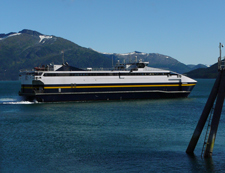
FVF Chenega in Prince William Sound. Photo by Ed Schoenfeld/CoastAlaska
The Alaska Marine Highway System says the engines being used in their two fast ferries are defective and builders of the ships knew it when they delivered the ships only six years ago. But the ferries’ builders say it’s not their fault, and they shouldn’t be obligated to replace the engines when the warranty doesn’t cover it.
Judge Philip Pallenberg enters the courtroom lugging a stack of files and documents easily a foot high. He’s about to get handed a few more accordian folders that will extend that by several more inches.
“I think the state fired the opening salvo in this naval battle,” said Pallenberg. “So, I think the state should go first.”
October 7th’s skirmish in Juneau Superior Court was over the engines installed in the state’s fast ferries Fairweather and Chenega, relatively new ships with diesel-powered jet drives that push the catamarans at a nice 32-knot clip. That’s about twice the speed of the ferry system’s standard mono hulls.
State attorney Dana Burke is leading the attack for the ferry system. But he runs out of time during oral arguments to carefully cite excerpts of contract documents and internal memos. Burke says manufacturers of the fast ferries knew the engines were defective, almost as soon as they were installed. He said they breached warranties that called for repairs and – if necessary – replacement of the engines. For both ships, all eight engines have been valued at $20 million.
“And we cannot wait,” said Burke. He said both the Fairweather and Chenega are in danger of being decertified from passenger service in the very near future.
Burke wants the ship and engine builders’ liability extended to the engines’ defects, especially when they admitted to using the wrong kind of coolant (that accelerated corrosion in the engines).
Burke said that MTU instructed the state to stop using Power Cool 3000 because it might degrade a layer of molybdenum in the crank case cylinder bores.
David McMahon representing Robert Derecktor Incorporated said the state was not entitled to any more rights after expiration of a standard year-and-a-half warranty.
“These two vessels have been operated on an uninterrupted basis since they went into operation,” said Burke.
But Derecktor Shipyard is only one of the parties in the state’s lawsuit. The state’s real target is MTU Friedrichshafen and MTU Detroit Diesel, the German company that built the engines and the American company that did the subsequent repairs.
Jon Dawson, who has already been prepared for a response, said they already have a potential repair of an interstitial ring that they’ve been trying to install.
“Scare mongering and hyperbole aside, the principle issue in this case involves only one component of these engines: the engine block,” said Dawson.
Dawson said there are clear factual issues at what caused the faster-than-expected deteroriation; instead of the coolant – perhaps the Alaska environment, improper maintanence by ferry crews, even excessive vibration caused by a misaligned installation by the shipyard.
“You can’t wave a wand and resolve this wear issue when you don’t know what’s causing it,” said Dawson.
Dawson also says the engine warranty was assigned to Derecktor – the general contractor, not the final buyer of the vessels, or in this case, the state ferry system. And it did not include replacement of the entire engine, beyond the engine block.
But the plantiffs always have the last word in any courtroom argument.
“Something’s wrong with these engines. They’re lemons,” said Burke. “These were defective beyond delivery and someone is responsible.”
October 7th’s hour-and-twenty minute oral arguments focused not on any factual disputes, but primarily arcane and esoteric interpretations of liability and warranty law. It will be sometime before Judge Philip Pallenberg issues an opinion.
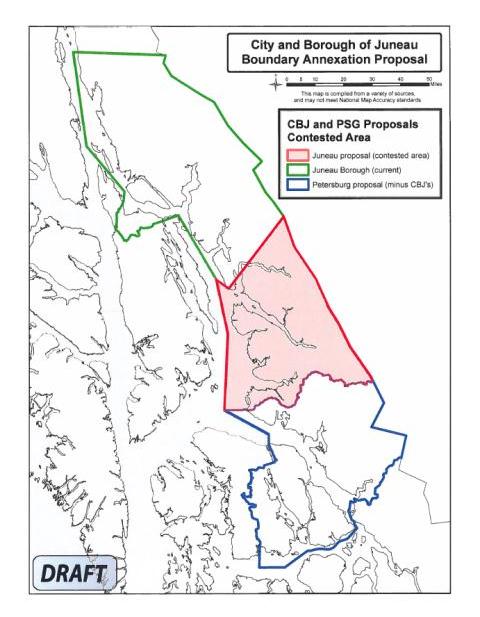
Map courtesy City and Borough of Juneau. Click to enlarge.
The City and Borough of Juneau is finalizing an annexation petition to be filed with the state’s Local Boundary Commission for lands that Petersburg wants to include in a proposed borough.
Last night, the CBJ Assembly approved several maps to be included in the petition. They show 92.6 percent of the contested area is in the Alaska Department of Fish & Game’s Juneau Game Management Unit; 93.7 percent is in the U.S. Forest Service’s Juneau Ranger District; and 71.4 percent in the Juneau Recording District.
The area was previously identified for annexation to Juneau. It includes all the territory from the southern CBJ boundary and east to the Canadian border; the Tracy Arm / Ford’s Terror Wilderness and Endicott Arm as well as Holkam, Windham and Hobart bays.
Before now, the CBJ hadn’t filed for the area in deference to Juneau Native Corporation Goldbelt, which owns 30-thousand acres at Hobart Bay. Goldbelt hasn’t expressed a preference for which borough it wants to be in, now that there will be competing claims for the land.
Juneau Mayor Bruce Botelho says the Local Boundary Commission may still decide not to include it in either Petersburg or Juneau.
“But absent our intervention there will be only one petition asserting a claim over that land,” says Botelho.
October 26th is the deadline for submitting competing petitions and opposing briefs to the Local Boundary Commission. The assembly will introduce an ordinance to approve its petition at its regular meeting next Monday.
A resolution authorizing City Manager Rod Swope to apply for state funds to pay for half of a new Mendenhall Valley library is on its way to the Juneau Assembly.
On Monday, the assembly’s Public Works and Facilities Committee sent the resolution to the full panel for approval.
The nonprofit group Friends of the Juneau Public Libraries has committed one-million dollars to the project, which is estimated to cost at total of 14-million. Friends president Jeff Vogt says it’s important to get it done now, while state funding is available.
“If we let this slip by our fear is that instead of looking at a 7-million dollar project to the city – of which the Friends have already committed a million at least – if we let this slip by at this point in time it could slip by for a long, long time,” Vogt says.
In addition to the Friends money, the city could count the value of the land at Dimond Park, where the new library would be built, toward its half of the project. Juneau Library Director Barbara Berg says other funds could come from an extension of the city’s one-percent temporary sales tax, private foundations, and fundraising.
“There’s potential for Rasmussen [Foundation money]. The Library Endowment Board has approximately 300-thousand dollars available at this time in its major project fund to put toward this, and the Friends are intending to run a capital campaign and other fundraising to support this project,” says Berg.
Applying for the grant now doesn’t commit the city to the project. The assembly will vote on the resolution next Monday.
Juneau Mayor Bruce Botelho is one of three local elected officials from around the state spearheading an effort to resuscitate the Alaska Coastal Management Program.
Before shutting down at the end of June, coastal management worked with developers, local residents, and state and federal permitting agencies to review proposed projects along the state’s coastline.
Botelho says it was disheartening to see the program go away after the governor and legislature couldn’t agree on terms to reauthorize it. Now a citizen’s initiative, sponsored by Botelho – along with Kodiak Island Borough Mayor Jerome Selby and Kenai Peninsula Borough Assemblyman Mako Haggerty – would revive the program.
Botelho says an application for the initiative petition, signed by more than 200 people, was delivered to the lieutenant governor’s office on Friday.
“Our initiative is intended to encourage our state leaders to redouble their efforts to create a credible coastal management program during the 2012 legislative session,” says Botelho. “And if they are unable to do so, Alaskans will have an opportunity to express their support for Alaska’s coastal program in November 2012.”
The proposed initiative differs from a bill to reauthorize coastal management that was on the table during this year’s legislative sessions. It reverts to the way the program was run prior to 2003, when Governor Frank Murkowski implemented sweeping changes to it. Many local communities opposed those changes.
“What we’ve tried to do here is design a program that we think is most suitable for Alaska,” Botelho says. “And part of that is looking and making sure that the permitting process is streamlined, that it encompasses all programs done by our resource agencies, and that it be done in a coordinated, collaborative way.”
Hagerty says he was disappointed with the legislative process, and thinks the initiative is a better alternative.
“We’re not just going to be delivering signatures. We’re going to be delivering a message that this is a program that the state needs to participate in,” says Haggerty.
Lieutenant Governor Mead Treadwell has 60 days to determine whether the initiative meets the legal framework to go before the public. At that point, the sponsors can begin collecting the nearly 26,000 signatures needed to qualify it for the ballot.
Botelho says the goal is to finish before the legislature begins next year’s session in January. That would give lawmakers the option of passing a substantially similar law or allowing it to proceed to a vote.
Close
Update notification options
Subscribe to notifications
Subscribe
Get notifications about news related to the topics you care about. You can unsubscribe anytime.