After being criticized for rushing a bill into the special session this year that some considered ill-conceived, the Parnell administration is now seeking a consultant to advise it on oil taxes.
The Department of Revenue is soliciting proposals for a consultant to provide expert economic analysis. The consultant will be asked, among other things, to identify issues with the current oil and gas tax structure that might limit industry investment in the state and make recommendations for improving the existing system.
The budget for the work is estimated between $400,000 and $700,000.
Gov. Sean Parnell failed to get his tax-cut plans passed the Legislature during regular and special sessions this year and last. The proposal quickly put together before this year’s special session was criticized by lawmakers in both parties.
The drilling-support barge that’s scheduled to get under way in the Arctic Ocean this month has a big Puget Sound connection.
A Seattle shipyard refurbished the two drill rigs that are currently making the long sea journey to the Arctic. The Noble Discoverer reached Dutch Harbor this week; the Kulluk is expected in Dutch later this week. The support-barge is designed to stop any oil spills from the first two.
It’s currently under construction, and federal scrutiny, on the Bellingham waterfront. Officials say it needs a stronger design.
For the past decade, the Bellingham Shipping Terminal has mostly resembled a ghost town. After the big pulp mill next door shut down, the terminal has gone mostly unused. The main exception is an old Horizon Lines container ship that’s been tied up here for years. It only rarely wanders out of port, like a ghost of commerce past.
But this year, Big Oil has brought the terminal back to life with hundreds of short-term jobs. Contractors for Shell Oil are turning a 38-year-old barge into an oil-spill response unit they call the Arctic Challenger.
Right now, inspectors from the Coast Guard and the American Bureau of Shipping are inside the terminal. They’re going over the Arctic Challenger with a fine-tooth comb. And that’s where Arctic drilling has hit a snag.
Those inspectors found deficiencies in the Arctic Challenger’s construction and design, things like welding, piping, and wiring. The Coast Guard says some of those problems have already been fixed. John Dwyer is the Coast Guard officer in charge of the inspections.
“We’re committed to making sure that this vessel meets all the pertinent requirements and putting certainly our best effort into doing that,” Dwyer said.
But just what requirements are pertinent is now the question.
Shell Oil is in a rush to finish the rig and get it up to the Arctic Ocean before summer vanishes and ice returns to the far North. They want to place the rig between the two proposed drilling areas, in case a well blows out in either the Chukchi or Beaufort seas off Alaska’s north coast.
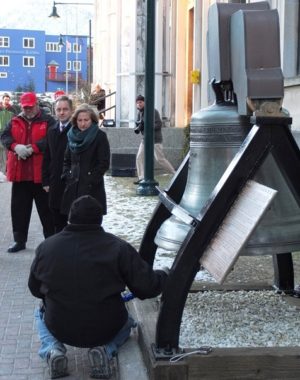
Shell Oil’s Arctic Challenger oil-spill response rig is under construction at the Bellingham Shipping Terminal. (Photo by John Ryan/KUOW)
Last week, Shell told the Coast Guard it can’t meet the design standard that the Coast Guard set for it.
Shell is currently required to build the Challenger to withstand storms so big, they only blow through the Arctic once a century. Those storms make waves 25 feet tall.
But Shell is asking the Coast Guard to soften the standards. The company only wants the Challenger to be seaworthy in the somewhat smaller, more frequent storms that blow through the Arctic every ten years. Those storms generate waves up to 20 feet high.
“If the 10-year standard is a 20-foot wave, you will definitely see waves higher than that,” David Atkinson said.
Atkinson teaches geography and researches Arctic storms at the University of Victoria. The difference between 20 feet and 25 feet might not seem like a big deal. But those five feet of water make a much more powerful wave.
The greater the height to which you can raise a wave, the more energy it has coming down to smash into something,” Atkinson said.
To be precise, the higher waves would smash with 56 percent more energy than the waves that Shell wants to plan for. If a storm were to damage the Arctic Challenger, it could cripple Shell’s ability to respond to an oil spill.
Atmospheric scientist Dave Battisti with the University of Washington calls it “silly” to design a vessel for a 10-year storm, unless you’ll only be using it for a few months.
“It’s like saying I expect to see a fire in my house once every 10 years. I might live in my house for a month, in which case, maybe it’s okay to not have fire insurance. But if you’re going to live there 10 years, and you know on average every 10 years, you have a fire, you better be prepared for it,” Battisti said.
There might be enough oil in the Chukchi and Beaufort seas to keep Shell drilling for decades. A Coast Guard permit for the Arctic Challenger would be good for five years.
Dave Atkinson says the Arctic usually has lighter winds and smaller waves than other oceans.
John Dwyer with the Coast Guard says that Shell would only get to drill in the summer. That’s the calmest time of year in the Arctic.
“If you reduce that from a year-round operation to only a several-month operation during the best weather conditions of the year up there, that’s going to reduce your risk factor because you’re not there year-round, 10 years in a row,” Dwyer said.
Shell and its Bellingham contractors declined to be interviewed. Shell spokesman Curtis Smith also did not respond to written questions.
Atmospheric scientists say the climate of the Arctic is changing so fast that it’s hard to know how storms might behave in the years ahead. But over the past decade, it has become clear that the Arctic is rapidly losing its sea ice. That’s expected to continue as the world keeps burning fossil fuels.
Less sea ice means the wind can build up bigger waves as it blows across large areas of open water that used to be frozen.
“The ice is relatively stiff and it basically keeps the ocean from heaving. The waves that will be experienced without sea ice, for the same storm, should be more intense,” Dave Battisti said.
The Coast Guard expects to decide what standard to apply to the Arctic Challenger in the next few days.
Ten environmental groups filed a lawsuit against the drilling on Tuesday. The groups say an oil spill will be extremely difficult to clean up in the remote Arctic Ocean–especially if oil mixes with ice.
Shell successfully tested the Arctic Challenger’s device for capping a blown-out oil well in June. The test was done in 200 feet of water in Puget Sound near Everett. But unlike the Arctic Ocean, Puget Sound lacks ice year-round.
A group of Alaska state lawmakers delving into the issue of high gas prices are finding no quick or easy answers for trying to provide Alaskans with some relief at the pump.
The panel, led by senators, is looking for ways to address the high cost of gas and heating fuel. A meeting Wednesday in Anchorage focused primarily on gas prices. Additional meetings are planned, and lawmakers also are seeking to hire a consultant to weigh in.
The attorney general’s office has looked into the issue in recent years and found no evidence of collusion or illegal price-fixing. Ed Sniffen, a senior assistant attorney general, says finding ways to increase competition in Alaska’s gasoline market could hold the most promise for trying to bring down the high costs Alaskans pay.
Currently, gas prices in Juneau are ranging between approximately $4.20 and $4.50 according to www.alaskagasprices.com.
The U.S. House of Representatives just voted to repeal President Barack Obama’s healthcare overhaul. Representative Don Young joined his entire party in the vote.
This was the 31st vote in the House to repeal the Affordable Care Act and it is one Republican leaders did not expect to take. After the U.S. Supreme Court mostly upheld the law, leaders scrambled to schedule this latest repeal bill.
Chief Justice John Roberts’s ruling labeled the so-called individual mandate that requires people to buy insurance or pay a fee as a tax and that tax has become a major talking point both at the Capitol and on the campaign trail.
Representative Young, who joined all of his Republican colleagues and a handful of Democrats in voting against the measure, called it just that.
“Healthcare is a tax. And we have a president who ran on “no new taxes.” Well that tax is going to hit everybody, to the point where it costs us billions of dollars – and they get worse healthcare,” Young said.
Republicans contend there are dozens of new taxes in the bill, though the individual mandate remains the most controversial. Democrats counter the law would save billions of dollars in the long run.
The Federal Department of Education has given Alaska a waiver for one of the requirements created by the No Child Left Behind Act.
Under the decision, the state would be allowed to freeze its student proficiency targets –formally referred to as Annual Measurable Objectives — for one year if Alaska commits to applying for a larger package of waivers by September sixth.
Eric Fry, with the state’s Department of Education, says by freezing the target levels, local school districts and individual schools will be more likely to meet the Annual Yearly Progress requirements.
The reason that’s beneficial is that at the same time we’re doing this freeze, we’re also putting together an application for a comprehensive waiver in which the state would implement its own accountability system. So it wouldn’t make sense to run the schools and districts through another year of the old NCLB when we’re going to be changing things pretty soon.
The frozen targets will require that eighty-three percent of students be proficient in English and seventy five percent of students be proficient in math. The system the state is planning to submit for federal approval would still hold the local schools responsible – only using a different method of determining accountability and with different consequences if a student fails. He says the state plan avoids much of the wasted efforts of the current federal standards.
Fairbanks Democrat Bob Miller is a long-time advocate of getting waivers from the federal system. He says twenty six states have now been granted waivers from the federal controls that were proving ineffective. He ‘s encouraged that Alaska may soon follow.
They want us to succeed. They’ve recognized the gaps. They’ve recognized the flaws in the No Child Left Behind System. And they’re happy to work with every state including ours. So the State of Alaska is gaining more and more control over our own destiny, and that can never be a bad thing.
Fry says the target freeze will go into place immediately – with tests that students took last April and results that will be released next month. He’s says other changes will take place at the state level over several years.
Teachers are going to start implementing the new standards soon, the students will not actually be assessed on them until the Spring of 2016. So they’re have several years of being educated under the new standards before being assessed under them.
The federal waiver must be formally accepted by the state Board of Education at a teleconferenced meeting on July 24th. It will require the adoption of new regulations that are already out for public comment. The Board last month approved its new standards for accountability that will be submitted to the federal government in September.
The U.S. Department of Education has approved the State of Alaska’s waiver request for one of the requirements created by the No Child Left Behind Act.
The decision allows the state to freeze its student proficiency targets for one year if state officials commit to applying for a larger package of waivers by September 6th.
The offer must be formally accepted by the state Board of Education at its July 24th meeting in Anchorage.
The single waiver would still require the state’s schools to meet federal Adequate Yearly Progress standards under No Child Left Behind. But the scores would be based on targets set for the 2010-2011 school year. The department anticipates the waiver will allow more schools to meet the law’s requirements than if they were to face the new levels.
The Board of Education last month (June) approved new standards for accountability that will be submitted to the federal government in September with the hope of obtaining more waivers from federal rules.
Close
Update notification options
Subscribe to notifications
Subscribe
Get notifications about news related to the topics you care about. You can unsubscribe anytime.