State Government

State signals intent to keep DoL employees at Plywood Palace

The State of Alaska plans to continue leasing the troublesome Department of Labor and Workforce Development building in Juneau. The so-called “Plywood Palace” has had numerous structural issues over the past ten years, as well as problems with air quality and mold. Some workers blame the facility for their lingering health problems. KTOO’s Casey Kelly reports.
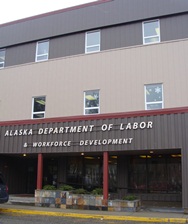
State Dept. of Labor building in Juneau. Photo by Casey Kelly/KTOO.
Earlier this year, it appeared the Parnell administration wanted out of the Plywood Palace. After mediated lease negotiations with the building’s owners – Juneau I, LLC – broke down, the state decided to seek new office space for the Labor Department’s 300 plus employees in Juneau.

But Chief Procurement Officer Vern Jones says the state only received four proposals. A committee reviewed them, and Juneau I successfully bid to keep 260 employees at the current facility. Mendenhall Mall owners, Salmon Creek, LLC, won the bid to house about 78 employees.

Jones says the Labor building will need significant work to meet minimum state standards.

“My understanding is that the building doesn’t meet the natural light requirements, so there’s going to have to be more windows,” says Jones. “The air handling and heating and ventilation system would have to be certified and my understanding is that would need to be replaced.”

In addition, carpets and other surfaces will need to be re-done, and Jones says the owners must prove there’s no mold in the building.

“Before we would sign off, you know, after the improvements are made, there would have to be competent professionals certifying that there isn’t any mold there,” Jones says.

The building’s owners did some repairs and mold remediation before the state pulled out of lease talks in March. Jones estimates the remaining work could take several months, during which time employees would continue to work at the building.

Kim Metcalfe is a Business Agent for the Alaska State Employees Association, which represents many Labor Department workers. She questions why the administration wants to keep leasing the facility considering its history of problems.

“We’ve been through this before,” says Metcalfe. “There was water damage. There were constant floods in the building for a number of years. And of course, that doesn’t help with the mold issue. They finally decided that they had to do some residing, and replace some windows. And our employees that are in the building were even more affected by the dust and debris from the upgrades.”

Metcalfe says many employees report headaches and cold or allergy-like symptoms when they’re in the building. She criticizes the administration for pulling support for a new state office building sought by Juneau’s legislative delegation.

“We need a safe place to house our employees,” she says.

Jones says a new building remains an option. That’s why the state included a shorter lease term in its request for proposals.

“It’s a five-year initial term, with five two-year options at the state’s discretion,” Jones says. “So, all we’re obligated for is initially five years. And that relatively short period was to allow for the possibility of a new building.”

Jones says the Mendenhall Mall space also needs significant upgrades.

Right now, the state has only issued a “notice of intent to award.” That triggers a 10-day “protest period,” during which other bidders can object. Jones says that will be followed by a negotiation period of a couple weeks before a final notice of award can be issued.

OCS grievance system “flawed,” state ombudsman says

The Alaska Office of Children’s Services’ grievance process fails to fairly and adequately respond to citizen complaints.

That’s the finding of an eight-month investigation by the state Ombudsman’s office, which resulted in a 94-page report released today (Monday). The report recommends a complete overhaul of OCS agency regulations governing grievances.

KTOO’s Casey Kelly has more.

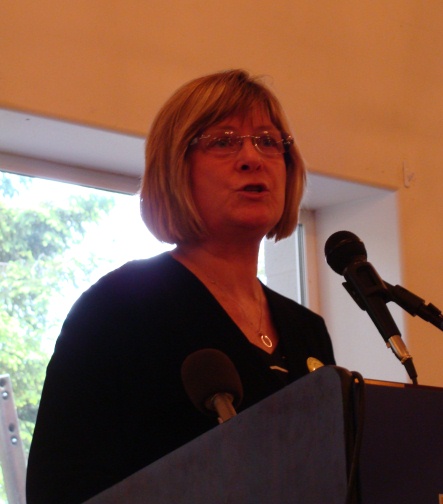
Alaska Ombudsman Linda Lord-Jenkins says her office rarely initiates an investigation. Instead, it usually responds to specific complaints lodged against state agencies or employees. But Lord-Jenkins says the number of complaints filed against the Office of Children’s Services in recent years led the ombudsman’s office to take a closer look at the agency’s grievance process.

“In this case we believed that there was a fatally flawed complaint system at Children’s Services,” Lord-Jenkins says.

Ombudsman’s office investigators spent eight months talking to OCS employees and citizens who’d complained about the agency. They found inconsistent and erratic responses to grievances.

“People would file grievances. They could prove to us that they had filed grievances, and they just never got responses, or the grievance was lost,” says Lord-Jenkins.

In her report, Lord-Jenkins places blame on OCS regulations, which she says are just as confusing to department caseworkers as they are to citizens. A grievance filed with OCS can end up in one of two venues. In some instances, an administrative law judge will hear the case, and present a decision to the Department of Health and Social Services Commissioner for action. In other cases, the facts are heard by a regional review panel, which can only issue non-binding recommendations. In either case, the OCS Director isn’t required to be notified.

“So there are a lot of structural problems that just create other problems for individuals who are seeking to enforce their legal rights,” Lord-Jenkins says.

Part of the problem is that OCS and the Division of Juvenile Justice used to be under the same umbrella at the Department of Health and Social Services. While both remain part of DHS&S, the two agencies have been separate for about 10 years. But OCS still uses the same regulations.

Lord-Jenkins recommends severing ties between OCS and Juvenile Justice, and completely rewriting regulations governing the OCS grievance process.

“We have recommended that they make these regs as simple and clear as possible,” says Lord-Jenkins. “That they not include one single word that isn’t necessary; that they make them understandable so that all OCS employees understand them and are aware of them; and so that all citizens who might want to use the grievance process can understand them.”

OCS Director Christy Lawton says agency employees were aware of the problems before the ombudsman’s investigation. She hopes to have new grievance regulations in place by early next year, and says the report provides a good starting point.

“It’s been an area that we have struggled with and have known we needed to work on. But frankly just didn’t have the staff time or resources,” says Lawton. “So the depth to which they really went through it and mapped out all the regulations and even gave us potentially language we can use to draft new regulations, it was very helpful, and I anticipate that we will be using a lot of that.”

The regulations in question are administrative and do not have to be approved by the legislature. However, they will be reviewed by the Department of Law and available for public comment before taking effect.

OCS is the state’s child protection agency, which can take custody of children if staff finds the parents are neglectful or abusive.

The ombudsman’s office is an independent state agency, though for funding purposes it’s considered part of the Alaska Legislature.

Link:
State ombudsman’s report on OCS grievance process [PDF]

Juneau Chamber sponsors coastal management debate

Two former employees of the Alaska Coastal Management Program debated in front of a packed house at the Juneau Chamber of Commerce today (Thursday). At issue – a measure on the August primary ballot that would re-establish the federally funded program, which gives the state oversight of permitting activities along its coastline.

KTOO’s Casey Kelly has more.

Former state Commissioner of Environmental Conservation Kurt Fredriksson co-chairs the recently formed “Vote No on 2” campaign. But he made it clear he’s not against the state asserting its influence over coastal development.

Kurt Fredriksson
Kurt Fredriksson (Photo by Casey Kelly/KTOO)

“Whether it’s called Coastal Management or some other form, clearly I believe Alaska needs a stronger voice in federal decision making,” said Fredriksson, holding up a piece of paper on which he’d written a wish list of what he’d like to see in a coastal management program. The list included many of the same ideas talked about by his debate opponent, Juneau Representative Beth Kerttula.

But Fredriksson said he finds Ballot Measure 2 problematic – namely, the measure would establish a Coastal Policy Board that does not include anyone from the governor’s office, and the board’s other representatives would no longer be elected officials from coastal regions.

“In the past I worked on the Alaska Coastal Policy Council. I was a member. I was a staff member to it. I had a lot of experience with the Coastal Policy Board,” said Fredriksson. “One of the beauties of that board is it was locally elected officials. Locally elected officials sat on that board and they were accountable to the citizens of their communities.”

Kerttula – a coastal management attorney before becoming a lawmaker – countered that members of the board would be nominated by elected officials in their communities, and the governor would ultimately make the appointments. Plus, she said policy board would include four commissioners.

“How it works is, the commissioners will meet with the governor. They’ll be talking to this governor before they make a decision. So, the governor’s voice will be heard,” said Kerttula. “But it will work in a way that Alaskans can come together for the final resolution on development.”

Beth Kerttula
Beth Kerttula (Photo by Casey Kelly/KTOO)

Kerttula said that’s the idea Congress had when it passed the Coastal Zone Management Act in 1972. The act allowed states to coordinate federal and local permitting activities for projects along their coastlines. It also provided a funding mechanism for them to do so.

Alaska had a program in place from 1979 until last year. Then Democrats and rural lawmakers sought changes giving local communities a stronger voice. But they ran into opposition from Governor Sean Parnell and some House Republicans. The two sides were unable to reach an agreement on the changes and lawmakers failed to reauthorize the program.

Kerttula said the absence of coastal management has hurt Alaska residents and businesses.

“The entire North Slope was developed under Coastal Zone Management,” said Kerttula. “The Kensington Mine, here at home, was developed under Coastal Zone Management.”

But Fredriksson argued the initiative starts from scratch when it comes to coastal policy. He said that’s counterintuitive to the goal of giving Alaska a stronger voice.

“What I do think the initiative will do, because it’s so poorly written as to leave many questions unanswered, is it’s going to lead to delay and potential litigation,” he said.

In response, Kerttula said the initiative sets up a framework for developing a strong coastal policy.

“Coastal Management is a process. It’s a tool,” she said. “It’s a way to bring people together, to give them a seat at the table, to decide up front how development goes forward.”

Voters will decide whether Ballot Measure 2 ultimately becomes law. The initiative is on the August 28th primary ballot. Both Kerttula and Fredriksson urged the audience to read the measure and past versions of the Alaska Coastal Management Program before the election.

More people running for the Alaska Legislature

More Alaskans are filing to run for the state Legislature as the deadline approaches.

As of this morning, only a quarter of the races remained without a challenger. That number was close to half earlier this week, and about a third Thursday.

The filing deadline for the August 28th primary is 5 p.m. today (June 1st).

All 40 House seats are on the ballot, as they always are. Nineteen of 20 Senate seats are also up for grabs.

Only 10 Senate seats are usually on the ballot. But redistricting changed boundaries enough to require all but one go before voters. That one is Juneau’s Senate district.

Retired University of Alaska political science professor Clive Thomas says those new boundaries may be a factor in unchallenged seats.

“It might have put off some people. I think that basically, the way redistricting works, it’s a political process, whatever people may say,” Thomas says.

Unopposed state Senators are Wasilla Republican Charlie Huggins, Eagle River Republican Fred Dyson, Anchorage Democrat Johnny Ellis, Kenai Republican Tom Wagoner, Bethel Democrat Lyman Hoffman, and Kodiak Republican Gary Stevens.

Unopposed Anchorage House candidates are Democrat Andy Josephson and Republicans Bob Lynn and Mike Hawker. Those from Juneau are Republican Cathy Muñoz and Democrat Beth Kerttula.

Also unopposed: Nikiski Republican Mike Chenault, Haines Republican Bill Thomas, Kodiak Republican Alan Austerman and Bethel Democrat Bob Herron.

Link to the official candidate list.

Candidate filing deadline looms

State elections director Gail Fenumiai says filing has been steady since the May 22 Supreme Court decision adopting an election district plan to be used for the 2012 elections.

“Because I think folks then realized that they have a solid answer to what district should they file for, so that’s invoked a lot of people to run for office,” Fenumiai says.

The court ordered the Redistricting Board’s April 5th maps be used for the elections. The plan puts Petersburg, Skagway and downtown Juneau in the same House and Senate district. (House District 32 and Senate District P).

Fenumiai says political party members must submit notarized declaration of candidacy forms by 5 p.m. Friday. Unaffiliated candidates have to submit a notice that they intend to run for office, and have until the August 28th primary to gather petition signatures.

Meanwhile, Lieutenant Governor Mead Treadwell Thursday signed regulations adopting the new precinct boundaries.

Click here for precinct boundaries and maps.

Many legislative races remain unchallenged

With the filing period nearly over, more than a third of the legislative seats on this year’s ballot remain unchallenged. Candidates have until 5 p.m. Friday (June 1) to submit their paperwork to the state Division of Elections.

Fifty-nine seats – 40 in the House and 19 in the Senate –are up for grabs in the August primary and November general election. It’s a larger-than-usual number because reapportionment requires elections in all but one district.

But so far, the state elections website shows only 37 races with more than one candidate. The other 22 seats are unchallenged, meaning the person running will almost certainly win. (See the list of filed candidates on the state elections website.)

Retired Juneau lawmaker Mike Miller says the small number of candidates is surprising. He says it wasn’t that way in the past.

Miller served 16 years in the state House during the 1970’s and 80’s. That means he won eight elections.

“Maybe politicians just have a bad name these days and people don’t want to do it. Although I can’t imagine that, because in Alaska, I’ve always been proud to serve with members of both parties,” Miller says.

The single-candidate contests are spread throughout the state. Eight of 19 Senate seats are unchallenged. So are 14 of 40 House races.

Candidate numbers have grown since earlier this week, when almost half of the races were unchallenged.

Three of Southeast’s four House districts have only one person on the ballot.

The region’s sole Senate race has two candidates running. Its second Senate seat is not on the ballot because it saw few redistricting changes.

Most of the open seats are held by incumbents, and many have a strong hold on their districts.

“The seats that are pretty safe, people just don’t contest them because it costs money, although not a lot of money in Alaska, compared to a place like California or even a place like Indiana,” says Clive Thomas, a retired University of Alaska Southeast political science professor.

The author of an Alaska politics and policy book says plenty of earlier elections have seen uncontested races.

“I guess it’s hard to round up somebody because campaigning takes a lot of energy out of somebody, and I guess there’s the big deflation when you lose,” Thomas says.

Republicans make up the majority of single-candidate races. They have 15 uncontested seats, while Democrats have only 7.

Thomas wonders whether people feel much need to challenge incumbents.

“Most people in Alaska I would figure are very satisfied. There’s a lot of money around in Alaska. We’re one of the very few states … that hasn’t cut its budget. Those people who follow California or read about it … will notice it’s going through amazing problems. In Alaska, we have large capital budget this year. Alaska’s in the chips, you might say, and that may affect the way that people may feel about challenging or not challenging,” he says.

Some of the challenged candidates face no opposition in the August party primaries. They’ll face off with another party’s nominee in the November general election.

Unchallenged Southeast races are in districts held by Haines Republican Bill Thomas, Juneau Republican Cathy Munoz and Juneau Democrat Beth Kerttula. All now serve in the House of Representatives.

Two incumbents, Angoon Democrat Albert Kookesh and Sitka Republican Bert Stedman, are running for the lone Southeast Senate seat on the ballot. Juneau Democratic Senator Dennis Egan does not have to run this year.

Site notifications
Update notification options
Subscribe to notifications