State Government

Dunleavy says he plans to roll out fiscal plan ahead of Alaska lawmakers’ return to Juneau

Gov. Mike Dunleavy greets a visitor to his final holiday open house as governor on Dec. 9, 2025.
Gov. Mike Dunleavy greets a visitor to his final holiday open house as governor on Dec. 9, 2025. (Eric Stone | Alaska Public Media)

Gov. Mike Dunleavy says he will roll out a new plan to stabilize Alaska’s tumultuous state finances in the coming weeks ahead of next month’s legislative session. The upcoming session provides Dunleavy his last chance to address an issue that has vexed his seven years in office.

“(The) next three, four, five years are going to be tough,” Dunleavy told reporters Tuesday ahead of his annual holiday open house. “We’re going to have to make some tough decisions, and that’s why we will roll out, in a fiscal plan, solutions for the next five years.”

The state’s fiscal issues are structural. Since oil prices collapsed in the mid-2010s, Alaska has spent more money than it has taken in despite years of aggressive cost-cutting and a 2018 move to tap Permanent Fund earnings to fund state services.

Dunleavy said a boom in oil and gas drilling and growing interest in a natural gas pipeline from the North Slope to an export terminal will likely ease the fiscal pressure in the coming years. He said his plan would serve as a bridge.

“I think the next five years, we’re going to have to be real careful, and we’re going to have to have in place things that will pay for government,” he said.

Dunleavy, a Republican, declined to reveal even the broad strokes of his plan, saying he plans to hold news conferences in the coming weeks to discuss it.

Prior efforts by Dunleavy and the Legislature to come to an agreement on a long-term fiscal plan have failed.

Dunleavy’s early plans for deep cuts led to an effort to recall him. He has also backed attempts to cap state spending and constitutionalize the Permanent Fund dividend.

A prior Dunleavy revenue commissioner floated a few tax proposals during talks with a legislative committee in 2021, but Dunleavy has since distanced himself from those ideas. Alaska is one of two states with no state-level sales or income tax, and asked directly whether his plan would include a sales tax, he declined to say.

“You’re just going to have to just wait a couple more weeks, and we’ll have that entire fiscal plan laid out, so you guys can take a look at it, and the people of Alaska can take a look at it,” he said.

In recent years, Dunleavy has proposed budgets with large deficits that require spending from savings. His most recent budget would have drained about half of the savings in the state’s $3 billion rainy-day fund, the Constitutional Budget Reserve, or CBR.

Still, Dunleavy says he wants to find a sustainable fiscal path forward for the state.

“We are determined to help solve this longstanding issue of, how do you deal with balancing the budget, and not just on the backs of the PFD or the CBR — what other methods are we going to employ to be able to do that?” he said.

Whether lawmakers will be receptive is an open question. Democrat-heavy bipartisan coalitions control both the state House and Senate, and even some minority Republicans crossed over to override Dunleavy’s vetoes repeatedly this year.

Dunleavy’s budget proposal is likely to offer some clues about the governor’s fiscal plan. He has until Dec. 15 to unveil it.

Correction: An earlier version of this story misstated that Alaska was the only state with no state-level income or sales tax. In fact, as of 2025, it is one of two. New Hampshire recently did away with its interest and dividends tax, a type of income tax.

State senators express skepticism about proposed Juneau ferry terminal backed by Dunleavy

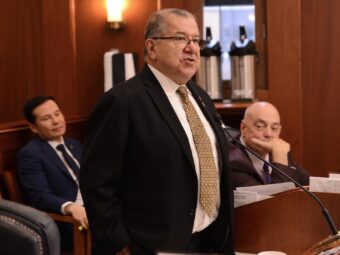
Sen. Jesse Bjorkman, R-Nikiski, speaks Wednesday, April 23, 2025, on the floor of the Alaska Senate.
Sen. Jesse Bjorkman, R-Nikiski, speaks Wednesday, April 23, 2025, on the floor of the Alaska Senate. (James Brooks/Alaska Beacon)

In a Friday hearing, members of the Alaska Senate spoke critically about a proposed new ferry terminal in Juneau, questioning why the project would be worth its multimillion-dollar cost.

Earlier this year, state legislators planned to divert $62 million from a variety of transportation projects in order to pay for the state share of federal transportation grants worth between $500 million and $600 million.

Lawmakers included the diversion in their budget for the year, but Dunleavy vetoed the maneuversaying that the “funding is either still obligated in the original project or has been fully expended and is unavailable for reappropriation.”

That left legislators’ spending plan partially unfunded.

One of lawmakers’ biggest targets this past spring was DOT’s plan to build a new ferry terminal in Juneau, roughly 30 miles north of the existing terminal in Auke Bay, at a place called Cascade Point, which would shorten ferry runs to Haines and Skagway.

Legislators sought to divert $37 million from an account intended to fund that new terminal, but Dunleavy vetoed the transfer and the Department of Transportation subsequently signed a $28.5 million contract for work on the terminal.

In October, the state’s ferry advisory board concluded that the project likely did not make economic sense.

“Do you agree with that study?” asked Sen. Jesse Bjorkman, R-Nikiski, during Friday’s hearing of the Senate Transportation Committee.

“Can you please make the case to the Alaska people why you think investing this money … in the Cascade Point project makes fiscal sense for Alaskans?”

Ryan Anderson, commissioner of the Alaska Department of Transportation and Public Facilities, responded that “as a public agency, we’re more than economics. In this case, there’s this idea of saving people time with a much shorter run, saving money, the cost of operating that ship, we’re saving fuel. It’s less carbon emissions. I mean, there’s a lot of good benefits to shorter ferry runs.”

Lawmakers didn’t have the votes to override the governor’s vetoes, which means that when they reconvene in January, they’ll have to come up with a new way to fund construction work this summer.

According to documents presented to the committee on Friday, the Alaska Department of Transportation has “deferred” about 25 projects 1-3 years “to remain within available match.”

Without new money, “fewer projects will move to contract award, limiting construction activity.”

Anderson told the transportation committee that his agency is prioritizing “shovel ready” projects, those that are about to go to construction.

“As we go and prioritize projects through this year, we’ll continue that action, and we’ll be ready. That’s really how we’re looking at this program,” he said.

Alaska settles 2 lawsuits against vape companies for allegedly targeting kids for addiction

A person using a Juul vape.
A person using a Juul vape. (Joey Mendolia/Alaska Public Media)

The state of Alaska has settled lawsuits against Juul and Altria, two nicotine vapor manufacturers, for a combined $7.8 million, the state Department of Law said on Friday.

The suits were part of a nationwide pattern: Alaska and other U.S. states had alleged that the companies deliberately targeted children with advertising, something that likely contributed to a surge in nicotine use among children and young adults.

Altria settled Alaska’s lawsuit for $2 million last year, and the state announced a $5.8 million consent judgment with Juul on Friday.

Under the settlements, neither Juul nor Altria must admit fault, but both must abide by marketing restrictions. One key point in the settlement: Juul can’t use cartoons to advertise its products.

“This case took five years and a great deal of work from our public health and consumer protection teams, but it was worth it,” said Alaska Attorney General Stephen Cox, in a prepared statement.

“We now have strong court-enforceable limits on how these companies can operate in Alaska, and we’ve obtained a per-capita recovery that ranks near the top nationally, with those dollars going straight into prevention and consumer protection.”

Alaska was one of the last states in the country to settle with Juul, which has already paid more than $1 billion to states across the country.

Some states have since filed additional lawsuits against vape distributors, alleging that they contributed to a surge in nicotine vapor use among children and young adults.

Money from Alaska’s Juul settlement is to be paid over the next five years.

Under the financial terms of the consent judgment, half of the proceeds would be used to fund tobacco control and prevention programs, and the other half would go to the Department of Law’s consumer protection program.

Typically, the spending of money earned in financial judgments must be approved by the Alaska Legislature before becoming official.

“The use of vapes and other nicotine products among youth in Alaska remains a concern,” said Alaska Department of Health Commissioner Heidi Hedberg in a prepared statement. “This funding will help families and communities continue to access education, prevention, and cessation programs.”

What was on Alaska state lawmakers’ playlists this year?

From right, Alaska Rep. Genevieve Mina, D-Anchorage, Sen. Mike Cronk, R-Tok, and Rep. Ashley Carrick, D-Fairbanks.

It’s that season: time for snow, holiday shopping and, of course, end-of-year top 10 lists. Last week, Spotify’s Wrapped and Apple Music’s Replay gave users their top songs, artists and genres of the year.

That got us wondering — what did state lawmakers have on their playlist this year? We asked a few.

Rep. Genevieve Mina, D-Anchorage: Feminine angst and ennui

For some people — maybe, a lot of people — music is one of those things that helps you get in touch with what you’re feeling. At least, that’s what Democratic Anchorage state Rep. Genevieve Mina said she got out of the more than 19,000 minutes she spent listening to Spotify this year.

“I guess my relationship with music is, being able to just tap into emotions that I love, to feel and to process,” Mina said. “I think that’s important, especially, you know, in a role where you have to present yourself in a specific way.”

At the top of Mina’s list is the song “Juna” by Clairo — a little indie pop with some R&B undertones. She said she loves the way the song swells in the middle.


“I definitely put that album on repeat a lot at the beginning of the year,” she said. “I mean, all of the songs are just like, they’re very romantic. They’re very lovey-dovey. And so it’s just, like, a good, easy listening album.”

Looking back at her top songs and artists of the year — Adrianne Lenker, Clairo, some of the more introspective Charli XCX songs — Mina said something of a theme emerged.

“It’s a bit of, I’m about to turn 30, feminine angst and ennui,” she said.

Sen. Mike Cronk, R-Tok: Comforting classics

For Tok Republican Sen. Mike Cronk, what Spotify calls “honky tonk” and “southern rock” were at the top of his Spotify Wrapped. He said he listens to all kinds of music but consistently returns to some familiar favorites.

“A lot of, like, the Eagles’ greatest hits, Bob Seger’s greatest hits,” Cronk said. “I guess it’s kind of soothing, in a way.”

He said the music he listened to the most this year calls back fond memories — like time at the family cabin after a long day tending traps.

“We had, like, four cassette tapes,” he said. “The Eagles’ Greatest Hits was one and Alabama was one.”

Grunge also makes an appearance on Cronk’s list. Chris Cornell, the late vocalist of Soundgarden and Audioslave, had two songs in Cronk’s top 5 — a cover of Prince’s “Nothing Compares 2 U” took the top spot.

Rep. Ashley Carrick, D-Fairbanks: Whimsical pump-ups

There’s a bit of that in the Fairbanks Democratic Rep. Ashley Carrick’s playlist. There are some familiar millennial anthems — you know, some Neon Trees, a little Florence and the Machine, Lady Gaga, Kesha — but also some newer songs, like “Yes, I’m A Mess” by the band AJR.

“There’s just like, this note of whimsy in these otherwise pretty serious, kind of power-you-up kind of songs,” she said.


Perfect, she said, for going to the gym, walking into work, and starting the day.

“I’m a huge fan of, like, turning my volume up all the way and going outside and just running,” she said. “You do that for 20 minutes to an hour, and you feel like a different person. And I just love that music lets me do that.”

This reporter: Danger Zone

I suppose, it’s only fair that at this point I share my own top song of the year — the Kenny Loggins classic “Danger Zone.” You know, the one from Top Gun.

It’s not because I’m really into the ’80s. I just flew a lot this year.

Stay with me: If you press “play” right as the engines on a 737 power up for takeoff, you leave the ground right around the time the chorus hits. You know, just like in Top Gun.


It’s a little moment — on every takeoff — that reminds me exactly how cool it is that humans can fly. And this year, I flew enough to push Loggins above Kendrick Lamar, Dua Lipa and Lake Street Dive on my Apple Music Replay.

What that says about me, that’s up to you.

Mat-Su Republicans suggest six candidates for two spots in Alaska House of Representatives

The Alaska State Capitol is seen on Tuesday, Nov. 25, 2025. (Photo by James Brooks/Alaska Beacon)

Republican officials in the Matanuska-Susitna Borough have proposed a field of six conservative Alaskans for two vacant seats in the Alaska House of Representatives.

On Sunday, local Republican Party officials delivered their suggestions to replace Cathy Tilton and George Rauscher, whom Gov. Mike Dunleavy appointed to fill two vacancies in the Alaska Senate.

Those Senate vacancies occurred when Sen. Mike Shower, R-Wasilla, resigned to run for lieutenant governor and Sen. Shelley Hughes, R-Palmer, resigned to run for governor.

To replace Tilton, the Republican leaders of House District 26 nominated Chickaloon tribal police chief Donna Anthony, veterinarian Sean McPeck, and a former Tilton aide, Steve St. Clair.

AnthonyMcPeck and St. Clair have each filed to run for the seat in next year’s elections.

For Rauscher’s former seat, Republican leaders for House District 29 picked Chikaloon tribal police officer Lucas Howard, local community council member Gerald Garret Nelson, and former police officer John James.

Nelson had previously filed a letter of intent to run for the seat next year.

The nominations are advisory only; Dunleavy may pick anyone who is a Republican, lives in the appropriate district and meets the constitutional requirements for state House.

Under state law, the governor has until Dec. 29 to make his picks. Anyone he chooses must be approved by a majority of the House’s 21 Republicans in order to be seated.

The governor is expected to act well before the deadline in order to allow time for that confirmation vote and for the new legislators to hire staff and prepare to move to Juneau for the five-month regular legislative session, which begins Jan. 20.

House Minority Leader DeLena Johnson, R-Palmer, is in charge of the House’s all-Republican minority caucus.

Through a spokesperson, Johnson said the timing of a confirmation vote is dependent upon the governor, but that she is tentatively planning a vote for the upcoming weekend.

Child support comes first when considering debts owed in foreclosure, Alaska Supreme Court rules

Students swing on a playground at Meadow Lakes Head Start in Wasilla, Alaska. It closed in 2024 due to funding and staffing challenges.
Students swing on a playground at Meadow Lakes Head Start in Wasilla, Alaska. It closed in 2024 due to funding and staffing challenges. (Lela Seiler | CCS Early Learning)

The Alaska Supreme Court has ruled that the state’s child support system has first priority when a foreclosed property is sold to pay multiple debts.

The court issued its opinion on Nov. 28, resolving a long-running lawsuit brought by Global Federal Credit Union (formerly Alaska USA) against the state and several other defendants.

“This is a pretty important case from my client’s perspective,” said Jonathan Clement, a senior assistant attorney general who represented Alaska’s child support system.

“This is the first time that a court has actually decided that child support gets priority over all other judgment lien holders, even liens recorded earlier, when there’s surplus funds at issue,” he said.

The case decided by the court involved property in Eagle River that was mortgaged by Wells Fargo. In 2017, Global levied a lien against the property for unpaid debt. Shortly afterward, the state’s child support division recorded another lien against the property for unpaid debt.

Typically, liens are repaid in chronological order: First filed, first paid.

In 2018, a law firm sold the property through foreclosure and paid off the remaining Wells Fargo mortgage. There was money left over, but not enough to pay both Global and the state.

The state protested the law firm’s plans to pay Global first, and the firm complied with a state order that required it to pay the state first.

Global sued in state court, but a district court judge and a superior court judge each ruled against the credit union before it appealed to the supreme court.

Writing on behalf of the court, Justice Jude Pate concluded, “Our interpretation of (state law) provides an effective priority for CSSD liens over competing judgment liens.”

Alaska’s Child Support Services Division (CSSD) is now known as the Child Support Enforcement Division (CSCD).

That priority doesn’t put the state above a bank holding a mortgage or “deed of trust” but it does give the state priority over other liens on the property.

“The important thing for this case is that it gives CSCD another tool where they can try to collect money that’s owed by the obligors,” Clement said.

“I would say of all the cases I’ve worked on, this is the one that will have the most impact in my career going forward,” he said.

An attorney representing Global declined comment on behalf of the credit union.

In a footnote attached to the case, Pate wrote that the court’s ruling could cause people to behave differently during foreclosure auctions.

He suggested that if the Legislature disagrees with the court’s interpretation, it might want to pass a law clarifying two conflicting statutes interpreted by the court.

“If our interpretation is contrary to the legislature’s intent,” he wrote, “amendments to the relevant child support statutes could clarify the interaction between child support liens, other liens, and mortgages.”

Site notifications
Update notification options
Subscribe to notifications