State Government

Alaska studies building a ferry terminal at Hyder to connect to the road system

Hyder is marked in red, located about 70 miles up the Portland Canal.

The state of Alaska is considering opening up a new ferry terminal in Southeast Alaska, connecting Alaska’s ferries to the Lower 48 road system without going through Canada.

The idea comes as Alaska continues to struggle with the closure of the ferry terminal at Prince Rupert, British Columbia. Now, the state is conducting a $250,000 study to see if a terminal on Alaska’s side of the border would be a good replacement.

For decades, the Alaska Marine Highway System relied on a terminal at Prince Rupert as its southern road connection. The state has leased the terminal from Canada since 2013, but it’s been closed for most of the past six years. There are numerous complications, like infrastructure challenges and disagreements with Canada over border control responsibilities. The dock needs over $20 million in repairs, and Alaska’s aging fleet isn’t certified for international travel anymore.

Jim Clark spoke about it at a regional development meeting in Ketchikan last year. He’s the former chief of staff for Governor Frank Murkowski, who worked on the ferry system for decades.

“If we can put a man on the moon, we ought to be able to solve the problem between here and 90 miles away at Prince Rupert,” Clark said.

Prince Rupert’s closed terminal has been a hot topic in many southern Southeast meetings. Some, like Robert Venables of the Southeast Conference, say they’re not ready to give up on Prince Rupert.

“It’s going to take everyone to lean into this thing,” Venables said. “It is problematic at the highest levels of bureaucracies to try to get back to Prince Rupert. But we’re going to give it our best, best push, and we’re going to keep pushing until it happens.”

The Prince Rupert connection isn’t completely off the table. But Alaska would need a federal waiver to bypass a requirement that steel materials for repairs be American-made. The state has requested this waiver in recent years without success. Canadian officials have opposed the requirement because the terminal is on Canadian soil.

And so, the state’s Department of Transportation has considered Hyder, Alaska — about 90 miles from Ketchikan — as an alternative.

“Fortunately, we have a lot of data for this site,” said Kirk Miller, an engineer with the state’s Department of Transportation, last year. “We’ve done engineering up and down this whole Causeway, the island, I’ve been working on their harbor and all these projects there for years. So, we have data, but not quite enough.”

This October, a new feasibility study began and is expected to be completed in mid-2026. The study is looking at all the details, like where a dock would go, the water depths, dredging, and environmental concerns.

It’s estimated the new terminal would cost about $30 million. It’s located about the same distance to Seattle as Prince Rupert – about 1,000 road miles. Prince Rupert is much larger than Hyder and has more amenities, but Hyder would be under Alaska’s control.

“I just want to really voice my support for Hyder,” said Bob Horchover, speaking in July as a member of the Alaska Marine Highway Operations Board, which makes recommendations to the state.

“In Hyder, we own the land, and most of the work is already done,” he said. “It’s a very adaptable situation. So, for me, there isn’t even a discussion.”

The state approved a 20-year ferry plan this year, based, in part, on a survey of over 2,500 Alaskans. Many respondents said restoring a road connection in Southeast was a priority.

Local governments agree. The Ketchikan Gateway Borough passed a resolution supporting a Hyder terminal if Prince Rupert doesn’t work out. Nearby Metlakatla feels the same. Mayor Albert Smith said that the lack of a Prince Rupert connection has hurt his town’s economy.

“With fishing, the rail system is real close to Rupert, so we could use the ferry to transport fish, and then it’s connected right to the 48s,” Smith said. “It’s a more efficient way than other ways of shipping.”

At least one Alaska lawmaker is on board: Republican Representative Jeremy Bynum of Ketchikan.

“I’m going to be a fierce fighter here on the legislative side and make sure we can get the funding in place that we need,” he said.

Whether Alaska rebuilds the Prince Rupert connection or builds a new terminal at Hyder, officials say either option would take five to eight years to complete the necessary infrastructure work.

Alaska Senate Republicans pick Tok Sen. Mike Cronk as new minority leader

Tok Republican Sen. Mike Cronk speaks during a news conference on January 21, 2025.
Tok Republican Sen. Mike Cronk speaks during a news conference on January 21, 2025. (Eric Stone/Alaska Public Media)

Tok Republican Sen. Mike Cronk is the state Senate’s new minority leader. The six-member minority caucus in the state Legislature’s upper chamber announced Tuesday its members had elected Cronk to replace former Wasilla Republican Sen. Mike Shower, who resigned to run for lieutenant governor earlier this year.

Cronk is a former schoolteacher and construction worker who first joined the state House in 2021. Last year, he won a seat in the Senate representing a massive swath of Interior Alaska that includes Glennallen, Tok, southeast Fairbanks, Delta Junction and much of the Yukon River.

In a phone interview, Cronk said he was looking forward to working on a fiscal plan that Gov. Mike Dunleavy plans to unveil next month.

“Obviously, we are in the minority, but I’m hopeful to, you know, work with the majority, to — can we get some of these things solved?” Cronk said.

The caucus includes six of the 11 Republican members in the Senate. Five others caucus with Democrats in a bipartisan majority that controls the chamber.

Fairbanks Republican Sen. Robb Myers will remain minority whip, the caucus’s the second-in-command.

Cronk will lead a caucus with two new members after Gov. Mike Dunleavy picked two House Republicans, now-Sens. Cathy Tilton and George Rauscher, to replace Shower and former Sen. Shelley Hughes, who is running for governor. Cronk said he would keep his seat on the Senate Finance Committee, but he said the caucus is still finalizing other senators’ committee assignments.

Cronk’s elevation to minority leader follows a leadership shakeup in the House’s minority caucus. That means both minority caucuses will have new leaders when lawmakers return to Juneau next month.

Disaster aid deadlines extended into 2026 for those affected by Western Alaska storms

Alaska Organized Militia members, assigned to Task Force Bethel, survey Nightmute, Alaska, while conduct post-storm recovery efforts for Operation Halong Response at Oct. 27, 2025. (Courtesy photo by the Alaska National Guard)

The State of Alaska and the Federal Emergency Management Agency have extended their deadlines to apply for individual disaster assistance for those impacted by storms in Western Alaska, including Typhoon Halong.

How to apply for State of Alaska or FEMA individual assistance:

  • Online
  • Call the Alaska Call Center at 1-866-342-1699
  • Or visit an assistance hub set up in Bethel through Dec. 19.

State and federal officials are continuing to encourage residents to register for both state and federal assistance programs to maximize their potential benefits. The new deadline for applications is February 20, 2026.

“We know that there may be more people out there, and we want to give them this opportunity to register,” said Jeremy Zidek, a spokesperson for the Alaska Division of Homeland Security and Emergency Management.

Zidek urged residents to apply for both assistance programs if they have experienced any level of storm damage. He said registrations can be updated once they have been filed.

“We always say that if people are unsure about their damages or unsure if they want to apply, to just go ahead and apply,” he said. “They can always amend their application at a later date. But after those deadlines, it becomes very difficult for us to register people, so we really urge anyone that had damage, even if it was a little bit of damage, to apply and go through the process.”

The state has received 1,920 aid applications and FEMA has received 1,630 applications for assistance as of Dec. 10. The programs provide relief for damage to homes, damage to essential personal property and medical, dental or funeral needs directly related to the disaster. State disaster aid also includes assistance for damage to subsistence camps. The Small Business Administration is also providing low-interest loans, including up to $100,000 for repairs to subsistence camps.

The state and FEMA have distributed over $41 million in disaster assistance as of Nov. 25, and have visited 43 communities.

An estimated 1,160 residents evacuated from Western Alaska following Typhoon Halong, with dozens of communities sustaining damage across the region.

Since the evacuations, 678 residents have been staying in hotels in Anchorage. The first group of families began moving into longer term housing last week, according to a state update. The state’s emergency management division is working with local property owners and non-profit partners to locate apartments and housing units throughout Anchorage for long-term housing for storm displaced residents.

Officials also set a Dec. 15 deadline for owners to claim pets. Over 200 dogs were evacuated from Western Alaska after the storms, and 21 dogs remain unclaimed. Pet owners who have not yet claimed their dogs  can search for them at a website created by volunteers.

Federal disaster areas include:

    • The Northwest Arctic Borough
    • Lower Yukon Regional Education Attendance Area
  • Lower Kuskokwim Regional Education Attendance Area

State of Alaska disaster areas include:

  • North Slope Borough Northwest Arctic Borough
  • Yupiit Regional Education Attendance Area
  • Lower Kuskokwim Regional Education Attendance Area
  • Bering Straits Regional Education Attendance Area
  • Lower Yukon Regional Education Attendance Area
  • Kashunamiut Regional Education Attendance Area
  • Pribilof Islands Regional Education Attendance Area
Pollution response teams from U.S. Coast Guard Sector Western Alaska and U.S. Arctic conduct post-storm assessments in Kipnuk, Alaska, Oct. 22, 2025, after the community was impacted by severe flooding from Typhoon Halong. Personnel deployed to affected areas to identify pollution concerns and work with state, federal, and industry partners to conduct clean-up operations. (U.S. Coast Guard photo by Petty Officer 1st Class Shannon Kearney)

After veto overrides, Alaska Gov. Dunleavy drops push for major education reform

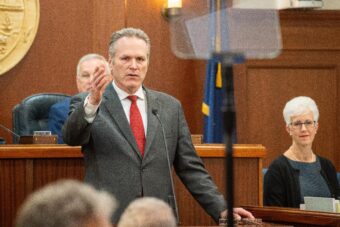
Gov. Mike Dunleavy speaks to reporters ahead of his annual holiday open house on Tuesday, Dec. 10, 2024 in Juneau.
Gov. Mike Dunleavy speaks to reporters ahead of his annual holiday open house on Tuesday, Dec. 10, 2024 in Juneau. (Eric Stone/Alaska Public Media)

Gov. Mike Dunleavy is dropping a longtime priority ahead of next year’s legislative session.

At his annual holiday open house on Dec. 9, the Republican governor told reporters he isn’t planning to revive his push to reform the state’s schools.

“I’ve always said this, for year after year after year, that once the issue of money is settled, nobody wants to talk about policy,” Dunleavy said. “So, unfortunately for us, I think we’re going to skip over that this year — not from my perspective, but I don’t think the Legislature enough for the people in the Legislature really have a desire to fix the outcomes.”

Improving the state’s public schools was the top issue in the last two legislative sessions. Dunleavy vetoed a series of bills seeking to boost public school funding, saying they didn’t do enough to improve student performance. He instead called for a variety of reforms that he said would help Alaska’s low test scores, in part by boosting charter schools and correspondence homeschool.

But lawmakers overcame Dunleavy’s vetoes to break the stalemate earlier this year.

Sitka independent Rep. Rebecca Himschoot co-chairs the state House Education Committee. She said lawmakers will continue to look at ways to boost students’ test scores — even with budgets expected to be tight this year.

“We need to ensure the best value for the dollar. Obviously, accountability is very important,” Himschoot said. “At the same time, we need to make sure that our kids have opportunities. And if we look to other states, there’s a lot going on in other states that we could be doing here in Alaska.”

She said she’d also like to see a smaller boost to public school funding this year to keep up with inflation.

Rep. Andi Story, a Juneau Democrat who also co-chairs the House Education Committee, said she wants lawmakers to override Dunleavy’s veto of a corporate tax bill tied to education funding.

“Those dollars are scheduled to go for reading intervention and career-tech, and that would just, to me, be a game changer,” Story said.

Backers pitched the tax bill as a way to extract more state money from Outside tech companies who sell to Alaskans. Dunleavy said he couldn’t support it without a larger fiscal plan.

The Senate Education Committee chair, Democratic Anchorage Sen. Loki Tobin, said she planned to introduce a constitutional amendment that would “codify the right for every child in Alaska to learn about Indigenous peoples and cultures.”

“With the largest Indigenous population in the United States, it is high time Alaska guarantee a robust public education rooted in Indigenous knowledge,” she said via email.

Dunleavy said he hoped lawmakers would pass a bill that would launch a pilot program for schools run by Alaska Native tribes. But Dunleavy told reporters his main goals for his final year are largely in other areas, including a forthcoming fiscal plan and preparation for a possible North Slope gas pipeline.

Lawmakers reconvene in Juneau on Jan. 20.

Report documents racial disparities in pandemic death rates in Alaska

A patient receives the COVID-19 vaccine.
A patient receives the COVID-19 vaccine. (Steven Cornfield/Unsplash)

About one in 500 Alaskans died of COVID-19 between 2020 and 2023. That’s according to an epidemiology bulletin the Alaska Department of Health released Dec. 9, which says there were substantial racial disparities in rates of COVID-19 hospitalization and mortality in the state.

Early in the pandemic, for instance, age-adjusted mortality rates in the state were about 3.6 times higher for Asian and Pacific Islander people compared to white people, according to the bulletin. The disparity during that period – from June 2020 to January 2021 – was greatest among American Indian and Alaska Native people, whose age-adjusted mortality rate was 5.5 times higher than that of white people.

“It matters because … at the end of the day, what we would like to get to is that there are no disparities based on race for the various disease processes and vulnerabilities that people may have,” said Jacoline Bergstrom, the executive director of health services for Tanana Chiefs Conference (TCC), a nonprofit tribal organization based in Fairbanks that aims to advance the health and social service needs of its 42 members, 37 of which are federally-recognized tribes.

Bergstrom read the state bulletin and said the results didn’t come as a surprise, since officials were tracking data during the pandemic. Other studies have also observed similar disparities nationally. But she said the report’s comprehensive look back at COVID-19 in Alaska makes it a useful resource.

“Because when we were in it, we were in it, right? And we were tracking real-time,” Bergstrom said.

The 33-page document splits the pandemic into seven distinct eras and reviews multiple topics, including the disparities, but also the spread of the virus, the state’s response, the efficacy of vaccines and gaps in pandemic preparedness.

The magnitude of the racial disparities for hospitalization and mortality rates in Alaska fluctuated in the different phases of COVID-19 analyzed in the bulletin. But it says that the disproportionate impacts “continued for the entirety of the pandemic in Alaska,” and concluded by saying more research is needed to grasp the underlying social and structural issues.

Bergstrom also said the causes behind the disparities are numerous and complex, but she said limited access to running water in some parts of Alaska is one example. That’s because it impacts people’s ability to take preventative measures, like hand-washing, she said.

According to the Alaska Division of Water, more than 3,300 homes in Alaska don’t have modern plumbing, and a study during the pandemic linked limited water resources with increased risk for COVID-19 in Alaska villages. Bergstrom said the new report offers more evidence that improving those resources would be a boon to public health.

“Just seeing this data … it’s another really important factor where we can show – and say, ‘Hey, we need to get water and sanitation to our rural communities,’ because we know, we’ve seen some of the impacts during the COVID-19 pandemic,” she said.

Through Megan Darrow, a state department of health spokesperson, the state section of epidemiology declined an interview request about the bulletin, saying emailed questions would be routed to the appropriate “subject matter experts.”

In a written response to questions, health officials wrote that the disparities in Alaska COVID-19 amplified pre-existing inequities, and that contributing factors likely include housing conditions, limited access to timely or speciality healthcare, and higher prevalence of underlying medical conditions associated with severe COVID-19.

The response also said that “[r]educing disparities in a future pandemic will require both long-term structural investments and strengthened public health systems,” including culturally grounded outreach, expanded access to care, modernized disease surveillance systems, as well as a clinical a public health workforce “capable of sustaining prolonged, high-intensity responses.”

Dunleavy’s proposed budget requires $1.5B from savings

Gov. Mike Dunleavy speaks direct-to-camera in a video published Dec. 11, 2025 discussing his budget proposal.
Gov. Mike Dunleavy speaks direct-to-camera in a video published Dec. 11, 2025 discussing his budget proposal. (Screenshot)

Gov. Mike Dunleavy unveiled his proposed state budget on Thursday — but this year, he skipped the usual press conference.

Instead, the governor released a short YouTube video and Facebook Reel outlining his plan.

“Here are the examples of the larger budget items proposed in this year’s budget,” Dunleavy read, “a full Permanent Fund dividend, as called for in law, full funding for K-12 schools and school transportation, continued funding for public safety.”

That full dividend would be roughly $3,600 per Alaskan. But it’s unlikely to materialize.

Dunleavy’s budget release sets the stage for months of debate in his final legislative session as governor. And lawmakers are already signaling concerns: the plan relies on drawing more than $1.5 billion from the state’s primary rainy-day fund, the Constitutional Budget Reserve — about half of Alaska’s remaining savings, and a deficit nearly identical to what the governor proposed last year.

This year, though, Dunleavy himself says the state’s persistent budget gap is untenable.

“Drawing down our savings is not a sustainable plan, nor is using your PFD year after year a sustainable plan,” he read in his video.

Since oil prices collapsed in the mid-2010s, Alaska has struggled to make ends meet. That’s despite efforts to slash government spending and the 2018 decision to use Permanent Fund earnings to fund state programs, like state troopers, jails and public schools.

Dunleavy says he’ll introduce his latest attempt at a plan to stabilize the state’s finances sometime next month. A required 10-year plan released alongside the budget includes about $1.6 billion in unspecified “New Revenue Measures” starting in mid-2027. His office declined to say what those would be, and also declined a request to interview the governor.

Sitka Sen. Bert Stedman, a Republican who co-chairs the powerful Senate Finance Committee, said he was skeptical Dunleavy could push through a fiscal plan in his last year in office.

“Quite frankly, he’s out of time,” Stedman said.

He said lawmakers tried to reduce the state’s budget deficit during this year’s session — but Dunleavy said no.

“We tried to take a couple of small steps to deal with some revenue enhancements or taxes, and then hold back the spending, and he vetoed the revenue measure,” Stedman said.

And Stedman said there’s not much left to cut when it comes to state services. So he’s skeptical Dunleavy will be able to push through a resolution to the decade-long issue during his final year in office.

Plus, he said the governor’s decision to again propose spending half the state’s savings on large Permanent Fund dividends is unwise with oil prices stubbornly low.

“If we would have followed his plan, after this year, we’d be completely broke,” Stedman said. “So it’s not acceptable, and we’re going to have to work through our process. And like I said, we need to veto that $1.5 billion dollar deficit.”

Stedman said he’d like to see a balanced budget, not a draw from savings. He said he does not want to see a Permanent Fund dividend smaller than this year’s $1,000 payout — but low oil prices will make that difficult to achieve.

“We’ve got to make payroll,” he said.

Rep. Andy Josephson, D-Anchorage, who co-chairs the House Finance Committee, isn’t quite as put off by the drawdown — but he said he wouldn’t use it to pay a large dividend.

“That isn’t how I would spend half of the CBR, right, for example, but I might still spend half the CBR,” he said.

He said he sees lots of needs around the state.

“The Municipality of Anchorage’s school district needs $75 million to maintain the status quo in funding of K through 12,” he said. “That’s where I would spend the money. That’s example one.”

Dunleavy’s proposed budget fully funds the state’s education funding formula, which lawmakers increased by $700 last year despite a veto from Dunleavy.

Josephson said he’d also like to see the state invest in capital projects and beef up things like the Division of Public Assistance.

Like Stedman, Josephson said he’s viewing the governor’s forthcoming fiscal plan with a skeptical eye.

“He told me and others, two years ago, he was filing a sales tax bill,” Josephson said. “He never did.”

Lawmakers return to the Capitol Jan. 20.

Site notifications
Update notification options
Subscribe to notifications