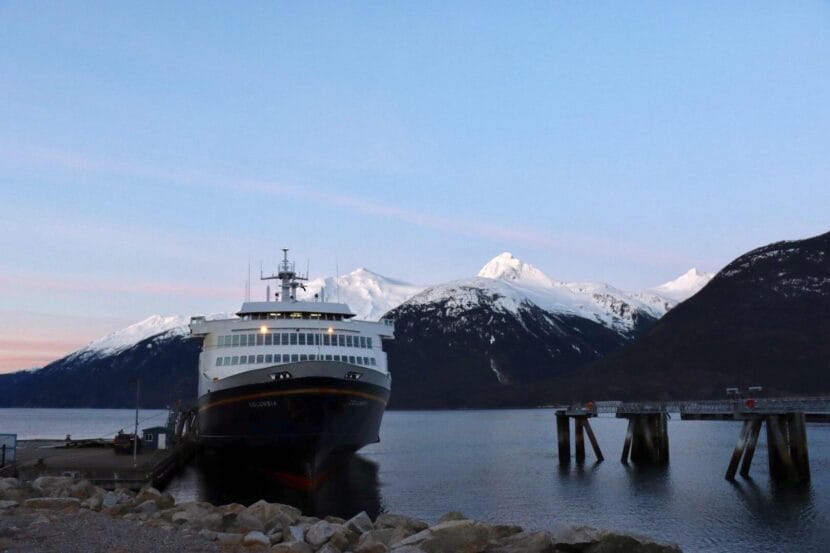
The Columbia, a mainliner in the Alaska Marine Highway System, docked in Skagway in early March, 2025. (Avery Ellfeldt/KHNS)
Travelers can now schedule ferry rides with the Alaska Marine Highway System for May through September. That’s after the summer schedule opened for booking Feb. 12.
The schedule looks a lot like recent years, with six of the state’s nine vessels sailing. There is not enough funding or staffing to run them all, said Shannon McCarthy, spokesperson for the state Department of Transportation.
“Our crew is relatively stable right now, but, you know, it’s not expanding rapidly,” McCarthy said. “Our budget is also a concern this year, so we will only be running one of the mainliners at any given time.”
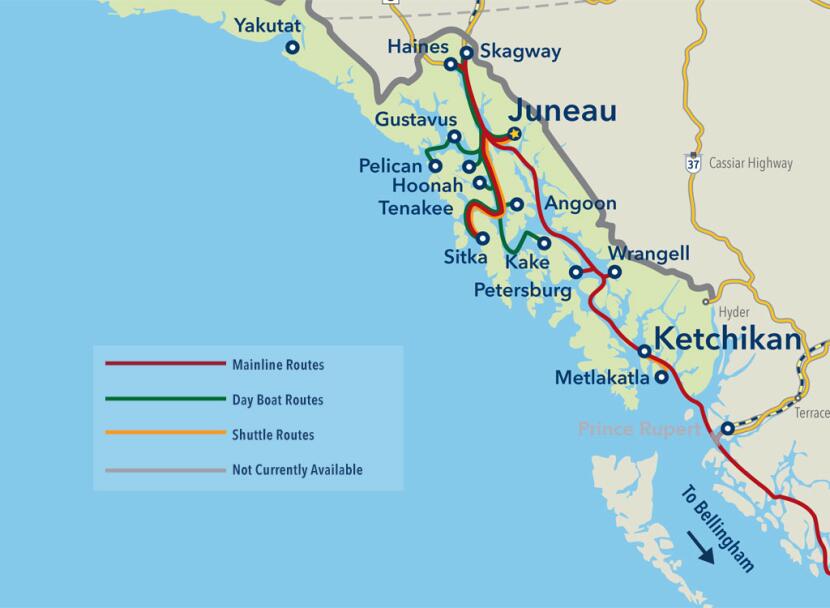
Only one mainliner – the Columbia – is scheduled to travel weekly through Southeast to Bellingham, Washington. That means a round trip every two weeks for most residents.
A map of the Alaska Marine Highway System’s routes in Southeast Alaska. (Alaska Dept. of Transportation and Public Facilities)
McCarthy said the Kennicott will be on standby in case the Columbia needs repairs.
“The nice thing is, it is much better to have two vessels — main liners — that are able to be sailed at any point,” she said. “It puts the state in a much better position.”
The Tustumena will sail the southwest region between Homer and the Aleutians. That’s roughly two round trips per week from Homer to Kodiak, and one full Aleutian Chain run per month.
The day boat, Leconte will sail Prince William Sound. And Lynn Canal will be similar to last year, with the Hubbard doing nearly daily runs between Juneau, Haines, and Skagway.
U.S. Senator Lisa Murkowski helped secure hundreds of millions in federal ferry funds over the last five years. But the state is now waiting on a key federal grant for this year. DOT Commissioner Ryan Anderson is scheduled to be in DC this week to talk to the Alaska Delegation about it.
“Because this money is still available — it was written into the law,” McCarthy said. “So, we’re just trying to figure that out, to see if there is some relief there.”
With ongoing funding issues, the state is considering selling the Matanuska, a 63-year-old mainliner that’s been tied up in Ketchikan and used for housing new ferry workers. McCarthy says they’ll still be able to offer housing in the mainliner that’s not currently sailing.
Meda DeWitt is running for governor as an independent. (DeWitt campaign)
A 17th candidate has announced she’s running for governor.
Meda DeWitt, 45, is a traditional healer, drawing on her Tlingit heritage. She teaches at the University of Alaska.
She’s running as a nonpartisan.
“I care about our future,” she said. “I care about the way that we steward our lands and want to see a state that has a thriving ecosystem and healthy communities that can live in perpetuity.”
In 2021, DeWitt chaired a campaign to recall Gov. Mike Dunleavy. The petition gathered more than 60,000 signatures but fell short of the number needed for a recall election.
Her campaign website lists a wide array of priorities, from cost of living to health care to the state economy.
DeWitt lives in Anchorage and has family roots in Wrangell and Yakutat, as well as relatives around the state.
The Aug. 18 primary will feature a long list of gubernatorial candidates, most running with the Republican label. In the primary, voters can choose just one. The top four candidates, of any party, will advance to the November ballot. General election voters will have the option of ranking up to four candidates.
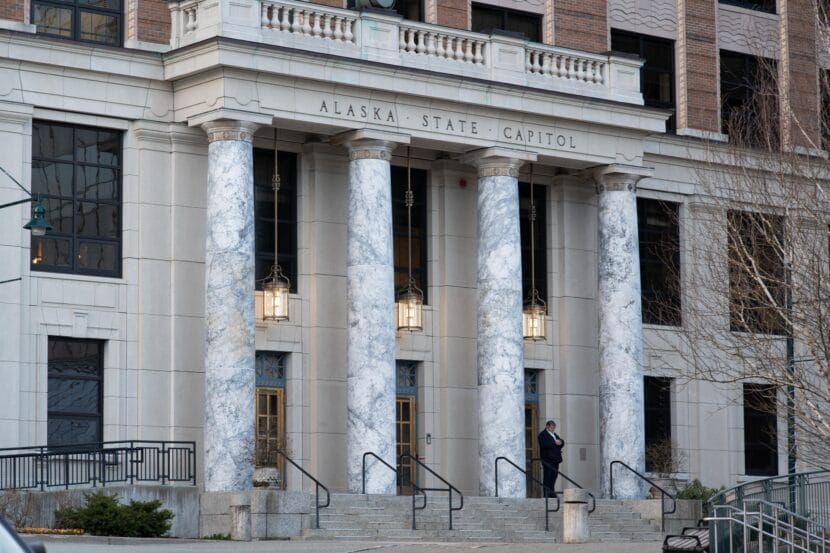
A legislative staffer waits outside the Alaska State Capitol in Juneau on March 20, 2025. (Eric Stone/Alaska Public Media)
Alaska lawmakers are going for round two on a bill Gov. Mike Dunleavy vetoed last year. The bill would change the way corporate income taxes are calculated, bringing in tens of millions of dollars in new revenue.
Backers of the bill say it’s necessary with a tight state budget, and it’s similar to a proposal Gov. Mike Dunleavy included in his fiscal plan.
Rep. Calvin Schrage, an Anchorage independent who co-chairs the House Finance Committee, said at the bill’s first hearing on Friday that it’s an effort to bring the state’s tax laws into the digital age.
“Currently, there is a loophole in Alaska’s corporate income tax structure, and that loophole is that if you’re a highly digital business that doesn’t have a physical presence here in the state, you are not paying taxes to the state of Alaska. You’re paying those taxes to other states,” Schrage said.
The bill would make two substantial changes to corporate income taxes in an effort to attribute more of Lower 48 companies’ income to Alaska.
The first implements what’s known as “market-based sourcing.” That essentially means that large businesses would pay taxes based on where their customers are, rather than where the company does its work. It’s a change dozens of other states have made and one the governor included in his fiscal plan.
The second component would change the tax rules for so-called “highly digitized businesses.” That’s an effort to extract more tax revenue from companies like Netflix, eBay and others that do most of their business over the internet but don’t have a presence in the state. That change is not a part of the governor’s plan.
Last year, the state Department of Revenue estimated the bill would raise between $25 and $65 million each year.
Rep. Will Stapp, a Fairbanks Republican in the minority who voted for the bill last year but voted against overriding Dunleavy’s veto, said he’d like to see some technical changes. For one thing, he’d rather not make the bill retroactive to the start of this year. But Stapp said he’s open to supporting it after a few tweaks.
“No change in tax structure is perfect,” he said in an interview. “But there are impacts that we should actually understand, that the public’s going to expect us to kind of understand so we can articulate it.”
Even though the bill is similar to an element of Dunleavy’s fiscal plan, it’s not clear the governor would sign the bill if passed. His office declined to comment on the new bill. But Dunleavy has said repeatedly he opposes new revenue measures without stricter limits on how state money can be spent.
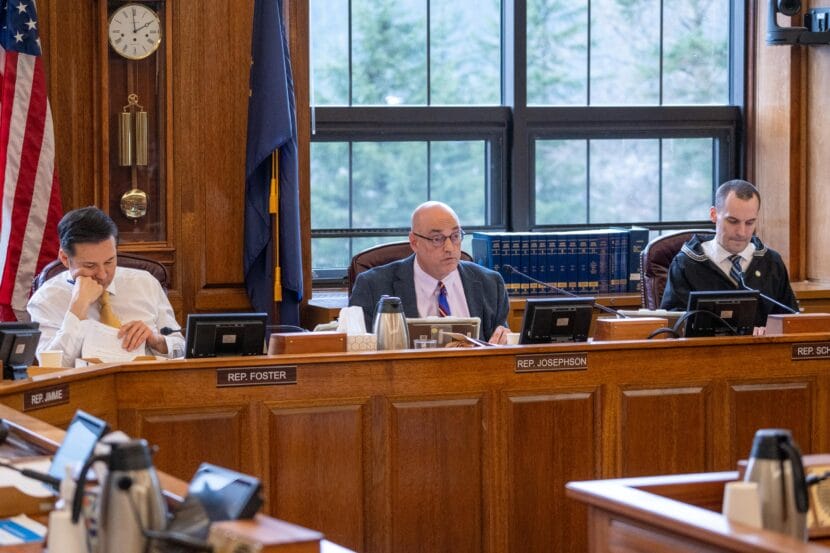
Rep. Andy Josephson, D-Anchorage, center, speaks during a House Finance Committee meeting alongside co-chairs Rep. Neal Foster, D-Nome, left, and Rep. Calvin Schrage, I-Anchorage, right, on Feb. 13, 2026. (Eric Stone/Alaska Public Media)
The Alaska House Finance Committee adopted its first draft of the state’s budget. It makes a variety of smallish changes from the governor’s proposal, and one really big one: it removes the Permanent Fund dividend.
The change has attracted a lot of attention. So what does it mean?
Committee co-chair Rep. Andy Josephson, an Anchorage Democrat, said Alaskans shouldn’t panic — there will be a dividend this year.
The House’s first draft strips out everything new in the governor’s budget and represents essentially the status quo, minus the PFD. That provides a starting point for lawmakers to work from, he said.
But putting any PFD number into the budget right now could give Alaskans the wrong impression of what their legislators support and what a realistic dividend could be, Josephson said.
“Perhaps it’s counterintuitive, but sometimes starting at zero — because we are going to have a dividend — is the more honest place to start,” he said.
It’s also fairly typical, he said. House lawmakers have taken this approach for five of the past eight years, according to Josephson’s office. Members of the bipartisan House majority who control the committee approved the new draft in a caucus-line 6-5 vote.
Lawmakers on both sides have said they see Gov. Mike Dunleavy’s proposal to pay a roughly $3,600 dividend as unrealistic with low oil prices and a tight state budget.
But minority Republicans say they see removing the dividend from the budget at this stage as a worrisome sign. House Minority Leader Rep. DeLena Johnson, a Palmer Republican, said dropping the dividend from the working draft reduces pressure on lawmakers to cut spending and hold down expenses.
“If we don’t have some kind of PFD, then we’re just going to spend it, and we’re going to continue to spend, and then we are going to continue to spend into savings,” Johnson said at a news conference on Thursday.
Economists told lawmakers earlier this year that reducing the PFD to cover a deficit is akin to a regressive tax and hits low-income Alaskans the hardest.
Removing the PFD from this early budget draft also helps the majority avoid an uncomfortable vote that threatened to hold up progress on the budget last year. During the last legislative session, the budget briefly stalled when lawmakers were unable to muster the votes to reduce the PFD in a later draft.
The upper house of the Legislature is taking a different approach. The first-draft budget in the Senate includes everything the governor asked for, including the PFD. (There is one exception, Dunleavy’s proposal to create a Department of Agriculture, which is the subject of an ongoing lawsuit.)
Both the Senate and House are controlled by Democrat-heavy bipartisan coalitions.
How much the dividend will ultimately be is up in the air for now, but some key lawmakers have said they don’t expect much change from last year’s $1,000 PFD.
“My best guess is between $750 and $1,400,” Josephson said. “Personally, based on what happened last year, I think it’s going to be around $1,000, but it’s way downstream.”
The state operating budget officially sets the dividend, and it’s typically one of the last bills to pass before the end of the regular session in May.
The Alaska State Capitol is seen behind other buildings on Tuesday, Feb. 10, 2026, in downtown Juneau. (James Brooks/Alaska Beacon)
The Alaska Legislature on Wednesday approved a 30-day extension for the state of disaster covering the fall 2025 storms that battered the state’s west coast.
The extension allows the state to continue spending money from its disaster response fund as it continues cleanup and repair efforts from two storms in October. Hundreds of Alaskans were displaced by the disasters, which devastated coastal communities.
The Alaska Senate approved the extension in a 19-0 vote on Monday, but the extension nearly failed in the Alaska House after members of the House’s Republican minority caucus raised procedural issues on Wednesday and said members of the majority were not following state law.
The extension was included in Senate Concurrent Resolution 12, which retroactively approves extensions issued since October and allows the governor to spend more from the state’s disaster response fund.
“Doing this as a resolution is dangerous, I think it’s a mistake, and I’m not even certain that it’s legal,” said House Minority Leader DeLena Johnson, R-Palmer.
Johnson and other Republicans said that under their interpretation of state law, legislators would need to approve the spending via a bill, not a resolution.
A legislative attorney, writing in a Feb. 2 memo to Speaker of the House Bryce Edgmon, I-Dillingham, said, “when the legislature means to take action having a binding effect on those outside the legislature, including extending a disaster declaration, the legislature must enact a bill in a special or regular session rather than using the less formal resolution process.”
Johnson was rebutted by House Rules Chair Louise Stutes, R-Kodiak and a member of the House’s majority coalition.
“This is not new money,” she said. “This is money that has been (in the fund) and is being allowed to be appropriated out. … it’s been agreed upon that maybe this wasn’t the optimum way. Nothing’s perfect. We’re moving forward. We are trying to do the best we can as quickly as we can. Time is of the essence, so I ask you to ask yourself: Do you want to be right in how it is done, or do you want to do the right thing when there’s a question?”
The House vote was 22-18, with Rep. Will Stapp, R-Fairbanks, joining the 21 members of the House’s coalition majority in support. All other members of the House Republican minority voted against the resolution.
As debate opened, Rep. Nellie Unangiq Jimmie, D-Toksook Bay, became choked up as she described the disaster, which devastated her district and resulted in the largest peacetime evacuation in state history.
“Today, months later, 340 of our neighbors remain without permanent houses. Mr. Speaker, we are Yup’ik. Our people have lived in this delta for thousands of years. We know storms. We know water. We know loss,” she said. “We have lived on this coast for thousands of years, and we’ve survived ice ages, epidemics, colonization. We’ve survived by adapting, sharing, by refusing to abandon our homes, but you can’t really live when your home floats 10 miles out to sea, when your fuel tanks that heat your home in winter are submerged in salt water.”
On Jan. 28, Gov. Mike Dunleavy requested permission to spend $20.5 million from the disaster response fund, up $5.5 million from a prior request.
When federal money is added to that tally, the total amount is $39.25 million.
More spending is expected.
Last week, the director of the Alaska Division of Homeland Security and Emergency Management said that the Federal Emergency Management Agency has estimated at least $125 million in state and federal costs related to the storm disaster.
“The declaration allows state agencies to continue their emergency response and to extend state funds as needed,” said Rep. Andy Josephson, D-Anchorage and co-chair of the House Finance Committee.
Rep. Justin Ruffridge, R-Soldotna, took issue with the fact that after Dunleavy declared a state of disaster in October, the Speaker of the House and Senate President approved subsequent 30-day extensions without consulting legislators.
“I think we should have called ourselves in (to special session), or the third floor should have called us in (to special session) to take up this very important issue,” Ruffridge said.
“What precedent does this set for the presiding officers to make the decisions before us on our behalf?” he asked. “What power do we give the executive by allowing disaster declarations to continue without (the House) or the (Senate) taking up that order of business?”
Rep. Dan Saddler, R-Eagle River, said he worries that failing to follow proper procedure could leave disaster relief vulnerable to legal challenge.
“We put the reliability of that relief at question if this is not done right,” he said.
The day after the vote, Ruffridge said members of the minority have drafted a bill that would fix the problems they see, and that bill is being reviewed by legislative attorneys.
House Majority Leader Chuck Kopp, R-Anchorage, said legislative attorneys have reviewed the majority’s plan.
“We have had our legal department tell us that this passes muster,” he said during the debate.
After the vote, Kopp’s office was unable to provide a legal memo to that effect but said he had received verbal advice.
Josephson, wrapping up debate, said the majority was working in good faith with Dunleavy to get the money out the door quickly.
“Given the urgency of the matter, we’re trying to cooperate with the executive branch,” he said.
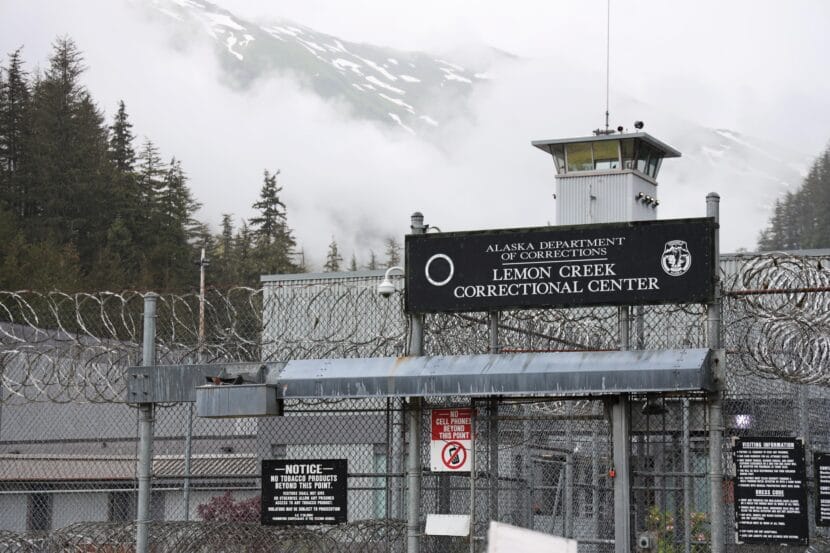
Lemon Creek Correctional Center in Juneau, Alaska in June 2023. (Clarise Larson/KTOO)
As Alaska lawmakers reckon with a tight state budget and rising costs in the Department of Corrections, some are floating an uncomfortable idea: once again sending Alaska inmates out of state.
Over the last ten years, lawmakers have boosted the Department of Corrections’ budget by 70%, and even that hasn’t been enough.
Each of the past five years, the department has had to ask lawmakers for millions more — or tens of millions more — to make ends meet. This year, the department is requesting $24 million to cover unexpected costs in the current budget.
The department’s commissioner, Jen Winkelman, told the Senate Finance Committee earlier this month that she looked every day for ways to rearrange operations to avoid budget shortfalls or overruns. Health care for inmates and overtime to make up for short staffing are the two largest cost drivers, Winkelman said.
“It is consistently … a perfect storm,” Winkelman said.
Lawmakers went as far as to close one housing unit at the Spring Creek Correctional Center in Seward last year in an effort to save money. But sometimes, Winkelman said, big expenses come up unexpectedly.
“Approximately two weeks ago, we had a large fight on the yard — 48 inmates involved in a fight,” Winkelman told a House committee on Tuesday. “Quick napkin math, we believe it to be just under $200,000 that that cost us.”
Five people were injured in the fight, and all are recovering, a department spokesperson said. But Winkelman said the cost-cutting move to close part of the prison may have played a role and ultimately resulted in a large unexpected cost.
“Those are just those anecdotal examples of the population and the complexity when we start overpopulating one area, what happens as a result due to the population we serve,” she said.
The spiraling costs have some lawmakers floating a return to a practice Alaska abandoned more than a decade ago: sending prisoners out of state to save money.
“We can’t keep going the direction we’ve been going the last few years,” said Sitka Republican Sen. Bert Stedman, a co-chair of the Finance Committee. “The operating budget is extremely strained with those items, and that’s what’s driving this discussion.”
Wasilla state Sen. Rob Yundt, a Republican in the minority, filed Senate Bill 126 last year, which if passed would direct the Department of Corrections to explore the idea to see if it saves money.
“Oftentimes we get to run legislation that we’re excited about,” Yundt said at a hearing on Tuesday. “There is none of that here.”
In the 1990s and 2000s, the state contracted with private prisons in Colorado and Arizona. By 2005, about a third of Alaska’s prisoners were held out of state in private facilities, according to news reports at the time.
One of those prisoners was Adam Barger, who spent more than a decade in out-of-state prisons after his conviction in Alaska in the 1990s. He returned in 2013 after the state opened the $240 million Goose Creek Correctional Center in the Mat-Su borough in an effort to bring Alaska’s prisoners home.
When he was transferred back, guards told him how much more difficult it was to manage prisoners who had been sent to Outside facilities than those who had not, Barger told lawmakers during public testimony on the bill.
“We were more violent, had gang affiliations, drug addictions, behavioral problems, and were more resistant to authority than those who had never been sent out of state,” Barger said. “Then, we were released back into the community.”
Some, like Barger, managed to leave the justice system behind them, he said. Barger said he earned a master’s degree and now lives in Arizona.
“For many, though, they were apt to get out and return to incarceration, often in conjunction with another charge,” Barger said. “They went back to their communities and created more victims because the behavioral issues they developed out of state had not been addressed or resolved prior to their release.”
Barger asked lawmakers to oppose Yundt’s bill.
Yundt’s bill would mandate that Alaska prisoners be kept separate from those from other states. It would also limit the prisoners that could be sent out of state to those with at least seven years left in their prison term, and Yundt said he’d like to see inmates brought back to Alaska as their release date approaches.
Sen. Löki Tobin, an Anchorage Democrat in the majority, said she sees other ways to reduce costs in the state’s prison system — like granting parole for people who are elderly, disabled or unlikely to reoffend.
“They’re engaging in double jeopardy,” Tobin said. “Folks who are up for discretionary parole, who are excellent candidates to re enter into their community safely with support, are being recommitted to incarceration.”
The parole board chair said last year that state law places strict limits on the board’s ability to grant parole.
The policy director of the Alaska chapter of the American Civil Liberties Union, Mike Garvey, said that sending prisoners out of state would cut them off from family and friends in Alaska and make them more likely to reoffend.
“Moving prisoners out of state jeopardizes the constitutional rights of prisoners in Alaska, as well as presents public safety concerns,” Garvey said. “Alaska’s Constitution guarantees prisoners the right to rehabilitation, to due process, the right to counsel and the right to adequate medical care.”
Yundt said he was sympathetic to Barger and Garver’s concerns.
“I was once a young child that would travel to see family members as well on a Sunday, and so that’s not a great situation for anyone to be in,” he said. “I wish we weren’t in the situation, but here we are.”
Democratic Juneau Sen. Jesse Kiehl, a member of the powerful Finance Committee, said he understands the cost concerns, but he’s skeptical.
“I will just express a little concern about the notion of shipping Alaskans to warehouses outside,” Kiehl said. “We’ve done that in the past. The cleanup has been both expensive and ugly, and I don’t know that that’s a long term cost we want to bear.”
To realize any savings, Winkelman said, the department would likely need to close a facility. And that brings with it a whole host of thorny questions about jobs, local economies and public safety.
But with few options to control rising costs, and a governor resistant to standalone efforts to raise revenue, it may be a choice they’re forced to make, said Sen. Lyman Hoffman, a Bethel Democrat who co-chairs the Finance Committee.
“We have a limited budget. If we are not able to pass revenue measures, we have to look at doing something,” he said. “So this is an idea that is on the plate.”
Close
Update notification options
Subscribe to notifications
Subscribe
Get notifications about news related to the topics you care about. You can unsubscribe anytime.