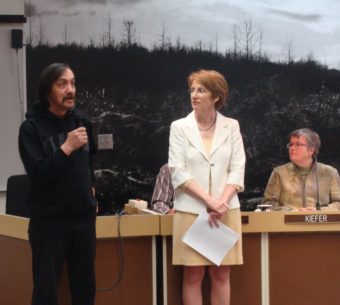
About a hundred people gathered at St. Paul’s Catholic Church in Juneau Monday for the annual Martin Luther King, Jr. Day celebration.
All of the speakers talked about the strides our society has taken in terms of race relations since King’s death 45 years ago. They also spoke of the need to keep fighting for equality.
Speakers and performers included:
Shirley Workman, Mistress of Ceremonies
Alaska Youth Choir, Missouri Smyth – Director
Juneau Senator Dennis Egan
Sally Smith, Office U.S. Senator Mark Begich
Mike Tagaban, Thunderbird House, Auke Village
Geny Evangelista-Del Rosario, Filipino Community Advocate
Glenn Mitchell, “I Have a Dream” reading
Salissa Thole, “My Country Tis of Thee”
Daymond Geary, Breakthrough Church
Lt. Mickey Sanders, USCG
Richard Green, Glacier Valley Church of God
Sherry Patterson, President Juneau Black Awareness Association
KTOO’s Casey Kelly produced this audio postcard.
Audience members at the Martin Luther King, Jr. Day observance in Juneau Monday link arms and sing "We Shall Overcome." Photo by Casey Kelly/KTOO.
The influenza virus has been active in the state since early November.
“It seems like the flu virus has hit much earlier this year,” says Brian Yablon.
He’s a medical epidemiologist with the Alaska Department of Health and Social Services. Yablon says flu cases don’t normally pick up until late December or early January.
“Really conditions everywhere are ripe for the spread of flu. This is the season in terms of the winter weather in terms of people sharing tighter quarters in the winter and breathing the same air and getting other illnesses and spreading cough and cold symptoms.”
But he says tracking the flu virus is tricky.
“We’re more likely to see flu tests done when someone has a severe illness or when providers are just really looking for it and that does make it challenging to compare flu rates between other states or within part s of this state.”
The rate of influenza infection is up across most of Alaska.
Bartlett Regional Hospital’s Infection Prevention Coordinator has seen an increase in the number of influenza cases in recent weeks.
Kim Vermedal says more cases of Influenza A and B are being seen in the hospital emergency room, and there’ve even been some hospital admissions. She says this year’s flu shot covers both flu strains.
She says a few weeks ago about 10 patients per week were coming to the hospital with flu-like illnesses, “and now we’re hitting the mid-30s, low 40s (a week), and these are people that are actually sick enough to come to the hospital.”
Vermedal says it’s not too late to get a flu shot.
“It’s probably going to run a couple more months, and who knows, we could have a second wave later in the season,” she says.
She says the flu is easily transmitted, so stay home if you’re sick. Always cover your cough, avid touching your eyes, nose and mouth.
Vermedal says hand washing is critical in preventing the spread of flu germs.
In the Interior region, many people contracted the illness early on in November. According to one doctor, the emergency room at Fairbanks Memorial Hospital is relatively quiet. But the Mat-Su valley and Southwest Alaska are seeing higher than normal influenza infection rates.
Nancy Davidian is a nurse at the public health center in Fairbanks. She leads a case management team that focuses on communicable diseases. She recommends everyone get a flu shot this year.
“Since it’s been in the national news, people have been calling in more and coming in more. We do know that the vaccine is available from other providers and amongst other pharmacies.”
Even out on the Aleutian chain, the health clinic in Unalaska reports an increase in demand for flu shots. Some states are reporting a shortage of the vaccine, but health officials in Alaska say there’s still plenty to go around in the far north.
The last three months were busy for Richard Miltenberger. The benefits consultant stayed up late, worked Saturdays and ignored some of his regular work responsibilities to help Alaska and four other Western states submit applications for federal health cooperative loans by the December 31st deadline. He sums up the amount of time he spent on the project this way:
“An embarrassing amount.”
When the 400 page applications were finally complete and in the hands of Fed Ex, the plane broke down in Memphis. A colleague of Miltenberger’s was tracking the packages and stayed up all night making phone calls:
“(She) had somebody get on the plane, get the package off at Memphis, put on a non Federal Express airplane to get it to DC overnight.”
He calls the episode comical. But for Miltenberger, the stakes were high. He has spent the last two years living and breathing health insurance cooperatives. In 2011, he helped Montana file the first health cooperative application under the new health reform law. As a former insurance executive, he immediately saw the appeal of a consumer owned health plan:
“Its very hard to change an existing insurance company, I’ve been there before and it’s like trying to steer a battle ship. But if you’re starting fresh, you can really do some innovative things.”
Health cooperatives are non-profit health insurance companies governed by members. They work with hospitals and medical providers to make sure patients get the best and most cost effective care. Miltenberger got so excited about the idea, he helped launched the National Alliance of State Health Cooperatives to encourage other states to apply for the federal loans.
“And I think, in Alaska, we have the best case of any state, to start a health cooperative. Its absolutely needed there.”
That’s because Alaska has high health care costs and limited insurance options. So last fall, with the final deadline for health cooperative applications looming, Miltenberger called up Lon Wilson, President of the Wilson Agency in Alaska. Wilson runs an employee benefits company and knows the ins and outs of the health insurance industry in the state. And it didn’t take long for Miltenberger to convince Wilson that a health cooperative could be one answer to the high cost of health insurance in Alaska.
“It was something that really could be transformative in our community and really appeal to a certain segment of our population.”
So the pair spent three months working on the application. They had to incorporate a non-profit, do a feasibility study and collect two dozen letters of support. Wilson also had to recruit a board of directors. He says he didn’t have trouble finding people in Alaska who embraced the idea:
“Healthcare, as we all know, it’s all local. And having a plan that is formed in Alaska, run by Alaskan, directed by Alaskans for the benefit of Alaskans in my opinion is a good thing. It’s an alternative, it’s not for everybody. But it would be just one more alternative in a small market that has limited choice.”
But as it stands now, Alaska won’t get the chance to see if a health cooperative could have worked. The state’s application miraculously made it to Washington DC on December 31st. But Wilson says the celebrating was short lived:
“The very next day we learned of the fiscal cliff compromise that was passed by the Senate.”
The fiscal cliff deal eliminated all funding for health cooperatives that had not yet been approved. That means 24 states will have cooperatives, but 26 states, including Alaska, will not. Miltenberger had to read an e-mail explaining the news three times before he could believe it.
“It was incredibly disheartening, almost to the point of tears for me.”
Lon Wilson, in Alaska, took the news a little better. But he thinks the last minute deal sets up a unequal situation, with about half the states getting a chance to test health co-ops, and half left out. Wilson says it’s disappointing:
“Without the application even being reviewed, without the opportunity for funding, we’ll never know if it could have had an impact on price, quality or access in our state. And that’s the unfortunate part about this.”
Miltenberger and Wilson aren’t giving up though. They’ve already been in touch with members of Congress, trying to get the funding restored.
This story is part of a reporting partnership that includes APRN, NPR and Kaiser Health News.
Jet skis, water skis and wake boards would not be allowed on Juneau’s Auke Lake, under a proposal to limit watercraft to 10 horsepower on the small lake.
The proposal was released Tuesday night to the Parks and Recreation Advisory Committee, or PRAC.
After a Juneau teenager died from injuries in an accident on the lake last summer, the city began a review of ordinances regulating lake uses. Testimony from a series of public meetings, written comments, and other research form the basis of the draft plan, which was written by city parks and recreation department staff.
Director Brent Fischer said the U.S. Interior Department’s Water and Land Recreation Opportunity Spectrum, or WALROS, also was used to determine the carrying capacity – the number of vessels that can reasonably and safely use the lake. Only 70 acres of the 165-acre Auke Lake are considered useable.
“The existing 16-foot length limit for motorized vessels should be replaced with a 10-horsepower limit,” Fischer said. “Due to the relatively small size of Auke Lake and its limited carrying capacity, the use of multiple high speed vessels is just not appropriate. Speed limits and wake restrictions are virtually impossible to enforce. A horsepower limit provides a practical means of controlling vessel speeds. This will result in few user conflicts and allow more vessels to safely use the lake.”
The 10-horsepower restriction would not apply to aircraft taxiing on the lake.
The proposal also calls for the city to replace current buoys that delineate restricted areas with markers that comply with state regulations. New maps and signs would go up, clearly explaining lake use, and regulations would be enforced by a CBJ park ranger. The draft plan also maintains the existing no-wake zone and operating area, and a ban on refueling.
Fischer acknowledged the difficulty of including all Auke Lake user groups in the management plan.
“It is true that Auke Lake is one of only navigable lakes on the Juneau road system. However, the lack of other options does not change how it should be managed,” Fischer said. “Auke Lake cannot be all things to all users and must be actively managed to best achieve the management objectives developed by the community at large.”
Only a handful of people came to the meeting and some didn’t stay once they heard that public comments would not be taken.
Commercial fisherman Aaron Woodrow had hoped to testify Tuesday night. Before the meeting, he said he was teaching his 10-year-old daughter to waterski on the lake the day of the accident that killed Savannah Cayce. He was flagged down by a jet ski to help.
Woodrow said education is key to preventing accidents on the lake.
“There needs to be some guidelines of how to safely tow someone around the lake. Myself and my friends have always followed some guidelines of towing around the perimeter, you know in straight lines. You don’t go zigzagging around because it’s not that big of a lake,” Woodrow said. “It’s just education.”
Lake shore resident Dave Hannah claims he has not missed a meeting about Auke Lake in the last decade. He panned the draft management plan as “rife with error.”
“I think they misconstrued the characteristics of the lake. They’ve misconstrued the attitude of the public. They’ve misconstrued the attitude of a lot of the residents of the lake. I think they’ve misconstrued the ability of the lake to support the uses that are there,” he said.
Public comments on the draft management plan will be taken at a Parks and Recreation Advisory Committee meeting on January 29th. Written comments can be made now to parks_rec@ci.juneau.ak.us.
PRAC members will use the comments as they determine changes they would like to see in the draft plan. The PRAC will forward their recommendations to the CBJ Assembly next month.
Parks and Rec director Fischer said the goal is to have any new regulations in place before the ice melts on Auke Lake.
A life ring hangs on the floating dock on Auke Lake. (Photo by Heather Bryant/KTOO)
Motorized vessels on Auke Lake should be limited to 10 horsepower, according to a draft Auke Lake Management Plan.
The new plan is the result of an evaluation process conducted last fall by the CBJ Parks and Recreation Department, after a teenager was fatally injured on the lake. The city vowed to review ordinances that govern use of the lake.
Parks and Recreation Director Brent Fischer will present the recommendations Tuesday night at a meeting of the Parks and Recreation Advisory Committee.
Fischer says neither the PRAC nor the public will be asked to comment, because the report has just been released.
The proposal recommends no towing on the small lake. In July, 16-year-old Savannah Cayce was being towed on an inner-tube by a jet ski, when her tube hit another jet ski.
Other recommendations include larger buoys on the lake, new signs at the boat launch as well as a public information campaign, so lake users clearly understand the regulations.
To enforce the rules, Fischer is suggesting the city create a seasonal park ranger for all CBJ parks. He says the ranger also would need access to a boat.
“This position, what we hope, would start mid-April to go all the way through mid-October,” Fischer says. “It allows us to set the buoy markers, which create the no-wake zone or the no-motorized use zone. It allows up to open that lake up. We’ll have a presence on the lake, and then take those buoys down once we close the season. This helps us really manage this lake and the uses out there.”
The Parks and Recreation Advisory Committee will meet tonight at 6 o’clock in the Mendenhall Valley library.
Fischer says public comment can be made at the city’s website, or at a public hearing later this month. The draft plan will be forwarded to the Juneau Assembly, which will determine if any changes should be made to current ordinances.
The state has ordered oyster farms in Jakolof Bay near Homer to stop selling oysters, due to possible pollution from two fishing vessels that sank earlier this week.
The Leading Lady and Kupreanof were discovered under water on Christmas day. Heavy snow load may have contributed to the sinking.
While the Kupreanof had no engine or fuel on board, the owner of the Leading Lady estimated that 50 gallons of diesel fuel and 35 gallons of hydraulic fluids and lube oils were on the boat. A pollution sheen approximately 100 feet by 100 feet could be seen around the vessels.
The boats went down within the Kachemak Bay Critical Habitat Area near several oyster farms.
The Alaska Environmental Health issued the stop sale order on Wednesday, but oysters are not scheduled for harvest until spring. Officials say they will evaluate the oysters at that time, before farmers will be allowed to sell them.