Sexual Abuse & Domestic Violence

Tlingit and Haida gets approval to receive federal reimbursements for child welfare services

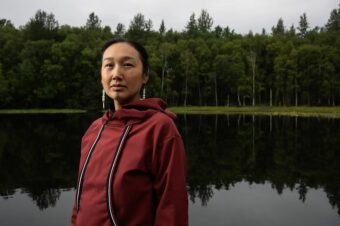
A woman dressed in an off-white sweater and pearl earrings smiles for a photo.
Mary Johnson sits for a portrait in her office in Juneau on May 6, 2025. (Photo by Jamie Diep/KTOO)

The Central Council of the Tlingit and Haida Indian Tribes of Alaska can now receive reimbursements for providing child welfare services directly from the federal government. Both governments finalized the agreement last month.

That means the tribe’s reimbursements no longer need to go through the State of Alaska. Tribal officials say the agreement gives them more flexibility in handling cases where child abuse and neglect may be happening. 

Mary Johnson is the senior director for family services at Tlingit and Haida. She said the tribe will continue working with the state on child welfare services, but it can now look into ways to expand its services.

“What do we need to get into place to license our own foster homes? What do we need to get into place if we do want to initiate a child welfare case within our own tribal court? And how do we go about putting that into action?” Johnson said. “Now we have the resources to make that happen with a lot of work.”

Alaska’s Office of Children’s Services has agreements with tribes across the state to serve Alaska Native children placed in the system. Tribes assist in Indian Child Welfare Act cases. The law sets standards for children’s services agencies to place Alaska Native and Native American children with family members or to keep them in their home communities if they are removed from their family.

That means Tlingit and Haida works with the state to find a suitable place for children to live after they’ve been removed. In the past, federal reimbursements were distributed to tribes from the state. With the new agreement, Johnson said the tribe can now receive reimbursements directly from the federal government.

Johnson said the tribe’s family services generally have a better understanding of a referred family’s cultural background.

“If you are working with a caseworker at Tlingit and Haida, the chances of them being Alaska Native or even a tribal citizen are pretty high,” she said. “So you’re going to be connecting with someone that just tends to know your way of living a bit more than someone who doesn’t. So that makes a huge difference when working with our families.”

Data from OCS shows that more than two thirds of the children removed from their home last year in the state were Alaska Native.

Tlingit and Haida worked on more than 233 cases in 15 states last year. The tribe serves all of its tribal citizens, including those that live outside of Alaska.

Johnson said the tribe hopes to expand its abuse and neglect prevention services through the agreement as well.

“We have communities that are really strong in one area, and that could be a great area to build off of to do a prevention activity so it can be individualized to a community based on their strengths and their needs,” she said.

The tribe will now go into an implementation phase, where officials will continue developing its child welfare and monitoring program to be approved for reimbursements. Johnson said in an email she anticipates the tribe will need six to 12 months to go through the approval process.

On Missing and Murdered Indigenous People Awareness Day, loved ones remember Tracy Day

Tracy Day’s daughter Kaelyn Schneider hugs MMIP advocate Jamiann S’eiltin Hasselquist at the Kaasei Healing Kootéeyaa on May 5, 2025. (Photo by Yvonne Krumrey/KTOO)

Monday was Missing and Murdered Indigenous People Awareness Day. In Juneau, at events like this one — held in recognition of the epidemic of violence against Indigenous people — one name comes up consistently.

“I’m here because of Tracy Day,” said Kanaagoot’ Mike Kinville. He helped take care of Tracy Day when she was still a teenager. Decades later, she went missing at the age of 43. It’s been six years, and her family is still looking for her.

Monday night, advocates for missing and murdered Indigenous people gathered at Kaasei Healing Kootéeyaa, a totem pole created to be a space of healing from gender-based violence.

Mike Kinville and Jamiann S’eiltin Hasselquist look on as loved ones of missing and murdered Indigenous people burn wood chips in a ceremony on May 5, 2025. (Photo by Yvonne Krumrey/KTOO)

Those gathered wrote names of loved ones that have been the victims of violence on wood pieces carved out of a dugout canoe and burned them in the fire. 

“It is so hard for me when I see all these faces and all these names and all these families, the amount of pain that radiates out from that, you know, the hurt, the not knowing,” Kinville said. “It’s just — it’s almost crushing.”

Kaelyn Schneider is Tracy Day’s daughter. She has been raising awareness about her mother’s case via social media for years. She said that she feels disconnected from Lingít culture because her mother’s time teaching her was cut short. 

“I need people to understand that when Indigenous people go missing, it’s so much deeper than anyone realizes,” she said. “Not only are these our family members who we love and miss every single day, but these are the people who pass on sacred knowledge to the next generation of our family.”

Schneider said she’s grateful for the people who come together at gatherings like these to share their traditional knowledge with her family. She says they help the families of people lost to violence grapple with their unanswered questions as a community, and fill some of the space left behind.

Those gathered at the Kaasei Healing Kootéeyaa in Juneau on Missing and Murdered Indigenous Peoples Day raise a fist at the end of a song. May 5, 2025. (Photo by Yvonne Krumrey/KTOO)

Juneau’s child advocacy center holds Superhero Walk amid funding instability

Rex Reid feeds a treat to a dog at the Airport Dike Trail in Juneau on April, 26, 2025. (Photo by Jamie Diep/KTOO)

Listen here:

Families, community members and dogs in superhero costumes gathered on the Airport Dike Trail in Juneau on a rare sunny Saturday morning. 

The Southeast Alaska Family Evaluation – or SAFE – Child Advocacy Center, Juneau Animal Rescue and AWARE, a nonprofit supporting survivors of domestic and sexual violence, set up tents by the trail, handing out dog treats, bubbles and capes for their first Superhero Walk.

Six-year-old Rex Reid was at the event dressed in a Spiderman and T. rex costume.

“I was supposed to be Spider Rex, but my T. rex mask is kind of lost,“ he said.

The superhero walk is part of the three nonprofits’ effort to raise awareness on different types of abuse. It’s a lighthearted event that celebrates how anyone can be a superhero when it comes to preventing child and animal abuse. Reid said he lost his dinosaur mask, but he was still having a great time hanging out with the animals.

“I’ve been able to pet the dog,” Reid said. “I also gave some treats.”

The effort comes as state funding for child advocacy centers, or CACs, is on the chopping block while the Alaska Legislature considers how to resolve a nearly $2 billion deficit in the budget.

Jenny Weisshaupt is the program manager for the SAFE Child Advocacy Center in Juneau. It’s one of 19 developing or established CACs in Alaska. She said state funding for CACs used to come from a federal source that’s not available next year. For the past decade, the state used federal Temporary Assistance for Needy Families money to fund CACs, but an audit last year put a temporary end to that. A federal grant to expand rural services ends this year too.

Now the Legislature has to decide whether to add their funding to the state budget.

“We were told that everything this year is going to be decided at the very end of session in a conference committee, and then up to the governor to decide what will be funded,” Weisshaupt said.

She said the changes mean Alaska’s CACs will be down $5.5 million if the state doesn’t fill the gap. So far this legislative session, lawmakers have added that money and taken it out of the proposed budget for the next fiscal year. It’s currently not in the latest draft budget. 

On top of that, the amount they receive in federal funding from the Victims of Crime Act is up in the air.

“It’s constantly, for years at the federal level, a question of whether that funding is stable for states,” Weisshaupt said.

She said the Juneau center has a small $75,000 grant meant to increase training and outreach across Southeast Alaska that can be put toward operations if state funding falls through. But it’s not enough to keep the center running as is.

She said that’s critical to the safety of one of the state’s more vulnerable populations. Data from the Annie E. Casey Foundation shows Alaska has one of the highest rates of reported child abuse and neglect in the country and consistently outpaces the national average. 

If child abuse happens, or is suspected, the centers do everything from medical exams and mental health counseling to advocating for children through the life of a case. Staff work on a multidisciplinary team with members from the Office of Children’s Services, law enforcement, medical professionals, lawyers and more.

A major role of CACs is to do forensic interviews to confirm if a child has been abused. But not just anyone can do forensic interviews. Weisshaupt said the skill requires years of training that others may not have the time to dedicate.

Matt Dubois is the investigations commander for the Juneau Police Department and sees their value. He said it would be “devastating” for police without the work CACs do.

“The absence of CAC means children might have to endure multiple interviews with different agencies, which is not only emotionally distressing, but can also undermine the integrity of the evidence in these investigations,” he said.

Assistant District Attorney Jennifer Chaudhary said the forensic interviews CACs provide are important when it comes to prosecuting people while avoiding traumatizing children.

“With the CACs, that’s a good way to get that evidence, to get that video testimony to be able to play in court, so that child victims don’t have to come in and re-go over every single thing that they’ve had to talk about already before and go through all of that trauma again,” Chaudhary said.

She said CACs are a neutral space where interviewers can talk to children in a safe space away from other influences, like family members or law enforcement officers. She said adults around children may intimidate them.

Despite the uncertainties, Weisshaupt said she is hopeful the state will fund CACs. 

“I know what the government’s thinking and considering right now, but this is a cost that I just don’t see them not funding,” she said. “So I have confidence that someone’s going to figure out how to fund child advocacy centers in some way.”

The legislative session ends May 21, when lawmakers must pass a balanced budget or face a state government shutdown.

Trial again delayed in sexual assault case against former Juneau chiropractor

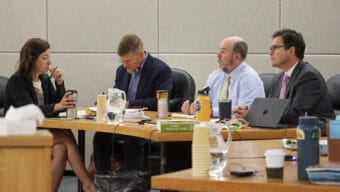
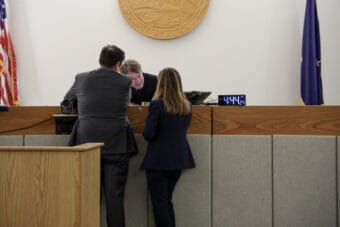
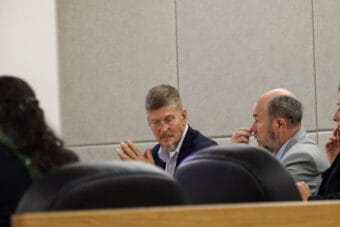
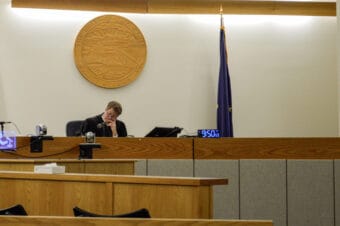
Courtroom A at the Dimond Courthouse in Juneau on Dec. 11, 2024. (Photo by Yvonne Krumrey/KTOO).

The trial for a former Juneau chiropractor accused of assaulting more than a dozen patients has once again been delayed. It was scheduled to start this week, but was pushed back at a pre-trial conference because a member of the defense team is having severe health issues. The court plans to hear the case later this year. 

Police arrested Jeffrey Fultz four years ago on three charges of sexual assault. More women have come forward since. A total of 14 women, a majority of whom are Alaska Native, have now accused Fultz of assault.

The charges are based on accusations that he assaulted patients who sought chiropractic care while he worked for Southeast Alaska Regional Health Consortium. 

Some of the charges date back more than a decade. 

The case has seen years of delays in the pre-trial process. Now the court is attempting to set a trial date for the third time. The delays have left the alleged victims in limbo, waiting for justice.

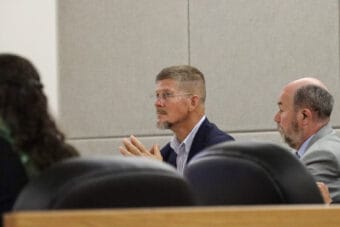
At a pre-trial conference last week, Fultz’s defense attorney, Anchorage-based James Christie, reported that his co-counsel, Wally Tetlow, is experiencing life-threatening health problems and has been advised not to travel for at least one month. Christie argued that Tetlow’s in-person participation is vital.

“So I think, I think we’re in a position where there’s, there’s really, unfortunately, we have to identify a new window for a trial date,” Christie said.

State Prosecutor Jessalyn Gillum told the judge that her team opposes the delay. 

“Given the age of the case, the number of victims, and the fact that the victims have been very clear on wanting their day in court, the state is in no other – has no other choice but to oppose this request,” she said.

Gillum acknowledged Tetlow’s health concerns, but pointed to the fact that Tetlow is not the attorney named in the case for Fultz’s defense — Christie is. She argued that his inability to participate in person shouldn’t derail the trial schedule. 

This is not the first time that the health of the defense has delayed the trial. Fultz’s previous attorney had health problems that caused delays for the majority of a year.

Several other factors have also contributed to the long wait for a trail. The investigating Juneau police officer died, then the first judge assigned to the case retired, and later Fultz’s first attorney was deemed “mentally unable” to continue with the case. 

Victims have repeatedly said in hearings that each time they have to call in to advocate for the case to go to trial, it’s traumatizing.

Fultz has been out on bail, living in Colorado with some pre-trial monitoring since 2021. He appeared in court in person once last year. 

Judge Larry Woolford, who is presiding over the case, said he was reluctant to reschedule, after the dozens of witnesses had set aside time for what is expected to be a long and complex trial. 

“I mean, certainly the parties are aware that it has been the court’s intention that this matter would be ready to go on April 21,” he said. “And we have been, I think it’s fair to say, marching steadily, if imperfectly, toward that for some time now.”

But he said Tetlow’s emergency health issues are within the bounds of what constitutes an appropriate reason for further delays. 

“This is obviously not something anybody could have predicted nor prevented,” Woolford said. 

Woolford cited recent orders from the Alaska Supreme Court to limit delays in older court cases, and said this situation abides by those new rules as well. Under that order, the defense and prosecution can request delays for up to 90 days each, and a court can consider delays for up to 90 days for “good cause.” 

Multiple witnesses who called into a hearing last week said this delay will impact the prosecution.

“I just want to remind the court that there are 14 victims that have cleared the next five weeks to make this happen,” one alleged victim said. Victims who called in did not identify themselves by name. 

Another cited the disruptions this is causing her own life. 

“I’m a therapist, and have to cancel my clients,” she said. “And it, you know, that’s a big deal too.”

Woolford said in the hearing the court is willing to extend the case into the summer, and no further. 

“The windows that I’ve outlined strike me as a reasonable compromise between the unfortunate situation in which your team finds itself, and the, I think, compelling need to get this matter to trial,” he said.

But both the prosecution and defense expressed that their teams and witnesses may not be available for much of the summer. 

A hearing to determine a future trial schedule is set for April 28. 

Former Juneau chiropractor’s long-delayed sexual assault case now scheduled for April trial

Dimond Courthouse plaque
A plaque at the Dimond Courthouse’s public entrance in Juneau acknowledes the building’s namesake, Feb. 27, 2017. (Photo by Jeremy Hsieh/KTOO)

After nearly four years, the sexual assault case against a former Juneau chiropractor is slated to go to trial April 21. 

Jeffrey Fultz is accused of assaulting more than a dozen women under the guise of medical care. Police arrested Fultz in 2021 based on initial accusations that he had assaulted three patients while he was a chiropractor for Southeast Alaska Regional Health Consortium. 

More women have come forward since, and he now faces 18 felony sexual assault charges and one misdemeanor harassment charge. Some of the alleged crimes date back more than a decade.

According to Assistant District Attorney Jessalyn Gillum, several factors have delayed the trial over the years, including the case’s complexity, the number of witnesses and a backlog of criminal cases in Juneau leftover from the  pandemic, when in-person trials were put on hold. 

In the time the case has been awaiting trial, the first judge assigned to the case retired, the investigating Juneau police officer died and Fultz’s first attorney was deemed “mentally unable” to continue with the case. 

Fultz hired his current attorney, James Christie, in January of last year.

The Anchorage Daily News and ProPublica reported early this year that felony cases in Alaska often face years of delays requested by defense attorneys and approved by judges.

Fultz’s case was finally scheduled to begin trial in February, but was delayed yet again as the court continues to process and release outstanding records.

Due to new limitations established by the Alaska Supreme Court, cases filed before 2023 will have a limit of 270 days before they must go to trial starting in May. 

The order says the defense and prosecution are each allotted 90 days of delay requests, and a further 90 days is included for “other periods of delay for good cause.” If Fultz’s case is delayed further, it would be subject to that ruling. 

Fultz has been living in Colorado since he posted bail three years ago. He has made one in-person appearance in Juneau court since.

In early 2021, the Indian Health Services established a hotline for callers to report suspected sexual abuse by calling 1-855-SAFE-IHS (855-723-3447) or submitting a complaint online on the IHS.gov website. The hotline may be used to report any type of suspected child abuse within the IHS, or any type of sexual abuse regardless of the age of the victim. The person reporting by phone or online may remain anonymous.

Locally, people can call AWARE in Juneau at (907) 586-1090.

Report on missing Native people removed from federal websites

Violet Sensmeier, Michelle Demmert, and Charlene Aqpik Apok at a hearing held by the Not Invisible Act Commission in downtown Anchorage in April 2023. Residents shared stories about their loved ones who are missing or were murdered. (Courtesy of Charlene Aqpik Apok)

A report that highlighted the crisis of missing and murdered Indigenous people was removed from several federal websites last month, to the disappointment of some Alaska Native advocates.

The final report by the Not Invisible Act Commission was a joint effort of the U.S. Justice and the Interior departments completed in November 2023. It focused on the disproportionate rates of assault and murder in Indigenous communities across the country – as well as unique issues faced by Alaska Native people. President Trump signed the law that mandated the report during his first term.

In February, the report’s authors and advocates noticed that the link had been deleted from several federal websites, including the Department of Justice website. The reason for the removal wasn’t immediately clear, though some federal agencies have acknowledged scrubbing material to comply with Trump’s executive orders to remove “diversity, equity, inclusion, and accessibility policies.”

Michelle Demmert, a longtime tribal judge and the University of Alaska Fairbanks professor, was one of the report’s commissioners. Demmert, who is Tlingit and Haida and a member of the Klawock tribe, said she was deeply disappointed with its removal.

“It’s like a slap in the face,” she said. “It just really saddens me to have the report removed like it doesn’t even exist.”

Over 18 months, the commission heard from people across the country, including in Anchorage, Bethel and Emmonak. Those stories were included in the final report.

Demmert said that more people showed up in Alaska than in other areas.

“People traveled far and wide to come give testimony about situations that involve their loved ones,” she said. “They trusted us with their stories, even though it was painful for them to have to retell these stories. But they felt like this might be the one opportunity that someone hears them and takes action, and for that to not have happened in any meaningful manner is really disappointing.”

Garments were placed on the backs of empty chairs to represent missing and murdered Indigenous people during the hearing in downtown Anchorage in April 2023. (Photo courtesy of Charlene Aqpik Apok)


Charlene Aqpik Apok, the executive director of the non-profit Data for Indigenous Justice, attended the commission hearing that was held in Anchorage. She said she liked that the commission did not limit the time for comments, allowing people to share their stories without interruption.

Apok also said she appreciated the report’s specific recommendations for Alaska. She said they spoke to historic violence against Alaska Native women, the landscape and structure of rural communities, and challenges with legal and public safety systems.

“They saw how Alaska stood out,” she said. “They had to make different recommendations that were situated for us.”

Apok, who is Iñupiaq, said she found it unsettling that the report was deleted from several websites, but she doesn’t want people to be discouraged. She said that organizations like Data for Indigenous Justice will continue to document and track cases of violence against Indigenous people in Alaska.

“We still know what was said,” she said. “We still know our stories, and they can’t take that away from us. Our knowledge and our truth is something that cannot be erased.”

Site notifications
Update notification options
Subscribe to notifications