Military

Begich: Public dollars are for public education

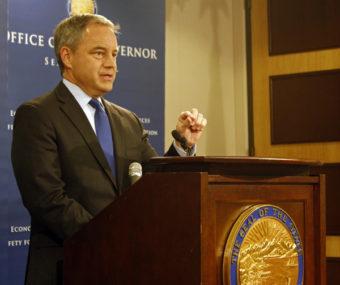
U.S. Sen. Mark Begich spoke to Alaska legislators Monday. Senate President Charlie Huggins is left. House Speaker Mike Chenault is on the right. (Photo by Skip Gray/Gavel Alaska)

Alaska’s junior U.S. Senator leaves no doubt on his opinion about a proposed constitutional amendment that would allow the use of state funds for private or religious schools.

“I believe strongly we should never amend the Alaska Constitution as a fix for education,” Sen. Mark Begich told Alaska lawmakers Monday.

Public dollars are for public education. Period.”

The Democrat was delivering his sixth speech to a joint session of the state House and Senate. His comments about HJR1 and SJR9 drew noisy applause from the gallery, but only a handful of lawmakers were observed clapping. If the legislature approves either resolution, the education funding question would be put to voters in a statewide election.

“There already is plenty of school choice in our public system, from home schools to charters to alternative programs. I was a product of one of them,” Begich said.  The former Anchorage mayor attended Stellar Secondary School, an Anchorage School District alternative school with grades 7 t0 12.

Begich also said he’s not happy with Alaska public school funding over recent years. The Base Student Allocation, the amount of money school districts receive per student enrolled, has remained the same for the last three years, with no adjustment for inflation. Legislation is pending to increase the BSA.

It’s like you’ve built a fire in the woodstove, but refused to add enough wood. Now some are complaining the stove doesn’t work and we need a brand-new heating system,” Begich said. “I know, some of you will say there’s been enough wood for the fire. That the state education budget has actually increased. The question is: Has it kept enough pace to allow school districts to keep up, to actually do their jobs?”

The Senator’s remarks about education were only part of his nearly 26-minute speech, followed by lawmakers’ questions. Other issues ranged from federal deficit reductions to possibly basing F-35 squadrons at both Eielson Air Force Base near Fairbanks, and Joint Base Elmendorf-Richardson in Anchorage.  Begich also thanked the legislature for supporting research and development of unmanned aerial vehicles at the University of Alaska Fairbanks. Alaska was recently named one of six sites in the U.S. to test UAVs.

Begich is chairman of the Subcommittee on Oceans, Atmosphere, Fisheries and Coast Guard, and a member of the Senate Appropriations Committee. He said two of the Coast Guard’s new high speed cutters will be based in Ketchikan, and one in Juneau.
 
Watch the full address courtesy of Gavel Alaska:

USCG’s Cold Bay crews conduct 5th rescue in two weeks

It’s been a very busy couple of weeks for Coast Guard rescue crews in Cold Bay. On Tuesday, they conducted their fifth medevac of crewmen from floating processors in the Bering Sea.

The Tuesday hoist was a return visit to the 680-foot Ocean Phoenix, which was 85 miles northwest of Cold Bay. A man in his late 20s suffered a severe injury to his left hand, and a Coast Guard duty flight surgeon concurred with the ship’s skipper that he needed to be medevac’d. The unidentified young man was transported back to Cold Bay where he was met by a Life Flight and brought to Providence Alaska Medical Center in Anchorage. Weather at the time of the rescue included 35-knot winds and 10-foot seas.

Adam de Rocher, a search and rescue coordinator at the Coast Guard 17th District command center, said the MH-60 Jayhawk crew that conducted the recent medevacs is deployed to Cold Bay from Air Station Kodiak for just such incidents in the winter Bering Sea and Aleutian Island fisheries.

MH-60 Jayhawk helicopter crews perform a search and rescue demonstration off the back of the Coast Guard Cutter Munro April 15, 2013, in Womens Bay, Kodiak, Alaska. (U.S. Coast Guard photo by Petty Officer 3rd Class Jonathan Klingenberg.)

Congress moves ahead on bill to restore Veteran’s benefits

A Tuesday press conference on the cost of living allowance. (Photo by Liz Ruskin/APRN)

Congress is working this week to protect military pensions from inflation. The U.S. House voted Tuesday to restore a cut to the cost-of-living-allowance for retirees, and the Senate Monday voted to move forward with a bill to do the same. The Senate bill was sponsored by Alaska Sen. Mark Begich, and, on the procedural vote, it passed 94-0. Still, the bill’s fate is uncertain.

When Congress passed its budget blueprint in December, the most controversial element was a $6 billion savings in military pensions. The idea was to dip the Cost of Living Allowance for veterans of working age, then restore full inflation-proofing once a veteran reaches age 62. Even before word of it stirred outrage among veterans, lawmakers of both parties were pledging to roll back the cut. At least a dozen bills were filed. The only one Senate Majority Leader Harry Reid decided to move forward was sponsored by Begich and three other Democrats.

On the Senate floor, Begich urged colleagues to just pass the bill, with no amendments.

“Very, very simple. You vote yes, you’re for our vets. You vote no, you’re against are vets. That’s it.”

Some Republicans, though, are insisting on an offset – $6 billion from somewhere else to avoid adding to the deficit. Sen. Lindsey Graham of South Carolina is among them.

“The good news is everyone in the body wants to undo the damage done to our military retirees. That’s good news. The bad news is we’re doing it in a fashion that would break the budget agreement, and I just don’t think that should be our choice.”

Alaska Sen. Lisa Murkowski has previously backed a plan to pay for the COLA restoration by not allowing illegal immigrants to claim the child credit on their taxes. The House version extends a cut to Medicare for an extra year.

Begich says some Republicans are trying to sink the bill because of the senators sponsoring it: himself, Mark Pryor of Arkansas, Jeanne Shaheen of New Hampshire and Kay Hagan of North Carolina. All four are Democrats up for re election this year in some of the tightest races in the country. The leadership’s decision to bring this particular bill to the floor gives them a chance to save the day for veterans. The Senate fight continues this week.

Begich pushing to restore veteran benefits

Photo by Liz Ruskin, APRN – Washington DC.

Veterans and military members in Alaska and around the country have been outraged at Congress since December, when lawmakers passed a budget that would trim their retirement benefits, starting in 2015.

All three members of Alaska’s Congressional delegation voted for that budget, even though they oppose the military pension decrease.

Senator Mark Begich yesterday stood with a group of veterans before a Senate Armed Services Committee hearing and pledged to restore the nearly $6 billion decrease.

At first, the cut doesn’t sound like much. It would drop a retiree’s cost-of-living adjustment below the inflation rate until the veteran reaches age 62. But some enlistees retire and start collecting their pensions while still in their 30s, so this COLA cut could mean diminished benefits for two and a half decades.

Paul Rieckhoff, founder of the group Iraq and Afghanistan Veterans of America, says for some individuals, it adds up to an $80,000 sacrifice.

“But I think most importantly it’s a broken promise,” Rieckhoff said. “This is America breaking their promise to men and women in uniform, and it’s unprecedented.”

Alaska has more veterans per capita than any other state, and they’re relatively young.  More than a quarter of them have served since 2001. It’s no surprise, then, that Alaska’s congressional delegation is getting an earful. Sen. Begich says he’s heard from more than 800 Alaskans objecting to the cut.

“I can tell you, the calls to me office are coming in 2-to-1, 3-to-1 over the next most popular issue, healthcare,” Begich said. “So this issue has taken front and center.”

Begich defends his vote for the budget containing the COLA cut, saying it was necessary to prevent another government shutdown. More than a dozen bills have been introduced to rollback the COLA cut. It’s a popular position in Congress, and Begich, running for re-election this year, sides with the veterans.

“When these heroes signed up and made the military a career, it’s what they were promised and what they expected, and they should expect no less now,” Begich said.

He isn’t proposing a specific way to pay for the rollback but says finding the money – $6 billion over 10 years – won’t be too difficult.

Some lawmakers are proposing to take it out of the Defense budget – exactly what the Pentagon fears. Admiral James Winnefeld, vice chair of the Joint Chiefs of Staff, told the Senate Armed Services Committee that something must be done to rein in personnel costs, which he says are unsustainably high. He says military compensation has been climbing since the 1990s and is now higher on average when compared to equivalent civilian jobs. Winnefeld says the growing cost threatens the Defense Department’s ability to prepare the troops.

“In the end, we believe the most important way we keep faith with the fantastic young men and women who volunteer to defend our nation is to only send them into combat with the best possible training and equipment we can provide,” Winnefeld said. “Controlling compensation growth in a tough budget environment will help us do just that.”

But even he says he can’t support the COLA cut that Congress passed.

Winnefeld says such a change should include a grandfather clause to exempt current retirees and service members.

Comment period opens on Navy Draft EIS

Fast attack submarine USS Los Angeles (SSN 688) is moored at the Southeast Alaska Acoustic Measurement Facility Static Site in Ketchikan, Alaska, as part of Escape Exercise 2006. “First and Finest,” Los Angeles was the first nuclear-powered U.S. submarine to conduct an open ocean escape. U.S. Navy photo by Mass Communication Specialist 1st Class Cynthia Clark

The U.S. Navy is seeking comments on a Draft Environmental Impact Statement that will update the Navy’s Northwest military training and testing activities, including the Southeast Alaska Acoustic Measurement Facility in Behm Canal near Ketchikan.

SEAFAC is the Navy’s only West Coast facility that measures underwater sounds made by submarines. The purpose of the draft EIS is to update mission requirements to fit anticipated needs for the next five years.

According to Navy Spokeswoman Liane Nakahara, no significant changes are proposed for testing activities at SEAFAC. She said that a public meeting is scheduled this spring in Ketchikan to provide details about the Draft EIS.

“It will provide a really good overview if people don’t have time to read through the whole document. It’s pretty lengthy,” she said. “And people can show up, ask questions – we will have subject-matter experts there who can answer them. If they would like to leave a comment during that time, we will have an oral comment section as well as a comment box – people can write out their comments if they choose to. If not, they can take their notes home, think about it and either mail us a copy or go to our public website and submit comments via the comment form.”

The public meeting is March 11 at the Southeast Alaska Discovery Center, starting at 5 p.m. The comment period for the Draft EIS ends on March 25.

In addition to the online comment form, the full Draft EIS is available at nwtteis.com.

Juneau Icefield Research Program founder, long-time director passes away

Dr. Maynard Miller
Dr. Maynard Miller, founder and long-time director of Juneau Icefield Research Program. KTOO photo.

A researcher who pioneered work on Southeast Alaska’s glaciers nearly 70 years ago has passed away.

Dr. Maynard Miller died January 26th at his home in Moscow, Idaho. He was 93 years old.

Miller was a founding member of the Juneau Icefield Research Project in 1946. He became the long-time director of what was later called the Juneau Icefield Research Program that has included the longest, continuous study of glaciers anywhere in the world.

Former Juneau resident Lance Miller said his father was passionate about the importance of such basic research and he even considered one last visit to the Juneau Icefield and the surrounding glaciers.

One of the things was always the mass balance which is essentially how much snow falls and much snow melts and ablates, and what that means for the life of a glacier, and how climate change has affected that. One of his initial goals and the long-term goal of the program was the health of glaciers, if you will. They’re really a litmus for what’s going on in the world for climate. So, still following up on those basic research questions.”


[box type=”shadow”]Related story: JIRP director developed early interest in Southeast Alaska glaciers that includes KTOO feature on JIRP that was broadcast in 2000.
[/box]


JIRP includes eleven permanent field stations and dozens of temporary camps spread out over 5,000 square miles.

In an interview with KTOO on the icefield in 1999, Dr. Miller explained that the program originally started with the Office of Naval Research to study possible military operations in the Arctic such as ballistic missile submarines running under the sea ice.

It’s the only program of its kind in the world, and it’s one that evolved out of absolute necessity. In those early years, we had to live out of tents, particularly in the Navy contract years. It was very difficult to do a lot of that research because there was so much housekeeping and logistics necessary. We estimate now that 80% of our time up here on the Juneau Icefield in those early summers in the ‘40s and ‘50s was spent on survival, housekeeping, and logistics. Leaving 20% for research and other activities.”


Dr. Miller said the military essentially lost interest after the launch of Sputnik that heralded the dawn of the Space Age. JIRP then became an academic and research teaching program for training the next generation of new scientists.

I would say in the fifty years our program that, frankly, very likely 50% of the leaders in arctic and polar science in the United States have come from our program.”

The best and brightest college students are selected to help during an eight-week immersion program. It includes helping out professional scientists from around the world in arctic ecology, glaciology, environmental science, geology, and biology who converge on the Juneau Icefield every summer to conduct their research.

Miller said that it is the perfect place to watch the push and pull of the counter-rotating Aleutian low and the Arctic high pressure systems.

Those two gigantic swirls or gyres in the atmosphere meet right along the coast of Alaska in the spring and the summer right where these icefields are. So, that the interaction between them shifts back and forth, and back and forth — we call that the Arctic Front – across the icefield, revealing on this icefield the climatic history of our atmosphere and climate change on the whole planet throughout the year. So, it’s a remarkably sensitive field site for observing that kind of phenomenon.”


From the time he was about six years old until high school, Lance Miller said that he and his brother Ross often accompanied their parents during their summer stays on the icefield.

It took awhile to figure out that this is pretty unique. My brother and I have talked about that since, like ‘Wow, this was kind of different!’ You’re running around at these camps and there’s snowmachines, and cravasses to crawl into, and skiing in the summer. It was a great place to be let loose, so to speak, and hopefully contribute as well.”


Dr. Miller retired as the head of JIRP in 2009 and Dr. Jeffrey Kavanaugh of the University of Alberta was appointed as the new permanent director in 2011.

Lance Miller said his dad always had a positive outlook. His grandchildren even remarked during a recent holiday visit that they were impressed by his “unrelenting enthusiasm”.

Dr. Miller leaves behind his sons Lance and Ross and their families that include a total of four children. Miller’s wife Joan passed away about six years ago.

Arrangements for services are pending.


This segment profiling the Juneau Icefield Research Program aired as part of KTOO-TV’s Rain Country program in 1988.


Link to website for Juneau Icefield Research Program

Site notifications
Update notification options
Subscribe to notifications