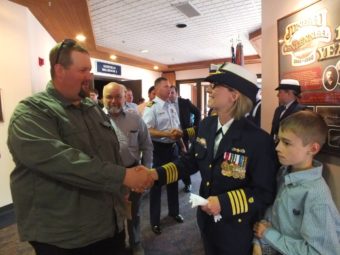
Rear Adm. Thomas Ostebo, commander of the U.S. Coast Guard in Alaska (USCG photo)
As the ice goes out in the Arctic, many people predict more ships will be drawn through the Bering Straits to take advantage of a shortcut between Asia and Europe. But, a recent government report suggests less ice may not mean more ships.
Sen. Lisa Murkowski has made it her mission to remind Washington the Arctic is opening up. In speeches and at hearings with top officials, she aims to instill a sense of urgency about preparing for an increase in ship traffic and new economic opportunities.
“The time to development the infrastructure and support capacity to handle this growing amount of traffic is now. Actually, it was yesterday,” Murkowski said on the Senate floor last month.
A recent report from the Government Accountability Office runs counter to her message. The report authors interviewed dozens of stakeholders, including executives at cargo companies, mining companies and cruise lines about their plans to send more ships into the Arctic.
“We came to the conclusion that it was going to be limited,” Lorelei St. James, team leader on the GAO report, said.
Two big caveats: The GAO report looked only at commercial activity in the American Arctic,
and only over the next decade, but St. James found that just because ships can traverse the Arctic for part of the year doesn’t mean they will.
“There’s just some fundamental geographic reasons that make it more difficult to operate in the U.S. Arctic,” St. James said.
While an over-the-top route can be 40 percent shorter than the traditional voyage between Asia and Europe, the GAO found container shipping companies aren’t interested. To them, speed is less important than reliability. The business is largely driven by the need for components to move steadily around the globe, from factories to assembly plants to markets. Nobody wants inventory to pile up, so if ships are late, St. James says, a factory might have to halt production.
“They’re very concerned about on-time, and with the unpredictability of some of the weather patterns up there, it just made the shipping companies we talked to less, the U.S. Arctic less attractive to them,” St. James said.
Time is also a big factor for cruise lines in the Arctic, the GAO learned.
“We were told that even if there were deep water ports or ports that the cruises could stop at, that it just takes so long to go through the U.S. Arctic that there’s just a lack of demand from the mainstream for that type of cruise,” St. James said.
While the Arctic lacks deepwater ports and the U.S. has only two working ice breakers, better maritime infrastructure would not really boost shipping or tourism, St. James says, although miners told the GAO they could use a new dock.
“Right now the zinc that the Red Dog Mine has is lighter than copper, so the copper industry would need a deeper water port but officials told us that they were not prepared to pay for that type of … infrastructure,” St. James said.
Admiral Thomas Ostebo, commander of the Coast Guard in Alaska, says he agrees with the GAO report and the cautionary note it strikes on building maritime infrastructure.
“Based on what we know now … it’s too early to tell, what infrastructure we need where we would need it and how big it should be,” Ostebo said.
Get those answers wrong and you waste a lot of money. Ostebo says the perceived need for more icebreakers goes up and down, but the Coast Guard is in the very early stages of possibly acquiring a new one. Meanwhile, though, Ostebo says the clearest need in Arctic waters is for things like better maps and charts, improved communication technology and new
environmental surveys.
“There is a future for the Arctic, and those things would be great investments in whatever future comes up,” Ostebo said.
Sen. Murkowski says she appreciates the GAO report’s emphasis on the need for mapping and charting, but maintains Arctic activity is on the rise, so now is the time to invest there.
The Russian-flagged tanker Renda, carrying more than 1.3 million gallons of fuel, sits in the ice while the Coast Guard Cutter Healy crew breaks the ice around the tanker approximately 19 miles northwest of Nunivak Island Jan. 6, 2012. (Photo courtesy U.S. Coast Guard Cutter Healy)
The U.S. Coast Guard has operated in the Arctic for more than a century, but as the maritime agency plans for an increased presence in the region, its taking stock of what its environmental impact will be in the Arctic in the years to come.
Mike Dombkowski is on the team drafting the Coast Guard’s new environmental assessment for Alaska’s District 17, which was released Tuesday. The document looks at what increased training and patrols in the Bering, Chukchi, and Beaufort Seas will mean for arctic ecosystems.
“What you might call day-to-day Coast Guard operations, doing patrols, search and rescue, aides to navigation, the other types of missions that we perform, here’s what we see ourselves doing and here’s what we think the environmental impact of those things are.”
The assessment looks at the Coast Guard’s plans for a broader arctic presence from mid-March through mid-November. Beyond summer training exercises in the Bering, Chukchi, and Beaufort Seas—exercises the service has already conducted for several years running—the increased arctic operations call for establishing safety zones around vessels exploring for oil, enforcing laws protecting endangered species and marine mammals, and “poaching prevention” of fish stocks and mineral deposits. The plan also calls for routine patrols of arctic waters with the nation’s two active icebreakers.
The assessment claims the impact will be minimal, and finds an increased Coast Guard presence will have “no significant adverse impacts” on water quality, arctic biology, cultural resources, and public safety.
It’s supported by a companion document, a biological evaluation endorsed by the National Marine Fisheries Service and the U.S. Fish and Wildlife Service, that affirms the Coast Guard’s increased arctic presence is “not likely to adversely affect” protected bird, fish, and marine mammal species.
Even if their arctic commitments increase, the bigger question for the Coast Guard may be one of resources.
Andrew Hartsig directs the arctic program at the Ocean Conservancy, a non-profit oceans advocacy group in Anchorage. He says an increased Coast Guard presence above the Arctic Circle is, on the whole, a good thing, but he questioned if the agency has what it needs to carry out its goals.
“The limiting factor is clearly funding, and until the Coast Guard gets more funding, specifically to engage in arctic work, they are going to be resource-limited in terms of the personnel and the assets they can bring to bear.”
Despite continued calls from residents and organizations in the arctic for plans and preparation for maritime disasters like an oil spill in arctic waters, Dombkowski said those are all questions for a different assessment to tackle.
“Oil spill response is such a huge, big enough thing that it really deserves its own document,” he said, “and that document and supporting stuff is being done right now.”
For now, the Coast Guard plans to tour its new environmental assessment statewide, with plans to visit Anchorage, Kotzebue, Nome, and Barrow next week for public meetings.
A delegation from the agency will be in Nome Monday, May 12 at the Northwest campus, delivering at the campus conference room from 3 p.m. to 7 p.m.
The TW Manila leaving port in Australia in 2013. (Courtesy: Basil Brindle/MarineTraffic.com)
The Coast Guard sent three aircraft on a long-range rescue for a mariner aboard a container ship near Unalaska Monday.
The 751-foot bulk carrier TW Manila first called for help late Sunday night. They reported a crewmember was suffering from appendicitis-like symptoms on board.
The ship was 450 miles south of Unalaska at the time. That’s too far out to sea for a helicopter to safely conduct a hoist, says Coast Guard public affairs officer Jonathan Klingenberg.
“They have to get within 125 nautical miles so the helicopters can get out there with the fuel that they have, pick up the individual and get him back safely,” he says. “Any further than that, they risk fuel consumption.”
He says the Coast Guard told the cargo ship to steer closer to Unalaska. Then, the Coast Guard deployed a Jayhawk helicopter and Hercules airplane from Air Station Kodiak. They also called in a Dolphin helicopter from aboard the Coast Guard Cutter Midgett. The Seattle-based vessel was on patrol nearby.
Klingenberg says the extra aircraft were there as a precaution because the rescue was so far from land.
“These long-range medevacs illustrate our crews’ abilities to coordinate a highly complicated medevac such as this,” he says. “It takes a lot of planning with not only our cutters, but also our air crews and the vessel that the patient needs to be rescued from, in order to get them within range for us to get out there and safely get him back to the medical care that he needs.”
The aircraft met the cargo ship 125 miles south of Unalaska early Monday morning. Klingenberg says there were 15- to 20-foot seas and winds up to 40 miles per hour at the time.
The Jayhawk crew hoisted the 28-year-old mariner off the ship and took him back to Unalaska. He was transferred to a commercial medevac for further care.
Governor Sean Parnell has been responding to allegations that sexual assault crimes within the state’s National Guard were reported to him four years before he requested a federal investigation. The Governor says as soon as he had specific information, he acted. Parnell’s commissioner of the Department of Military and Veteran’s Affairs, Major General Thomas Katkus says the federal investigation should help improve the system.
Major General Thomas Katkus, how large do you think the sexual assault issue is within Alaska?
The numbers I’ve got show us below what it would be in Alaska, we have a different number, total number of cases, because we track victims, don’t track it as if we’ve got that many suspects. We’ve got 37 cases; of those 37 cases we have only 11 reported sexual assaults are Guard members as perpetrators. My position is even one is too many and it’s a problem – a large problem; 37 cases over the past 5 years.
How does Alaska compare to military nationally for sexual assault?
With Alaska being the highest sexual assault in the nation, dark climate, small houses, alcohol, there is a lot of propensity toward that kind of activity, which is unfortunate but also very rampant in cold, dark climates. I think the problem is getting better results with the resources being put toward it. The Guard is community based so we have a lot of resources beyond DOD. We have a lot of members in the National Guard that are counselors or lawyers so we have resources. The issue is out there fairly evenly across all services but we’re better equipped to offer services.
Does the legal structure of the Guard make it more cumbersome, more difficult to track cases and get information, Anchorage Police Department handling cases? Helpful or more difficult?
Difficult to address. We as a National Guard, we don’t have an independent criminal justice system. We’re not like active duty that has its own Uniform Code of Military Justice to address specifically infractions within the National Guard, because we have members that are also traditional, that go home at night and are under the laws of their communities. The authorities that cover our members are really the local authorities, the state troopers or other law enforcement. It’s not our purview to supplement that. We take our own disciplinary actions through normal business practices, rules and regulation enforcement and then we have discipline. But we don’t incarcerate individuals. We don’t have a requirement; that our preponderance of evidence is what we go off of, 51% is civil action as opposed to beyond a reasonable doubt in any type of criminal investigation.
Governor Parnell said he acted to call for a national investigation as soon as he had specifics. What kind of specific information is needed to prompt an investigation?
For the National Guard Bureau that the Governor asked, it’s just the request of the Governor. The Governor, anytime he has a desire to have an independent assessment or look into an organization he’s responsible with, which would be the Air Guard or the Army Guard, he can contact the National Guard Bureau, advise them of the problem and they would propose the best solutions to step forward to look into it. Because it could be a safety issue, it could be an area of concern on finance, so either the safety investigators would come out or an auditor. Or in this case to look at a problem with how the reporting system is or an assessment of how overall, we are addressing sexual assaults or sexual harassment in the National Guard. So, in this case, again, he puts the problem statement forward and they provide the resource that best answers that.
Why wouldn’t chaplains risking their positions to bring the concerns forward to the Governor be enough to prompt an investigation by the DOD?
I don’t know that I have an answer for that. The Chaplains shouldn’t be at risk for bringing any of these issues forward. There’s no risk to them to, matter of fact it’s incumbent on them to bring those issues forward. Their job description is pretty much, they advise the command….trying to make sure I get this right so that this is fairly accurate. The significant responsibility that they’re held to is to advise the commander of issues of ethics, morals and morale within an organization. So they’re almost held on a no harm, no foul. They’re required to bring the bad news forward if they’ve got the bad news.
Well it seems there was some confusion or hesitancy in that regard. Your deputy commissioner asked the chaplains to sign a document saying they wouldn’t speak on behalf of the Guard, when actually what they were doing was bringing victims concerns forward. Did you ask him to do those things or was that something he felt he needed to do as deputy commissioner?
I believe the letter you’re referring to is a letter that went out to all of our members as we approached the political season. It was advising everyone to be very judicious and cautious on how they answer anyone that is approaching them and asking them for an official position of the department. So in that sense that was just to reiterate to clear it with a supervisor and we’re not prohibiting anybody from talking to the press, their chain of command or other people. Just that they try to clear that, get the best information possible and if they’re speaking for the department, make sure they clear it through our public affairs office in order to make sure we have the best, most accurate information out there.
Do you think there needs to be changes in reporting and how people can bring these concerns forward to help boost confidence for people who are taking on the very difficult thing to have to come forward and talk about trauma and painful episodes they may have experienced?
Absolutely, especially with as many deployments as we have because it’s not only in the area of sexual assault, it’s any type of experience that they are not normally exposed to in civilian activity. So there are traumatic events in everyone’s life. We follow DOD policy and its changing constantly. I think in the last five years the department of defense has definitely stepped up its game. It’s provided additional resources and of the limited training dollars, a significant amount of that resource is directed to bystander training, self help awareness to educate people about reporting any type of sexual assault or activity related to it. Then the resourcing for the investigation of those has increased and we’ve worked on training our investigators to investigate the civilian equivalent complaints of sexual harassment. WE have additional resources that would look into any allegations of sexual assault, after the law enforcement have also been engaged on that same topic. And then the victim advocacy program we have. Multiple victim advocates have been assigned to the Guard as of late. Currently have three sexual assault coordinators assigned and 42 victim advocates assigned to the National Guard. So your question was, do I see better ways to do it? We can always improve but it is an incredible change over the past five years to where we are now.
Major General, how damaging is this for morale?
You know, it’s damaging for morale, but where I’m very, very concerned, is we’ve made great strides in making people aware, we have a process in place, it’s very transparent and they can feel comfortable reporting and they’re going to get the help. With all of the adverse press and the senior officials who have basically expressed their concern and trust, I would hope that would not translate to the other end of the food chain to the young members who may be victimized and may now decide not to come forward because of lack of trust in the system. The DOD has spent five years trying to put in place a system that works and I’m very afraid that this might be undermined by the lack of confidence that may be generated by this perception that is out there.
Are you confident that when this investigation is over, that the system will show there are no major problems with how the guard is handling reporting and the cases that come forward?
I’m confident that the assessment will come in with a better way of doing it. This is the first time we’ve really stepped back and evaluated from top to bottom, the entire process. I would hope they would come in and advise us of better ways to do business. So we look forward to what we will get as feedback. My feeling is we have a good system in place right now, it’s a workable system that follows all of DOD’s processes and regulations and I’m thinking an outside look will provide that much more suggestions that we can incorporate and make this better.
My last question would be, you just mentioned Guard members and a perception of what’s happening. What would be your concern about perception? We know there are high rates of assault, what perception are you concerned about?
Well, the perception I’m concerned about is that, in the past five years, 70% of reported assaults, the perpetrator was a member of our community, not the National Guard. So 11 assaults in five years, those members were Guard members who committed those acts, so out of 37 cases, only 11 have we had to discipline one of our own members over. The rest, the other 26 cases, are all cases were we have provided exceptional support for the victim. Those victim advocates have engaged. We’ve taken the victims to local law enforcement, supported them through all of the issues and tried to make sure we could be there for them. That’s what’s not getting reported here is DOD as an organization has provided incredible response in taking care of the soldiers and airmen that are assigned in the National Guard and that’s where I’m really afraid the perception is being missed here.
Is the Guard looking at, the people who have been victimized. Are there efforts underway to track back and look at where are people getting into positions where they’re at risk. Is there research into that so you can help young men and young women avoid some of those pitfalls?
There’s always different types of training we have people exposed to and mandate and some of the best is bystander training where not only do you train people to look out for themselves and not put themselves into harm’s way but also train soldiers to look out for other people that may be inadvertently putting themselves in harm’s way. So they teach them how to carefully approach a situation and defuse it. Sometimes a third party, that extra set of eyes that the potential victim may not be able to see. So your answer is yes, we’re training people to be safer and we’re training them to look out for each other and realistically that’s how you start solving all of these problems is everyone becomes aware of looking out for each other.
Governor Sean Parnell discusses his proposed FY15 budget. (Photo by Josh Edge/APRN)
Governor Sean Parnell is defending his decision to wait four years to request a federal investigation into reports of a sexual assault problem in the Alaska National Guard. Anchorage Daily News columnist Shannyn Moore wrote Sunday that Parnell first learned about misconduct in the Guard in 2010, when he was approached by three guard chaplains. Parnell says he took those charges seriously, but lacked the details to prompt an investigation until February.
He says after the initial concerns were raised, he went to Major General Thomas Katkus to make sure the systems were in place to protect guard members. Then in February, Parnell says he was able to talk with a guard member who provided specifics.
Based on what you’ve heard from victims and others, how big of a problem do you think sexual assault is in the National Guard?
I think one allegation is too much and I take every allegation seriously, because I am concerned about Alaskans who suffer from sexual assault and violence. It’s been a core part of who I am fighting for victims of domestic violence and sexual assault. So, I take every assault allegation seriously. So, in 2010 when the chaplains first came to speak with me and they made allegations that sexual assault was occurring on Guard members I questioned them and asked for detail, and they could not provide it because they were under duty of confidentiality to the people they counseled, but immediately after that I took action and went right to the Guard, to the general, and asked him to talk to me about what he knew of sexual assaults occurring in the Guard. And he went through the cases that had been filed at that time; spoke about how any cases that involved allegations of criminal activity, as in sexual assault, are not only investigated but they are also referred to local law enforcement – like the Anchorage Police Department. And I made sure that for the safety of the victims and any future victims in the Guard that there was, and is, a reporting process that’s safe for anybody in the Guard to utilize; that there’s an investigation process that is complete and accurate and directed that appropriate penalties be assessed. Now, that’s outside the criminal context, but the criminal context goes directly to law enforcement. I had only those general allegations of sexual assault, but I still took action to make sure that there was a system in place that works for victims of sexual assault.
Those general allegations persisted but they were the same allegations about events that occurred years ago. And then on Feb. 26th, Senator Dyson, came to me and said he had specific detail. Before when he spoke to me he had general allegations and he asked me to call a guard member who would provide me with specific detail about how the system wasn’t working. I made that contact within 24 hours of Sen. Dyson’s [call], personally spoke with a Guard member. That Guard member provided me with two instances where, if the allegations were substantiated, that the system would have failed our Guard member. And at that point, I realized I needed to get an independent assessment of the entire reporting and investigation structure. So I called in the National Guard Bureau, they have a complex investigation review team – I did that within 24 hours and that team is on the ground now in Alaska, doing their work to make sure that victims are safe.
Some people will think why was it four years? In hindsight do you wish you would have come forward four years ago, what do you think could have been done differently?
At the time I took immediate action to make sure that every victim of a sexual assault had been referred to law enforcement. I made sure that anyone who had concerns about what was happening in the Guard had a safe reporting structure, but without specific detail about how the system was otherwise failing, that’s all I could do, is what I believed. And still believe that. But, on the other hand, once I got specific information about how the structure was actually failing, in other words the who, what, where, when why – the same thing you reporters ask – even though I pressed for that earlier and nobody could or would provide me with that, the second I got that kind of information I took immediate action with the National Guard Bureau to get them in there and get an independent look at what was happening.
Talk more about the specifics? What exactly were you needing for you to have that ability to actually ask for an investigation?
So, 4 years ago I was told there is a problem with sexual assault in the Guard. That is the sum and substance of what I was given. When I went to Guard leadership to inquire about that they said that yes they had specific instances where sexual assaults had been reported, that those had been referred to law enforcement for investigation, like the Anchorage Police Department. And they also detailed the reporting structure for any kind of alleged malfeasance in the Guard that was in place. And I had detailed for me, here’s the list of cases that are pending; here’s the list of cases that have been resolved in the past. But when it came specifically to the sexual assaults, when that kind of criminal activity was brought forward, that went immediately, as I was told, to law enforcement, which I think is appropriate.
One of the problems with sexual assault cases is there often isn’t enough information and it’s very difficult for victims to come forward. Did you consider that when you decided not to pursue an investigation earlier? What would you say to a victim of sexual assault about the statement that you didn’t have enough specifics? Do you think that’s enough of an answer for someone?
What I did is an internal state investigation. Meaning, I went in, my office went in and we made leadership tell us exactly what they were doing to protect sexual assault victims. When I had an actual specific set of facts related to how the system had failed, or – in this case – was alleged to fail, I asked the National Guard Bureau, as an independent assessing body, to come in and look at what I had been told and also look at the entire system to make sure we protect our guard members.
The Choose Respect campaign has been a big focus for you. Are you concerned this will damage the momentum or image you’re hoping to get across to Alaskans about coming forward when these things happen?
Well, absolutely. Anyone who knows me would say I care deeply about victims of sexual assault and domestic violence. And I’m more concerned than anything that victims may not come forward. Because I know from speaking with many across the state how difficult that already is, and I don’t want to make that more difficult. That’s why I launched the immediate investigation, even when I had the barest of details, and now that I have specific details, I’ve called in the National Guard Bureau to help because I think it’s beyond us at this point.
When do you expect the investigation to conclude, when will you have a report and will you commit to releasing that report publicly?
I already have. I have made that commitment. The review team from the National Guard Bureau let me know they would be on the ground, in Alaska in the month of May. They said that it would take several months after that to complete the report and make that available to me. I already committed to making that report public, with the exception of any confidential victim information that should not be put forward, because I do want to protect the privacy of the victims. So, that’s been my commitment and remains so.
You’re still standing behind General Katkus. Do you have confidence in him? Do you wish he would have come to you sooner?
General Katkus has been very forthright. When I started asking questions about sexual assault cases, he came forward right away, showed me the cases that had been transferred to law enforcement, showed me how they have tracked cases, detailed how they investigate cases. And he’s been very proactive about holding what the Guard calls “sensing sessions,” meaning going into guard units and informing people about how to report acts of sexual harassment, acts of sexual violence. So General Katkus has been very proactive in that regard, and that’s what I know at this point.
Do you think he could have done more within the Guard itself to make sure this behavior was not at all tolerated?
From what I know now, the answer is no. But again, I’ve asked the National Guard Bureau to come have that independent look to make sure our Guard members are safe. General Katkus has told me at every turn that’s his desire and mission, he understands it, gets it and he has the systems in place that demonstrate that. I have asked the National Guard Bureau to make sure that those systems truly work for victims because we care deeply, and I care deeply, about protecting Alaskans.
Did you talk to anyone beyond General Katkus about the chaplains’ concerns?
Yes, in fact, our office talked with numerous Guard members. All of which had the same general allegations. There was one victim who came forward and spoke with a member of my office. Her case was also being investigated by Anchorage Policed Department at that point in time, so the answer is yes, we spoke with a number of people.
Mike Nizich-yYour chief of staff- was using his personal e-mail account to correspond about this issue. Why was that?
I spoke with Mr. Nizich and understand that was at the request of the chaplains who wanted to go outside the official channels. However, I’ve asked Mr. Nizich to check his personal e-mail for that and his recollection is that it’s one email. I’ve asked him to check for that and move it to the state account, which is protocol to follow. And that will be a part of the public record at that point.
McHugh Pierre was asking questions. Who asked him to have the chaplains sign confidentiality statements?
I don’t know that but I do have a copy of what he apparently asked to be signed. It’s a statement that was emailed to all Department of Military and Veterans Affairs employees. It says employees aren’t authorized to give statements on behalf of department without first coordinating the request with one’s supervisor, which is standard operating policy in any department or any business that you don’t speak for the business, you don’t speak for the department. without first coordinating it with your supervisor.
He also spoke with people on base about wanting to know how information was getting out. It almost feels a bit like a witch hunt. Does that concern you that oftentimes it takes people acting outside of the normal channels to get this information out and at the end of the day, that’s the main mission, is it not?
Well that’s true and that’s why I asked these questions. Again, there’s nothing that stops the employee, as long as they’re not speaking on behalf of the department. In other words they’re speaking as a person, as an Alaskan who’s concerned, that’s not what this statement addresses though.
But the chaplains weren’t’ saying they were speaking for the department, they were raising concerns about people who were alleging sexual assault.
And I don’t condone the activity you just described. I do, on the other hand, understand when supervisors are asking their employees not to represent the department in certain things. In this case, I don’t have all the facts, but I don’t condone trying to stop what you’re describing.
So you’re saying you wouldn’t condone McHugh Pierre asking them to be quiet?
No. But again, I don’t have evidence is that’s what he did. What I evidence is that he asked them not to speak on behalf of the department without coordinating that with a supervisor.
What have you taken away from this process? Do you think there are changes that need to be made? Are you frustrated by the process are there things that need to be done differently?
I am frustrated when Alaskans in the Guard don’t feel like they are protected; that’s entirely frustrating. And it’s frustrating to me when I don’t have enough information to take action beyond what I did. In other words, I took action, I made sure that the systems were in place to protect Guard members; and that the people were in place, like an independent investigator – a safe route for people to report, but until the end of February, until then I didn’t have verified facts that alerted me I needed to bring the National Guard Bureau in. So, I do get frustrated when Alaskans are reporting harm and are continuing to report harm, even though, from all appearances, the system is in place and the checks and balances are in place to assure their safety – including referrals to law enforcement agencies. So if indeed we find there is wrongdoing, I ‘ll take steps to punish that and make it right, there’s no question about that.
Petty Officer Third Class Travis Obendorf died in a Seattle hospital Dec. 18 as a result of injuries he sustained during search and rescue operations near Amak Island, Alaska, Nov. 11, while serving aboard Coast Guard Cutter Waesche. (Photo courtesy Coast Guard Cutter Waesche)
The Coast Guard has finished investigating a Bering Sea rescue that left a 28-year-old crewman with fatal head injuries late last year.
According to a review board, faulty equipment and work practices developed by the crew of the cutter Waesche put Petty Officer Travis Obendorf in harm’s way.
Obendorf and the rest of the Waesche crew had been on patrol in the Bering Sea for three months when they were called to help the Alaska Mist. It was a large fishing vessel that lost propulsion and started drifting near Amak Island.
The Waesche reached the fishing boat on November 11. Chief Warrant Officer Allyson Conroy says the situation was urgent.
“They had 22 mariners on board; they were disabled,” Conroy said “The Coast Guard needed to get the non-essential personnel off the Alaska Mist.”
Although they had access to a helicopter, Conroy says the Waesche crew wanted to send their rescue boat to pick up the crew. It’s a 24-foot inflatable Zodiac, with hard sides.
Conroy says the crew conducted a risk assessment of their rescue plan.
“With this particular mission, they had already done so many small boat operations in the environment that they were in on November 11 that they were more concerned about rescuing these people, and they were comfortable with conducting the operation,” Conroy said.
The Waesche had used the small boat 130 times during their patrol in the Bering Sea. It always went smoothly – except for the fact that the boat launch and recovery system was broken.
It was a capture net and line, designed to snag the rescue boat when the crew it back into its compartment at the back of the cutter. The system was supposed to secure the vessel without any human intervention.
But on the Waesche, it only worked about 40 percent of the time. The other two national security cutters also had problems with this system, but not as consistently.
Chief Warrant Officer Conroy says the cutters formally requested improvements to the boat capture system about four years ago.
“The safety implications were not evident at that particular time,” Conroy said. “Of course, retrospectively, the changes were incorrectly prioritized among numerous high-priority configuration change projects.”
In the meantime, the Waesche decided to work around it.
Conroy says they started posting a crew member at the very front of the small rescue boat. That person would manually secure the vessel after a mission. It wasn’t common practice, but it worked – until it was time to rescue the Alaska Mist.
Petty Officer Travis Obendorf – a 28-year-old Idaho native – was assigned to sit at the front of the rescue boat. They gathered five non-essential fishermen off the Alaska Mist and started to take them back to the Coast Guard cutter.
The Coast Guard Cutter Waesche tows the fishing vessel Alaska Mist through the Bering Sea near Amak Island, Alaska, Nov. 13, 2013. Joint effort between the crew of the Coast Guard Cutter Waesche, a Coast Guard Air Station Kodiak MH-60 Jayhawk helicopter crew, the 207-foot tug Resolve Pioneer and the fishing vessel Pavlof resulted in the successful tow of the Alaska Mist and safe disembarkation of the crew to Dutch Harbor. (U.S. Coast Guard photo by Coast Guard Cutter Waesche)
According to the Coast Guard’s investigation report, they faced rough seas – worse than what the rescue boat was rated to operate in. That made it hard steer the back into the compartment aboard the Waesche.
The rescue boat was halfway inside when a series of swells washed in behind it. The boat slid underneath the capture net, and the net shoved Obendorf backwards. He was slammed into the center console of the rescue boat and lost consciousness.
Obendorf had been wearing a helmet, but he still had severe head injuries. A medical crew aboard the Waesche responded as soon as possible, and Conroy says they called for a medevac.
“He was then medically evacuated from the Waesche and taken to Cold Bay,” Conroy said. “From Cold Bay he was taken to Anchorage; after Anchorage, he was then transported to Seattle for continued care.”
“And then, on December 18, he died in a Seattle hospital.”
Conroy says the Coast Guard started making changes to its national security cutters almost immediately after Obendorf was injured. They got rid of the rescue boat that the Waesche crew had been using and replaced it with a slightly larger model.
“There’s also been guidance put out that commanding officers are not to put any crewman forward of the center console, which is what happened in the incident with Petty Officer Obendorf,” Conroy said.
But Conroy says that within a few months, there shouldn’t be a need to put crew members in that position anymore. The Coast Guard is going to fix the system for launching and recovering rescue boats from cutters, so it’s fully automatic.
The repairs are similar to what the national security cutters requested back in 2010. And Conroy says that fact has prompted the Coast Guard to rethink the way they prioritize upgrades to their fleet.
“They are taking a closer look at the recommendations that are coming into the field, and specifically looking to see if they have a safety aspect and reevaluating those recommendations,” Conroy said.
In the end, Conroy says the Coast Guard is not taking disciplinary action against any personnel connected to the rescue operation or the accident. And Conroy says there haven’t been any lawsuits related to it, either.
Close
Update notification options
Subscribe to notifications
Subscribe
Get notifications about news related to the topics you care about. You can unsubscribe anytime.