Military

Bergdahl release ignites political controversy

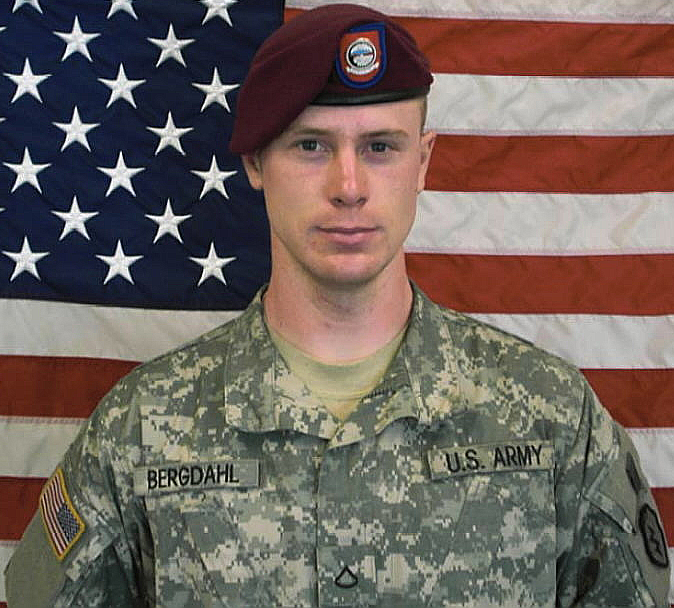
Sgt. Bowe Bergdahl was captured in 2009. (Photo courtesy U.S.  Army)
Sgt. Bowe Bergdahl was captured in 2009. (Photo courtesy U.S. Army)

Former Fort Richardson soldier Bowe Bergdahl was released over the weekend from nearly five years in captivity in Afghanistan. Both of Alaska’s U.S. senators issued warm statements welcoming the news, but in Washington, the price paid for Bergdahl’s release and questions about how he became separated from his unit are igniting a political firestorm.

Allegations that Bergdahl walked away from his unit because he was bitter about U.S. conduct in the war have been public since a 2012 Rolling Stone article, based on interviews with fellow soldiers and his emails home. Bergdahl reportedly told several people he might leave and head into the mountains of Afghanistan, and maybe walk from there to India. On military social media sites, some are calling him a deserter.

Still, Sen. Lisa Murkowski says the decision to release five Taliban prisoners from Guantanamo Bay in exchange for Bergdahl was the right call.

“I do think that it was appropriate that we not leave any servicemen behind. It’s what we do as a nation, so we were going to make sure that Sgt. Bergdahl was brought back home.”

Murkowski says the facts of how he was captured can come to light later. Sen. Mark Begich also says he won’t speculate about whether Bergdahl should face any punishment.

“I don’t know that, but I’m just glad that he’s back to be reunited with his family.”

But Sen. John McCain of Arizona, a former prisonAer of war, says it was wrong of the Obama Administration to trade Bergdahl for the release of five Taliban, who he called the worst of the worst. McCain says it’s a dangerous precedent.

“The question is … by getting the return of Sgt. Bergdahl are you placing in danger the lives of Americans in the future, and I believe you are.”

Sen. Lindsey Graham says he’s also concerned about reports that Bergdahl may have deserted but he says he won’t judge the man based on what little is known so far.

“I want a professional independent investigation by the appropriate military authorities … to find out what labels apply to Sgt. Bergdahl … but I want to understand what happened.”

The Senate Armed Services Committee, including senators McCain and Graham, is scheduled to hear a closed door briefing about the prisoner exchange next week.
Begich speaks on VA care in Alaska

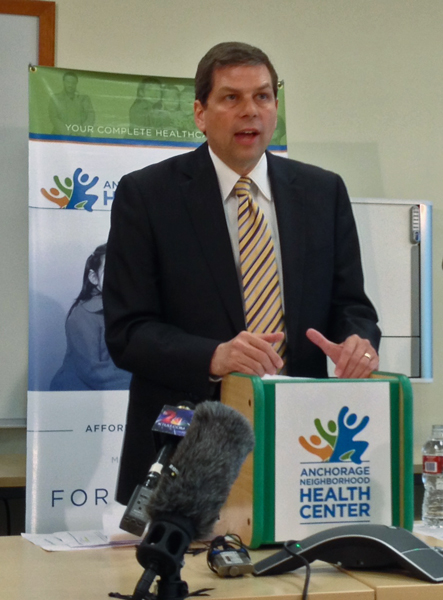
(Photo by Anne Hillman/KSKA)

Update | May 30, 2014 at 7:40 a.m.

President Obama now says Secretary Eric Shinseki resigned his post Friday.

Original Story

Amid national outrage over the Veterans’ Administration’s handling of medical services for veterans and congressional calls for the resignation of VA secretary General Erik Shenseki, Senator Mark Begich stopped short of calling for a resignation, but Begich said officials from the top down will be held accountable when Shenseki’s report comes out.

Begich, a member of the Senate Veteran’s Affairs committee, spoke at the Anchorage Neighborhood Health Clinic where he touted a collaboration in Alaska between the VA, the IHS and the neighborhood clinic to address veteran’s health care needs wherever they live.

“For example up in Nome, a beautiful new hospital up there. 800 veterans there, Native and non-Native, but they could not use that hospital,” Begich said. “They had to fly to the hub if they were in a village, fly to Anchorage for service or go to Seattle. So we figured out through these agreements, which were not easy and they’re still being worked on, a lot of complication but we figured out now that if you’re a veteran in a place like that, you could walk across the street, if you want, to get that service, right next door and the VA will reimburse them.”

Because of the agreements in Alaska, veterans can now go to 26 tribal health facilities across the state, and in Anchorage they can be seen at the Neighborhood Health Clinic.

Begich said in 2009, Alaska’s VA facility had one thousand veterans on a waiting list of 90-120 days. Now the list has dwindled to 10 and the wait time for new veterans is about 8 days. Susan Yeager is the director of VA services for Alaska, she confirmed the streamlined process and said the Alaska VA budget has gone from $150 million to $206 million this year.

“And the big change there was, in 2010, it was decided that patients with cancer needs should receive care in Alaska, because the VA is normally a hub spoke, normally we’d be sending to Seattle and it was determined at that time it’s better, more honoring veterans to receive that cancer care here in Alaska,” Yeager said. “So in 2011, that concept was expanded to any of the care that can be provided to an eligible veteran in Alaska, should be.”

Yeager said the Alaska VA facility passed a surprise inspection of their scheduling system and were told by inspectors they are scheduling in the right way.

Kimberly Cohen, executive director of the Anchorage Neighborhood Health Clinic said over the past two months they’ve started seeing more veterans come in and are currently serving about 200 veterans and hope for up to 2000 eventually.

“The first thing that’s happened with many of our veterans is, they’re not too sure about us because they think of a community health center as where poor people go,” Cohen said. “And then they come in and see they are welcomed and get really great medical care, they get really enthusiastic doctors.”

Doug Ebee, the Vice President of Medical Services for Southcentral Foundation, says the Alaska Native Health care provider is proud to be part of a system that helps veterans to be treated where they live.

“Because the only statewide network of health care in this state is the tribal system, so the hundreds of small villages. While it’s 26 Native entities, it’s hundreds and hundreds, over 200 village sites and small towns and communities where the only infrastructure is the tribal system and it’s now open to everyone,” Ebee said. “So community health center payments, VA payments, everyone can go.”

Ebee says there are currently 400 veterans who are signed up and being seen at the Mat-Su Southcentral Foundation facility. He expects that to grow to thousands across the state.

The VA’s Yeager says there are 77,000 veterans in Alaska with about 30,000 signed up for VA services. She says they serve about 18,000 veterans annually.

Juneau observes Memorial Day

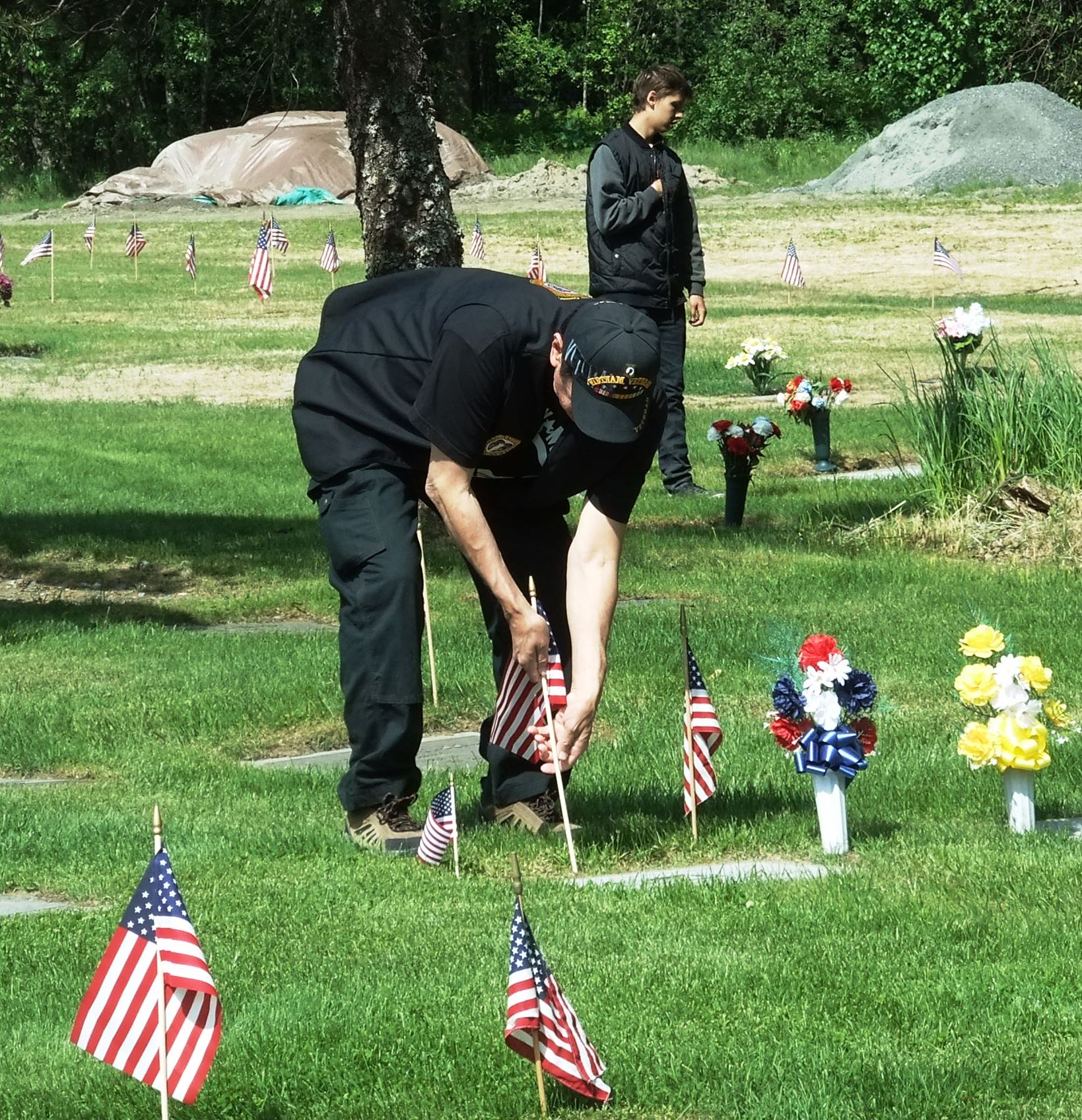
A veteran places a small flag near a grave stone on Memorial Day at Alaskan Memorial Park on Riverside Drive in Juneau. (Photo by Rosemarie Alexander/KTOO)

Amid the barbecues, picnics, annual sales and day off work, Juneau observed Memorial Day at three services designed to honor those who died in the service of their country.

Flags hung at half-staff and promptly at 11 a.m. the commemorations began at Alaskan Memorial Park in the Mendenhall Valley and Evergreen Cemetery in downtown Juneau.

U.S. Coast Guard 17th District Command Center Supervisor, James Armstrong, lamented the way Memorial Day has changed over the years.

“Happy Memorial Day, someone said to me the other day,” he said, noting the word memorial is defined as something designed to preserve the memory of a person or event.

“Nowhere does the definition include the words party or sale. Memorial Day is not a happy occasion; it is not to be celebrated. It is and should be an event to be reflected upon and observed. It is not at all about the beginning of summer, unofficial or otherwise. It is most certainly not a time for merchants to exploit as an excuse for a sale,” Armstrong said.

Armstrong blamed the Uniform Monday Holiday Act for degrading the true meaning of Memorial Day. Since the act took effect in 1971, Memorial Day has always been on the last Monday of May, though the original date of May 30th was set in 1868.

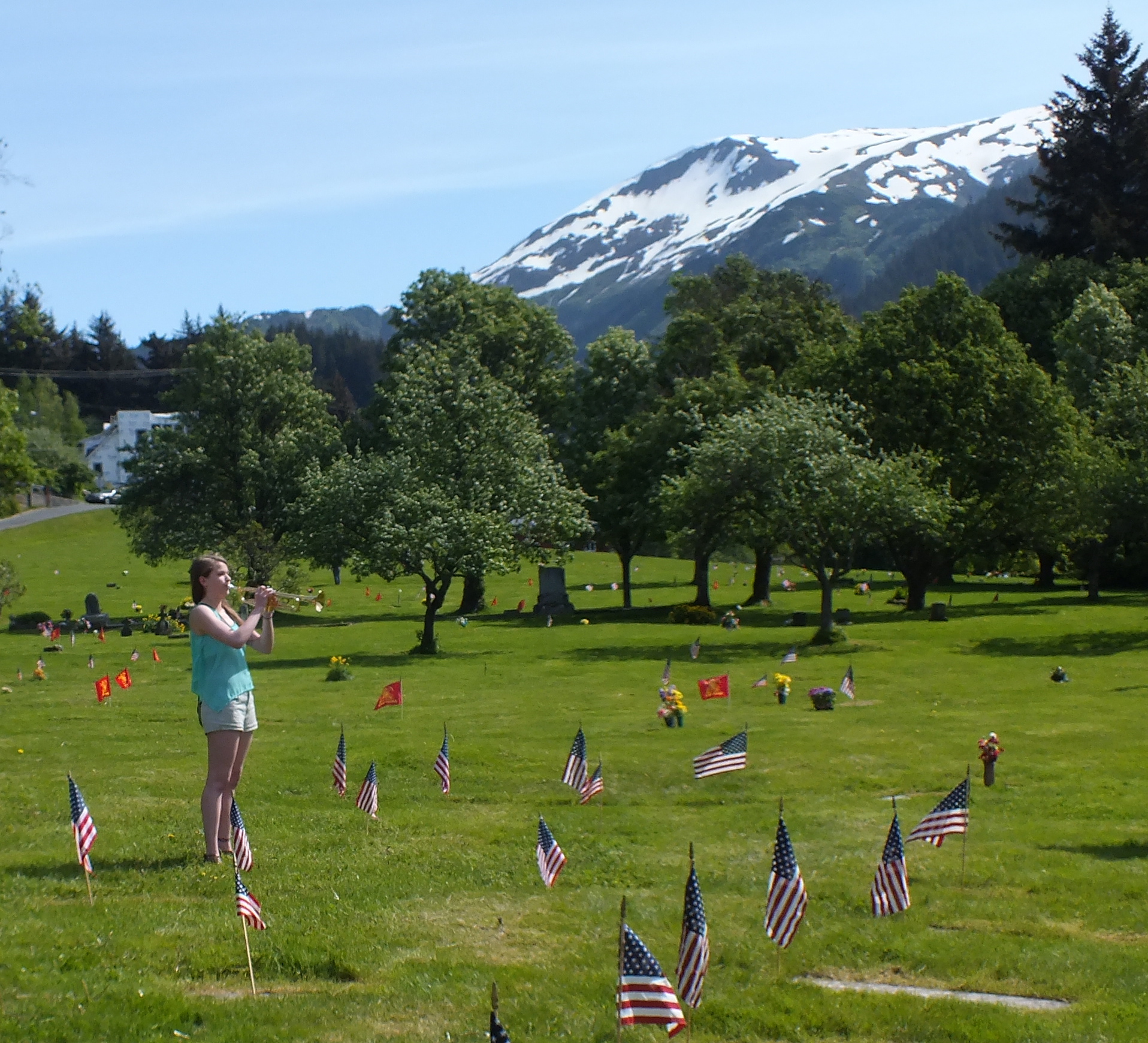
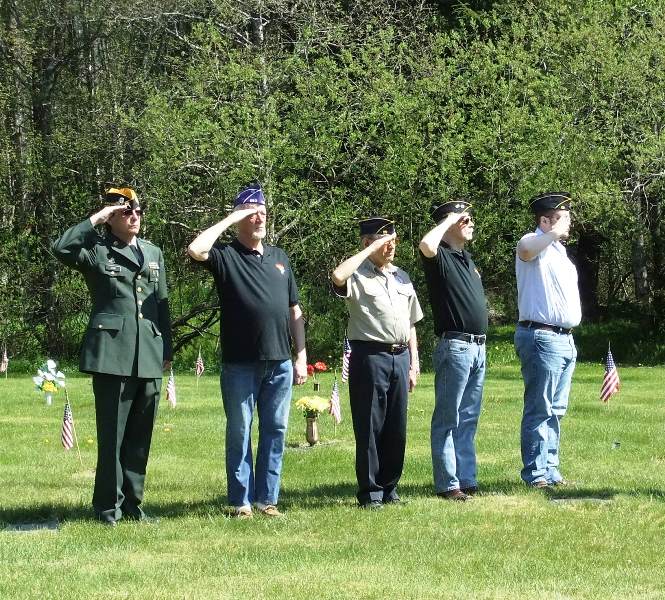
American Legion Auke Bay Post 25 hosted the Mendenhall Valley observance, where poems were read, prayers were given, flower wreaths were hung and taps were played. Families gathered to visit the graves of their loved ones and friends; many of the graves were marked with small American flags and fresh flowers.

Evergreen Cemetery observance

Memorial Day observances at Evergreen Cemetery featured the playing of  Taps. (Photo by Matt Miller/KTOO)
Memorial Day observances at Evergreen Cemetery featured the playing of Taps. (Photo by Matt Miller/KTOO)

The scene was similar at Evergreen Cemetery in downtown Juneau, where Taku Post 5559 of the Veterans of Foreign Wars held the annual commemoration.

Coast Guard Cmdr. Patrick M. Hilbert said he never really understood the importance of Memorial Day until he was stationed in the Netherlands. There he was approached by multiple generations of Dutch residents who still remembered and valued U.S. service members’ efforts during World War II.

Hilbert recalled the words on the Margraten, Netherlands memorial for missing service members at the American Cemetery:

‘Each for his own memorial earn praise that will never die and with it the grandest of all sepulchers. Not that in which his mortal bones are laid, but a home in the minds of men.'”

“With that sentiment in mind, today we mark the sacrifices of those that have passed over the bar in service of our nation,” Hilbert said. “We take stock of what we have to be thankful for. And most of all, we remember and honor those that we have to thank for the opportunities and prosperity we continue to enjoy today.”

Vet jackets
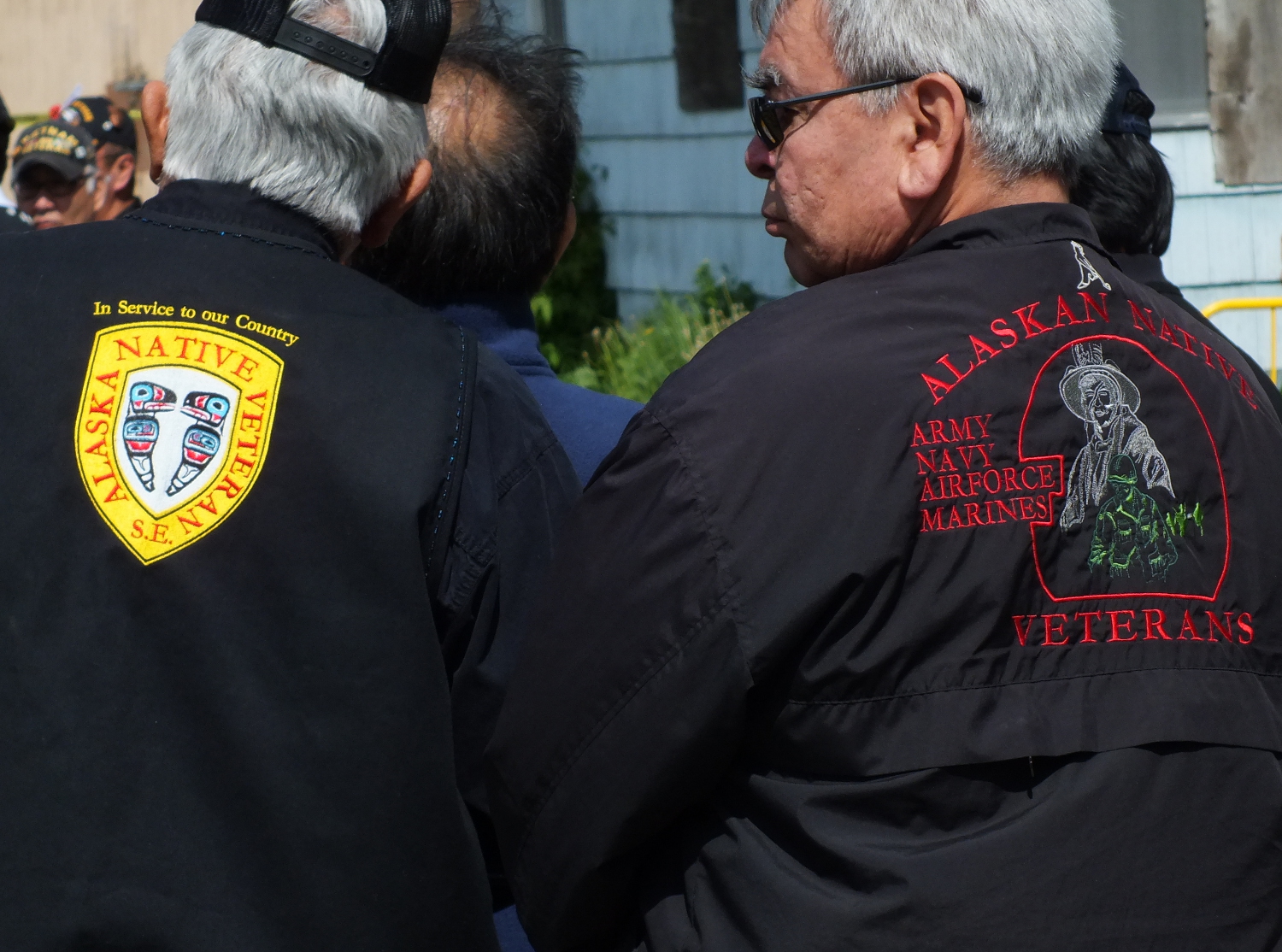
Jackets worn by Southeast Alaska Native vets during Monday’s Memorial Day observance. (Photo by Matt Miller/KTOO)

Alaska Native Memorial Day commemoration

Shortly after the Alaskan Memorial Park and Evergreen Cemetery events, another ceremony commemorating Southeast Alaska Native military members was held at the park adjacent to Elizabeth Peratrovich Hall.

As the names were read aloud, American flags were placed at the stones inscribed with the Tlingit, Haida, and Tsimshian words for warrior and courage.


Juneau Memorial Day Observances

Veterans salute the flag at the 2013 Memorial Day observance at Alaskan Memorial Park. (Photo by Rosemarie Alexander/KTOO)

Two observances are scheduled in Juneau for Memorial Day.

The annual downtown service will be held at 11 a.m. on Monday at Evergreen Cemetery, hosted by Taku Post 5559 of the Veterans of Foreign Wars.

The Mendenhall Valley observance is at Alaskan Memorial Park on Riverside Drive, also at 11 a.m. It will be hosted by Auke Bay Post 25 of the American Legion.

While many people think of Memorial Day as a day off work and the beginning of summer, it was first observed after the American Civil War when families would decorate the graves of their loved ones who died in the war.  It was known then as Decoration Day.

It is now an opportunity to remember all of those who have served their country.

On Memorial Day, the American flag should be flown at half-staff until noon then raised to full staff.

Investigators find no cover-up at Alaska National Guard

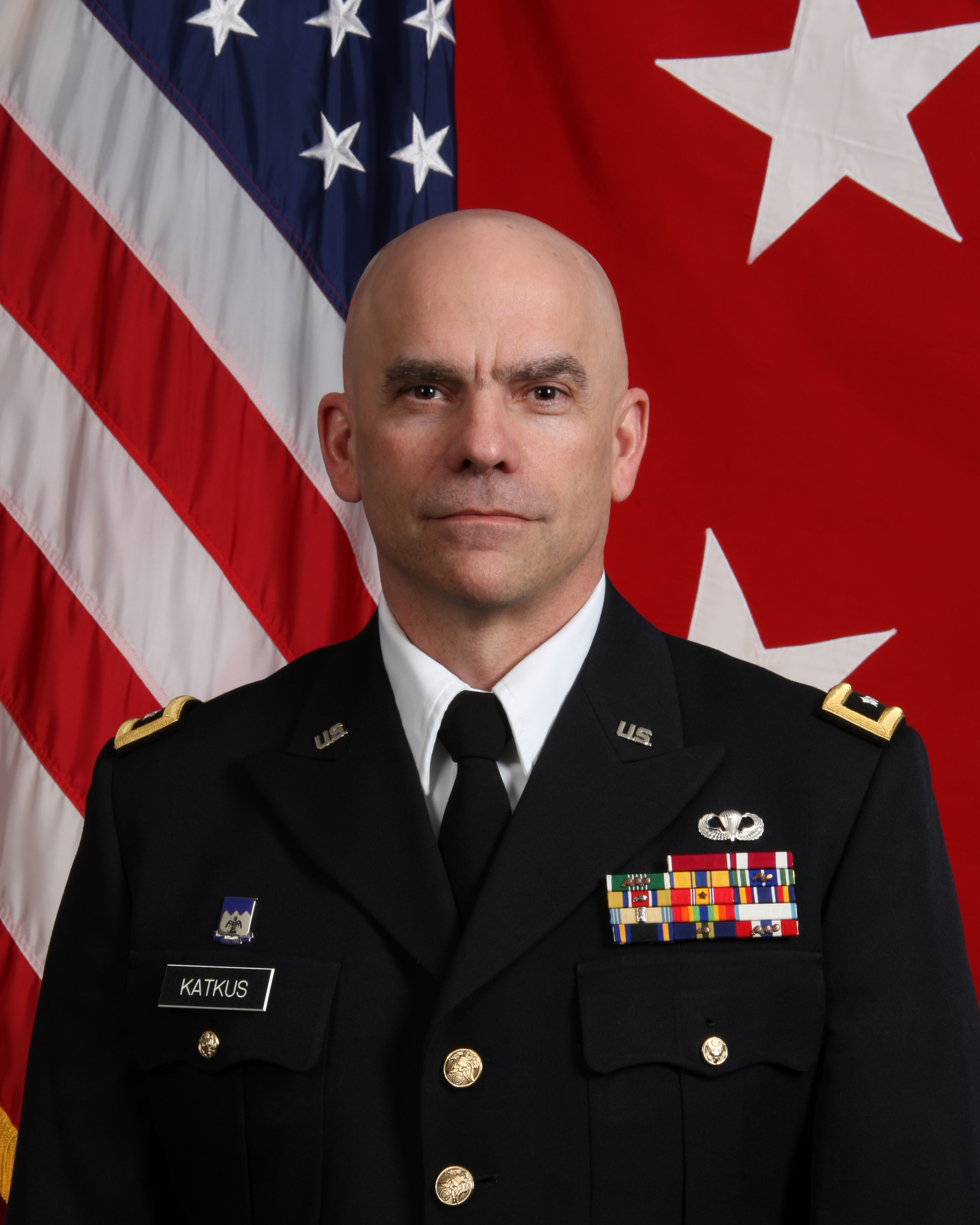
Major General Thomas Katkus

An Army Inspector General found no fault with how the Alaska National Guard handled reports of sexual assault and harassment. At least, that’s how the Inspector General’s office for the Defense Department explained it in a letter to Sen. Lisa Murkowski. Murkowski says she asked for the investigation last year after hearing troubling reports from two Guard chaplains. She says she won’t comment until she gets a chance to see the IG report for herself.

The one-page letter to Murkowski  says the Army Inspector General’s investigation ended last month. Its focus was whether the Alaska Guard allowed a management climate that wasn’t conducive to reporting sexual assaults, and whether officials tried to cover up any accusations.  The letter to Murkowski says the Army IG didn’t find evidence of a cover-up.  It also says Guard commanders didn’t identify any concerns about the reporting of sexual assaults during “climate sensing sessions” with the troops.

The letter confirms some of the broad outlines of the case. It says the Guard’s Sexual Assault Response Coordinator received 11 allegations of sexual assault since 2012. They were forwarded to civilian police, but only two were substantiated, and none were prosecuted in court. The letter from the Pentagon IG seems to clear the top officer of the Alaska Guard, Thomas Katkus. It says he delivered administrative punishment on the only two cases he could, by discharging one of the accused from Guard service and initiating the departure of another. Another DoD oversight branch, the Directorate for Investigations of Senior Officials, reviewed the Army IG report and concurred, the letter says.

Major Candis Olmstead, a spokeswoman for the Alaska Guard, says nine alleged sexual assaults by Guardsmen have been reported to the Sexual Assault Response Coordinator since 2009. She doesn’t know why the letter mentions 11 cases just since 2012. She says, though, the response coordinator takes reports from Guard victims regardless of whether the person they accuse was in or out of the Guard.

One more investigation into the Alaska National Guard is still underway. It’s by the Office of Complex Investigations, part of the National Guard Bureau.

Pentagon plans to dismantle HAARP before winter

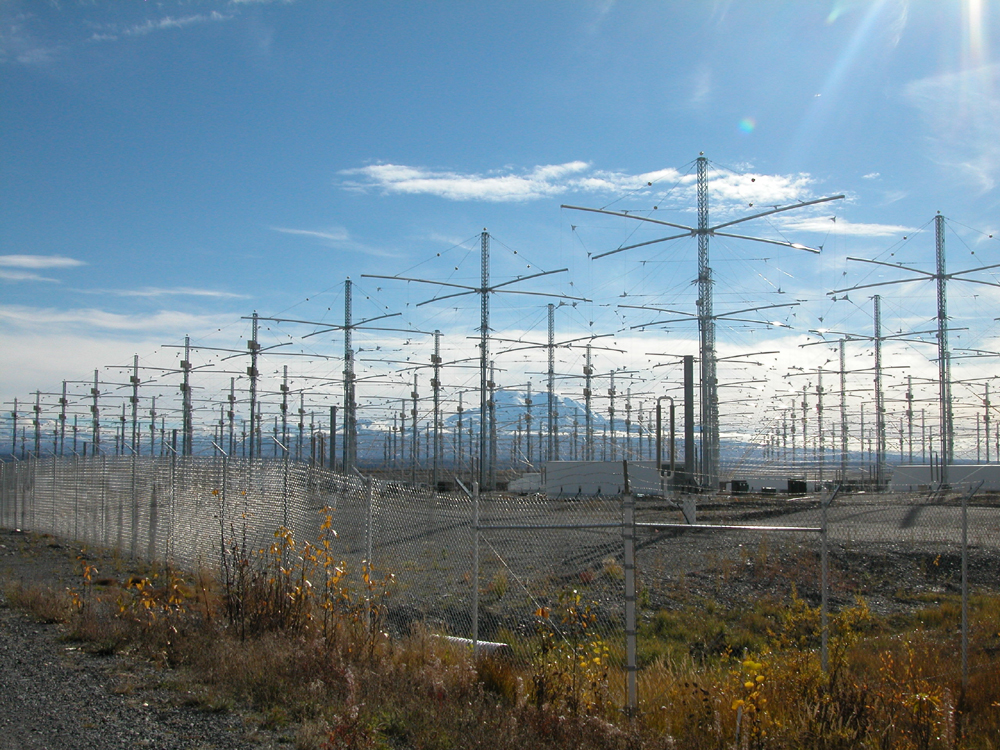
HAARP antenna array. (Photo by Michael Kleiman, US Air Force)

Pentagon officials said at a U.S. Senate hearing Wednesday they hope to take down the project in Gakona known as HAARP before winter sets in.

David Walker, an Air Force deputy assistant secretary, says the military has moved on to other ways of managing the ionosphere, which is what the High Frequency Active Auroral Research Program was designed for.

“Our position has been that if there’s not somebody who wants to take over the management and the funding of the site, then the Air Force has no future need and that we do plan to do a dismantle of the system in the future.”

Walker says the University of Alaska Fairbanks has inquired about taking over the system but hasn’t offered to pay the cost of operating it, which runs about $5 million a year. Walker and other Pentagon scientists at the hearing say they made good use of HAARP, which uses antennas to direct energy into the ionosphere. The 30-acre facility cost $300 million and opened seven years ago.

Site notifications
Update notification options
Subscribe to notifications