Crime & Courts

After cliff fall, Ketchikan’s ‘Gandalf’ says reports of his death were greatly exaggerated

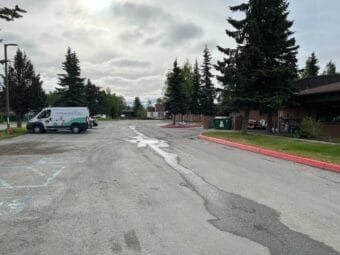
The view of Ketchikan Creek from Park Avenue, upstream from the ledge where Henderson fell. (Photo by KRBD)

A well-known Ketchikan resident was sent to Seattle for medical treatment after he was allegedly pushed off a 30-foot cliff into a creek. The man’s name is Robert Henderson and in recent days, Ketchikan residents took to Facebook to express anger and sadness at the news that Henderson had died from the fall. Except that he didn’t.

“No, I’d be the first person to know if I was dead,” Henderson joked from his hospital room in Seattle. He says he sustained a few cracked ribs and a busted shoulder, but he’s alive.

Henderson was medevaced to Seattle following an altercation that took place in mid-February at the local homeless shelter. Ketchikan police say that, following an argument, another man attacked Henderson and kicked him off a cliff behind the shelter. Henderson fell roughly 30 feet into the bed of Ketchikan Creek below.

Henderson — who is tall and often sporting a beard — was affectionately nicknamed “Gandalf” by patrons of a local bar he frequents called The Asylum. That bar is also where the grim rumors started this week. An unnamed patron called the bar to share the tragic news about the man who could often be seen listening to music on the second floor.

Word spreads quickly in small-town Alaska, and soon enough, the grief and frustration of Ketchikan residents rippled outward and spilled onto Facebook. “So sad and shameful,” one community member wrote. Another expressed frustration at what they say is a rise in crime and decline in resources for homeless individuals in Ketchikan.

As for Henderson, he says he’s looking forward to returning to Ketchikan.

“I should be back next week. Full recovery, things are looking up,” he said.

Darian Bliss, the man who allegedly kicked Henderson, faces one felony count of second degree assault from the incident. Bliss’ trial is scheduled for May 13.

After Brian Smith’s Anchorage murder conviction, MMIP advocates hope for change

Rena Sapp hugs her sister Margie Lestkenoff, after the guilty verdicts in the Brian Smith trial were read. Both are sisters of Veronica Abouchuk, who Smith confessed to killing sometime around 2018. (Rhonda McBride/KNBA)

The dark and disturbing trial of a man who killed two Alaska Native women, and shot footage of their murders, ended with his conviction last week — but the sound of Brian Smith’s voice on those videos, with his thick South African accent, will likely haunt those who sat in the courtroom for a long time.

two women
Kathleen Jo Henry (left) and Veronica Abouchuk (right). Henry was 30 when she was killed and Abouchuk was 52. (Facebook/Courtesy Mary Dan)

The national media dubbed the case the “Memory Card Murders,” with coverage that focused on Brian Smith and his terrible crimes.

Before the verdict was read, Veronica Abouchuk’s family huddled together in the back of the courtroom, as they had each day of the trial, along with advocates for both Abouchuk and the killer’s other victim, Kathleen Henry.

a trial
Throughout the three-week trial, family members and advocates for the victims sat on the wooden courtroom benches, often tearful as they watched graphic images of the killings. (Matt Faubion/Alaska Public Media)

They hoped their presence would show the jury how much they cared. And whether that was a factor in the final outcome, the jury reached guilty verdicts on all 14 counts against Smith in less than two hours. The unusually quick verdict came as a relief for Veronica Abouchuk’s older sister, Margie Lestenkof.

two women
Rena Sapp and Margie Lestenkoff wait on Feb. 24, 2024 for the verdict in the trial of Brian Smith, who was convicted of killing their sister, Veronica Abouchuk. (Matt Faubion/Alaska Public Media)

“It was pretty hard on all of us, but we tried to be strong in our hearts,” Lestenkof said. “But it still hurts a lot.”

Lestenkof says there is at least closure in knowing what happened to her sister, who was 52 when she disappeared. And although the amount of evidence was almost overwhelming, Lestenkof says she’s grateful it convinced the jury of Smith’s guilt and that he now faces a life sentence.

Much of the testimony focused on an SD memory card that gave police their big break in the case. The card, labeled “Homicide at midtown Marriot,” came from a sex worker, who told them she found it on the ground. It had footage of Kathleen Henry’s torture and murder — and in the background, Smith’s chipper voice with his South African accent, gleefully narrating the footage, as he taunted Henry for being too slow to die.

“In my movies, everyone dies,” he said.

Only the jury, attorneys and court staff saw the footage, but everyone in the room heard the sound.

“It was just sitting there, hearing the gasping for air,” said Golda Ingram, a Victims for Justice advocate, who said it was painful to hear Smith say, “You live. You die. You live, you die,” as he took his hands on and off Henry’s throat.

Ingram said she watched Smith as the recording was played and he appeared to be proud of what he did.

a murderer
Brian Smith listening to closing arguments in his murder trial. (Matt Faubion/Alaska Public Media)

Ingram says she’s used to hearing about violence in her line of work.

“But this is beyond anything that I’ve ever experienced. I was not prepared for the extent of the trauma,” she said.

But Ingram said it helped to spend time with the Abouchuk family, as they quietly supported each other. She said their kindness and perseverance helped to restore the dignity of the victims.

three women
From left to right, Margie Lestenkoff, Rena Sapp and Veronica Rosaline Abouchuk — three sisters in happier times. (Courtesy Rena Sapp)

When there was a break in the testimony, they would sit together at a table in the courthouse lobby, to share food and memories. Margie Lestenkof says she wishes everyone could have known the sweet girl she remembers from childhood.

“My sister Veronica was a real nice person,” Lestenkof said. “She never cussed. Didn’t have a mean bone in her soul.”

a woman in a graduation cap and gown
Veronica Rosaline Abouchuk graduating from high school. (Courtesy Rena Sapp)

Lestenkof says Veronica was also known for her beautiful grass baskets and dolls. But throughout the trial, her sister, as well as Kathleen Henry, also became known for their addictions and risky choices.

From what Kathleen shared on her Facebook page, it was clear she had her struggles, but there was one proud post — that she had earned her GED at the age of 24 at the Hiland Mountain Correctional Center, where she was remembered as someone who loved to write poetry. She died six years later.

Both women were originally from small coastal villages in Western Alaska. Veronica’s daughter, Kristy Grimaldi, says her mother was not able to raise her, as well as her sister and two brothers. She believes her mother’s troubled life goes back to her childhood in St. Michael, where a Catholic priest molested her.

“After that, I looked at my mother very differently,” said Grimaldi, who, after hearing her story, began to feel understanding and compassion for her mother.

Grimaldi says, after her first child was born she invited her mother to live with them, happy to discover they had the same favorite snack of rice and melted cheese.

There were other visits, but after a few weeks, her mother would return to the streets. And then in 2018, she disappeared.

“I remember when I didn’t know what happened to my mother, waking up and feeling like you’re in a complete nightmare,” Grimaldi said. “Just not knowing.”

a woman
Martha Tom was the youngest sister of Veronica Abouchuk, who was last seen by her family in 2018. Tom’s body was found under a picnic table at an Anchorage park in 2005, badly beaten. Her case remains unsolved. (From Anchorage Crime Stoppers)

Grimaldi had reason to fear the worst. Her mother’s younger sister, Martha Tom, had been found badly beaten under a picnic table at an Anchorage park in 2005. She died later at the hospital. Her case remains unsolved. She was only 35.

a couple
Kristy Grimaldi and her brother Sean Hinson. Their mother, Veronica Abouchuk, had another son and daughter. Grimaldi and Hinson say women like their mother need compassion and understanding but have been stigmatized because of their struggles to survive on the streets of Anchorage, making them vulnerable to killers like Brian Smith. (Rhonda McBride/KNBA)

“We’re just one story,” said Sean Hinson, Grimaldi’s younger brother. He says his family is not alone, that all too many Alaska Native families have had loved ones, gone missing or murdered.

“We’re one piece of that puzzle. Everyone has their own piece,” he said. “You never know what someone is going through and what baggage they’re carrying.”

Hinson says the stigma of homelessness and addiction make women like his mother faceless to the world and easy prey for men like Brian Smith.

After police confronted Smith with video of Kathleen Henry’s murder in 2019, he surprised them by confessing to Abouchuk’s murder. The prosecution played video from a police interview with Smith, in which he sounded almost casual about the killings.

“OK,” said Hinson. “He’s talking about someone’s daughter, talking about someone’s mom, talking about someone’s sister. It’s not clicking in the brain, what he was doing.”

During the trial, the family also saw footage from a flash drive police seized from Smith’s home that had images of Abouchuk’s last moments. It had been erased from the drive, but investigators were able to restore the footage, which showed scenes before and after her murder, in which Smith treated her body like a trophy.

“What hurt me really most, when he had taken her clothes off,” said Lestenkoff. “She was dressed when he killed her.”

But despite all that she saw and heard during the trial, Lestenkoff says she will always be grateful to Valerie Casler, who gave the police the SD card that ultimately led to Smith’s arrest.

“If it wasn’t for that,” she said, “we wouldn’t have known what he did to my sister and Kathleen.”

Lestenkof calls Casler a hero, even though she initially lied to police about the history of the SD card she turned over to them.

In court she admitted the video was from Smith’s cell phone, which she stole — and when she saw what was on it, copied the footage to a stolen SD card. As a sex worker and a drug addict, she feared police would arrest her if she told them the truth.

“She is an absolute brave, amazing woman,” said Amber Nickerson, a member of Community United Safety and Protection (CUSP), an advocacy group for sex workers.

“Rather than just saying, ‘Oh it’s too difficult. I don’t know what to do, I’m just going to leave this the way it is and go on with my life,’” said Nickerson. “She chose to go above and beyond to get that information to police.”

Nickerson says it wasn’t easy for Casler to admit she was a deeply addicted drug user, who lived in a tent and survived as a sex worker. She told the court she had been on what she called “a date” with Smith, when she stole his phone from his truck. And while her testimony may have been messy, Nickerson says we cannot ignore what the footage revealed.

“I hope this causes some people to say, ‘Enough is enough,” Nickerson said. “We need to look deeper when someone’s body is found on a park bench, when a woman’s body is found in the woods. We need to do more.”

MMIP advocates hope what the memory cards revealed won’t be forgotten – the violence that went unchecked because the killer thought no one would really care.

There are also two names among the loose ends in the case, Alicia Youngblood and Ian Calhoun, who Smith purportedly confided in, to impress them about the killings.

Prosecutors say Youngblood went to police to report what Smith had revealed to her but later took her own life. The investigation into Smith appeared to be on hold until a detective recognized his voice on Casler’s memory card.

During the trial, prosecutors showed texts between Calhoun and Smith, which indicate that Smith wanted to show him Kathleen Henry’s body, before he disposed of it along the Seward Highway.

In 2018, the Urban Indian Health Institute listed Anchorage as one of the top three cities for Missing and Murdered Indigenous Women and Girls. Alaska was also ranked fourth in having the highest number of MMIP deaths.

Advocates like Dr. Charlene Apok, director of Data for Indigenous Justice, says she hopes this case will bring attention to some of the underlying issues that she calls “pre-MMIP.”

“Our unhoused relatives are the pre-MMIP, as people who are targeted, most at risk and most vulnerable in our communities,” she said. “They are targeted by perpetrators.”

Apok says housing is one of many pre-cursors to being targeted, which need to be addressed to stop the violence.

Michael Livingston, a retired Unangax police officer, who has researched the role of historical trauma and colonialism in MMIP deaths, says the Smith case has forced us to confront the horror of racial violence, just as the Emmett Till lynching did in 1955.

“When his mother insisted on an open casket to show the world the ugly face of racism, she launched a civil rights movement,” Livingston said.

And while the two situations are very different, there are hopes that the deaths of Veronica Abouchuk and Kathleen Henry will help to fuel a movement for change and not be lost in vain.

16-year-old charged with murder after Point Hope shooting leaves 2 dead, 2 wounded

The view from Point Hope, early winter 2015. (Photo by Ellen Chenoweth/University of Alaska Fairbanks)
A winter 2015 scene in Point Hope (Ellen Chenoweth/University of Alaska Fairbanks)

A 16-year-old boy has been charged with killing two adults and wounding two others during a shooting Sunday night in Point Hope.

Court records show two first-degree counts each of murder and attempted murder in Sunday’s shooting.

According to a charging document filed Monday, borough police responded just after 11:30 p.m. Sunday to the shooting at an Agvik Street residence. Officers found four gunshot victims: a dead man and woman, along with two severely wounded men.

The charging document says one witness told police she saw the suspect go into a house with a handgun and start shooting. Other witnesses described watching the suspect leave the house with a handgun and drive away on a four-wheeler.

The document did not mention what relationship the suspect had with the victims, if any, or any motive for the shooting.

Prosecutors said the suspect’s father brought him to the Point Hope police station soon after the shooting, saying he had confessed. The charging document says that officers read the suspect his Miranda rights before an interview with his parents present where he allegedly told police he had shot all four adults.

Iditarod disqualifies former champion Brent Sass amid sex assault allegations

Brent Sass in 2015. A letter from an official at Planned Parenthood Alliance Advocates Alaska said “multiple survivors” alleged sexual assault by Sass over the course of a decade. (Loren Holmes/Anchorage Daily News)

This article was produced for ProPublica’s Local Reporting Network in partnership with the Anchorage Daily News and Alaska Public Media. Sign up for Dispatches to get stories like this one as soon as they are published. 

Reader warning: This article contains descriptions of sexual violence. 

The Iditarod Trail Sled Dog Race on Thursday voted to disqualify a former champion from this year’s event following accusations he sexually assaulted multiple women.

The decision on Brent Sass, 44, came nearly four months after the race received a letter from an official at Planned Parenthood Alliance Advocates Alaska on behalf of women who the letter writer said had accused Sass of sexual assault. The unanimous vote by the Iditarod Trail Committee Board also came a week after Alaska Public Media, the Anchorage Daily News and ProPublica first asked it about sexual assault allegations against Sass. The news organizations sent the Iditarod additional questions on Wednesday, and other outlets have made inquiries.

Sass denied the accusations in an interview on Tuesday with the newsrooms. “It’s all made up. None of this is true,” he said. “This is because they want to ruin my career.”

The Iditarod Trail Committee Board said its decision was based on the race rulebook’s personal conduct policy, which includes the statement, “Musher conduct that is recklessly injurious to the Iditarod, Iditarod competitors, sponsors or anyone associated with the race is strictly prohibited.” The 2024 event begins on March 2.

Sass on Friday posted a message on social media linking the disqualification to sexual assault allegations.

“You are giving the accusers exactly what they are hoping for and in the end this hurts the actual victims of sexual abuse and the sport of mushing,” he wrote. He did not respond to requests for comment after he was disqualified.

Sass, who won the Iditarod in 2022, was the second competitor to be disqualified this week by the race’s board. It said on Monday it would not allow musher Eddie Burke Jr., who faced a felony domestic violence charge, to compete, but the Iditarod reversed itself Friday after the state Department of Law said it was dropping the case. Burke said on Facebook that he is innocent.

The Planned Parenthood letter about Sass did not provide the names of any accusers. Independently, the newsrooms spoke with two women who said that Sass forced them to have sex within otherwise consensual sexual relationships that took place more than a decade ago. The newsrooms typically do not name people who allege sexual violence unless they choose to be named. The women did not file complaints with the police nor did they file lawsuits against Sass, who has not been charged with a crime.

The news organizations obtained correspondence and conducted interviews indicating the women shared information in the past about the events they are now describing. The accounts these sources provided generally supported what the two women say now.

One of the accusers said that on one occasion, Sass choked her and forced her to have sexual intercourse after she told him no. A different time, she said he forced her to have anal sex. She said on both occasions she was unable to physically stop Sass. Two of the woman’s friends also spoke to the newsrooms and, in separate conversations, said she had told them years prior about Sass having nonconsensual sex with her. The newsrooms also obtained a sworn and notarized statement that the woman prepared saying Sass had twice sexually assaulted her.

The second woman told the news organizations that Sass hit and slapped her during sex without her consent, forced her to perform oral sex on multiple occasions and forced her to have intercourse in one case after she said no. She provided the newsrooms with a letter from the Interior Alaska Center for Non-Violent Living dated Dec. 30 stating that in 2015 she had been a client of the Fairbanks domestic violence shelter, which describes itself as a provider of support and advocacy for victims of domestic violence and sexual assault, and had “identified Brent Sass as her abuser.” The woman also provided three emails sent over a two-year period telling friends and family that Sass had sexually assaulted her.

The first accuser said she didn’t go to the police at the time because she was not thinking clearly, depended on Sass for shelter at his remote dog kennel and worked for him. She said it took her time to realize what happened to her was wrong.

The second accuser said she considered going to the police but had little faith it would do any good. “Our society is highly prone to victim shaming,” she wrote to a family member at the time.

Dog mushing is the official state sport in Alaska, where sexual assault rates are highest in the nation. The Iditarod, a 1,000-mile race across the Alaska wilderness, is set to include roughly 40 competitors this year.

The Iditarod and other top sled dog races received the Planned Parenthood letter dated Nov. 2 and signed by Rose O’Hara-Jolley, the organization’s Alaska state director. It said O’Hara-Jolley had been approached by “multiple survivors” alleging sexual assault by Sass over the course of a decade.

Without providing specifics or evidence, the letter called on races to ban Sass from competing.

It is not clear how much of the information that the news organizations subsequently obtained from two women and additional sources may have been in the possession of the Iditarod when its board voted Thursday.

The newsrooms obtained a copy of a Feb. 5 email from an Iditarod lawyer, Mike Grisham, to a dog musher concerned about the Planned Parenthood letter, Emily Rosenblatt, saying the race’s governing board couldn’t speak to allegations involving a racer but adding the following:

“To be clear, this board committee is in no position to be an arbiter of evidence or to decide disputes regarding a musher’s conduct. The Iditarod lacks the resources to conduct such an investigation and process, nor is it an appropriate role for the Iditarod to play.”

The news organizations contacted Iditarod officials on Feb. 15 asking about what they had learned about sexual misconduct allegations against Sass and how they had responded. The officials did not answer the newsrooms’ written questions.

A day later, the Iditarod board issued an email to competitors saying it had been “informed of a number of accusations being made within our community concerning violence and abuse against women.” The email said the board condemned such behavior, was “monitoring the situation closely” and wouldn’t hesitate to act if the situation required it.

Another race, the Bethel-based Kuskokwim 300, asked Sass in December to withdraw from its competition in a letter and provided him with information it had obtained in addition to the Nov. 2 Planned Parenthood letter, and he withdrew, according to documents obtained by the news organizations.

A board member for the Fairbanks-based Yukon Quest Alaska said she resigned after learning about how the race was handling the accusations.

The race’s board president, Mark Weber, told the news organizations the Yukon Quest Alaska was taking the accusations seriously but said he told Sass before the Feb. 3 race start that “with the information we currently have we are not taking any action at this time.”

Sass, in addition to denying the two women’s accounts, stated more broadly in his interview Tuesday: “I have never, ever, ever, ever, ever had nonconsensual sex with anyone. I am a respectful, upstanding human being.”

***

In an interview, one of the women who shared her allegations with the newsrooms said she was a young adult when she moved to Alaska to work for Sass as a dog handler. Eventually, they started having sex, she said.

She said they were in a sauna together one time when Sass said he wanted to have sex with her.

“I said, ‘No.’ He pushed me against the wall, put his hand around my throat, choking me,” she said.

Sass proceeded to have sex with her, she said.

Another time, the woman said, she and Sass were having consensual intercourse when he told her he wanted to have anal sex. She said she told him “fuck no” but was unable to stop him.

The woman said she recalled Sass responding that he was going to do it anyway.

“I was, you know, underneath him, so I couldn’t really do much about it,” she said.

In the sworn statement, the woman wrote, “Brent also from time to time, without my consent, would slap me, sometimes in the face, during sex with him.”

The woman provided the news organizations a copy of a journal entry dated during the time she worked for Sass saying he suddenly slapped her in the face while they were having sex.

A friend of the woman who asked not to be named also said the accuser told her that Sass had hit her during sex.

Sass told the newsrooms that he never hit women during sex and denied each specific allegation from the former dog handler.

“None of that happened,” Sass said. “I’m going to flat out deny it. None of it happened. These are personal attacks. People just don’t want me in the sport anymore.”

The former dog handler said she was motivated to write the sworn statement in order to warn others, perhaps young women thinking about working for Sass.

The woman said she did not communicate with Planned Parenthood or the author of the Nov. 2 letter at any point before it was sent out. She said she didn’t learn about the letter until December and wrote her sworn statement in early February.

Hannah Corral, who said she was friends with the alleged victim, said the woman told her more than a decade ago about nonconsensual sex with Sass that the woman said occurred a year or two earlier.

“So she told me some pretty graphic things about some times that he definitely went over the border of consensual in a big way and was violent,” Corral said in an interview Thursday. “And, you know, she would just get very uncomfortable and sad and didn’t really know how to handle it, because she was also working with him still.”

Another one of the victim’s friends, Melanie Richter, told the newsrooms that the former dog handler told her in roughly the same time period that she had experienced nonconsensual sex with Sass in the years before she and Richter met.

“She had mentioned that he was quite aggressive and did not take no for an answer for any of his sexual advances,” Richter said.

“She didn’t have a way to get out of it while it was happening, because now they’re in a remote place,” Richter said. “There’s essentially no one, and he is her source of housing, food and income in the middle of Alaska, where she didn’t really have anybody else. And so she was just trapped at the time.”

***

The second woman who shared her allegations with the newsrooms also said she spent time in a consensual relationship with Sass and said he forced her to engage in sex acts to which she didn’t consent.

“I was actively saying, ‘Stop,’” she said in an interview, describing an encounter in which she said Sass forced her to have anal sex.

She also said that Sass physically abused her without her consent during sex.

The woman once described the relationship in a 2016 email to a family member. She provided a copy to the newsrooms.

In the email, the woman told her relative that Sass during sex “choked, hit, bit and otherwise caused me a lot of physical pain, all without prior consent, or any discussion on these activities.”

The woman also wrote: “When the day came that I was brave enough and in enough pain to say ‘no’ and ‘stop’ multiple times he completely ignored me. On multiple occasions, he forced me to perform oral sex.”

She told the relative that she didn’t think reporting Sass to the police would do any good.

“Why don’t I take legal action?” the woman wrote. “I’ve thought about it. Rape is extremely difficult to prove, and our society is highly prone to victim shaming. I have little faith the result would be positive for me. I struggle with the fact that he is a quasi-public figure with a sunshiney, heroic reputation. I do want people to know the truth, but it’s not a truth that people want to hear, or are likely to accept.”

The woman also provided the letter from the Interior Alaska Center for Non-Violent Living, which she said she visited to ask for resources for sexual assault victims.

The woman said she was in contact with the Planned Parenthood letter writer about Sass six years ago but was unaware of the organization’s Nov. 2 letter until after it was sent.

Sass denied the second woman’s allegations when presented with her statements to the newsrooms and a description of her 2016 email and the shelter’s letter.

“I didn’t do anything,” Sass said.

“I am being tore apart by this,” he added, “because of these false accusations.”

“The mental abuse that’s happening to me right now is outrageous,” he said.

The second woman told a relative in the 2016 email that Sass warned her that “if I said anything to anyone in Fairbanks that was bad about him he would ruin me.”

Sass said Tuesday he never threatened anyone.

“If they felt that way,” Sass said “I would tell them, ‘Tell somebody.’ If they felt that way, I would be talking it out. I would never tell anyone to hide it or just not say anything.”

***

The Planned Parenthood letter to officials at top races followed an allegation of sexual assault that reached the Kuskokwim 300 Race Committee in early October, according to a document that the race gave the newsrooms labeled “Factual Statement on Brent Sass.”

Sass said a fellow musher, who serves on the board for another race, the Knik 200, first told him about the Planned Parenthood letter. Sass said he knew the Planned Parenthood official, O’Hara-Jolley, as a friend whom he’d hung out with and encountered at races.

“This totally came out of the blue,” he said of O’Hara-Jolley’s letter.

He said copies of the letter went to all sled dog races where he’d registered as a competitor and also made their way into the hands of his sponsors.

Sass said he immediately began phoning race managers.

“I called everybody and just said: ‘Hey, these accusations are out there. They are completely false.’”

Sass said he hired an attorney, who sent a letter to O’Hara-Jolley.

The message was that O’Hara-Jolley “needed to shut up. That was the bottom line of the cease and desist,” Sass told the newsrooms.

O’Hara-Jolley declined the news organizations’ request for comment.

The K300 asked Sass to voluntarily withdraw from the 2024 event in a letter from race director Paul Basile on Dec. 12.

“Our organization does not have the capacity nor the desire to conduct an investigation of such matters. But while we can’t prove or disprove the allegations made against you, we feel that to dismiss them entirely would be irresponsible,” Basile wrote to Sass.

He wrote that one longtime volunteer told the race she would “have nothing to do” with it if Sass participated this year.

“Rates of sexual assault, sexual abuse and rape in our region are the highest in the nation,” Basile wrote. “Rape is obviously a serious issue anywhere, but it is an especially serious and sensitive issue here, where so many are survivors of sexual violence.”

Sass replied two days later, Dec. 14, asking the K300 organizers to reconsider. He said the sport’s premier sled dog race, the Iditarod, had “conducted a three-week investigation” and closed its inquiry “due to insufficient information.” (The Iditarod, when asked by the news organizations to address Sass’ assertion, said the race does not comment about its processes for reviewing allegations.)

In his letter to the K300, Sass wrote of the request for him to withdraw: “I understand the importance of community and the need to have their support but the K300 had the ability to change the narrative, to do something, anything to protect one of the sport’s most well known and competitive mushers.”

He told the board he would withdraw if the board decided, upon further consideration, it still wanted him to do so.

The K300’s statement said the board continued to gather information. On Dec. 21, the board voted to uphold its earlier decision asking Sass to withdraw, the document said. He did not compete.

***

Another premier sled dog race, the Yukon Quest Alaska, made a different decision after receiving the Nov. 2 Planned Parenthood letter.

The race, which Sass won in 2015, 2019 and 2020, was originally 1,000 miles and crossed the border between Alaska and Canada. It fractured in 2022 when American and Canadian organizers disagreed over rule changes. The two organizations now run shorter, separate races.

Sass said Weber, the Yukon Quest Alaska board president, told him after the Planned Parenthood letter that the board was not investigating.

“‘We stand by you Brent,’ is basically what his statement was,” Sass said. “‘We stand by you and we’re not going to pursue this in any way.’”

Weber confirmed he told Sass the board was not taking action but denied Sass’ claims that he voiced support for Sass or was dismissive toward the allegations.

Yukon Quest Alaska board member Jodi Bailey said she resigned on Nov. 17 because the race did not investigate the accusations.

“I was told that this might be bad for Brent and we needed to try and keep this quiet,” said Bailey, a Quest and Iditarod veteran. She said the person who told her that was Weber.

He denied making the statement to Bailey.

“The only position I had was that this was a serious allegation and that it was tragic no matter what the truth because people[’s] lives are going to be affected forever,” Weber wrote in an email. “I did not want our board to be involved in the ‘spreading’ of the allegation because we had no facts.”

Sass was allowed to compete in the Yukon Quest Alaska and on Feb. 5 won first place, receiving $7,500 among other prizes.

***

After obtaining copies of the Planned Parenthood letter, the Daily News, Alaska Public Media and ProPublica contacted people including some of Sass’ female former dog handlers, who were identified through social media and archived pages of Sass’ kennel website.

One woman declined to comment. Two said they had never had sex with Sass. Another wrote in a direct message, “I have had a very good experience being a handler for Brent, and I’ve never felt unsafe or anything like that around him.”

On Friday, Sass’ kennel’s Instagram page carried a letter that he had addressed to the Iditarod. The letter is undated, but the wording suggests it was written after the race board asked him to voluntarily withdraw last week but prior to his Iditarod disqualification on Thursday.

“I cannot afford to back out,” Sass wrote in the letter. “I have way too many sponsors, family and friends that have supported my kennel and my career this season. Let alone the 120,000+ fans that are eagerly waiting to watch me race in this year’s Iditarod.”

On Wednesday, with Sass still in the race, Iditarod chief executive Rob Urbach responded to a second set of emailed questions from the news organizations with a statement:

“We take all allegations of misconduct involving mushers, staff, volunteers and other community members seriously,” he wrote. “The Iditarod has processes in place to review allegations and act accordingly, but we do not comment on our processes and will provide a statement if and when any actions are taken.”

The next day, Sass was removed from the race.

Kyle Hopkins is a reporter and editor for the Anchorage Daily News. Casey Grove is a reporter, editor and host for Alaska Public Media. Reach them at khopkins@adn.com and cgrove@alaskapublic.org.

Jury makes quick decision in Brian Smith murder trial, convicting him in deaths of two Native women

Brian Smith, 52, is seated in court on Thursday to hear closing statements in his trial. (Photo by Matt Faubion/Alaska Public Media)

In just a little over an hour on Thursday, an Anchorage jury reached a guilty verdict in the trial of Brian Smith, accused of killing two Alaska Native women. They convicted Smith on all counts in the deaths of Kathleen Jo Henry and Veronica Abouchuk.

During the three-week trial, police and prosecutors showed how Smith preyed upon the women’s vulnerability. Both came from small communities in Western Alaska and struggled with homelessness and addiction in Anchorage. Henry was 30 and Abouchuk, 52.

Kathleen Jo Henry (left) and Veronica Abouchuk (right). (Facebook photo of Henry, Abouchuk’s photo courtesy of Abouchuk Family)

In the final moments of the trial, the prosecution recapped scenes from videos and photos stored on an SD card, which showed Henry being tortured and strangled. Police said someone found the card on the ground, labeled “Homicide at the midtown Marriot.” The voice of a man could be heard in the footage with a thick South African accent, which police connected to Smith, who had been under investigation in a different case.

Debate over the memory card was a source of contention throughout the trial, as well as the credibility of Valerie Casler, the woman who gave it to police.

During her testimony, Casler changed her story and said the footage actually came from a cell phone, she stole from Smith’s pick-up truck and copied to the SD card.

Timothy Ayers, the defense attorney for Brian Smith, asks the jury to consider the quality of the evidence, not the quantity.
Timothy Ayers, the defense attorney for Brian Smith, asks the jury to consider the quality of the evidence, not the quantity. (Photo By Matt Faubion/Alaska Public Media)

Smith’s attorney, Timothy Ayers, argued in closing statements that Casler’s testimony alone was enough to give the jury reasonable doubt.

“Whether she wanted the limelight, whether she wanted to hide something, whether she doesn’t have a good memory,” Ayers said, “she is a very comfortable and constant liar, and there is reasonable doubt there.”

Ayer also told the jury that the state cluttered their case with a lot of weak evidence and did not do enough DNA testing to support its case.

Heather Nobrega, co-counsel for the prosecution, reminded the jury to remember the videos and photographs they saw on the SD card that Valerie Casler gave police. And even though Casler lied to police about how she obtained the images, Nobrega told them what they saw was the truth. (Photo By Matthew Faubion/Alaska Public Media)

But the co-counsel for the prosecution, Heather Nobrega, asked the jury to consider the totality of the evidence, which included cell phone data, text messages, surveillance footage and video from another cellphone police seized from Smith, which showed him toying with Abouchuk’s dead body.

“The defendant violently and brutally murdered two women. That is why we are here today,” Nobrega told the jury. “That is why the state is asking you to convict Smith of the crimes charged, and that the state has proved its case beyond a reasonable doubt.”

While the trial yielded an exhaustive amount of testimony, there are still many dangling threads in the case – the possibility that at least two people knew about Smith’s murders, because he had bragged to them about the killings.

Earlier this week, prosecutors showed texts and Facebook messages between Smith and Ian Calhoon, a heavy metal drummer, who seemed to know about Smith’s murders. In one text exchange, it appears Smith is trying to arrange a time with Calhoon, to show off Kathleen Henry’s body before disposing of it.

Smith also apparently confided in a girlfriend, Alicia Youngblood, about the murders. It was Youngblood, who went to police to warn them about Smith and led them to investigate him. The prosecution says Youngblood has since died by suicide, but there was no explanation about why the case went dormant — only that detectives recognized Smith’s voice on the SD card that Casler gave them from their earlier investigation.

“And he’s proud of what he’s done. He has bragged about it. He has shown videos and photos. He told Alicia Youngblood about what he did to Miss Abouchuck,” Nobrega said in her rebuttal to the defense’s closing statement. “He showed her where he dumped the body. He showed pictures about what he had done to her, after he killed her.”

“And based on his text messages,” Nobrega said, “it’s likely that Mr. Smith showed Ian Calhoon what he had done to Kathleen Henry.”

Calhoon made an appearance at the trial this week but said he would only testify about Smith, if he was offered immunity from prosecution.

In closing, Nobrega said, “It is difficult to explain the callousness and the brutality that the defendant has perpetrated on both of these women.”

Throughout the three-week trial, family members and advocates for the victims sat in the courtroom benches, often tearful as they watched graphic images of the killings. (Photo By Matt Faubion, Alaska Public Media)

But in their unusually quick decision, the jury demonstrated that they learned enough to hand out a long list of guilty verdicts. As the judge read each of the 14 convictions against Smith out loud, he sat, stone-faced, while families and advocates for the victims, cried and embraced each other. Throughout the duration of the trial, they said they hoped their presence would send a message of strength and caring, but most important of all, bring justice.

Trial of Brian Smith, accused of murdering two Alaska Native women, enters third week

Kathleen Henry (left) was killed in a midtown motel room. Police say Veronica Abouchuk was murdered a year or two earlier in Brian Smith’s home. Both cases came to light after a woman stole Smith’s cell phone, copied the images to an SD card and gave it to police. (Photo of Kathleen Jo Henry, courtesy Of Facebook. Photo of Veronica Abouchuk, courtesy of the Abouchuk family)

The trial of a Brian Smith, a man accused in the murders of two Alaska Native women, resumed on Tuesday. The case, which has drawn national attention, has been dubbed by Court TV as the “Memory Card Murders.” Smith, who is 52, is originally from South Africa.

Last week, jurors saw cell phone videos of the murder of Kathleen Jo Henry, a 30-year-old Native woman – and heard Smith admit to police that he killed another woman, 52-year-old Veronica Abouchuk.

As the trial got underway two weeks ago, the prosecutor apologized to the jury for the horrific images they would see, that might live on in their heads long after the trial.

But those who are not in the courtroom may also be affected by what they see and hear about the trial.

Advocates for Missing and Murdered Indigenous People (MMIP) say the Brian Smith case is part of an ongoing pattern, made worse by historical trauma.

“I hope that we ultimately, as a state, and we as a community, do a better job of respecting all human lives,” said Michael Livingston, a former police officer and historian.

Livingston, like many Alaska Natives, has been following the Smith trial, as it’s covered in newspapers, local television and streamed live on Court TV.

Last week, the core of the case finally unraveled, the story of two murders — one that took place in 2019, and another, sometime a year or two before that.

The courtroom was rearranged so that the TV monitors faced away from the gallery. Only the jury, Smith and those involved in the trial could watch the last moments of Kathleen Jo Henry’s life, which Smith is accused of recording on his cell phone.

Everyone else in the courtroom could hear the sounds of Henry being tormented and taunted in a midtown hotel room as she lay dying. In a gleeful voice, a man with a thick South African accent beseeches the woman to die quickly. Police say that man is Brian Smith.

The jury also saw an interview police recorded with Smith, in which they confront him about the videos. Afterwards, he confesses to killing another woman later identified as Veronica Abouchuk, who like Henry, had also struggled with homelessness and addiction in Anchorage.

Last week, Livingston gave a training session on Zoom.

“The title of my presentation is serial killers in Alaska and MMIP,” Livingston said, as he began his lecture. Livingston is Unangax̂ and currently works on the Healthy Relationships Team for the Aleutian Pribilof Islands Association.

He told the group that there is a connection between modern serial killings and Alaska’s long history of dehumanizing Indigenous people. He traces it back to the late 1700’s, when the Russians battled to dominate the fur trade and enslaved or killed the Unangax̂ people, who were scattered across the Aleutian chain. Although memories of those mass killings are gone, he says place names and collective trauma remain.

“Places such as Murder Point, Massacre Bay, Massacre Beach,” Livingston said. “And Krasni Point. Krasni is the Russian word for red. The ocean water was so red from the blood of the Unangax̂ people that the Russians named it Krasni Point.”

Livingston says Russians called Native peoples savages, as did the colonists who followed them.

“And savages is a code word for a non-human being,” he said, “and you cannot murder a non-human being.”

Livingston says this word helped to normalize the historical lack of attention given to Native murder cases. He says serial killers today capitalize on society’s lack of caring for the most vulnerable among us.

“That’s wrong thinking,” Livingston said. “Just because someone happens to drink, or someone has a drug challenge, or someone chooses a lifestyle that we don’t think is safe, does not give anybody the right to think that they’re less human than we are.”

Livingston says the Brian Smith murder trial is a chance for all of us to do some soul searching — not just about the women in this case – but their many sisters, who have also suffered at the hands of other perpetrators.

Livingston says we need to ask ourselves some important questions.

“Are some human beings less human than others? And when we reflect on that, if we do, I think it’s important that we change our way of thinking,” he said.

About 50 people attended Livingston’s lecture, a training certified by the Alaska Police Standards Council. He closed with a warning that details from his lecture and the trial may hit the Alaska Native community hard.

“Meditate and do something that helps rest your mind,” he said, and if need be, call 988, a 24-hour-crisis line that offers listening and support for those in distress.

Livingston offers his training to any organization that makes a request at no cost. The groups can be small or large. The training also includes information about victim services and how people can protect themselves and each other from predators.

Site notifications
Update notification options
Subscribe to notifications