Public Safety

More women testify in trial against former Juneau chiropractor

Former Juneau Chiropractor Jeffrey Fultz and his defense team at the Dimond Courthouse in Juneau on Thursday, July 31, 2025. (Photo by Yvonne Krumrey/KTOO)

This was the second week of testimony in the trial against Jeffrey Fultz, a former Juneau chiropractor who is accused of assaulting more than a dozen women under the guise of medical care. 

This week, the jurors heard from more complainants — alleged victims. Thirteen women have accused former Juneau chiropractor Jeffrey Fultz of touching them inappropriately and without their consent while they sought treatment for pain and injuries. As of Thursday afternoon, we heard from most of them. 

They testified that they felt discomfort during their appointments. Some said their experiences with Fultz caused them to avoid medical care later. 

Rebecca Parkey testified on Friday. She worked at Southeast Alaska Regional Health Consortium and saw Fultz for treatment of recurring migraines. She said she was uncomfortable with the way he touched her, but she assumed he must have been acting within the bounds of medical care. She kept going back to treat her pain.

“Every time I walked down the hill, I kept questioning myself, like, ‘what are you doing?’” Parkey said. “‘Why are you going back?’ And then I would argue with myself, like, stop being crazy.”

Defense attorney James Christie asked Parkey to compare her care with Fultz to that of other chiropractors and massage therapists she’s seen, including when she lived in Missouri. 

“And the chiropractor in Kansas City, who you really liked, they didn’t do massage therapy? Well, your chiropractor, I mean?” Christie asked.

“No, because he wasn’t a massage therapist. And technically, neither was Jeff,” Parkey said.

Tori Talley, another woman who testified, was in her early 20s when she was treated by Fultz. She said he touched her in sensitive places, making her very uncomfortable. But like Parkey, she doubted herself. 

Prosecutor Jessalyn Gillum asked Talley if Fultz asked for permission or warned her that he would touch those areas.

“Do you remember if at any point the discussion of touching sensitive areas of your body — did that ever come up with Mr. Fultz prior to that last appointment, when he was doing the massage?” Gillum asked.

“No,” Talley said.

“Did you give any consent to that part of your body being touched, even for medical purposes?” Gillum asked. 

“Absolutely not,” Talley said.

Talley said experience with Fultz caused her to avoid all medical care in general.

“I took a break from seeing anyone at SEARHC and a long break from physical therapy,” she said. 

“How did that affect your symptoms, if at all?” asked Gillum.

“I definitely had a lot more headaches, and I stopped seeing all providers, and I developed really bad anxiety, and I developed a panic disorder, and not being able to see my providers,” Talley said.

During cross-examination, Fultz’s lawyers pointed out that Talley had anxiety and panic disorders before seeing Fultz. She said they escalated after her experience and break from medical care. 

Marcy Sowers was a Fultz patient in 2014. She said she worried at the time that confronting him or avoiding physical therapy appointments with him could jeopardize her ability to access health care in the future. 

“Your PT was linked in with your compliance with everything else,” she said.

Defense attorney Wally Tetlow quoted her telling the police years ago that she would have acted if Fultz was being inappropriate.

“Did you say you would have run to [Juneau police] quicker than quick if Fultz touched you inappropriately? He never crossed the line with anything inappropriate did he?,” he asked. 

“He flirted with the line,” Sowers said.

On the stand, Sowers said that now she thinks about the women who say they were harmed by Fultz years after she was. She initially reported him to Indian Health Services. She wonders if things would have been different for them if she reported it to police then.

Proceedings are scheduled to continue for at least one more week. 

Correction: this story has been updated with more information about Marcy Sower’s reporting process and with the correct prosecutor’s name. 

USGS expands landslide monitoring in Southeast Alaska

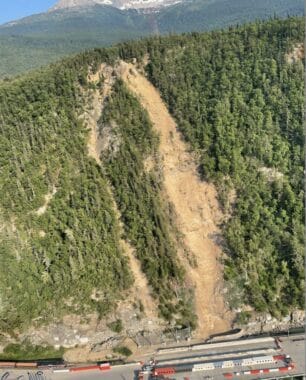
A landslide on Gastineau Avenue in Juneau on July 14, 2024. (Photo by Clarise Larson/KTOO)

The U.S. Geological Survey is expanding its landslide monitoring efforts in Southeast Alaska. The goal is to eventually develop an emergency alert system. 

Data from Juneau’s Mount Roberts went online last month. 

Dennis Staley leads the Alaska Landslide Hazards Project at USGS. He said that even though people in Southeast die from landslides, there aren’t forecasts for them yet. At least a dozen people have died in landslides in the region over the past decade. 

“We’re trying to understand the hydrometeorological conditions that make landslides,” he said. 

In Juneau, Staley said his team chose research sites on the northwest and southwest slopes of Mount Roberts partly due to the danger posed to the downtown area. Numerous recent and historic landslides have struck the town, including one in 1936 that killed 15 people

The agency’s end goal is to build a model that can use weather forecasts to reliably predict when slopes are likely to be unstable, then warn those who live beneath them. But Staley said it will take years to amass a large enough data set to create such a model. 

The team deployed several sensors on Mount Roberts to gather the data. The first is a heated rain gauge that measures rain and snow. The others are buried in the ground to measure three main factors in the soil: saturation, cohesion and the water pressure between soil particles. The data will help the USGS measure how strong the slope is and how that changes in response to the weather.

Even after scientists make the model, Staley said that they won’t be able to anticipate precisely where the land will give way. 

“Locally, there can be tremendous variability in the way soil responds to the introduction of water, even at very short distances,” he said. 

So far, the USGS has established research sites in Juneau and Sitka. The agency plan to add another Southeast community this fall, but Stale said they are not prepared to announce where yet.

Assembly votes down new ‘safety zone’ around Juneau’s homeless shelter — for now

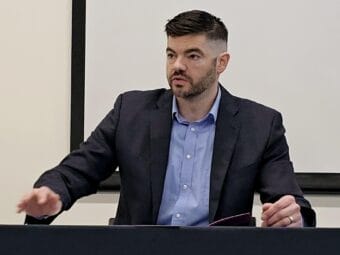
Assembly member Wade Bryson speaks during a committee meeting on Monday, Aug. 4, 2025. (Photo by Clarise Larson/KTOO)

Juneau Assembly members have rejected a plan to create a shelter safety zone with tightened restrictions on camping in the area around the Glory Hall homeless shelter in the Mendenhall Valley.

The narrow vote came during a committee meeting on Monday night, but members may reconsider the proposal in September. 

The city outlined a loose plan for the zone after staff, patrons and neighbors of the shelter asked the Assembly to take action to protect the Teal Street area. They say it has become unsafe because of threats from some unhoused people camping in the vicinity

The topic generated a lot of tension at the meeting. That was between Assembly members who supported what they saw as a public safety measure and those who saw it as a stopgap solution for the larger issue of homelessness in Juneau. 

Assembly member Wade Bryson voted in favor of the plan. He argued the Assembly’s inaction is putting people’s safety at risk. 

“We haven’t protected the patrons. We haven’t protected the staff. And we’re not talking about allowing people to camp near this property. That’s not really what the issue is,” he said. “We’re talking about protecting those very vulnerable, the most vulnerable of us, from the predators of our community.”

City leaders say the shelter safety zone is intended to increase protection for staff and people using the shelter’s services. It would likely make the rules for camping or loitering in public spaces stricter in the zone than they are citywide.

The City of Bellingham, Washington, created a protection zone surrounding a shelter last year following similar safety concerns. It added harsher restrictions on camping or loitering in the zone.

Some Assembly members who voted against the zone said they worried it would unlawfully target unhoused people and could open the door for possible lawsuits. Assembly member Neil Steininger argued it wouldn’t solve any issues, but merely move them somewhere else. 

“I just can’t see how it takes us forward as a community on this issue, more than just whack-a-mole on the next piece of the problem, without actually trying to address anything beyond one symptom of a much broader, much more difficult issue,” he said. 

Assembly members asked the city to look into other potential safety measures, like hiring private security to patrol the area or establishing a city-sanctioned summer shelter.

Juneau residents rally to protest a violent arrest

Andy Cadiente speaks at a protest with is sisters outside of the Juneau Police Station on August 2, 2025. (Photo by Yvonne Krumrey/KTOO)

Dozens of Juneau residents gathered at the police station on Saturday to protest a violent arrest last week.

A video of the arrest generated public concern on social media. It showed a Juneau police officer handcuffing an Alaska Native man, then throwing him to the ground where he appears to lie unconscious for the remainder of the video.

Since, the man’s family has identified him publicly as Christopher Williams Jr. The police department has not released the name of the officer.

Protesters offered condolences to the man’s family and expressed their outrage, including X’ash Kugé ka Yaanasax Barbara Cadiente-Nelson.

“We’re here to hold this system accountable to the words they took an oath to to protect, to serve,” she said. 

Williams’ cousin, Pamela James, said his family didn’t know where Williams was for a full day after they heard he was medivaced for care. She confirmed that Williams was in Anchorage Thursday evening after calling multiple Seattle and Anchorage hospitals. She said he is conscious and speaking.

James said Williams plans to sue JPD. She said her family will continue to speak up.

“We’re not doing it just for Chris, but we’re doing it for everybody that’s been hurt by our cops here in town,” James said.

Assembly Member Paul Kelly was at the protest and said it’s important that the City and Borough of Juneau work to restore trust in the community after a violent arrest. 

“Whenever we have an emergency, whenever we need somebody to intervene, we need it to be somebody that we can trust,” he said. “We need to be able to trust our police force.”

Protestor Ḵáaḵ’utx̱éich Kai Monture said that Lingít people have to support and protect each other, and abide by traditional values of perseverance and community support. 

“Even though asking for police reform is important and something we need to fight for every day, it’s not guaranteed,” he said. “It’s not guaranteed that it’ll happen, but what is guaranteed is that we can protect each other.”

JPD says the officer has since been placed on administrative leave. Officials from the City and Borough of Juneau and JPD say there will be an external investigation of the violent arrest.

Witnesses begin to testify in the sexual assault case against former Juneau chiropractor

Former Juneau chiropractor Jeffrey Fultz sits during his sexual assault trial in Juneau on Wednesday, July 30, 2025. (Photo by Yvonne Krumrey/KTOO)

Content warning: This article includes mentions of sexual assault and abuse that may be uncomfortable for some readers. Resources are available at the bottom of this post.

The trial against former Juneau chiropractor Jeffrey Fultz, accused of assaulting more than a dozen women under the guise of medical care, is underway. KTOO reporter Yvonne Krumrey breaks down the first few days of witness testimony with reporter Clarise Larson. 

Listen:

Clarise Larson: Where are we in the trial now?

Yvonne Krumrey: After two weeks of jury selection and Tuesday’s opening statements, the trial is now really in full force. That means we are starting to hear from expert witnesses and alleged victims. This will likely be the bulk of the next two weeks: both the state prosecutor and Jeffrey Fultz’s defense team will be using these witnesses to try and establish their side of the story.

Clarise Larson: Tell me more about the opposing sides. What did the attorneys say during opening statements? 

Yvonne Krumrey: The state is arguing that Fultz used his position as a medical provider at Southeast Alaska Regional Health Consortium to gain access to vulnerable women and assault them when they sought medical care.

This is state prosecutor Jessalyn Gillum:

“We are here because the defendant engaged in sexual contact with his patients under the guise of legitimate medical treatment,” she said. “He violated their trust and he violated their bodies. ” 

The state points to repeated testimony from witnesses who say Fultz touched them in a sexualized way and in sensitive places without reason or consent, and denied them appropriate coverings during treatment.

The defense team argues that Fultz was giving appropriate medical treatment, and that the women who accused him didn’t express their discomfort at the time. 

“The evidence in the case is going to show that during legitimate medical treatment, Dr. Fultz did make contact with sensitive areas of the body, but he did not make any contact with sensitive areas of the body without consent,” said defense attorney Wally Tetlow.

He also said that the former investigator for this case — a Juneau police officer who died in 2023 — led the women to the conclusion that they were assaulted. 

Clarise Larson: Okay, so who have we heard from since those opening statements?

Yvonne Krumrey: Tuesday and Wednesday we heard from Dr. James Lehman, an expert witness called by the state. He’s a doctor and professor at the University of Bridgeport School of Chiropractic. Attorneys asked him about a whole lot of specific medical treatments. Remember, this case is about medical treatment and whether it was appropriate or abuse. 

The state asked Dr. Lehman about what areas are appropriate to touch based on what treatment the women accusing Fultz requested.

“Are you aware of any legitimate chiropractic or any legitimate chiropractic treatment that requires a practitioner to make direct contact with the breast or vulva of a patient who comes in complaining of generalized back pain?” asked Krystyn Tendy.

“No,” Lehman said.

This went on for about two minutes, as the prosecutor asked about other medical conditions the women sought treatment for. The answer was always no. 

In cross-examination, the defense showed Dr. Lehman charts that show that tension muscles and tissue in the chest area can impact muscles down the arms. And that treating the chest area can be appropriate for treating other pain elsewhere in the body.

The state then asked Dr. Lehman about informed consent – something the women claim Fultz did NOT do before touching sensitive areas.  

“You explain to the patient what you’re going to do, why you’re going to do it, and what they should expect the outcome to be, make certain that they understand it and they approve of your proceeding,” he said.  

Clarise Larson: And I know witnesses and alleged victims were expected to speak this week. Has that happened?

Yvonne Krumrey: Yes, Wednesday and Thursday we heard from Christina Love. The court is now using alleged victims’ full names but we are only using ones who have given us permission. Love has given us permission to use her full name.

She testified about how her experiences with Fultz got progressively more uncomfortable and how different they were from other SEARHC providers she saw.

Love said initially things were comfortable but his behavior started to change [after a few years]. He walked in on her changing. He gave her a covering that was too small.

He began touching her in places she wasn’t comfortable with, without permission, and moved her hands away when she tried to cover these areas. 

She began requesting other providers, but would only get scheduled with Fultz, who she understood to be in charge of appointments. And the weird behavior escalated. 

“I trusted him,” she said. “I was so mad and betrayed. I felt betrayed by myself that I should have known.”

Love reported it to AWARE, who called JPD, and from there, the criminal investigation into Fultz began. Her testimony dug into that process as well.

Fultz’s attorney James Christie questioned Love next. He asked about her previous testimony  earlier in the case and questioned her memory. He also pointed out her lack of experience with medical treatment.

“We can agree that you have no training as a chiropractor,” Christie said. 

He argued that her testimony has changed throughout official proceedings and asked about Detective Darbonne guiding or leading her to the conclusion that she was assaulted. 

Clarise Larson: So what do you expect the rest of the trial to look like? 

Yvonne Krumrey: I believe more of what we saw this week. The prosecutor said we would hear from more of the women who have accused Fultz of similar behavior. Based on the defense’s opening statements, I’m expecting they will call their own expert witnesses, too. All told, they’re expecting to call dozens of witnesses to the stand. 

There are two more full weeks scheduled for this trial. 

Juneau officer placed on administrative leave following violent arrest

A Juneau Police Department vehicle park in downtown Juneau on Thursday, June 13, 2024. (Clarise Larson/KTOO)

The Juneau Police Department has placed an officer on administrative leave following a violent arrest on Wednesday that led to a man being medevaced out of town for a head injury. 

City and tribal officials have expressed concern about the incident after a witness posted a video online. But that witness said he felt protected by the officer’s actions.

Juneau’s City Manager Katie Koester released a statement on Friday responding to the incident and public outcry that has followed. She said the city acknowledges the “deep community concern” over the incident and is taking steps to review the department’s policies and procedures. 

According to Koester, the Juneau Police Department has requested an independent investigation by an external agency to review the use of force by the officer. Following the investigation, the state’s Office of Special Prosecutions will then review the case to determine if the officer was justified in his response. 

Koester said the city will also conduct an internal investigation of the case to examine the incident and whether the officer’s actions aligned with the department’s current policy. Body camera footage of the incident will be released to the public within 30 days of the incident. 

“We appreciate our community’s outreach and shared concerns, and are taking steps to review our own policies, procedures, and practices to ensure they are consistent with JPD values to preserve human life while meeting its mission to protect public safety,” the statement said. 

Police have not named the officer or the injured man – nor have they shared his current condition.  

According to the department, the incident took place after officers responded to a report of a woman fighting with a man outside of the Douglas Library. Police say the woman threw water in the man’s face and made racial comments. 

According to the department, an officer was attempting to place her under arrest and into a vehicle when a friend of hers appeared and continued to yell at the man. Police say the man then aggressively approached an officer. 

Police say the officer attempted to place the man under arrest and into handcuffs, but he resisted and was “taken to the ground.”

Ibn Bailey was the man initially harassed by the woman and who recorded the video of the incident that has circulated online. He said he was surprised by the community reaction to the video and said he felt protected by the officer’s actions.

“The officer was able to respond in the manner and the quickness in which he did, in what I can only describe as the most professional manner, given the circumstance,” he said. 

The Central Council of Tlingit and Haida Indian Tribes of Alaska, based in Juneau, has also responded to the video with a statement. In a social media post, President Chalyee Éesh Richard Peterson said the tribe is “deeply concerned” about the incident, which he said involved a tribal citizen. 

Peterson said the level of force used during the arrest raises serious questions and asked the mayor and police chief for several actions, including a meeting with tribal leadership and an independent review of the incident.

Site notifications
Update notification options
Subscribe to notifications