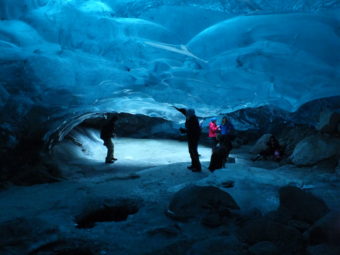
Attendees were reminded often that every time you step out on the ice, you're taking a risk. (Photo by Greg Culley)
(Photo by Greg Culley)
People line the walkway to watch the ice rescue demonstration. (Photo by Greg Culley)
CCFR member Travis Mead submerges himself in the pond next to Mendenhall Visitor's Center. (Photo by Greg Culley)
Capital City Fire/Rescue members demonstrate how to get out of the water after falling through ice. (Photo by Greg Culley)
(Photo by Greg Culley)
(Photo by Heather Bryant/KTOO)
The only truly safe ice in Juneau is at the Treadwell Arena. That’s one of the lessons from Saturday’s ice safety workshop.
A full house packed the Mendenhall Visitor’s Center auditorium this weekend to learn about ice safety. The hour and a half workshop was made up of a slideshow and video of safety tips and advice before attendees headed out into the snow to watch CCFR volunteers demonstrate ice rescues on the pond next to the visitor’s center.
CCFR’s Travis Mead demonstrated three different types of rescue including self rescue, assisted rescue and a rescue when the victim is unconscious. Volunteers reminded attendees that the most important thing to do is to call 911 before attempting any sort of rescue in case you also become a victim.
People on the ice in front of Mendenhall Glacier. (Photo by Heather Bryant / KTOO)
Juneau’s fickle winter is prompting lots of warnings to stay off lake ice. And on Saturday, Capital City Fire and Rescue and the Forest Service will hold ice safety training at the Mendenhall Glacier.
Events this winter at the glacier show just how unstable ice can be.
Rocks are sliding off Mount Bullard, Mendenhall Glacier is constantly calving, and Juneau has been in a freeze/thaw weather pattern for weeks.
The natural events that happen just tend to make that ice very unsafe.
Capt. Dave Boddy says it could even be a lethal combination.
Boddy is a first responder when someone falls through the ice in Juneau, a place with lots of lakes and ponds and opportunities to venture out during the winter.
He also understands the events that make ice unsafe.
Like a recent rockslide down Mount Bullard near popular Nugget Falls.
The scar down Mt. Bullard from a recent rockslide. Photo courtesy of Laurie Craig, U.S. Forest Service.
Forest Service Naturalist Laurie Craig first spotted it late last week through the telescope in the Visitors’ Center observatory.
“This is just so obvious on the landscape, which is just sort of speckled with white and dark, and there’s this huge gash just right down, sliding down Bullard mountain,” and onto the ice, Craig says.
Another Mount Bullard landslide in late November actually created a tsunami under the ice.
University of Alaska Southeast Geologist Cathy Connor says this year’s freeze / thaw, rain/ snow cycle is compounding Mount Bullard’s rock slide activity.
“If you dump water into rock fractures and then freeze it, it acts like a hydraulic jack. So you do that over a lot of seasons for a long period of time, it doesn’t take much to set it off,” Connor says.
Then there are the ice bergs. Naturalist Craig often sees skiers and skaters approaching the beautiful blue bergs, though like the glacier, those bergs are always on the move.
“So even though they’re frozen into the lake, there are still changes happening because they are thawing underneath the lake ice in the water,” Craig says, “because there’s still a current flowing.”
So what do you do if you ski into an open hole of water under the snow and fall through the ice?
That’s one of the questions Capital City Fire and Rescue’s Captain Boddy and Captain George Reifenstein will answer during Saturday’s workshop.
“What are you going to feel? How long do you have that you muscles and your body is continuing to work and kind of do what you want it to do and what are the best techniques for either getting out of the hole or staying alive in a hole until somebody gets you,” Reifenstein says.
The water under that ice is likely to be in the mid to low 40s this time of year.
With the recent warming trend, Reifenstein says there are about 3 to 4 inches of slush on Juneau-area lakes. The ice underneath varies in thickness.
“I was auguring Auke Lake over the weekend and under the slush there was probably five inches of ice in the place that I augured,” he says. “But over at the glacier near the Visitors’ Center we went down through a foot of ice, under 4 inches of slush.”
Capital City Fire and Rescue’s ice rescue team was formed in 1992. Reifenstein and Boddy have been training and teaching others about ice safety ever since. Boddy says people often assume Mendenhall Lake ice is really thick because it’s in front of the glacier, but that’s not the case.
“One of the biggest fears we have is the instances that have traditionally happened in other parts of the country where people fall through the ice and other people try to go out and rescue them and they end up becoming victims themselves,” Boddy says. “That’s one thing we’re really trying to avoid is compounding the situation by getting more people stuck in the ice.”
Saturday’s ice safety training will start inside the Visitors’ Center and include video from Canadian researcher Dr. Gordon Geisbrecht, also known as “Dr. Popsicle” for his cold water immersion studies.
Then the Juneau team will move outdoors for an actual rescue from an icy pond next to the Visitors’ Center. The guinea pig from CCFR will be wearing an immersion suit. That’s usually not the case when most people fall through the ice.
Saturday’s ice safety training begins at 1:30 p.m. at the Mendenhall Glacier Visitors’ Center. The event is free.
(Editor’s Note: An earlier version of this story said the event begins at 11:30. It actually begins at 1:30 p.m. The story has been updated to reflect the actual time of the event.)
A commercial helicopter was used to medevac a camper with a broken leg out of Point Bridget State Park on Sunday.
Fire Chief Rich Etheridge, both through Twitter and Capital City Fire and Rescue’s online incident reporting webpage, said that they initially intended for the Coast Guard to travel by boat to Camper’s Cove (sic) or formally-called Camping Cove in the southwest corner of the park.
The woman, identified as 31-year old Jenne Sipniewski of Juneau, was apparently safe and warm with a friend in a cabin nearly four miles from the road. According to Alaska State Troopers, Juneau Mountain Rescue was placed on stand-by for a possible rescue.
Etheridge says high winds and freezing spray prevented a medevac by boat. A Temsco helicopter landed Sunday afternoon on the beach after the tides and wind both diminished in the Cove.
Sipniewski was picked up and transported by the helicopter to the Juneau airport where she was met by a friend and then was taken to Bartlett Regional Hospital by personal vehicle.
Six people are reported safe after their boat ran aground in Unalaska Bay on Friday.
The 105-foot crabber Arctic Hunter reported going up on rocks about six miles from Dutch Harbor at about 3:30 a.m. on Friday morning.
The vessel lost power and the crew could not dewater a flooded engine room.
Two other vessels, the Bristol Mariner and the Saga, responded to the scene as the Coast Guard dispatched a helicopter from Cold Bay.
Six crewmen on board the Arctic Hunter donned survival suits and evacuated into a life raft. According to officials at the Coast Guard Command Center in Juneau, the Saga took the raft in tow and later brought the crewmen on board for transportation to Dutch Harbor. The helicopter, which was still on its way to the scene, then returned to base.
There was no immediate word on any injuries, extent of damage to the vessel, or any pollution at the scene.
Sometimes called the “Galloping ghost of the Alaska Coast,” the retired USCGC Storis (middle) sits in storage at the National Defense Reserve Fleet shipyard at Suisun Bay, California. Photo courtesy Storis Museum and Educational Center.
The U.S. Coast Guard Cutter Storis will be towed to Mexico on Friday and cut up for scrap metal.
Once the longest-serving cutter and called the Queen of the Fleet, the Storis was sold this summer to a scrap metal dealer for $71,000.
The medium-endurance cutter was built in Ohio for $2 million and launched in 1942. After serving through World War II and as a cutter in Juneau and Kodiak, the Storis was decommissioned in 2007. In 1957, the cutter became the first American flagged ship to sail the Northwest Passage through the Arctic Ocean.
Juneau attorney Joe Geldhof is secretary of the Storis Museum, the non-profit that was trying to save the ship and turn it into a museum.
Geldhof says the museum group does not harbor hard feelings toward the businessman who bought the Storis, but thinks the U.S. General Services Administration bungled the entire proceeding.
“General Service Administration botched the disposal. They didn’t give non-profits the opportunity to select the Storis before it was put on the scrap market,” Geldhof says.
He also blames personal politics by former U.S. Senator Jim DeMint, a South Carolina Republican, for keeping the Storis from being transferred to the museum.
“Jim DeMint routinely was putting a hold on the congressional authorization to transfer it to the non-profit museum a couple years running,” he says.
DeMint was a one-term Republican senator from South Carolina.
Geldhof says the Storis Museum organization still has some money left and the board will meet to decide what to do next to memorialize the ship and those who served on it.
The Storis has been in the Suisun Bay mothball fleet storage in California and will be towed by tug to Ensenada, Mexico, where it will be stripped down and cut up for its scrap metal value.
Its final fate comes less than a year after the Storis was named to the National Register of Historic Places.
Video courtesy U.S. Coast Guard Kodiak Air Station crews
Update:
The U.S. Coast Guard says a 59-foot longliner that burned Sunday in the Bering Sea has sunk.
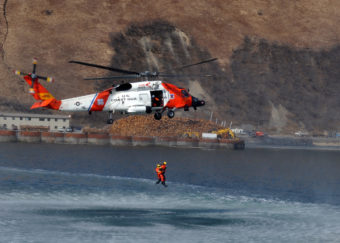
A Jayhawk helicopter crew Monday flew over the area where the Western Venture was last seen, about 70 miles west of Adak, according to Petty Officer Sara Mooers.
“We had good search conditions with good visibility and did not locate the vessel, so we presume it has likely sunk.“
She says the Coast Guard is working with the Western Venture’s owner to determine the cause of the fire.
The fuel tanks held up to 4,300 gallons, but Mooers says they weren’t full.
“The updated figure for the fuel aboard is 2,000 gallons of diesel but it is unknown if any of that was consumed by the fire. It’s likely it was,” Mooers says.
The Western Venture fishermen were uninjured and picked up by the fishing vessel Aleutian Beauty, which responded to a Coast Guard urgent marine broadcast. The Aleutian Beauty took the fishermen to Adak.
Mooers calls the case an excellent example of a fishing crew that was prepared for disaster.
“They had their EPIRB (Emergency Position Indicating Radio Beacon) and they used it. They had their survival equipment and they used it, which allowed them to abandoned ship to their life raft safely and stay alive until rescuers could arrive on scene.”
She says the burning ship was quite far out in the Bering Sea, away from any land mass, and the vessel is now likely several hundred feet below the water’s surface.
Original story:
Five crewmen who escaped their burning fishing vessel in the North Pacific have been rescued.
The 59-foot longline fishing vessel Western Venture activated its emergency location device while it was west of Adak on Sunday morning. A wife of a crew member said she heard from her husband that there had been a fire in the ship’s bow.
The Coast Guard dispatched two helicopters, a C-130 aircraft, and a cutter to the area near Adak in the Western Aleutians.
The 98-foot fishing vessel Aleutian Beauty was first on the scene on Sunday afternoon and they picked up all five Western Venture crew members who were in a life raft. No injuries were reported.
The Coast Guard says the exact location of the Western Venture is currently unknown. It reportedly was still adrift, unlit, and emitting smoke. It reportedly had 4,300 gallons of fuel and other oils on board before the fire.
The Coast Guard may schedule overflights later on Monday. The vessel is not considered to be a hazard to navigation since there is little traffic in the area.
Close
Update notification options
Subscribe to notifications
Subscribe
Get notifications about news related to the topics you care about. You can unsubscribe anytime.