Sports

Should management of Juneau swimming pools change hands?

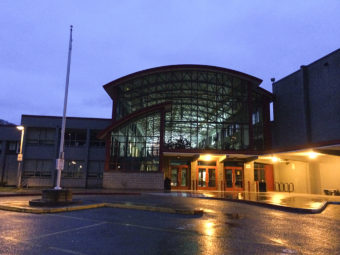
Augustus Brown Swimming Pool downtown is one of two aquatic facilities in Juneau. A proposition on next week's municipal election ballot would let the Assembly create an empowered board to manage both buildings. (Photo by Kayla Desroches/KTOO)
Augustus Brown Swimming Pool downtown is one of two aquatic facilities in Juneau. A proposition on next week’s municipal election ballot would let the Assembly create an empowered board to manage both buildings. (Photo by Kayla Desroches/KTOO)

Juneau voters next week will decide whether management of the city’s two swimming pools can be shifted out from under the city’s Parks and Recreation department.

A proposition on the Oct. 7 municipal election ballot would allow the Juneau Assembly to appoint an empowered board to set budgets and raise revenue for the Augustus Brown Swimming Pool and Dimond Park Aquatic Center.

On a recent afternoon at The Augustus Brown pool, adults do laps and children swim around in the shallows. Opinions about the empowered board are mixed.

Bonnie Chaney recently retired as the city’s budget analyst, and uses the pool two to three times a week.

“City employees, they’ve been tasked with looking for all the efficiencies that they can find in all of the city operations and the city’s open to suggestions from citizens. And if it’s a good idea, the city will implement it,” Chaney says. “So I don’t see where an empowered board is going to improve the efficiencies of running the pools.”

For Eric Peter, the most important thing is to make sure the downtown pool stays open.

“I guess as long as it would, you know, take care of any ideas about closing this place or any kind of fiscal difficulty or trouble the place is in, I guess that would be a good thing,” Peter says.

Built in 1972, Augustus Brown needs significant maintenance. Earlier this year, City Manager Kim Kiefer proposed closing the facility to help address the city’s projected $12 million shortfall over the next two years. The shortfall led to several budget cuts and layoffs, and Kiefer argued the city could save money and figure out how to pay for upgrades while the building was mothballed.

But the Assembly decided to listen to pool supporters, who argued for the empowered board. Max Mertz is with Glacier Swim Club, one of the largest city pool user groups. He says the pools tend to get lost in the shuffle under the current management structure as part of the city’s parks and rec department.

“You have Zach Gordon, The Pipeline, Augustus Brown, Dimond Park, youth (and) adults (sports), Treadwell Arena,” Mertz says. “They’re spread very thin. It gives them very little opportunity to really focus on the pools. And so, some of the decisions that are made don’t necessarily happen within a structure that is clearly defined, transparent and effective.”

Mertz thinks an empowered board could increase usage, much like the board for Eaglecrest Ski Area has increased numbers at the city-owned ski hill.

“Because of the fact that we’re not renting the pool when we can, because of the fact that we’re not marketing the pools the way we could be marketing those pools, the pools really aren’t a destination source for recreation for a lot of Juneau in the way that they should be,” says Mertz. “And we think that that could change with successful marketing, better outreach to the community, things that aren’t happening right now.”

Assemblywoman Kate Troll says the empowered board might provide a much-needed jolt of energy to management of the city’s swimming pools.

“They will kind of lend their expertise and help be creative and try things a little bit different in how to generate revenue so that it’s less of a drain on the city,” Troll says. “We want people that have experience, you know, in management as well as the business community.”

But she says a yes vote on the measure would only be the first step.

“It’s to give the Assembly the authority to go forward in setting up the empowered board,” says Troll. “At the same time, we are asking our city manager and our parks and rec staff to come to us to also present their plan on how they would do things differently to raise revenues.”

Assemblyman Jesse Kiehl says he’s against the empowered board, but voted to put it on the ballot to hear what Juneau residents have to say.

“My concern is that if we give a board a target and say, ‘You will raise this percentage of what it costs to run the pools,’ we’re going to start pricing low income people out of our pools and that’s something the Assembly needs to be accountable for doing or not doing,” says Kiehl.

And, he adds, the Assembly should take the community’s good suggestions and implement them.

Southeast cross-country teams race in Petersburg

Members of boys' cross-country teams from around Southeast Alaska begin their race Saturday, Sept. 13, near Petersburg's Sandy Beach. (Ed Schoenfeld, CoastAlaska News)
Members of boys’ cross-country teams from around Southeast Alaska begin their race Saturday near Petersburg’s Sandy Beach. (Photo by Ed Schoenfeld/CoastAlaska News)

Cross-country runners from 15 Southeast Alaska high schools competed in Petersburg over the weekend.

The hometown girls’ team came in first, followed by Ketchikan and Juneau’s Thunder Mountain High School. Ketchikan’s team won the boys’ race, followed by Thunder Mountain and Sitka.

Here’s a look at the meet and some of the coaches and chaperones who make it happen.

Runners race down the final stretch during Saturday's cross-country meet in Petersburg. (Ed Schoenfeld, CoastAlaska)
Runners race down the final stretch during Saturday’s cross-country meet in Petersburg. (Photo by Ed Schoenfeld/CoastAlaska News)

Team chants filled the air as about 240 runners from Southeast Alaska high schools met under sunny skies.

The runners lined up, ready to take on the challenge. But the starting pistol wouldn’t fire, so the organizers used something similarly loud: An air horn.

“It was awesome to have all of our fans and parents get to see our kids run. And all the volunteer help that we have is amazing,” said Jaime Cabral, Petersburg’s athletic director.

“Overall, the boys did great, the girls did great. It was an awesome meet,” he said.

The top-scoring girls’ team finished together, in ninth to 15th place. In order, they’re Hannah Pfundt, Kayleigh Eddy, Julia Murph, Makayla Newman, Madisyn Parker and Erin Pfundt.

The boys’ team placed seventh, behind mostly four larger and two smaller schools. Ben Zarlengo, Tucker Hagerman and Nathaniel Lenhard ran in the top 30. Also racing were Kyle Hagerman, Stuart Medalen, Gus Peterson and Andrew Weller.

Teams from around the region came to the race via ferry. The Haines team traveled the farthest, bringing a dozen students.

A fan holds a sign cheering on Petersburg High School during Saturday's cross-country meet.
A fan holds a sign cheering on Petersburg High School during Saturday’s cross-country meet. (Photo by Ed Schoenfeld/CoastAlaska News)

Chaperone Jane Cowart said they included some runners in their first year of racing.

“There’s a good menagerie, from freshman to senior. And I think they’re all just feeling their way out, finding their place and doing well,” she said.

And what do kids get out of such an event?

“Self-confidence. And a team spirit, because you run by yourself, but yet you run together as a team.  They learn to encourage one another and build one another up,” she said.

Juneau’s Thunder Mountain High School sent 30 runners. The boys team came in second, the girls team third.

Head Coach Scott May was happy with the results.

“I was counting PRs, that’s personal records, and we have … seven out of our nine girls who had lifetime personal records. That’s very exciting. It’s a great course and a gorgeous day, perfect for getting for getting personal records,” May said.

Sandi Pahlke is Thunder Mountain’s assistant coach.

“For most of them, running is really important. But they learn how to be part of a team, they learn how to work hard, be responsible for themselves, and learn how to set goals and follow through on them. And those are great life lessons, not just for running,” she said.

The meet and associated travel were not just about the races.

Members of high school cross-country girls' teams line up just past the finish line during Saturday's meet.
Members of high school cross-country girls’ teams line up just past the finish line during Saturday’s meet. (Photo by Ed Schoenfeld/CoastAlaska News)

May says he and Pahlke make sure students keep up with their schoolwork.

“It’s a very important thing. We’ve already had two study sessions during this trip and we’ll have another one coming up. It’s academics first. This is a distant second,” he said.

The top two runners in the girls’ race were Thunder Mountain’s Naomi Welling and Erin Wallace. The top two boys were Ketchikan’s Christopher Llano and Sylvan Blankenship.

The top boys were separated by only hundredths of a second.

Petersburg’s Jaime Cabral says that was measured using microchips attached to racers’ bibs.

“As soon as they cross the finish line … the system picks up their chips. So it’s a little bit more accurate times, as they come across. It’s instant data too. We put it into a system and we can post results two minutes after the race is over,” he said.

Southeast cross-country runners have already met in Juneau and Metlakatla. They’ll be in Sitka next week, followed by the regional championships in Ketchikan.

Volunteers remove digital timing tags from races' bibs at the end of Saturday's boys' race. (Ed Schoenfeld, CoastAlaska News)
Volunteers remove digital timing tags from races’ bibs at the end of Saturday’s boys’ race. (Photo by Ed Schoenfeld/CoastAlaska News)

XC team results Female-1XC team results Female-2XC team results male 1XC team results male (2)-page-1

Juneau runners complete Klondike Road Relay solo

Houston Laws, Klas Stolpe, Klondike Road Relay
Ultrarunners Will Kidnew of Chicago, Houston Laws of Juneau and Klas Stolpe of Juneau near the start of the Klondike Road Relay in Skagway. They attempted the 109.4-mile race solo. Kidnew did not finish. Laws and Stolpe finished in 23 hours and 34 minutes. (Photo by Katie Emmets/The Skagway News)

While many runners participated in this weekend’s Klondike Road Relay as a member of one of 170 teams, two Juneau residents ran over 109 miles completely by themselves from start to finish.

Houston Laws, 29, and Klas Stolpe, 54, ran all 10 legs from the very start in downtown Skagway, over White Pass, past Tutshi Lake and Carcross, and then to the finish line in Whitehorse. Chicago ultrarunner Will Kidnew started the race, but he did not finish.

This was Laws’ fifth ultramarathon this year and he described the experience during an interview on KTOO’s Morning Edition on Monday. Laws said he and Stolpe ran the race in honor of the late Glenn Frick who ran in every Klondike Road Relay since the race started in the 1980s. Frick passed away from cancer in March at the age of 75.

Stolpe finished with a total time of 23 hours, 34 minutes, and 34 seconds. Laws finished 6 seconds behind Stolpe. Both runners had a 12:55 pace with average speed of 4.6 miles per hour.

“You do have a certain amount of energy that you like to keep in reserve,” Laws said. “The more that you save in the beginning, the more that it pays in the end.”

Laws said he and Stolpe ran the race side-by-side to keep each other company. But Laws said the race was toughest in the middle of the night when they tried to keep their spirits up and could not see anybody else except for the pilot car. He also noted as a challenge their inability to make out recognizable landmarks and accurately gauge the remaining distance in the final leg of the race.

Laws said he plans to run the Klondike Road Relay as a ultramarathon again next year.

Juneau ultrarunners attempt first solo Klondike race

Laws and Stolpe
Houston Laws, left, and Klas Stolpe snap a selfie minutes before starting their solo attempts of the 109.4-mile Klondike Road Relay on Friday. (Photo courtesy Houston Law)

The 32nd Klondike Road Relay is underway, and it includes two Juneau ultrarunners attempting the 109-mile race–solo.

Officials say there are three people attempting the feat: Klas Stolpe, 54, and Houston Laws, 29, both of Juneau; and Will Kidnew, 26, of Chicago. They’re the first to attempt the Skagway-to-Whitehorse race by themselves. It’s usually a 10-part relay.

Event coordinator Kevin Patterson says he doesn’t know what to expect.

“Since it is the first year of them running. So we’re not sure how long it will actually take them,” Patterson says. “Will in particular from Chicago, he’s actually estimating he would get to the finish line by about 6 o’clock tomorrow morning.”

This is Stolpe’s first race that’s longer than a marathon.

“Officially it is, I mean, of course, like a lot of the Juneau crowd, I fell in with a good group of guys, and once in a while, they drag you out onto the mountain for, you know, 30 plus miles, but you don’t realize it until you’re done,” Stolpe says.

Stolpe says he’s running in honor of Glenn Frick, a pioneer of running culture in Juneau, who died in March at the age of 75.

Stople asked Laws, an experienced ultrarunner, to keep him company on the Klondike. A few minutes before starting the race in Skagway on Friday, Laws described their plan.

“We’ll budget some times to walk. We’ll budget some time to rest. Probably average at least five resting points for 30 minutes, totally off our feet, the feet out of the shoes, changing socks if necessary. Changing clothes to help with chafing, and just trying to be as comfortable as you can be doing a 100-mile race.”

Laws says he thinks they’ll average bout 13-minute mile pace through the varied terrain.

“Really take the hills easy is the plan, and really reserve a lot of the energy for the time we hit the last 20 miles. It really pays off to take it easy in the beginning.”

More than 170 teams are participating in the race.

Slideshow: Learn to Play introduces a new generation to hockey

The Juneau Douglas Ice Association, with assistance from the city’s Youth Activity Board and Treadwell Ice Arena, sponsored a Learn to Play event Saturday at the arena. JDIA coaches and advanced players showed newcomers how much fun hockey could be.

All photos by Steven Quinn.

Alaska student journeys home by foot and kayak

If you’re boating between Ketchikan and Gustavus in the next few weeks, keep an eye out for Zachary Brown. He’s kayaking north through the Alexander Archipelago, the final leg of a journey that started in Northern California. Brown made a pit stop in Ketchikan recently.

Zachary Brown's route home from Stanford University, walking and kayaking to Gustavus.
Zachary Brown’s route home from Stanford University, walking and kayaking to Gustavus.

He’s headed home from college. It’s a journey many graduates take, but in his case, it’s taking a little – no make that a lot – longer. Brown earned his Ph.D. in oceanography at California’s Stanford University. It’s from there that he started his journey home – on foot — to Gustavus in Southeast Alaska.

Anyone with a grasp of Alaska geography knows it would be impossible to walk all the way to Gustavus, a small community northwest of Juneau. So after about 55 days on foot, Brown ended the walking portion of his journey in Port Angeles, Wash. He got into his kayak and started paddling.

One goal of the trip is to have a big adventure and get back into the Alaska lifestyle. But the journey serves another purpose.

“A big part of it is to try to start a field school near where I grew up, near Glacier Bay. There’s this really special property out there on this remote group of islands called the Inian Islands,” he said.

The five-acre area is called the Hobbit Hole. Brown says it’s a beautiful spot that’s always been special to the residents of his hometown. It’s for sale and he’s working with a team from Stanford to buy it and turn it into an institute for students, researchers and local residents.

“Part of why I decided to do this big trip is to spread the word about that and look for our sugar daddy, as it were, to help us buy that special property,” he said.

Any luck with that?

“I’ve met a tremendous number of people and handed out a few hundred cards. No luck with the big fish yet, but there are a lot of connections percolating, so you never know,” he said.

Quite a few of those connections were made on the walking portion of the journey. He hiked along the coastal highway most of the way, rather than on trails.

“Because I figured it’s a shorter distance for one thing, but also going along the coastline you’re passing through a lot of communities, meeting more people. It’s not exactly a wilderness experience, in fact I’d say a good half of that 1,000 miles was right along the shoulders of the highway,” he said.

He admits to being tempted to take offers for rides, but stood firm on his commitment to walk.

“I had a few days of just total pouring rain and these wonderful nice people would stop and say, ‘Hey do you need a lift?’ and I’d say ‘no, I gotta walk.’ I can’t cheat this thing. I gotta walk all the 1,000 miles,” he said.

Brown started paddling about a month ago and hit Ketchikan on day 91 of the epic journey. He’s seen some amazing sights on the kayaking portion of the trip.

“When I was just about to cross into Alaska, I was sitting in a little inlet, watching eight humpback whales bubble-net feeding for over an hour. They would come up all at once and then you’d see all their eight flukes go down,” he said. “All kinds of haunting, beautiful noises coming from them.”

Brown also saw his first bear and a wolf soon after crossing the Alaska border. One of his wilder encounters, though, had nothing to do with wildlife.

“I was right in the path of one of those giant ferries in British Columbia at one point. They’re almost as big as the cruise ships” that visit Ketchikan. “They’re absolutely enormous.”

Brown was crossing close to Nanaimo on Vancouver Island and wasn’t sure at first whether the ferry was headed his way.

“And suddenly I started paddling furiously. Then there were four long horn blasts that I knew were for me. I just barely got out of the way in time.”

That’s not to say that Mother Nature also didn’t throw some challenges his way. Brown hit the Alaska border just in time for a big two-day storm. The tempest was just kicking in when he had a two-mile crossing to the Alava Bay Cabin.

“Getting across that two miles was a little hairy. It was choppy, waves were coming over the bow of the boat,” he said. “That’s the thing about being out alone. You don’t have this group decision-making process about whether the conditions look right or wrong. You have to use your own judgment. There’s nobody else to act as a safety net.”

Speaking of safety, Brown is prepared in case he gets into trouble. He has a Spot GPS that allows people to track his progress online. Through that, he sends a check-in every night to let his mom know he’s OK, and he can send an SOS if he gets into trouble. Brown also has a VHF radio and a satellite phone.

“I’m pretty well covered when it comes to communication. So I feel like even if I do have to ditch, if I somehow get separated from my boat, these things are connected to me on my PFD. Something pretty bad would have to happen for me not to be at least able to be saved,” he said.

So far, his trip has not involved any dangerous mishaps. In fact, the only time he had to bail out of his kayak was when he first started paddling from Port Angeles, Wash. in full view of well-wishers watching from shore.

“I had a group of six or eight friends who came down to see me off on my triumphant transition from the walk to the paddle,” he said.

Brown launched, turned to give a big wave and noticed his water bottle had fallen into the surf. So he went back to get it, but caught a wave and flipped. He couldn’t roll the kayak upright because it was too shallow.

“I fumbled for my spray skirt handle and I bailed out and I was just hanging my head in shame because my triumphant departure was completely ruined.”

Since then, though, Brown has managed to stay in the boat.

The trip up the Canadian coast includes a lot of wilderness, but Brown says he found some pockets of humanity along the way.

“The lighthouse on Addenbrooke Island, the caretakers there. They used a crane to hoist my kayak up onto the dock and took me in for the night. The hospitality has just been tremendous.”

Brown also stopped at an old, falling-down cannery where the caretaker let him borrow a fishing pole to go trout fishing.

Those human encounters have been few, however, and Brown has spent a lot of time on his own.

“It definitely gets lonely. No question about that. I have a lot of time to think; almost too much time to think, sometimes. But it’s incredibly rewarding and enriching at the same time. I know that before long, I’m going to be back in the real world and real life, and I have to enjoy this while I can.”

Brown estimates that his re-entry into the real world will happen around the first of September, when he expects to land back home in Gustavus.

Site notifications
Update notification options
Subscribe to notifications