The Augustus Brown Swimming Pool and Dimond Park Aquatic Center could be managed by a single board, under a proposal before the Juneau Assembly. (Photo by Aaron Russell)
The Juneau Assembly on Monday will take up an ordinance to create one board to run both city-owned swimming pools.
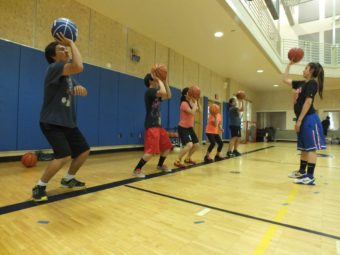
The idea was first floated by the city’s Aquatic Facilities Advisory Board and Glacier Swim Club when the city proposed closing the downtown Augustus Brown pool to save money. Supporters say a single empowered board could operate Augustus Brown and the Dimond Park Aquatic Center more efficiently and cheaply.
The empowered aquatic facilities board would be similar to the Docks and Harbors and the Airport boards. It would have to be established in the City and Borough’s Home Rule Charter, which requires voter approval.
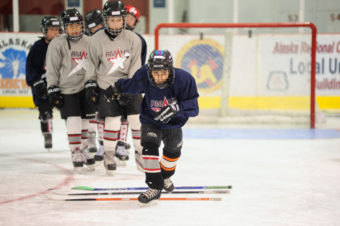
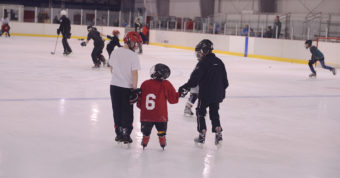
A proposed ordinance before the Assembly would put a charter amendment on the October municipal ballot giving the Eaglecrest board authority to manage the city ice rink. Eaglecrest already manages the non-profit Wells Fargo Dimond Park Field House.
Both ordinances require approval of at least six of the nine Assembly members.
The Assembly meets at 7 p.m. in city hall chambers and can be heard live on KTOO Radio.
It’s a warm July day in Girdwood, but after a 10-minute helicopter ride into the Chugach Mountains to Eagle Glacier, it starts to look and feel a bit like winter. The temperature drops, and snow blankets the ground. About two dozen women—most from Alaska Pacific University’s cross country ski team—take advantage of the summertime snow during a week-long training camp.
The athletes workout five hours a day, and spend their down time in a rustic building precariously perched beside a 5,000 foot cliff. Olympian Kikkan Randall has been coming to the trainings for 14 years, and says they’ve helped her become one of the world’s top speed skiers.
“I’ve always been really proud of Eagle Glacier and the opportunities we have here,” she says. “We can ski twice a day, and we can do so at a moderate altitude where we don’t have to modify our training intensities, so it’s pretty unique.”
While snow is a constant, relatively warm summer temperatures create less-than-ideal skiing conditions on the glacier. As the athletes trudge up a steep hill on the 10 kilometer track, they struggle to push through the slushy snow. But Erik Flora says the tough environment has its perks.
“Every time the Olympics come up people pray for nice weather, but the trail always turns to a mess,” he says. “You have rain, sleet, soft snow and that’s the magic of Eagle Glacier because as you can see in the course here it’s not easy…. We have a term for it: championship weather.”
APU skiers aren’t the only ones benefiting from the weeklong training. Each year at least one international athlete travels to Eagle glacier. Two years ago Aino-Kaisa Saarinen came from Finland and quickly befriended APU skier and Olympian Holly Brooks. The two reunited at the Sochi Olympics last winter where Saarinen took home two silver medals.
“We ran into Aino Kaisa and she stopped us and she started crying and said I want to thank you girls, because I think spending time in Alaska and spending time with you really helped me and my team earn this medal,” Brooks recalls. “Of course we wished that the U.S. had been able to bring home that medal, but that was really a priceless moment for us.”
This summer Norway’s Celine Brun-Lie traveled 4,000 miles to train on Eagle Glacier. Since thereare no places to ski in the summer in Norway, Brun-Lie says she’s having a blast in Alaska. And while she recognizes that many of the women she’s skiing with will be fierce competitors on the World Cup circuit come winter, right now she’s just trying to learn as much as she can.
“I can teach Kikkan [Randall] something, she can teach me something, and then in the winter maybe I beat her because of what she taught me, or she beats me because I told her something,” Brun-Lie says. “But I think that’s the way it should work, and that’s the fun thing about sports.”
The women’s training session ends Sunday, and APU’s men’s team will be on the glacier at the end of July.
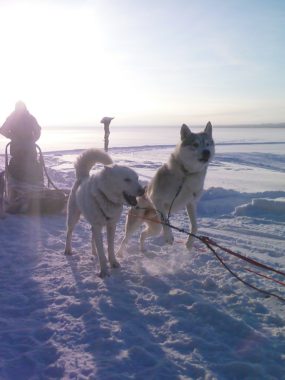
Brent Sass’s lead dogs lick the ice from their booties during a quick stop for supplies at Carmacks during the 2014 Yukon Quest. (Photo by Emily Schwing / KUAC)
The Yukon Quest International Sled Dog Race will have a new set of rules in 2015. Overall rest time has been decreased by two hours, but mushers will be required to make more mandatory stops along the 1000 mile trail.
Driving a dog team between Fairbanks and Whitehorse used to take 12 days or more, but in the last few years the fastest sled dogs have completed the run in just over nine days. Eureka musher Brent Sass says the addition of more mandatory stops fundamentally alters the race.
“It’s huge. It’s huge. It’s a huge change!” he exclaims.
A mandatory 36 hour layover at the race’s midway point in Dawson City has been cut by 12 hours. Sass says that will improve overall dog care.
“There may be a dog that has a wrist injury that you’ve been milking and he’s doing fine but it’s definitely getting sore,” explains Sass. “You know when you get to Dawson, you know 36 hours you can get rid of a wrist injury. With 24 and a bad wrist injury? Not necessarily.”
Other changes are likely to shake up race strategy.
A second mandatory stop in Eagle, near the Canadian border, will increased from four to six hours. Next year, mushers will also be required to take two additional six hour layovers at a checkpoint of their choosing in the first and last third of the race. An eight hour mandatory layover at the last checkpoint before the finish line remains in place.
Yukon Quest Executive Director Marti Steury says the decision is meant to help sleep-deprived, exhausted mushers.
“I find it to be a progressive move forward in looking at the overall success of the race and it seems to me that because the speed has changed so much in the last few years,” says Steury, “that this is something that is going to be of assistance and that’s our hope is that it helps the mushers.”
Last year’s race saw teams spread out over more than 200 miles of trail. Steury says floating stops means race personnel can keep up with teams running at both the front and back of the pack.
Two-time champion Allen Moore of two Rivers plans to run a fifth Quest in 2015, but he says the changes will force him to rethink his plan. He also says the race could become more competitive. “It will probably draw more interest from a lot of people who haven’t thought of running the race just by changing it up a little bit,” sayss Moore.
The race organization has struggled in the last few years to draw interest from long distance mushers due in part to a small purse and a notoriously challenging trail. Mushers will sign up for the race in August.
Holly Brooks hugs fellow competitor Charlotte Edmondson before Mount Marathon race. (Photo by Alexandra Gutierrez, APRN – Seward)
Tens of thousands of spectators were on hand in Seward for the start of the 2014 Mount Marathon race Friday.
Holly Brooks after the race. (Photo by Alexandra Gutierrez, APRN – Seward)
After coming in second last year, Olympic skier Holly Brooks has reclaimed her title as winner of the women’s Mountain Marathon race. She finished the 3,000-ft climb in 52 minutes and 49 seconds, with 2013 champion Christy Marvin right behind her.
“It was a tough field. This was the deepest women’s field in a long time,” she said. “So, I didn’t know what was going to happen.”
Brooks has competed in Mount Marathon six times, and come in as the runner-up in half of those runs.
“You know I’ve been second three times in this race,” she said. “Twice, I’ve gotten passed on Main Street right here, and that was all I could think about. I didn’t want to have to think about that for another year.”
The 3-mile race is always grueling, but the dry weather this year meant runners had to contend with dust and heat. Brooks was the first to finish the uphill portion, but says the descent was a struggle.
Racers lined up at the start. (Photo by Alexandra Gutierrez, APRN – Seward)
“I’m coming downhill, I just felt like a marionette going down a mountain,” she said. “I just could barely hold myself up.”
Seventeen-year-old Allison Ostrander, of Soldotna, made history in the junior’s race as the first girl to ever win it. She came ahead of all the girls and boys with a time of 28 minutes and 54 seconds, with a 40-second lead to spare.
Eric Strabel has again won the men’s division. Coming in just before 4 p.m. with a time of 44 minutes, 46 seconds. Matias Saari came in second and Benjamin Marvin in third.
Former Juneau resident, Juneau-Douglas High School player, and Juneau Soccer Club coach Jeremy Gleason has spent the last few weeks in Brazil watching the 2014 FIFA World Cup. He’s provided commentary on the games and the very unique cultural experience every few days during KTOO’s Morning Edition program. Below are some of the images that he’s collected from his recent stop in Salvador.
Some of the pictures include images of the cobblestone streets of the Pelourinho historical district, Bahian Independence Day celebrations, and a fried fish snack called bolinho de bacalhau.
Gleason said many American fans appeared to be heading home after the United States’ loss to Germany in the knockout round. But he planned to stick around until the final game of the World Cup.
Tom von Kaenel took the M/V Matanuska from Prince Rupert, British Columbia, to Juneau. He arrived on Sunday morning. (Photo by Lisa Phu/KTOO)
Tom von Kaenel, 59, bicycles from state to state in remembrance of fallen veterans. (Photo by Lisa Phu/KTOO)
Tom von Kaenel's odometer when he got off the ferry. He still had about 14 miles left to ride. (Photo by Lisa Phu/KTOO)
Tom von Kaenel departs the ferry terminal to ride the final miles to the Alaska State Capitol. (Photo by Lisa Phu/KTOO)
In Juneau: the final leg of Tom von Kaenel's 5,800-mile trip. (Photo by Lisa Phu/KTOO)
Tom von Kaenel bikes with mace. He says Louisiana has the nicest people but the meanest dogs. (Photo by Lisa Phu/KTOO)
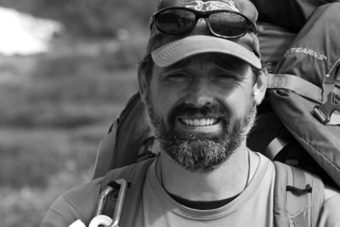
Veteran Tom von Kaenel, 59, has biked nearly 6,000 miles across the country to Alaska to honor members of the military who’ve died since 9/11.
For the past four months, the South Carolina resident has biked an average of about 50 miles a day.
He arrived in Juneau on Sunday.
Tom von Kaenel is the last one off the ferry late Sunday morning. He walks his red steel touring bike off the M/V Matanuska wearing black bike shorts and a chartreuse wind breaker. Juneau is his last stop for now.
“I’ve been looking forward to it for about 120 days and it was certainly worth the wait, certainly worth the wait,” he says.
von Kaenel’s bike odometer reads 5,793 miles.
This isn’t the first time von Kaenal has crossed the country by bike. Two years ago, he pedaled 4,300 miles from Washington State to Washington D.C. He rode with another bicyclist and had a support vehicle.
This journey, von Kaenel decided on an unsupported solo bike ride touching the corners of the country, from Key West, Florida, to Juneau, Alaska. He was asked, “Why Alaska?”
“I said, well, it’s part of the 50 states. We want to remember those 22 Alaskan service members that died in Iraq and Afghanistan. Every state is equally important. Some people say, ‘It’s only 22 service members.’ But to those people that are the family members or friends of those 22 service members, that is the world to them. For some people, that’s the sum of their lives,” vonKaenel says.
von Kaenel started riding March 1 from Clemson, South Carolina and biked through 14 states. In each one, von Kaenel holds a memorial ceremony where he reads the names of service members who died in Iraq and Afghanistan. California had the longest list with 723 names.
“We only do that one time in each state. Sometimes it’s been in a small town. Sometimes it’s been in the capital. And sometimes it’s been with other organizations. Sometimes it’s just with a very small group of people,” von Kaenel says. “But it is important that we honor the sacrifice that those men and women made and it’s important that we tell their families and their friends that we remember.”
von Kaenel wants to eventually bike to every state. He’s already planning another trip in May.
His motivation stems from an accident he had in 2009 while biking the French Pyrenees.
“The bike hit a rear wheel, flipped me up and crashed. My left hip dislocated and acted as a battering ram and shattered my left pelvis into 20-something pieces. They call it a seagull pattern because the break resembles a flock of seagulls,” von Kaenel says.
He ended up in a hospital in France, then was medevaced to a U.S. military hospital in Germany. von Kaenel spent 18 days in a trauma ward with wounded and injured service members coming back from Iraq and Afghanistan, some who didn’t survive.
von Kaenel says the military hospital saved his life and his experience at the trauma ward transformed him.
“I said I’ve got to give back. I’ve got to do something. I’ve got to raise the awareness of the sacrifices that these people are making,” he says.
And that’s why von Kaenel bikes thousands of miles across the country. He also wants to honor the families of the fallen. And the scores of veterans who suffer from post-traumatic stress disorder, traumatic brain injuries and other life altering injuries.
von Kaenel served 20 years in the Army, including 12 years in Germany during the Cold War. He never saw combat.
The final miles between the ferry terminal and the Alaska State Capitol completes his more than 5,800 mile expedition.
“I’m going to be savoring these 14 miles each mile along the way. I really look forward to the trip. I really look forward to arriving there and I know it’s going to be a little pang of sorrow to know that it’s completed,” von Kaenel says.
At 2 p.m. Thursday, von Kaenel will read the names of 22 Alaska service members who died in Iraq and Afghanistan. The public memorial will be in the Beltz Committee Room in the Tom Stewart Legislative Office Building.
Close
Update notification options
Subscribe to notifications
Subscribe
Get notifications about news related to the topics you care about. You can unsubscribe anytime.