Sports

U.S. Patent Office Cancels Washington Redskins’ Trademark

Several of the Washington Redskins' trademark registrations have been cancelled, in a decision that is likely to be appealed. Nick Wass/AP
Several of the Washington Redskins’ trademark registrations have been cancelled, in a decision that is likely to be appealed. Nick Wass/AP

The U.S. Patent and Trademark Office has revoked the trademark of the NFL’s Washington Redskins, after ruling in a case brought by five Native Americans that the name disparages a minority. While the decision could have wide repercussions, it does not require the team to change its name.

In a statement about the decision, the patent office said the petitioners proved that “the term ‘Redskins’ was disparaging of Native Americans, when used in relation to professional football services, at the times the various registrations involved in the cancellation proceeding were issued.”

As a result, the agency said, “the federal registrations for the ‘Redskins’ trademarks involved in this proceeding must be cancelled.”

Explaining the decision’s immediate effects, the agency said its review board “determines only whether a mark can be registered with the federal government (and thus gain the additional legal benefits thereof), not whether it can be used.”

The trademarks in question date back to the 1960s and ’70s. The Washington, D.C., team lost a similar trademark case in the late 1990s, only to have its registration reinstated by a U.S. district court in 2003. It is almost certain the team will appeal the agency’s latest decision.

From The Washington Post:

“Federal trademark law does not permit registration of trademarks that ‘may disparage’ individuals or groups or ‘bring them into contempt or disrepute.’ The ruling pertains to six different trademarks associated with the team, each containing the word ‘Redskin.’ ”

The decision comes from the patent office’s Trademark Trial and Appeal Board, which said the trademark registrations will remain “on the federal register of marks” and wouldn’t be officially listed as canceled until “after any judicial review is completed.”

The football team has been under increasing pressure to change its name. You can follow our coverage here.

Copyright 2014 NPR. To see more, visit http://www.npr.org/.image
Read original article – Published June 18, 201410:43 AM ET
U.S. Patent Office Cancels Washington Redskins’ Trademark

10,000 smolts ready for family fishing day

Dozens of families made their way to Twin Lakes on Saturday, June 2, for Family Fishing Day. Cheyenne Herline, 5, shows off her first fish.
Cheyenne Herline, 5, shows off her first fish from the 2012 family fishing day. (Photo by Heather Bryant/KTOO)

Young anglers will get their fishing poles out for the 25th Family Day at the Lake on Saturday. The event runs from 10 a.m. to 3 p.m. at Twin Lakes.

Family fishing day lets Juneau residents try fishing regardless of income, says event volunteer Laury Scandling.

“There are a lot of families for whom this experience would not otherwise be possible. Meaning, they don’t own fishing gear, they don’t own a life vest, they don’t have a rowboat, they don’t have a pleasure craft out at the harbor,” she says.

Personal equipment is welcome, but the Department of Fish and Game will provide rods, bait and expert advice. The U.S. Forest Service will provide rowboats.

The Juneau-Gastineau Rotary Club will sell hamburgers and hot dogs. There will also be fishing games, bean bag tosses and sack races to entertain landlubbers. Kids can make fish prints of their recent catch to commemorate the event.

The lake was stocked with 10,000 king salmon smolts from the hatchery at Douglas Island Pink & Chum earlier this week for family day.

Celebrating the life of Ron Dippold

Ron Dippold at Eaglecrest Ski Area. He was a volunteer with the National Ski Patrol and the American Red Cross in Juneau for more than 50 years. (Photo courtesy Elisabeth Dippold)

A celebration of life will be held at Eaglecrest Ski Area this weekend for the guy who probably taught first aid to more people in Juneau than anyone else.

Ron Dippold died in January at the age of 78.

He could tie bandages like nobody’s business,” says Juneau Ski Patrol member Mick Lowry.

He says Dippold could have written a book on first aid.

Dippold was a member of the National Ski Patrol for 52 years and taught first aid to patrollers from the beginning. He also taught first aid and CPR courses for the American Red Cross – not just to students but to instructors.

Ernie Mueller sometimes taught alongside Dippold.

He was kind of a guiding light for all the instructors that worked with him in the Red Cross,” Mueller says.

It’s rare for someone to stick with a volunteer endeavor for half a century, but it became a way of life for Dippold.

He grew up in western New York, attended forestry school, did a stint in the U.S. Navy then got back to the woods with the U.S. Forest Service. He was able to spend much of that forestry career in Juneau.

He also was Southeast Regional Director for the Alaska Division of the Red Cross for several years, but those who knew him best say it was the years he worked without pay that define his legacy.

“The volunteers that we have, they’re a gold mine to us, especially those that stay active for as long as Ron has,” says Red Cross Disaster Response Specialist Roger Rettig. “I don’t think we have anyone that’s close to six decades.”

In 2006, the Red Cross created a Southeast chapter volunteer of the year award and named it after Dippold. He was the first recipient.

“He was intense,” Rettig says. “He was serious about everything he taught, everything he said.”

Mueller says for many years Dippold was the face of the Red Cross in Juneau. He also helped people recover from disasters such as home fires and floods. And when he was teaching, he had a way of reaching them even when they didn’t want to be there.

“You know, you can teach a class and you can tell that this person is here because they have to be here. But when you’re teaching the ski patrol or Red Cross volunteers you’re teaching people who want to be there, because they want to be there for other people,” Mueller says. “I think Ron really responded to both groups.”

Maybe it was easier to teach those classes because he loved to bike, kayak and ski and wanted to be prepared himself.

“I know some of the people that are on the patrol now, he actually pulled them down in sleds when they were younger,” says ski patroller Lowry. When they joined the patrol, it was Dippold who taught them first aid.

Early in his ski patrol career, Dippold received what’s known as a National Appointment for demonstrating leadership and extraordinary service to the skiing public and the National Ski Patrol.

The appointment is for life, but a patroller can lose it. Lowry says Dippold just kept earning it.

“It’s a very prestigious award, there’s not a whole lot of them done. There’s maybe 20 in the whole state of Alaska,” he says.

Throughout his more than 50 years volunteering for the ski patrol and the Red Cross, Dippold had to continually keep up to date on the changing protocols for administering CPR and first aid. He never missed a re-certification.

Mueller believes he knows what drove Ron Dippold to be the ultimate volunteer.

He had an underlying belief that it was important for people to have skills in the event of an emergency, which might require somebody to get first aid treatment, or CPR, or even react to a natural disaster,” Mueller says.

Friends and family will gather at 1:30 p.m. Saturday at Eaglecrest to celebrate Dippold’s contributions to their lives and to Juneau.

British kayakers take on Aleutian Chain

Atka bids farewell to Sarah Outen and Justine Curgenven on May 16. (Lauren Rosenthal/KUCB)
Atka bids farewell to Sarah Outen and Justine Curgenven on May 16. (Photo by Lauren Rosenthal/KUCB)

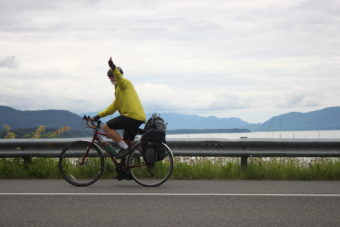
For the past three years, a British woman has been trying to travel around the globe using only her own strength. Sarah Outen has biked through China and rowed the Pacific Ocean.

Now, she’s in the Aleutian Islands, tackling some of the world’s wildest seas in a kayak — and learning plenty along the way.

When she first left London in 2011, Sarah Outen couldn’t have known that her journey around the world would lead to do this:

Danny Snigaroff: “Fish don’t wanna eat? You come around, and you just snag ’em.”

Sarah Outen: “Oh, really?”

Snigaroff: “Yeah. You get between them and jerk.”

Outen’s standing on Korovin Beach in Atka — a village of about 70 people in the Aleutian Islands.

The man giving her fishing lessons is Danny Snigaroff. For the past few days, he’s been teaching Outen and her kayaking partner all about the traditional foods that line Aleutian beaches.

Snigaroff: “Oh, yeah. I was going to ask you, do you have a triple hook? No, eh?”

Outen: “A triple hook? No, I don’t think so. Whoa! No! We don’t.”

Snigaroff: “You don’t have one of these, I’ll give you one.”

Outen: “Thanks, Danny. That’s really kind.”

That could come in handy over the next few months, as these women attempt to kayak through the Aleutian chain — from Adak to Homer.

They know it’s been done — at least in part. Traditionally, the Unangan people traveled through the Aleutians in kayaks. Outen says there have been more recent trips.

Outen: “But we’ve not heard of anyone in modern times doing the whole length like that.”

There are plenty of reasons why that would be. Outen’s kayaking partner on this trip, Justine Curgenven, has no trouble listing them off.

Curgenven: “There’s rocky landings, there’s not very many beaches. There’s no people, so if something goes wrong? You know, our longest stretch without people is 250 miles. That would take us 20 days even if everything went well — even if we’re not sat around waiting for weather, which we’re likely to be. So, there’s just so many potential things that could go wrong, I suppose.”

Sarah Outen — the explorer at the center of all this — knows what challenges lie ahead. But she prefers to take things:

Outen: “Bit by bit. In piecemeal. Because it is overwhelming to think of the whole thing in its entirety. I mean, it’s complex logistically, financially, physically.”

Outen is only 28. It wasn’t that long ago that she was back in England — studying at Oxford, rowing on the crew team, and dreaming of adventures.

Outen: “I had no experience of rowing across oceans. I certainly had no money. I was just a student at the time. And during that kind of early phase, just a few months into those ideas, whilst I was still a student, my father died very suddenly.”

That inspired Outen to row across the Indian Ocean alone — a record-breaking trip, that set the stage for this journey around the world.

It was never supposed to lead to Alaska. Last fall, Outen was trying to row across the Pacific Ocean — to Canada.

Outen: “The weather had been crazy, as you guys who live up here know — that it can be really crazy and unpredictable and fickle.”

That meant changing course. When she arrived at Adak, in the western Aleutians, it had been four months since Outen last saw another human being. She was sick and tired.

In Atka — a week into the kayaking run — Outen isn’t 100 percent.

Outen: “My face looks rather red at the moment, but it’s all allergies. Coming back into contact with people and dust and animals.”

But it’s worth it. Outen says new friends, and new experiences are what this journey around the world is all about.

That’s clear as the adventurers get ready to the leave the village. They’re packing their kayaks on the beach, when the buzz of engines fills the air.

It’s more than a dozen residents, riding down on four-wheelers, to say goodbye.

Crystal Dushkin: “We’re so glad you made it to Atka.”

Curgenven: “Yeah, so are we! Yeah, that was great. We had a really lovely time.”

Outen: “Mike, I realized I didn’t say cheerio. Bye now!”

Mike Swetzof is an elder, and he says he has to hand it to the kayakers:

Swetzof: “Got some balls to do something like this. Be adventurous, I guess? I don’t know. It’s just not my thing.”

Taking on the entire Aleutian Chain is scary, he says. But Swetzof and a lot of other elders in Atka think it can be done.

With enough respect for the weather and the sea — and an open mind — anything’s possible.

CLARIFICATION: Technically, Outen and Curgenven are not attempting to kayak the entire Aleutian Chain. Their trip skips the far western Aleutians.

You can track the kayakers through the Aleutians by visiting Sarah Outen’s website.

Salmon derbies set for Wrangell, other SE cities

Jan Herron displays the 41.2-pound fish that won Wrangell’s 2008 derby (KSTK)

Wrangell fishermen are getting their gear ready for the chamber of commerce’s king salmon derby. But some anglers in other towns are already out on the water.

Organizers say things are looking good for this year’s Wrangell King Salmon Derby.

Now, organizers are always optimistic. But this year, they’ve got evidence.

“I’ve been seeing some pictures on Facebook. People are already out there catching fish. So I think it’s going to be a great year,” says Cyni Waddington, who runs the derby for Wrangell’s Chamber of Commerce.

The organization promises more than $30,000 in prizes for contestants. They range from $6,000 for the overall biggest Chinook to smaller prizes for youth and seniors.

Not all winners get cash.

“One of the local Native artists … does a sterling silver salmon bracelet for the woman who catches the biggest fish in the derby and that’s very popular,” she says.

Wrangell’s salmon derby runs through the first week in June.

Ketchikan, Sitka, Haines and Petersburg have salmon derbies over the Memorial Day weekend. Ketchikan continues for two more weekends, Haines and Sitka for one.

Skagway’s Game Fish Derby is near the end of June. And Craig and Klawock have one running this and next month, with another starting in July.

Juneau has two large derbies, and one is already underway.

“It seems like the run is just fantastic this year. I don’t hear anyone complaining about long rod hours. Everybody’s catching,” says Leslie Isturis, organizer of the capital city’s Spring King Salmon Derby.

It’s a project of the regional Central Council of Tlingit and Haida Indian Tribes of Alaska. Proceeds go to scholarships.

The contest runs all of this month, and the prize for the top fish is $10,000.

Isturis says other payouts are a little different from last year.

“Rather than have a lot of the money in the regular prize listing, we split it up between daily and weekly prizes,” she says.

Juneau’s longest-running derby, the Golden North, runs the second weekend in August.

Many of the prizes are goods or services rather than cash.

Wrangell’s Waddington says that’s part of the fun.

“We actually get lots of prizes from the community … for derby award night. We just basically go down the ladder from the largest weight. I think last year everybody who entered a fish got a prize of some sort,” she says.

Tlingit-Haida’s derby has its own collection of prizes donated by individuals and businesses.

Isturis says there’s even a mystery prize, donated by two local carvers.

“They gave me a check inside an envelope and they said we’ll let you know about half-way through what the weight is. They won’t even tell me,” she says.

The derbies help merchants sell fishing gear, groceries, and other important supplies, such as beer.

Wrangell’s Waddington says they also promote tourism.

“There’s a good number of people who come from other places in Alaska, but there’s definitely a good number of people who come from the Lower 48 as well, who make this one of their travel destinations to come fishing,” she says.

Anglers should have a better chance to catch the big one this year.

The resident bag limit is three kings a day, 28 inches or larger, with no annual limit. That’s up from one a day in 2013.

Denali climber dies in fall

2010 Denali base camp. (NPS Photo/Kent Miller)
A 2010 Denali base camp. (NPS Photo/Kent Miller)

A 39-year-old Washington state woman is the first victim of the Denali climbing season.

Sylvia Montag, of Tacoma, fell earlier this week while descending Denali Pass on Alaska’s highest mountain, officially known as Mount McKinley.

National Park Service mountaineering rangers say Montag and Michael Fuchs, 34, of Berlin, Germany, were climbing near the pass on Saturday, May 3. They were about 18,000 feet when poor weather forced them to turn back from the summit and set up camp to shelter from high winds.

Two days later, on Monday, Montag and Fuchs began their descent down Denali’s West Buttress, but became separated.  Fuchs told the Park Service via satellite phone that each had limited supplies and he’d taken shelter in a storage locker at High Camp, around 17,200 feet.  On Tuesday, Fuchs requested rescue. He told park rangers that he’d heard nothing from Montag.

High winds and poor visibility prevented the Park Service from launching a rescue helicopter until Wednesday.

Montag’s remains were spotted nearly 1,000 feet below Denali Pass.

Fuchs was found near his camp and airlifted to base camp.  After a medical assessment, he was flown to Talkeetna State Airport.

Site notifications
Update notification options
Subscribe to notifications