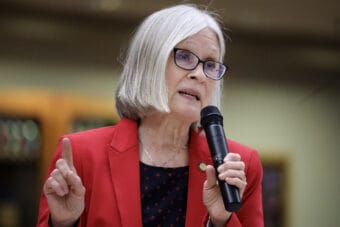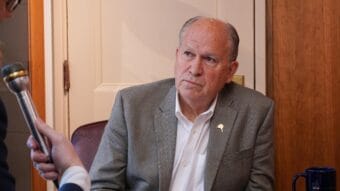
Rep. Louise Stutes, R-Kodiak, questions officials from the Department of Transportation and Public Facilities during a House Transportation Committee meeting in Juneau on Feb. 10, 2026. (Eric Stone/Alaska Public Media)
Members of the House Transportation Committee slammed state transportation officials on Tuesday over a controversial ferry project that lawmakers said stands to benefit private interests but not ferry users themselves.
“The Alaska Marine Highway System was created for Alaskans — not for DOT — but for people and their usage. And you know, I don’t like to see you lose sight of that,” Rep. Louise Stutes, R-Kodiak, said during the hearing,
At issue is the Cascade Point ferry terminal project. The Alaska Department of Transportation signed a $28.5 million dollar contract over the summer to kickstart the effort, which aims to shorten the ferry route between Juneau, Haines and Skagway.
The project would entail building a ferry terminal 30 miles farther north of Juneau than the current one in Auke Bay. That means passengers would have to drive or use a shuttle service to travel between the remote terminal and town.
The contract ignited a wave of opposition from people in all three communities during a public comment period. During the hearing, Stutes noted that the vast majority of the more than 600 public comment letters opposed the project.
“92% of the people said, ‘We don’t want Cascade Point,'” Stutes said.
The pushback has largely centered around concerns that the new terminal would make regional travel less convenient and efficient – as opposed to more, as the state has argued. People have also argued the funds would be better spent on improving existing ferry service.
Christopher Goins is DOT’s southcoast region director. During the hearing, he acknowledged that the numbers Stutes cited are correct and that the project has sparked a lot of “fear” in the public.
But he added that the agency is taking public feedback seriously. He said that includes extending the original comment period and planning two additional rounds of public meetings in Haines, Skagway and Juneau.
“My staff is going to sit there, and we are going to listen to what people have to say, because we want them to be able to put that on the record,” Goins said. “That is fair and that is just. I think this project, of all the projects, needs that process.”
Goins acknowledged public concern over the state’s decision to move forward with the initial contract before soliciting feedback. Still, he said, the agency plans to go through the proper process.
“I think a lot of people got afraid because we hired a contractor to do a design-build process,” Goins said. “That doesn’t mean that the design, and the engineering, and the permitting, the consultation that comes with that process, is ignored. It is not.”
That answer didn’t appear to satisfy lawmakers.
“When you talk about there being controversy and welcoming the dialog, it doesn’t seem to jive with the fact that dollars are already dedicated towards this project,” said Committee Co-Chair Ashley Carrick, D-Fairbanks.
Lawmakers also grilled Goins and DOT Commissioner Ryan Anderson over concerns that the project stands to benefit private interests more than the communities that rely on the ferry system to get to Juneau for health care, groceries, air travel and more.
The new terminal is expected to benefit Grande Portage Resources’ proposed New Amalga Gold Project, which would likely use Cascade Point as its logistical base. But the terminal would also serve as a boon to Goldbelt Native Corporation, which owns the land.
“It feels very strongly to me like what’s really happening is Goldbelt is the primary beneficiary of a project the state is going to utilize federal dollars to support,” Carrick said.
Anderson, the agency’s commissioner, emphasized the importance of the private sector to the state’s economy and said working with industry can help promote economic development in Alaska.
Other lawmakers pressed agency officials over a controversial economic analysis of the project and about uncertainty around the new terminal’s overall cost and whether it would actually generate significant savings for the state.
Alaska Supreme Court Chief Justice Susan Carney delivers the State of the Judiciary address to the Alaska Legislature on Feb. 11, 2026. (Eric Stone/Alaska Public Media)
Alaska Supreme Court Chief Justice Susan Carney highlighted efforts to reduce case backlogs and asked lawmakers to fund new judges and long-delayed courthouse maintenance during the annual State of the Judiciary address on Wednesday.
Carney is also the judicial branch’s chief administrator, and she says the reports remind the court system that it must remain committed to resolving cases quickly and fairly.
“I know that the cases with extreme delay are outliers compared to the vast majority of criminal cases and the time it takes to resolve them, but it’s still heartbreaking to think of the anguish that victims suffer and the problems that delays cause to everybody involved in criminal cases,” Carney said.
But the court system has made significant progress, Carney said. She said courts had cleared a pandemic backlog, with the number of open cases significantly below pre-pandemic levels. She said the number of felony cases more than two years old has been cut by more than half since 2023.
Carney thanked prior chief justices for their work bringing the backlog down, and she says she’s recently put out a new policy tightening existing limits on orders known as continuances, which delay court proceedings.
Carney also celebrated the rededication of the Utqiagvik Courthouse to honor an Indigenous legal pioneer. She called magistrate Sadie Brower Neakok a “trailblazer” and highlighted her commitment to ensuring language access for Indigenous people, starting before statehood.
“She regularly held court at her kitchen table and did it in Iñupiaq when the people appearing in front of her didn’t understand English,” Carney said. “When she became a state court magistrate, she and magistrate Nora Guinn from Bethel insisted that they be able to hold court in the language that their community members understood.”
Carney also came with requests. She asked lawmakers to open the state’s purse to fund a new judge in Palmer to handle the growing workload in the Matanuska-Susitna Borough. The last time the state added a judge to the state’s fastest-growing region was in 2006, according to the court system, and in the meantime, the population has grown 40% and the number of cases filed has risen 55%.
Carney said the court system has tapped retired judges and those from other communities to fill in at the Palmer courthouse to handle criminal cases and other urgent matters, but she said she was concerned delays could mount in other areas without a new judge.
The chief justice also urged lawmakers to fund long-delayed maintenance. She says court facilities across the state are badly in need of repair, including an administrative building in Anchorage.
The building has a crumbling facade, “barely keeping out the elements and the occasional vermin,” she said.
“On the facade, close to head height, so that people passing by can see it, is a great big metal map of the state of Alaska,” Carney said. “I’m sorry to tell you, Kodiak is no longer part of the state of Alaska.”
Fortunately, Carney said the Kodiak-shaped hunk of metal did not land on any passing pedestrians. But she said the episode underscores the dire need to repair and upgrade courthouses.
Key lawmakers have said that despite a large deficit, they plan to prioritize school and state facility maintenance in this year’s budget.
Juneau Rep. Sara Hannan speaks during a protest in February 2023. (Photo by Clarise Larson/KTOO)
A Juneau representative’s proposal to ban law enforcement officers from wearing face masks on duty got a chilly reception from some state lawmakers during its first hearing on Tuesday.
Rep. Sara Hannan, D-Juneau, prefiled House Bill 250 in early January ahead of the legislative session. In a presentation to the House State Affairs Committee, Hannan called her bill “pro-law enforcement.” She said it’s aimed at increasing police transparency and communication in Alaska.
“Masked law enforcement is wrong on many levels,” she said. “When officers conceal their faces, they compromise transparency, communication and the public’s perception of accountability.”
“I think about the harm that’s happening, what we’re hearing about on the federal level now, when people are coming into communities,” she said. “It’s significant psychological harm that I have been hearing and reading about, and I think that’s what you’re trying to prevent in this bill for that happening here.”
Other states across the U.S. have sought to impose similar bans. On Monday, a federal court blocked enforcement of a law in California that sought to bar federal and local officers from wearing masks. The judge ruled it violated a federal doctrine that prohibits state laws from discriminating against the federal government — in this case, federal agents.
However, Hannan’s bill, as drafted, would ban anyone acting as a law enforcement officer in Alaska from wearing a mask while on duty — including federal, state and local agents. The ban exempts medical masks, transparent safety shields, cold-weather masks or masks worn by undercover officers.
An officer who violates the ban would be charged with a Class B misdemeanor per violation, which is punishable by up to 90 days in jail and a $2,000 fine.
At Tuesday’s hearing, some lawmakers were skeptical.
“I’m seriously concerned about this bill,” said Rep. Kevin McCabe, R-Big Lake.
He argued that masks are a tool that can prevent attacks and doxxing of officers. He questioned whether the bill was necessary in Alaska.
“I have never seen a masked officer that wasn’t on a snowmobile actually in Alaska,” McCabe said. “So I’m not sure that this is actually a problem, but I do think it is a tool.”
Hannan said ahead of this year’s legislative session that she saw the bill as a way to start a conversation about the issue. It’s unclear if it will have enough support to advance in the Legislature.
Frieda Nageak (right) a board member with the North Slope Borough School District, and student Faith Brower (left) testify before a joint session of the House and Senate Education committees as part of the annual fly-in advocacy day on Feb. 9, 2026. (Photo by Corinne Smith/Alaska Beacon)
Students and school officials from across Alaska visited the Legislature — from the North Slope, to the Yukon Flats, to Yakutat and Hoonah — to make what has become an annual plea to lawmakers to invest in the state’s public education.
“I have been in this building every February for 20 years, and for 20 years I have been saying nearly the same exact thing, and we’re at a point now where that conversation is at an inflection point, ” said Lon Garrison, executive director of the Association of Alaska School Boards, which organizes the annual fly-in event on Monday.
“Pretty soon, public education will not work in the state of Alaska,” he said. “And we have to do something. We have to be bold.”
Decades of deferred maintenance for Alaska’s schools is reaching crisis levels, lawmakers heard, with some districts grappling with deteriorating school buildings, failing water and sewer systems.
Alaska’s school maintenance problems are well-known, but the schools’ needs come with a multi-million dollar price tag. Lawmakers will be negotiating how much to allocate to schools among a slate of other dire state funding needs, from transportation to increased disaster relief funding. That negotiation is further complicated by declining oil prices and state revenues — and the threat of Gov. Mike Dunleavy’s veto pen.
But on Monday, students and school board members, some parents themselves, shared emotional testimony of how schools continue to endure failing infrastructure.
“Some of our schools are so riddled with black mold that I developed a headache almost immediately,” said Julia Phelen, a member of the school board with the Delta-Greely School District, on visiting rural schools in the Delta Junction area district. “Some of them have only one working restroom in the entire building, and others are hauling water and using honey buckets.”
Last year, the Legislature approved $38 million to address school maintenance needs on the state’s major maintenance list, a ranking of school projects submitted to the state for reimbursement. That was enough to cover the top nine projects on the list. Gov. Dunleavy vetoed that down to roughly $12.8 million, citing declining oil prices and state revenues, to fund the top three projects on the list.
This year, whether lawmakers will allocate more funding for public education remains uncertain amid early budget negotiations.
But leaders in the bipartisan Senate Majority Caucus expressed support for addressing more of schools’ major facilities needs at a news conference on Tuesday.
“Now this year, we’ve got $401 million on the deferred maintenance list of schools,” said Sen. Bert Stedman, R-Sitka, a member of the Senate Finance Committee. “We need to have a dialogue with the administration and try to get them to work with us so we can, you know, slow down this deferred maintenance. Because every year doesn’t get addressed, it just gets worse.”
The deteriorating school facilities are coupled with stretched budgets — some districts face steep budget shortfalls and school closures — and rising costs, especially for rural districts. Some speakers said budget shortfalls are forcing districts to cut classes, teachers and activities, which they said is posing a growing risk to students’ safety and wellbeing, including mental health.
Reanna Brown, a school board member from Yakutat, testified that in rural communities like hers, which are connected to the road system only by boat and plane, the costs of education are higher, from retaining teachers to powering buildings and transporting supplies.
“Our students deserve the same opportunities as any student in Alaska, regardless of their zip code,” Brown said. “Stable, equitable education funding allows us to retain quality educators, support student services and provide safe, consistent learning environments.”
In the Yukon Flats School District, which covers a vast area in the northeast of the state, Rhonda Pitka, a school board member, said the decades of deferred maintenance is a constant problem.
Rhonda Pitka, a board member of the Yukon Flats School District, and chief of the Beaver Village Council testifies before legislators on the challenges faced by the school districts on Feb 10, 2026 (Photo by Corinne Smith/Alaska Beacon)
“There’s always a problem with the sewer systems and the water systems,” Pitka said. “One of our smallest schools, Chalkyitsik, has about 13 students this year, but they’ve had this water issue for like, 20 years,” she said.
She said extreme cold and the remoteness of schools in the Interior is also exacerbating schools’ water and sewer issues.
“We have incredibly cold weather. It was 50 below for five weeks, and then it hit a three day streak of minus 70 below in the Interior. So, you know, at those temperatures, nothing’s running, nothing’s working,” Pitka said, and spoke about the difficulties of retaining essential maintenance workers in the villages at $20 per hour.
Many speakers thanked lawmakers for supporting the increase to the state’s per student funding, the base student allocation, last year, but said that state education funding still falls far short of what is needed.
“Every day we see the impact of not having enough resources for our education,” said Melina Pangiak, who testified with a classmate, Lucia Patrick, from the Chevak school in the Kashunamiut School District in Western Alaska.
The students spoke about the cuts to elective classes and learning opportunities. “Elective classes are more than just extra courses. They are where we discover what excites us and where we find talents and when we could discover our future paths,” Pangiak said.
Students with the Kusilvak Career Academy, a residential program focused on career and technical education for high school students with the Lower Yukon School District. They visited the Legislature as part of the annual fly-in organized by the Association of School Boards on Feb. 9, 2026. (Photo by Corinne Smith/Alaska Beacon)
“When these classes are cut or limited, it feels like doors are being closed on our potential,” Patrick added.
Students and school officials testified that there is a growing need for more school counselors and resources for mental health support.
“Our region recently experienced another suicide, which deeply affected our students and our only regional counselor,” said Kay Andrews, a school board member from the Southwest Region School District that includes eight schools spanning across the Bristol Bay region.
“Schools are more than our classrooms. They are community centers. They are safe places for our children, yet, schools are being asked to do more with less,” she said.
Some speakers pointed to bill proposals that lawmakers are considering this year as potential solutions. Some testified in support of House Bill 261, proposed this year by Rep. Andi Story, D-Juneau, that would redefine how districts calculate their student count to create more predictable budget estimates in the spring.
“It’s come to be a guessing game, almost, because we’re not sure how many students we’re going to have,” said Jack Strong, a board member from the Chatham School District, which serves four rural schools in Southeast Alaska. “It’s really hurting us in the long run, our children are not getting the education that they need, basically because of the way the paper shuffle is.”
Speakers also expressed support for state pension reform, House Bill 78, currently being debated in the House Finance Committee, to help support recruitment and retention of teachers.
Students came with solutions as well: Maddie Bass, a sophomore at Juneau Douglas High School: Yadaa.at Kalé testified to the stress of teachers struggling with low pay, and leaving to pursue other jobs with health care benefits. Following the hearing, Bass said she’d like to see the state generate more tax revenue from the millions of tourists that visit Alaska each year.
“I’m seeing the government turning to taxing Alaskans. They want to tax Alaskans more instead of taxing corporations, and I think that that is the wrong idea,” Bass said. “I think to bolster the education system in Alaska, it would be a good idea to tax the tourism industry or cruise ships more, instead of putting a further burden on Alaskans that are just trying to work, learn and live here in the state.”
Alaska Sen. Lyman Hoffman (D-Bethel), the state’s longest-serving legislator, sits in the Legislative Information Office in Bethel on Jan. 29, 2026. (Evan Erickson/KYUK)
Sitting in the Legislative Information Office in Bethel, full of hardbound volumes and photos of the state’s political history, Sen. Lyman Hoffman said he’s ready to close the book on his own four-decade career in politics.
“I think it’s, it’s time … the next closest person behind me is 14 years behind me,” Hoffman said.
Hoffman has spent most of his time in the Senate, representing Southwest Alaska. He said he thinks he’s made a difference in the lives of rural Alaskans.
“I funded weatherization, set up a weatherization program where close to 60% of the funds, about $700 million, went into weatherizing people’s homes. People have come up to me and said, as a result of the weatherization program, their heating bill went down by hundreds of dollars a month,” Hoffman said.
Hoffman also cited his creation of a billion-dollar endowment to protect rural electricity subsidies under the state’s Power Cost Equalization program. He does admit that the cost of living in rural Alaska remains staggeringly high.
Hoffman said that his priority in his final session is finding ways to fund the budget. He said that Gov. Mike Dunleavy’s idea of a sales tax is not one of them.
“I haven’t heard anybody that really likes that idea in the legislature,” Hoffman said.
Hoffman said that the proposal to add a 4% sales tax during the tourist season and a 2% sales tax during the other half of the year would run up against local taxing schemes adapted to rural needs.
“He wants no exceptions, no loopholes, no food, heating, fuel. Everything is going to be taxed. And I would say that that would put rural areas at a larger disadvantage because we already pay the highest cost for heat,” Hoffman said.
In Bethel, there have already been long-standing challenges collecting the 6% local sales taxes the city levies. Hoffman said that the governor’s proposal would mean the state would collect taxes on behalf of cities like Bethel, removing that burden. But he said this potential upside is far outweighed by the downsides.
Dunleay’s fiscal plan also proposes a constitutional amendment that would require half of the state’s yearly draw from the Permanent Fund to go toward paying higher dividends. Critics say that would make balancing the budget nearly impossible.
Hoffman said the state might be in a better position today if lawmakers hadn’t stripped down a 2018 bill that used Permanent Fund earnings to cover state operating costs for the first time. Hoffman said he supported a provision to set the dividend at a lower, more sustainable rate. But that idea was rejected.
“If we had passed that bill with that provision in it, the dividend would be $1,500 and continue to grow out in the future. Now, we’re fighting tooth and nail to try to get at least $1,000 in the dividend and fund government,” Hoffman said.
Hoffman said that he has encouraged Dillingham Independent Rep. Bryce Edgmon to run for his Senate seat in November. Edgmon is also the current Speaker of the House. Hoffman said it makes sense because of Edgmon’s record of rural and urban support, and the fact that he’s already represented Kuskokwim River communities within his district.
Hoffman said that he’s concerned that there will be less rural representation on the powerful Senate Finance Committee he co-chairs when he leaves. But he’s optimistic that the bipartisan Bush Caucus he has played a key role in can continue to wield power across the aisle, and that rural issues will continue to get attention statewide.
“The influence of people off the rail belt over the last three decades has been tremendous,” Hoffman said.
Hoffman said that it is critical that legislators form a better working relationship with the governor in 2026. When it comes to ways the state can support ongoing relief efforts following damage from Typhoon Halong, he said Dunleavy has given him an open ear. But Hoffman said specific ideas should come from affected communities.
“The decisions on what needs to be done has to be decided by the local people, and we have to see how we can implement them,” Hoffman said.
Soon, Hoffman will be stepping away from politics. On top of having more time to spend with his wife, Lillian, who he says has been his greatest source of support, Hoffman plans to take time for hunting and fishing around Bethel.
“I’m going to jump on my snowmachine and ride away into the sunset,” Hoffman said.
The 2026 regular legislative session is scheduled to wrap up by May 20.
Alaska Supreme Court Chief Justice Susan Carney delivers the State of the Judiciary address on Feb. 12, 2025. (Eric Stone/Alaska Public Media)
The head of Alaska’s court system is set to deliver the annual State of the Judiciary Address from the Capitol in Juneau at 11 a.m. Wednesday.
The Alaska Legislature has a tradition of inviting the Alaska Supreme Court’s chief justice to deliver an address each year during session. Chief Justice Susan Carney was appointed to the court in 2016 and became chief justice last year.
Watch Gavel Alaska coverage of Carney’s address live on KTOO 360TV or here, or listen on your local public radio station, including KTOO 104.3 FM and 91.7 FM in Juneau.
Close
Update notification options
Subscribe to notifications
Subscribe
Get notifications about news related to the topics you care about. You can unsubscribe anytime.