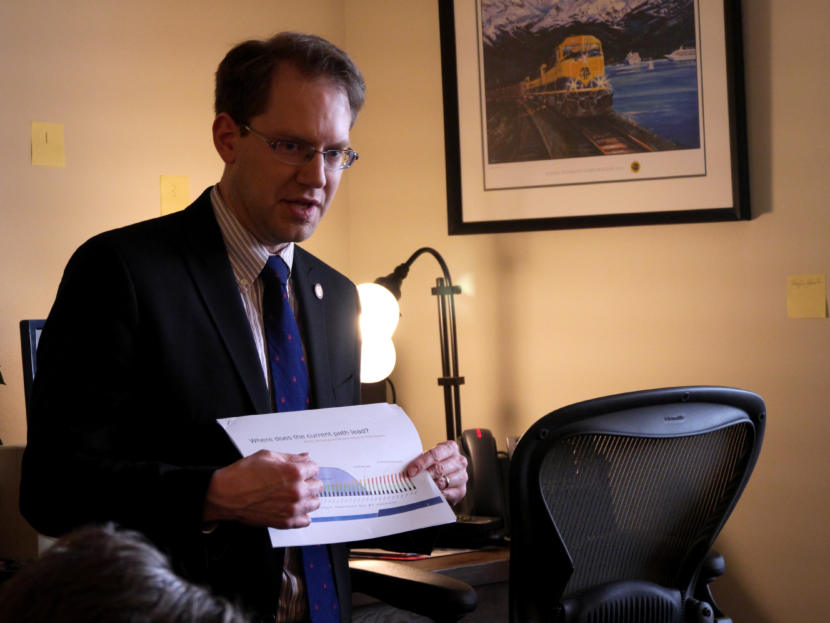
Rep. Lance Pruitt, R-Anchorage, talks to reporters at a House Republican minority press availability in his office at the Capitol in Juneau in March. Pruitt said Tuesday he anticipates there won’t be enough votes to draw from the Constitutional Budget Reserve unless the House amends the capital budget bill to fund full permanent fund dividends under a 1982 state law. (Photo by Skip Gray/360 North)
The state capital budget for the next year is caught in a dispute over the size of permanent fund dividends.
It also affects programs to pay for college grants and scholarships and to equalize power costs across the state.
The capital budget, Senate Bill 19, depends on at least six Republicans who aren’t in the House majority supporting the budget. That’s because it would draw $162.5 million from the Constitutional Budget Reserve, and drawing from that piggy bank requires support from three-quarters of the members of both chambers.
It doesn’t look like those votes will be there without dividends of roughly $3,000.
House Minority Leader Lance Pruitt, an Anchorage Republican, said his caucus supports amending the capital budget to pay full dividends under a 1982 state law. If that amendment isn’t successful, Pruitt anticipates there won’t be enough votes to draw from the Constitutional Budget Reserve.
“If the amendment for the dividend did not pass, then there would not be enough votes to have … the CBR language pass,” Pruitt said.
The capital budget debate could begin as soon as Wednesday. The budget would fund the reopening of Palmer Correctional Center and provide funding for new drug treatment facilities.
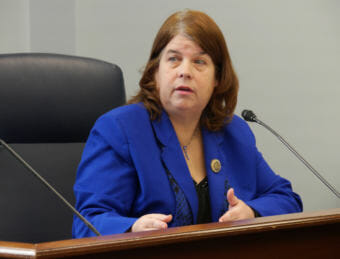
Rep. Tammie Wilson, R-North Pole, at a House minority press availability on Feb. 23, 2017. (Photo by Skip Gray/360 North)
North Pole Rep. Tammie Wilson said $10 million would go to grants to expand drug treatment throughout the state.
“We know that there’s pretty much not a part of the state that’s not affected by not having enough treatment beds,” said Wilson, a Republican in the House majority caucus.
The House Finance Committee advanced the budget Tuesday on an 8-3 vote.
If the entire House falls short of the 30 votes needed to draw from the Constitutional Budget Reserve, there would be no money in the budget for the Power Cost Equalization program for residents with high energy bills. And there would be no money for both Alaska Performance Scholarships and needs-based Alaska Education Grants. Both programs pay for Alaska students to attend postsecondary education.
The capital budget also would include more than $1 billion in federal funding. But the state must spend some of its own money to receive the federal dollars.
Watch the latest legislative coverage from Gavel Alaska.
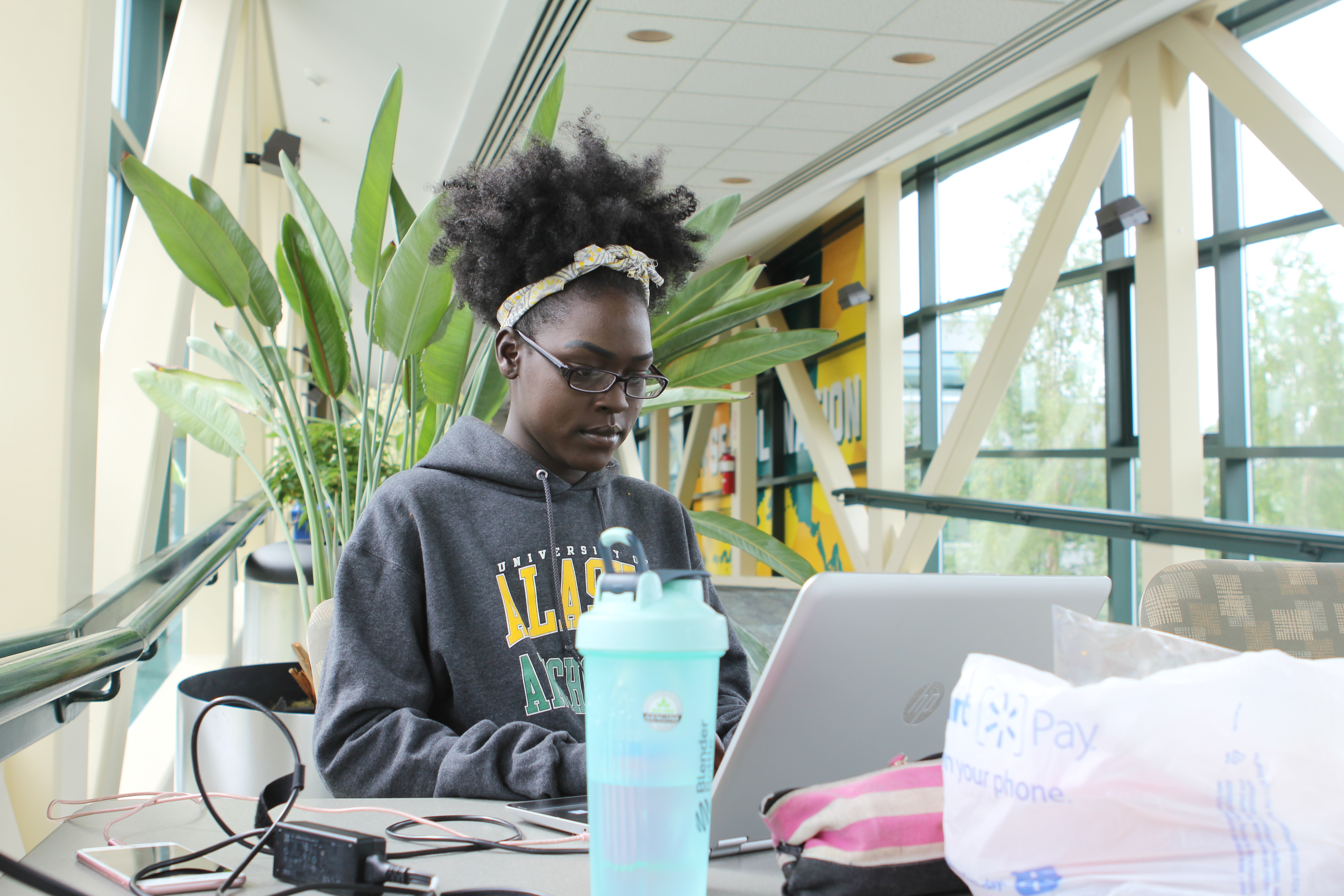
Nyariak Kuany studies for one of her summer final exams at the University of Alaska Anchorage in July. Kuany receives both the Alaska Education Grant and the Alaska Performance Scholarship. (Erin McKinstry/Alaska Public Media)
There is a state-run grant program designed to help more low-income Alaskans afford college. But it only receives around half as much money as the state’s merit-based program.
Nyariak Kuany studies accounting at the University of Alaska Anchorage. She and her two sisters are the first in their family to attend college.
Kuany gets around $4,000 every year from two state programs: the merit-based Alaska Performance Scholarship and the needs-based Alaska Education Grant. She said she probably wouldn’t be at college without them.
“And I just thought here’s what you have available. You can really benefit and profit off this award that you were given, um, why not take it?” Kuany said.
Kuany’s mother immigrated from Sudan before she was born. She’s a widow and a single mom of eight.
The federal financial aid application calculates that Kuany’s family can’t afford to pay anything to send her to college. But thanks to federal and state aid and a job at Olive Garden, she’s currently debt-free.
“With those I actually haven’t paid any money out of pocket other than my parking pass,” Kuany said.
But there are a lot of students in Kuany’s shoes who aren’t so lucky. Well over 1,000 qualified low-income students don’t receive Alaska Education Grant funding each year. Around 40 percent of students with a financial situation similar to Kuany’s don’t receive funding. And that doesn’t include students whose families make a little bit more.
That’s because funding for the program dries up before all the need can be met. In contrast, the merit-based Alaska Performance Scholarship funds everyone who qualifies.
The Alaska Education Grant receives half as much funding as the Alaska Performance Scholarship, as outlined by state law. Only one in five students receiving that scholarship are low-income. To qualify, students have to take certain classes in high school, maintain a certain GPA and score well on standardized tests.
So why prioritize one over the other?
University of Alaska’s Saichi Oba said his sense is that the system is set up to value merit where people who do well in high school are rewarded. He’s the assistant vice president of student and enrollment services.
“And I just don’t think maybe there’s enough understanding of what the real need is for low-income families who would like to send their child to college. Or a mother and father who would like to attend college themselves perhaps to finish a degree,” Oba said.
The performance scholarship is also meant to keep college-educated students in state and contributing to the economy.
Alaska isn’t alone in prioritizing merit-based aid.
“Need-based aid continues to shrink as a share of the total state aid as compared to merit-aid which we see is on the rise,” Cooper said.
Cooper said merit-based programs tend to be politically popular. They often give middle and high-income students more choices when looking at colleges. Need-based programs, in contrast, often determine whether low-income students attend college at all.
“So it really promotes access. It helps students get into the door,” Cooper said.
Not every state has state-run scholarship and grant programs, but most have at least one. Alaska’s programs — in their current state — were a product of the Parnell administration.
The Legislature has tried to cut funding or even eliminate both programs, mostly because of the state’s budget crisis. Both are currently funded through the Alaska Higher Education Investment Fund, which works like an endowment.
Stephanie Butler is the executive director of the Alaska Commission on Postsecondary Education, the organization that runs both programs. She thinks there’s less funding for the need-based program, in part because it was tacked on to a bill at the last minute and because money for education is tight. She said, in general, the Legislature sees the benefits of both programs.
“Especially when we get a low-income student out of a dependency status, where they’re dependent on the state for income, and into workforce where they can earn a living wage. And that’s really transformative for generations and it’s also transformative for the Alaska economy,” Butler said.
Butler said they’d love to be able to fund all low-income students, but for now, the commission prioritizes who they fund based on factors like financial need and whether the student has received the award in the past.
And that means students like Kuany are left wondering whether they’ll have to foot the bill for an extra couple thousand dollars every year. Kuany said right now, she plans to graduate in four years, but a cut to her funding could change that.
“I have taken five classes a semester, that is very pricey on my end. So if I didn’t have that, I’d have to minimize the amount of classes I take on my end,” Kuany said. “So I think that’s how it would hurt me, I’d have to end up being in school longer.”
If everything goes according to plan, Kuany will be working as an accountant by 2020. And she’s hoping that’ll inspire her younger siblings to go to college too and maybe even pursue graduate school.
For a more in-depth, national look at the issue, check out this story from The Hechinger Report.
As legislators make cuts to the state’s budget, they’re looking to draw money from various state funds to cover costs. But changes drawing money from the fund to help rural Alaskans pay utility bills – and cutting money to local governments — are raising concerns.
The House Finance Committee is considering a budget bill that would cut state government spending $418 million more than the $100 million in cuts Gov. Bill Walker proposed.
House Bill 256 would change the source of funding for two budget items. A $76.7 million payment to the Teachers’ Retirement System would be paid from a fund for college scholarships and grants.
And $24.7 million for the University of Alaska would come from the Power Cost Equalization Fund, rather than the operating budget.
Big Lake Republican Rep. Mark Neuman said the proposal draws on available funds to meet the committee’s priority: balancing the state’s budget. Neuman is the committee’s co-chairman.
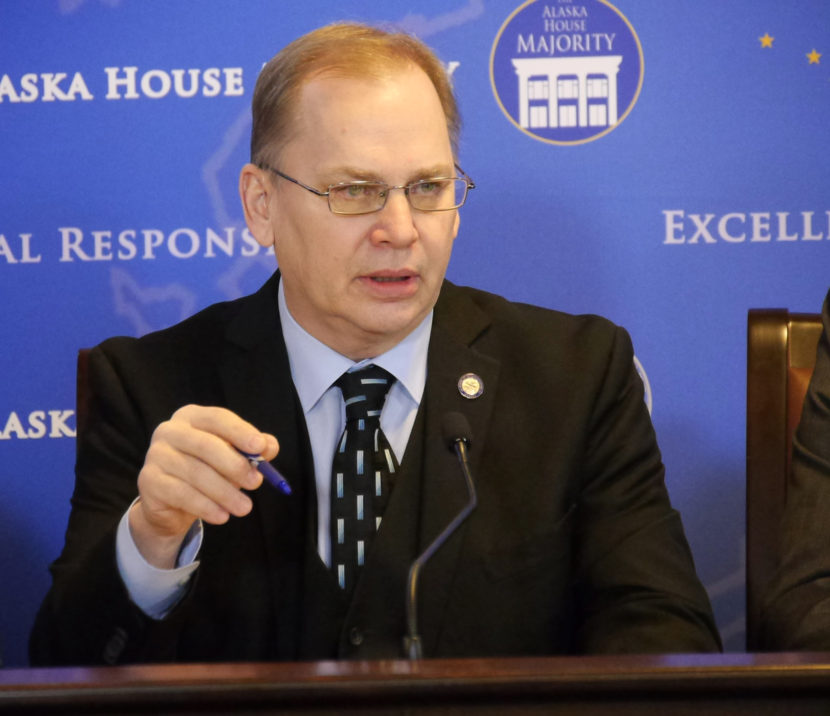
Rep. Mark Neuman, R-Big Lake, at a House Majority press availability, Jan. 22. (Photo by Skip Gray/360 North)
“We’re still in the first innings here,” Neuman said. “We’re trying to make sure we’re setting up the budget for the final decisions that we have to do.”
The Teachers’ Retirement System would receive money from the Higher Education Investment Fund, which was started four years ago with $400 million. It was launched to fund Alaska Education Grants, which are for post-secondary students with unmet financial needs and Alaska Performance Scholarships for students with high grades.
If the state draws out similar amounts annually to the proposed $76.7 million, the fund would be exhausted in a few years. Neuman said he expects all current grant and scholarship recipients to continue to receive the money.
The $24.7 million for the university is a small share of the overall $900 million Power Cost Equalization Fund.
But the proposal concerns Newhalen resident Evelynn Trefon. She’s a board member for a small regional electric co-op, whose customers benefit roughly $90 per month from cost equalization.
“Power cost equalization was set aside as a fund to help rural Alaskans and it wasn’t designed to help the University of Alaska,” Trefon said. “They need to look at the budget situation and figure out their own source of revenue funding. And power cost equalization is essential for rural Alaskans.”
Neuman said drawing money for the university this year shouldn’t have any effect on PCE payments.
“This was excess funds. It’s funds that weren’t needed to make the mandatory, statutory payment for power cost equalization,” he said. “It has no effect on paying PCE or any future payments.”
The House Finance Committee also cut a $35 million payment that Walker planned for community revenue sharing. If this change is kept, it would be the second straight year that the state didn’t add money to the revenue sharing program.
Without more money, the program fund would be so low that there could be no revenue sharing in two years.
Alaska Municipal League Executive Director Kathie Wasserman is concerned about the issue. She noted that rural areas depend on the money to provide basic services.
“The large communities – it will impact them. The small communities, it could devastate,” Wasserman said. “And then, when you look at the other cost shifting that is going on, due to the budget crunch that we have, I’m not sure how some municipalities are going to make it through.”
Neuman said he’s aware of the concern, and the committee would like to make changes that would make revenue sharing more secure.
“Everything is on the table right now,” he said. “I’m certainly cognizant of the needs of a lot of the communities in the state of Alaska, particularly the small, rural villages across Alaska, and their ability to do their governmental functions. And, yes, we’re certainly taking those under consideration.”
The committee also cut $25 million from the Public Employee Retirement System. That money could be restored in the next week based on the details of a state actuarial analysis of the pension obligations.
And it proposed a cut of roughly $25 million for the AKLNG pipeline project. Committee members want more details about how the money would be spent before budgeting it. Walker asked for the money to prepare the pipeline’s front-end engineering and design work.
This week, the committee has been hearing public testimony on the budget from residents statewide, ahead of a vote on the budget. It would then head to a vote by the full House before being considered by the Senate.
Close
Update notification options
Subscribe to notifications
Subscribe
Get notifications about news related to the topics you care about. You can unsubscribe anytime.