Archives for:

"Willow project"

What does a North Slope ‘renaissance’ mean for Alaska’s state budget?

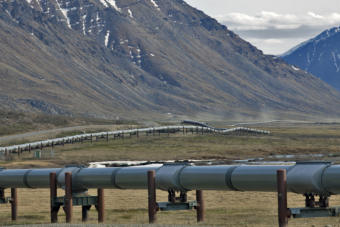
The Trans-Alaska Pipeline runs alongside the Dalton Highway near the Toolik Field Station on June 9, 2017, in the North Slope Borough. (Photo by Rashah McChesney/Alaska's Energy Desk)
The trans-Alaska Pipeline runs alongside the Dalton Highway near the Toolik Field Station on June 9, 2017, in the North Slope Borough. (Photo by Rashah McChesney/Alaska’s Energy Desk)

Industry leaders say a “renaissance” is underway on the North Slope. Major projects are well on their way to production, and oil companies say they’re planning to expand even further, helping to reverse a long-running decline in production in the Arctic.

Construction is well underway on high-profile oil development projects like ConocoPhillips’ Willow and Santos and Repsol’s Pikka. Both of those stand to substantially boost the amount of oil flowing south.

At the Alaska Oil and Gas Association’s annual conference last month, ConocoPhillips’ Donald Allan said Willow remains on track to start production in 2029.

“It’s a super exciting time for Alaska,” he said. “We have big projects happening right now. We have a whole new play ramping up, and there’s more to come with our exploration season and future projects.”

Meanwhile, Santos VP of Business Development Peter Laliberte shared the news that the Pikka project is running months ahead of schedule and is more than 90% complete. It’s on track to produce its first barrel of oil in the first quarter of next year, he said.

“Once we start up, we’ll ramp up about mid-year,” he said. “We’ll ramp up to 80,000 barrels a day, and by then, we’re going to be looking on for the next project.”

An additional 80,000 barrels a day would boost North Slope production by nearly 20% from where it is right now.

What does that mean for the state’s economy — and the state’s stretched budget?

“I look at it as all positive,” said Sitka Republican state Sen. Bert Stedman, one of the top budgeters in the state Legislature. “Quite frankly, this is just the beginning. There’s going to be probably a decade of build-out going on on the Slope.”

It’s a boon for the economy, he said, and a welcome source of relief for the state budget. Pikka — which, importantly, is on state-owned land, and thus generates more state revenue than projects on federal land — is likely to yield more than $200 million for the state in its first year, according to an analysis from the state revenue department.

That’s a significant, though not life-changing, chunk of change for the state, Stedman said. For comparison, the education funding boost lawmakers approved this session cost about $170 million.

“It’s not going to be, you know, you’re in euphoria because you have massive surpluses in your budget or anything like that, but it’s definitely positive,” he said. “You want to take multiple steps like this forward, then they all add up to definitely helping the state balance its budget.”

Higher-than-expected oil prices are also providing a lift to the budget, he said.

Sen. Bill Wielechowski, an Anchorage Democrat, said the surge in North Slope activity is, indeed, good news. But not as good as it could be.

“Absolutely, $200 million, of course, happy to see it. It will help the budget,” he said. “But when you compare it to what other jurisdictions are getting, it is nowhere near what we should be getting.”

He pointed to oil-producing states like Texas and North Dakota, which have substantially higher tax and royalty rates than Alaska. Of course, the fact that most of Alaska’s oil comes from the remote North Slope, where costs are high, complicates the picture.

“We can’t even afford to fund our schools. We’ve got schools falling in the ocean. We’ve got communities that still have honey buckets. We can’t maintain our roads, we can’t plow our roads,” he said. “We have colossally mismanaged our oil wealth in the state of Alaska.”

Wielechowski said lawmakers should make changes to the state’s tax and royalty system to take advantage of the surge in activity. For one thing, he said he’d like to prevent companies from deducting investments on federal land — like Willow — from the state taxes they owe on other projects. State revenue officials recently cut the state’s projected income from Willow by half.

“Why should we subsidize that?” he said. “Why should the state of Alaska be subsidizing hundreds of millions to billions of dollars for production, for exploration costs, drilling costs, for which we get zero royalties, for which we get very little in production taxes?”

Wielechowski has backed a number of bills that would stiffen the state’s oil and gas taxes, though they have yet to advance to a final vote.

Willow opponents try again, this time in a US appeals court, to block the ConocoPhillips project

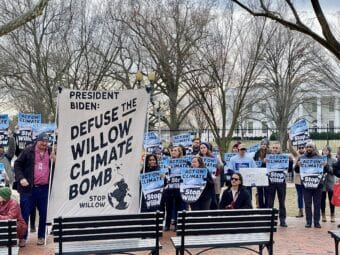
Protestors at the White House in 2023 demonstrate opposition to the Willow oil drilling project on the North Slope. (Liz Ruskin/Alaska Public Media)

ConocoPhillips has already begun to develop its Willow oil leases in the western Arctic, but environmental organizations and a group of Inupiat people opposed to the project are still trying to stop it.

Attorneys for both groups of opponents argued at the 9th Circuit Court of Appeals that the federal agencies made mistakes when they approved the project.

Earthjustice attorney Erik Grafe argued that the government should have fully considered lower-impact options. Instead, Grafe said, the agency clung to the idea that it had to allow development on the whole field, and only at the end chose to trim the proposal slightly.

“The decision that they reached was constrained by the lack of alternatives they looked at,” he said.

The groups also claim the agencies didn’t adequately consider the climate impact Willow would have on the region’s polar bears and other animals listed under the Endangered Species Act.

The government’s attorney, Amy Collier, said experts at the agencies did consider that an increase in greenhouse gas emissions would cause the Arctic to lose sea ice, which the region’s polar bears depend on. But, she said, the link wasn’t direct. They didn’t have evidence that the specific emissions resulting from the Willow project would shrink sea ice in this part of the Arctic, hurting this particular population of polar bears.

Willow has become a flashpoint for climate activists and others who say President Biden’s approval of it is incompatible with his climate goals. It’s the largest new project on federal land anywhere in the country and would produce 180,000 barrels a day.

ConocoPhillips Attorney Jason Morgan said the Bureau of Land Management’s approval of Willow was the logical result after years of careful planning and study.

“So how could BLM then come back and say: ‘I know we’ve zoned it open to surface development. I know we’ve issued you leases and charged you millions of dollars for these leases. But we’re not going to allow you to develop this area, even though your proposal complies with all of the stipulations,’?” he said.

Willow has broad support from tribal and government leaders on the North Slope. The region is projected to reap billions of dollars in revenue sharing and local taxes over 30 years

Alaska is short on gravel and long on development projects

A gravel berm is one of the ways that the North Slope Borough protects infrastructure from storm damage.

Every year, millions of migratory birds flock to Arctic Alaska. Hundreds of thousands of caribou use the tundra, rich in plant life, as their calving grounds. Alaska’s North Slope is also rich in other natural resources: oil, gas, minerals. But one important thing is lacking: Rocks. “Yes, gravel is a precious commodity on the North Slope,” said Jeff Currey, an engineer with the state’s Department of Transportation and Public Facilities who works in the agency’s Northern Region Materials Section. For decades, Currey said, the state has been searching for gravel all over the North Slope, with limited success.

Gravel is essential for all kinds of long-term development: building projects, road construction, runways and other major infrastructure. “There’s a big need for gravel, and not a lot of it, is really what it comes down to,” said Trent Hubbard, a geologist with the Alaska Division of Geological and Geophysical Surveys.

“We need roads. We need housing developments,” said Pearl Brower, president and CEO of Ukpeaġvik Iñupiat Corporation (UIC), based in Utqiaġvik, during a panel discussion at last year’s Arctic Encounter Symposium, the largest annual Arctic policy symposium in the United States. Brower was among a handful of leaders from across the Arctic speaking on the region’s future.

“I definitely think it’s kind of a paramount necessity,” said Brower. UIC runs a construction company that has completed more than $1 billion in construction projects throughout the United States. The company’s website boasts that it specializes in remote locations. Brower said its projects over the last three decades have exhausted two gravel pits, and the corporation is now developing another. “You look all around (Utqiaġvik) and we’re very gravel-based,” Brower said. “You know, we don’t have pavement for the most part, and you wonder, ‘Wow, you know, where did all this gravel come from?’”

Ross Wilhelm — the project superintendent at UIC Sand and Gravel, which opened a new pit last year — said that if all the projects that currently require gravel from UIC’s pit are completed, it could be in operation for up to nine years.

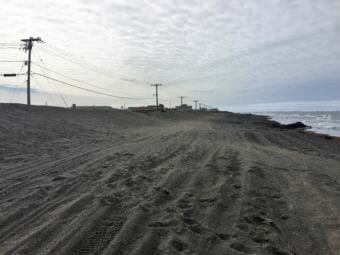
A piece of the Utqiagvik coastline in a residential area near downtown. Much of this bluff collapsed during the September 2017 sotrm. Visible to the left are “supersacks,” part of the North Slope Borough’s strategy at the time for protecting the coastline from storm damage. (Ravenna Koenig/ Alaska’s Energy Desk)

According to Wilhelm, climate change is increasing demand: Gravel is needed for stabilizing existing infrastructure as the frozen ground underneath it thaws, as well as for a seawall to protect Utqiaġvik from high rates of coastal erosion. “I think it’s a big factor,” he said. A five-mile-long sea wall was priced at nearly $330 million, according to a 2019 feasibility study by the U.S. Army Corp of Engineers.

Gravel may also be a means to a richer economic future for Alaska’s North Slope. “To keep the economy growing, it’s so vital,” said Wilhelm. Many of the region’s residents dream of connecting at least some of its eight main communities by road, but doing so would require lots of gravel. The state and the North Slope Borough are partnering on a project, the Arctic Strategic Transportation and Resources, or ASTAR, that could do exactly that. It’s been under evaluation by state geologists since 2018.

The issue isn’t just locating enough gravel for projects like ASTAR; the cost can also be exorbitant. Currey said he’s heard of other North Slope projects where the bids are as high as $800 a cubic yard for gravel, enough to cover about 50 square feet. In Anchorage, a cubic yard of aggregate gravel — the kind used for building projects — goes for about $15. “The DOT has paid on the order of a couple hundred dollars a cubic yard for material being barged in, because that’s the only way to do it,” Currey said. Some of those barges come all the way from Nome, traveling more than 700 sea miles north and east through the Bering Strait and up and into the Beaufort Sea to deliver gravel.

Gravel is also a prized commodity for the oil and gas industry. Last year, the Biden administration approved ConocoPhillips’ Willow Project, a decades-long oil-drilling project in the National Petroleum Reserve. The controversial endeavor will require 4.2 million cubic yards of gravel — more than 12,800 Olympic-size swimming pools’ worth of rocks — for its three oil drilling pads, as well as enough for more than 25 miles of new road. Much of that gravel will come from a 144-acre mine ConocoPhillips will dig itself.

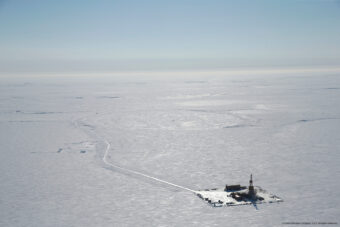
ConocoPhillips’ Willow prospect, pictured here, is still being explored. (Photo courtesy ConocoPhillips)

When it comes to gravel, the Willow Project may fare well, mainly due to its geography; it will be located just west of the village of Nuiqsut, where there’s actually plenty of gravel. Nuiqsit lies on the eastern side of Alaska’s North Slope, where the Brooks Range is closer to the coast. Streams that run northward down the mountains carry gravel with them, according to Hubbard.

But the North Slope is vast, spanning nearly 95,000 square miles, and further west, gravel resources dwindle: The mountains are farther from the coast, and gravel gets caught in the Colville River. “Much of the material north of the Colville River is largely silt and sand left over from historic sea-level rise and fall,” said Hubbard. It’s the kind of material that doesn’t work for projects like Willow or the roads and critical infrastructure that communities rely on. “Gravel,” said Hubbard, “is just a really hard resource to find.”

Emily Schwing is a reporter based in Alaska.

Email High Country News at editor@hcn.org or submit a letter to the editor. See our letters to the editor policy.

This story originally appeared in High Country News and is republished here with permission.

State expects Willow and Pikka to push oil production up 30% by 2032

The Trans-Alaska Pipeline runs alongside the Dalton Highway near the Toolik Field Station on June 9, 2017, in the North Slope Borough. (Photo by Rashah McChesney/Alaska's Energy Desk)
The trans-Alaska Pipeline runs alongside the Dalton Highway near the Toolik Field Station on June 9, 2017, in the North Slope Borough. (Photo by Rashah McChesney/Alaska’s Energy Desk)

North Slope oil production is projected to rise significantly in the next decade, according to a state production forecast presented to lawmakers on Wednesday.

Oil production has been flat or declining over the past five years. In the short term, it’s expected to stay fairly stable at roughly 480,000 barrels per day through mid-2025. But the commissioner of Alaska’s Department of Natural Resources, John Boyle, told lawmakers Wednesday that he expects a more than 30% increase by the start of the 2033 fiscal year in mid-2032.
“We are realizing currently a major boom in investment, and I think it’s safe to say that we really are starting a new chapter when it comes to the future of the North Slope and the types of operators that we’re seeing up there,” Boyle told the Senate Finance Committee.

Boyle said he expects major projects like ConocoPhillips’ Willow and Santos’ Pikka to drive much of the growth. The state’s forecast anticipates production exceeding 630,000 barrels per day by 2032. Pikka is expected to start production in 2026, with Willow following in 2029.

A slide from the Department of Natural Resources’ presentation on its 2023 production forecast, which was presented to lawmakers on Wednesday. (Department of Natural Resources)

Boyle said he’s also encouraged to see a returning oil producer, Apache partnering with Armstrong to drill three wells on the eastern portion of the North Slope

By the end of the decade, Boyle expects existing fields like Prudhoe Bay to make up a minority of the oil flowing through the trans-Alaska pipeline.

Sen. Bert Stedman, a Sitka Republican and co-chair of the Senate Finance Committee, welcomed the forecast.

“Things look a lot brighter, especially with all the national headwinds on oil and gas. We’ve done well, relatively speaking, with what we have to deal with, so we do have a bright future in our oil basin,” Stedman said.

The state also offers high-end and low-end forecasts, which diverge significantly. The high-end forecast shows production climbing to nearly a million barrels per day by 2032, and the low-end forecast would have production falling by roughly 20% over that same period. For the past year, production came in roughly 3% lower than the state’s forecast.

Appeals court allows ConocoPhillips to keep building its Willow project on Alaska’s North Slope

The ConocoPhillips Alaska headquarters, seen here on April 8, 2020, looms over downtown Anchorage. An appeals court order denying environmentals’ request for an emergency injuction allows the company to proceed with its ongoing winter construction at its massive Willow project on the North Slope. (Photo by Yereth Rosen/Alaska Beacon)

A federal appeals court rejected a motion by environmental and Alaska Native groups that were seeking to block construction of the Willow oil field project, allowing ConocoPhillips to continue with its planned winter work on the huge development on the North Slope.

The 9th Circuit Court of Appeals, in a three-page order issued Monday, denied the motion for an emergency injunction that was filed two weeks ago by the groups that are seeking to overturn the Biden administration’s Willow approval.

The order was issued “without prejudice,” meaning that the larger legal case remains alive, with merits of the arguments for and against development to be evaluated later.

The Willow project, in line to become one of the most prolific oil fields on the North Slope, would tap into an estimated 600 million barrels of recoverable oil and produce up to 180,000 barrels a day, according to ConocoPhillips and federal regulators. That would be a significant boost to North Slope production that has dwindled since its 1988 peak of over 2 million barrels a day. Production in the last fiscal year, which ended June 30, averaged 479,400 barrels per day, according to state officials.

Willow has been the subject of intense controversy. Alaska political and business leaders are championing it as critical to the state’s economy and the North Slope’s future as a long-term oil producer, while environmentalists are blasting it as a polluting “carbon bomb” that threatens to derail U.S. efforts to combat climate change.

For ConocoPhillips, the court order affirmed ongoing plans.

“ConocoPhillips is pleased the Ninth Circuit Court of Appeals denied the plaintiffs’ request for an injunction pending appeal. ConocoPhillips is proceeding with Willow construction as we continue to review the court’s decision,” company spokesperson Rebecca Boys said by email on Tuesday.

The company has 800 employees and contractors already assigned to the project, and this winter’s work includes building an ice road, mining and placement of gravel and pipeline construction, Boys said. Activities that do not disturb the surface, such as preparations for the ice road, have already started, as have deliveries of construction materials to a staging area, she said. The surface-disturbing activities like gravel mining and placement are expected to start this month, she said.

Road construction is seen on March 12, 2017, at ConocoPhillips’ Greater Mooses Tooth Unit in the National Petroleum Reserve in Alaska. ConocoPhillips plans similar construction work farther west at its huge Willow project. (Photo by Sarah LaMarr/U.S. Bureau of Land Management)

Willow opponents, in a statement issued Tuesday, said they will press on with their challenges despite the latest setback.

“It’s disappointing that the court has allowed ConocoPhillips to continue doing construction on the Willow project when there’s ongoing litigation charging the Biden administration with unlawfully approving the project in the first place,” said Bridget Pasrianos, senior staff attorney with the environmental law firm Trustees for Alaska, which is representing the plaintiffs.

“This project was approved despite known harms to the community of Nuiqsut and despite the fact that it will produce huge amounts of greenhouse gases in a region already suffering existential climate impacts like the collapse of fish populations and community infrastructure,” she continued, citing the Inupiat village that is closest to the Willow site. “We will do everything we can to protect the western Arctic and stop Willow in the weeks and months to come.”

The continuing legal fight dates back to 2020, when the plaintiffs successfully challenged the Trump administration’s project approvals. After President Joe Biden was sworn into office, agencies in his administration reevaluated the plan and ultimately approved a project that would be somewhat smaller in scope, winnowing it down to three drill sites rather than the five that were in the Trump-approved plan.

Critics of the project continued to press their legal challenge, but their arguments were ultimately rejected last month by U.S. District Court Judge Sharon Gleason. The plaintiffs appealed Gleason’s decision.

Backers of the project have amicus briefs supporting the Biden administration’s approvals. Briefs have been filed with the appeals court by the state of Alaska, the North Slope Borough and the Native-owned Arctic Slope Regional Corp., as well as by ConocoPhillips. The appeals court, in its latest order, also agreed to accept additional supportive briefs that the Alaska Congressional delegation and Alaska legislature plan to file.

The court set a series of deadlines later this month and in January for the parties to flesh out their arguments. On Tuesday, the court scheduled oral arguments on the matter to be held on Feb. 4 in San Francisco.

Willow, with production expected to start in 2029, would be the farthest-west producing oil field in Arctic Alaska.

Because it is located on federal land, within the National Petroleum Reserve in Alaska, the state would reap much less income from oil produced there than it does from most North Slope oil fields, which are located on state land. The extent to which state revenues would be negatively affected is being reviewed.

This story originally appeared in the Alaska Beacon and is republished here with permission.

Federal judge rejects legal challenge to ConocoPhillips’ Willow Project

This 2019 aerial photo provided by ConocoPhillips shows an exploratory drilling camp at the proposed site of the Willow oil project on Alaska’s North Slope. (ConocoPhillips)

The massive Willow oil project on Alaska’s North Slope can move forward, a federal judge in Anchorage ruled Thursday.

U.S. District Court Judge Sharon Gleason ruled against environmental groups, who argued that the government’s decision to greenlight the ConocoPhillips project in the Arctic was flawed.

Gleason found the government’s analysis was consistent with environmental laws and with goals Congress established for the large federal area in the western Arctic, called the National Petroleum Reserve in Alaska.

“ConocoPhillips, as the lessee, has the right and the responsibility to fully develop its oil and gas leases in the NPR-A subject to reasonable restrictions and mitigation measures imposed by the federal government,” she wrote.

ConocoPhillips has called Gleason’s pending decision “make-or-break” for the major oil prospect. The project’s federal approvals have been challenged by several environmental groups. In April, Gleason gave ConocoPhillips a green light to begin constructing roads to support the project.

The initial federal approval of the project under President Joe Biden generated a political backlash, ranging from pushback among Alaska Native groups to protests in Washington, D.C. and opposition from the United Nations and outdoor-gear maker Patagonia.

Biden has tried to temper that anger by making other parts of the NPR-A off-limits to drilling and canceling oil leases in the Arctic National Wildlife Refuge, in Alaska’s eastern Arctic.

The project has been greeted with more favor in the realm of Alaska politics, with state budget projections improving as they take Willow into account and an unanimous Alaska House vote in support.

Conoco says the project would produce 600 million barrels of oil over 30 years, $7.6 billion in revenue for the U.S. Treasury and 2,500 construction jobs.

Site notifications
Update notification options
Subscribe to notifications