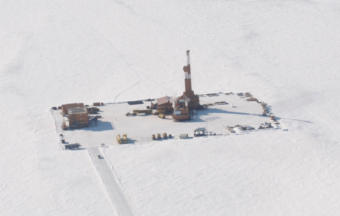
ConocoPhillips’ undeveloped Willow prospect, pictured here, is still being explored. The company announced this week that it’s selling a one-fourth stake in Willow and other projects in Alaska. (Photo courtesy ConocoPhillips)
The Trump administration has approved ConocoPhillips’ development plans for its massive oil project in the remote National Petroleum Reserve-Alaska, on the western North Slope.
Interior Secretary David Bernhardt signed the record of decision for the Willow project on Monday, earning praise from Alaska’s Republican Congressional delegation and governor, and condemnation from environmental groups.
The decision allows Conoco to construct up to three drill sites, plus an oil processing facility, pipelines, roads and other infrastructure.
The Willow project would be the North Slope’s westernmost oil field, and the Department of the Interior says the project could produce up to 160,000 barrels of oil a day, over 30 years.
U.S. Sen. Dan Sullivan said in a statement celebrating Willow’s approval that “the NRP-A is slated to be among the hottest energy prospects in the world.” Bernhardt said in a statement that the project will help keep oil flowing down the trans-Alaska pipeline, and will lead to hundreds of jobs.
“President Trump made his administration focus on American energy independence and the freedom it provides from day one of his term,” Bernhardt said.
But environmental groups are blasting the project, and say it poses significant risks to wildlife, including caribou and polar bears, and is a threat to the Teshekpuk Lake area, one of the Arctic’s most important habitats. Also, they say, it will further contribute to climate change in an already rapidly-warming region.
“The world remains mired in a global pandemic and the oil markets are experiencing continued volatility, yet this administration has once again opted to barrel forward with unnecessarily aggressive oil and gas development,” said a statement from Kristen Miller, conservation director at Alaska Wilderness League.
Conoco described the federal government’s approval of the Willow project as a “key milestone” and says construction could begin as early as next year. The company says it’s planning for oil production to begin in 2026, though it has also said the project could be delayed if Ballot Measure 1 passes, which supporters of the measure say they don’t believe.
More drill sites could be later added at Willow. The Interior Department says it will decide later on whether Conoco can add two additional drill sites. The oil and gas company requested the deferral on that piece of its proposal so it could do more community outreach, according to the federal agency.
ConocoPhillips’ undeveloped Willow prospect, pictured here, is still being explored. The company is selling a one-fourth stake in Willow and other projects in Alaska. (Photo from ConocoPhillips)
ConocoPhillips wants to sell a stake in some of its Alaska oil projects, in hopes of offsetting risk and sharing the expense of costly investments it’s planning in the state over the next decade, the company announced this week.
The package for sale includes old, new and unbuilt projects that represent most of Conoco’s holdings in Alaska, with the notable exception of the company’s 36% share of the massive Prudhoe Bay field, America’s largest.
Among the assets on the block: the Kuparuk River Unit, which is Alaska’s second-largest oil field and has been operating for decades; the newer Alpine unit to the west, which is still expanding; and the undeveloped Willow prospect in the National Petroleum Reserve-Alaska.
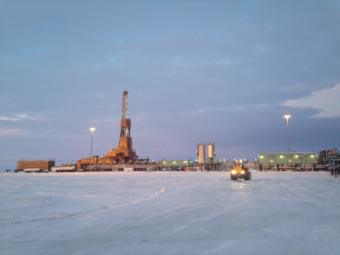
Sometimes oil companies sell off projects if they aren’t measuring up to expectations. Earlier this year, BP announced it would sell all of its Alaska assets to a smaller company, Hilcorp. But Conoco’s sale is not about a lack of confidence in its Alaska projects, according to spokeswoman Natalie Lowman. Instead, she said it stems in part from Conoco’s plan to invest billions of dollars to expand and develop an array of projects in Alaska.
The company aims to spend $11 billion on its core assets in Alaska over the next decade, not including the estimated $5 billion that would be needed to bring the major Willow project into production.
“We have a lot of exciting work that we are planning to do on the North Slope, and it costs a lot of money,” Lowman said in an interview Wednesday. “So what we’re looking for is a co-venturer, a company that shares our vision for increasing production on the North Slope.”
Conoco currently owns 100%, or close to it, of the assets up for sale, and the company says it’s unusual for it to own that much of a stake in its projects. Oil companies often split project ownership into chunks to help share costs: Conoco owns about one-third of the Prudhoe Bay field, America’s largest, with BP and ExxonMobil also holding stakes, for example.
The company is not looking to sell more than one-fourth of the assets, Lowman said, which will leave it in control. And it wants to find a buyer that will be similarly enthusiastic about making the investments needed to move the projects forward.
The announcement did not make a big splash in Alaska’s oil industry, and one analyst said the move does not signify much of a change in Conoco’s view of the state. Some of Conoco’s holdings in Alaska that started as “bite-sized” projects have now grown into bigger undertakings, said Rowena Gunn, who works with energy research firm Wood Mackenzie, in an email.
“Alaska represents a good chunk of ConocoPhillips’ global portfolio, so I think they have taken this decision in order to spread the risk and cost of these projects,” she said. “They will still retain being the largest shareholder and operator of assets.”
Gunn declined to speculate on which oil companies could be interested customers, but she did say that the sale could bring a new player to the North Slope.
The asking price is not going to be made public, Lowman said.
“This is a large commercial negotiation,” Lowman said. “And I think those people who are interested will know how to find us.”
ConocoPhillips’ CD5 drill site, which is linked to its Alpine development that opened in 2000, is 9 miles from the North Slope village of Nuiqsut. (Photo by Elizabeth Harball/Alaska’s Energy Desk)
A major proposed North Slope oil project is running into local opposition from residents of the village of Nuiqsut, who are already partially surrounded by development and wary of more.
After hearing residents’ concerns at a North Slope Borough planning commission meeting that ran past midnight earlier this month, the commissioners declined to support a rezoning proposed for the Nanushuk project — a development that could produce 120,000 barrels of oil a day at its peak, or about one-fourth the amount that currently flows through the trans-Alaska pipeline.
The 4-2 vote isn’t binding, and the borough Assembly will take up the question at a meeting next month. But the decision highlights how the balance between development and subsistence is becoming increasingly fraught in Nuiqsut, a village of 450 that’s found itself in the middle of the oil industry’s resurgence on the North Slope.
Eight miles north of the village is ConocoPhillips’ Alpine project, a $1.3 billion development that opened in 2000 and is still expanding, with sites to the south and west. Another big new Conoco project, Willow, proposes to establish a gravel mine 7 miles west of Nuiqsut, with as many as 250 wells at the site of the development farther away.
Then there’s Nanushuk, pushed by Papua New Guinea-based Oil Search. The company plans to build one of its drill sites 7 miles northeast of Nuiqsut, with a processing facility — to separate out oil from natural gas and water — farther away.
Some of Alaska’s elected leaders have touted the developments as a major boost to the state’s oil-dependent economy. And many Nuiqsut residents support continuing oil development, citing the ample financial benefits and quality-of-life improvements the industry has brought to the village’s residents — particularly those who are shareholders in the village’s Native corporation.
But Sam Kunaknana, Nuiqsut’s representative to the borough and an outspoken critic of oil development’s impacts on the village, said that the other commissioners — who represent different North Slope communities — were persuaded to vote against the Nanushak resolution by testimony from Nuiqsut residents.
People are concerned about development’s impacts on the fish they’re catching and the caribou they’re hunting, Kunaknana said in a phone interview. Already, oil development has affected as much as one-third of Nuiqsut’s traditional subsistence range, according the local Native village corporation.
“It’s not just one project,” Kunaknana said. “It’s everything that’s going on around this area.”
Oil Search’s Nanushuk project and Conoco’s Willow project could, if built, together produce 250,000 daily barrels of oil at their peak, or roughly half the amount of oil that currently flows down the trans-Alaska pipeline. The companies’ management would have been watching the planning commission’s meeting closely, said Tim Bradner, a former BP employee and journalist who’s long followed Alaska’s oil industry.
“And they would be very concerned about making sure that their relationships are good with the local people up there,” he said. “Because unlike in a lot of places, the North Slope is a place where the local people really do have clout.”
Oil Search has been expanding its footprint in Alaska and recently hired Joe Balash, formerly a top official in the U.S. Interior Department; the company recently moved into office space in BP’s Midtown Anchorage headquarters. Spokesperson Amy Jennings Burnett declined to comment.
The planning commission’s vote comes as the Trump administration pushes to loosen restrictions on oil and gas development in the area. Later this week, the Bureau of Land Management plans to release an environmental review of a new land-use plan for the National Petroleum Reserve in Alaska, where the Willow project and others are located — and it’s expected to revoke some of the environmental safeguards contained in a previous, Obama-era version.
The challenge of balancing resource extraction and subsistence exists across the North Slope, but that tension has escalated in Nuiqsut amid the increasing development nearby.
“I can’t think of anywhere in the state where the juxtaposition of these issues comes to roost as it does in Nuiqsut,” Bradner said. “You have to feel some sympathy for the people — they’re surrounded by all this and they worry about their community kind of becoming a truck stop for the industry. On the other hand, there are people in the community who see a lot of upside to this.”
Nuiqsut sits in the biologically-rich delta of the Colville River, just south of where it flows into the Beaufort Sea, and it was founded amid passage of the Alaska Native Claims Settlement Act in the early 1970s. At the time, the oil industry’s focus was 50 miles east, where the Prudhoe Bay field had been discovered. But in the decades since, development has crept steadily west.
Since Alpine opened in 2000, Conoco has linked its central facility with several additional sites, with pipelines and roads now stretching nearly 180 degrees around Nuiqsut; a new connected drill site, Greater Mooses Tooth 2, is under construction.
The village of Nuiqsut in June 2018. (Photo by Elizabeth Harball/Alaska’s Energy Desk)
Oil Search’s Nanushuk development is proposed northeast of Nuiqsut. And Conoco’s new proposed Willow project, to the west, is currently undergoing federal environmental reviews.
Conoco has a “long-term relationship with Nuiqsut, which goes back over 20 years with our Alpine development,” spokesperson Natalie Lowman said in an emailed statement.
“We are actively engaged with the community on our Willow project to identify concerns and seek collaborative solutions,” she said. “It is our goal to assist the community and ensure the North Slope Borough and all the NPR-A villages have the opportunity to benefit from our activities in the NPR-A.”
In February, Nuiqsut’s tribal government sued the federal government over its approval of Conoco’s exploratory drilling program for the previous winter.
But Nuiqsut’s Native village corporation, Kuukpik Corp., has taken a different approach, often partnering with the oil industry to bring cash and infrastructure improvements to shareholders and residents.
Kuukpik’s shareholders receive as much as $30,000 a year in dividends, thanks in part to royalties from oil pumped from some of Kuukpik’s lands that are part of the Alpine project. Alpine also is the source of a natural gas line that runs directly to Nuiqsut, allowing residents to heat their homes for a fraction of the cost in other rural Alaska villages.
Kuukpik has fought for, and received, concessions from oil companies to protect the village’s subsistence harvests and health. For one project, Conoco agreed to move the location of a proposed bridge away from an area where residents fish; for another, it used lower-emission generators to power a drill rig, reduced noise levels and boosted air and water quality monitoring.
The Nanushuk project also included a list of mitigation measures in the resolution that the planning commission rejected this month.
Oil Search, the company pushing the project, would have been required to hire a “subsistence representative” and conduct an array of studies on fish, caribou and the “cumulative impacts” of development in the area. It also would have been required to host an annual job fair in Nuiqsut, and to the extent possible, involve local students in their studies and hire local boat and snowmachine drivers.
The company has also agreed to build a boat ramp on the Colville River, along with a road to it, to improve residents’ access for subsistence.
“The corporation still thinks that Oil Search will be a genuine and viable partner in the Colville delta,” Lanston Chinn, Kuukpik’s chief executive officer, said in a phone interview this week. “And we’ll see where it goes from there.”
The North Slope Borough Assembly is scheduled to consider the Nanushuk rezoning at its meeting Dec. 3. The borough’s chief administrative officer, Deano Olemaun, said he could not comment on the project “until all the final processes have been completed.”
Bradner, the journalist, said he expects the Assembly to balance the planning commission’s position with the project’s potential to add to the North Slope’s tax base. Most of the borough’s $400 million budget is paid for with property taxes on oil infrastructure, and “as the industry matures on the North Slope, its existing tax base is depreciated,” he said.
“They need new projects to keep their tax base active and renewed, to maintain all the public services that they support up there,” said Bradner. “So there’s two sides to this issue, and it’s a complicated question.”
The Willow oil development would be located in the federally-managed National Petroleum Reserve-Alaska, west of Prudhoe Bay and the village of Nuiqsut.
It would be a significant addition to the region, where ConocoPhillips already has built a series of other oil developments. The company hopes to construct a new oil processing facility, up to five drill sites, about 40 miles of permanent roads, a gravel mine and hundreds of miles of pipelines and seasonal ice roads.
ConocoPhillips estimates Willow could produce up to 130,000 barrels of oil per day. That would be a notable boost — this year’s average daily throughput down the trans-Alaska pipeline has been just over 500,000 barrels per day.
Natalie Lowman, a spokesperson for ConocoPhillips in Alaska, said the company is “encouraged” by the release of the draft analysis, calling it “a key milestone in the environmental permitting process for the project. ”
BLM anticipates the project would support hundreds of jobs — an estimated 350 direct positions once completed, and well over 1,000 during peak construction — and provide billions in tax dollars to the state, the federal government and the North Slope Borough.
“Nuiqsut’s core subsistence use area has shifted west over time due to the development in Prudhoe Bay,” the BLM’s draft analysis states. “The BLM expects that limitations to subsistence access and the reduced resource availability attributable to development of the Project would result in an extensive interference with Nuiqsut hunter access.”
“BLM will be allowing development that is likely to pose a serious threat to critical and irreplaceable habitat,” Karlin Itchoak, Alaska state director for The Wilderness Society in Anchorage, said in a statement.
Itchoak also criticized the length of the public comment period, which ends Oct. 15.