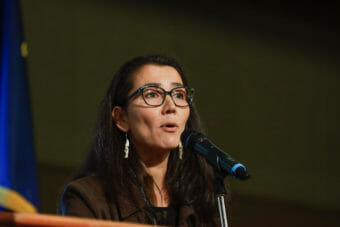
Mary Peltola speaking at the Alaska Oil & Gas Association candidate forum on Aug. 31, 2022. (Photo by Matt Faubion/Alaska Public Media)
Alaska’s congressional delegation, including Democrat Rep. Mary Peltola, sent a letter to Interior Secretary Deb Haaland Tuesday asking her to approve the Willow project, a proposed oil development in the National Petroleum Reserve-Alaska.
The letter itself is not unusual. It recounts the lengthy permitting process, lists benefits to Alaska’s economy and urges Interior Secretary Deb Haaland to approve the project in time for the winter construction season.
Republican Sens. Lisa Murkowski and Dan Sullivan have sent at least two earlier versions of the letter, but Rep. Peltola’s signature could carry extra weight with Haaland. She, like Peltola, is one of only a handful of Indigenous women to ever serve in Congress.
Haaland gave an emotional speech at a reception last week celebrating Peltola’s swearing-in. She’s contributed to her political campaign. And they’re both Democrats.
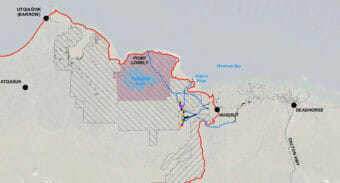
The Willow oil and gas prospect is located in the northeastern corner of the National Petroleum Reserve-Alaska. (Image credit Bureau of Land Management)
Whatever the letter’s power to expedite the Willow project over the objections of environmental groups, it helps Peltola’s profile as she campaigns in a Republican-leaning state. With her next election just weeks away, actions like this help her show that she can work in tandem with Alaska’s Republican senators.
They also demonstrate that she’s in favor of some development projects, making it harder for her Republican opponents Sarah Palin and Nick Begich to define her as a captive of the Democratic left and their allies in the environmental lobby.
This map from the Bureau of Land Management shows the site of the Willow development on the North Slope of Alaska. Willow’s drill sites are marked by squares. (Bureau of Land Management image)
On Friday, the federal Bureau of Land Management released a draft environmental impact statement for the Willow project, a major oil development planned for federal land on Alaska’s North Slope.
Willow, which at peak production is expected to deliver as much as 180,000 barrels of oil per day to the trans-Alaska Pipeline System, is opposed by environmental groups who successfully sued to overturn a prior impact statement that would have allowed the project to advance.
The release of the new impact statement is necessary to advance the project toward construction.
Members of the public have until 10 p.m. Aug. 29 to state their support for one of five options for the project’s future. The alternatives include “Option A,” which would not build it, and “Option B,” which is preferred by ConocoPhillips Alaska, the company backing the project.
On Friday, the BLM’s initial draft stated that it supports “Option E,” which reduces the amount of surface infrastructure to something less than preferred by ConocoPhillips. Early Saturday morning, the BLM said that language had been a mistake and it does not have a preferred option.
The state of Alaska and Alaska’s Congressional delegation have supported the project.
At current oil prices, the Willow project could be eligible for hundreds of millions of dollars in state tax credits, according to information provided to the Alaska Legislature in 2019.
In the long term, the project is expected to generate several billion dollars in additional state revenue, and generate work for construction firms and oilfield services companies.
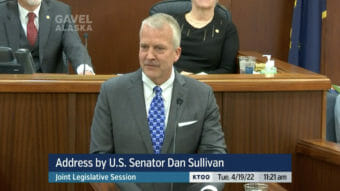
U.S. Sen. Dan Sullivan addresses a joint session at the Alaska Legislature on Tuesday, April 19, 2022 in Juneau, Alaska. (Screen capture from Gavel Alaska)
With Interior Secretary Deb Haaland visiting his state, U.S. Sen. Dan Sullivan on Tuesday aired his dissatisfaction with her progress on oil development in the Arctic and other Alaska issues.
“I won’t sugarcoat it. My relationship with Secretary Haaland has been strained,” he said in his annual address to the Alaska Legislature. “I’ve called her numerous times, reminding her of her pledges that she gave me during our meetings before she was confirmed. I’ve let her know that many of the actions taken by the department under her leadership are hurting our people.”
Sullivan told legislators he was trying to take a different approach than he did in his speech last year, when he bashed President Biden for what he considers an anti-Alaska agenda.
“If you didn’t notice, I was pretty worked up,” he said.
Instead, he said, he wanted to focus this year’s address on pressing the federal government on matters all Alaskans could get behind.
“Today should be about where we can all work together — all of us, Democrats, Republicans, independents — on issues that we should focus on,” he said. “And there are many of these issues that truly matter for our state, our future and the wonderful people we are all privileged to represent.”
But most of the issues Sullivan named as bipartisan have significant opposition, and several Democrats were purposely absent.
State Sen. Tom Begich, D-Anchorage, watched on TV from his office.
“I’m tired of listening to him attack Democrats when he takes that forum,” Begich said. “It’s disrespectful.”
Begich said Sullivan talked up bipartisanship but is among those who treat politics as a partisan “bloodsport.”
“The bottom line is if you spend your time always criticizing the other side, it doesn’t get you to bipartisanship,” Begich said.
Sullivan’s list of issues he said all Alaskans can get behind included:
The long-sought road for King Cove. Residents of King Cove say the road would save lives, by providing access to Cold Bay’s all-weather airport. But the road would go through a protected wilderness area in the Izembek National Wildlife Refuge. Environmentalists say a road would harm important habitat for migratory waterfowl and other wildlife.
Permitting oil development in the Arctic National Wildlife Refuge and ConocoPhillips’ Willow Project in the National Petroleum Reserve Alaska. While Alaska Native corporations support drilling in these areas, some communities, tribes and environmental groups oppose them.
The Ambler road, to aid mining in Northwest Alaska. Like Arctic drilling, the Ambler road and proposed mining is controversial among Native communities and opposed by environmental groups.
After Sullivan’s address last year to the Alaska Legislature, Democrats in the state Senate wrote him and said his speech damaged the bipartisan cooperation many legislators strive for.
Legislators who were in the chamber for his address this year joined Sullivan in cheering the end of the federal mask mandate for air travel. At the conclusion of the speech, lawmakers gave Sullivan a standing ovation.
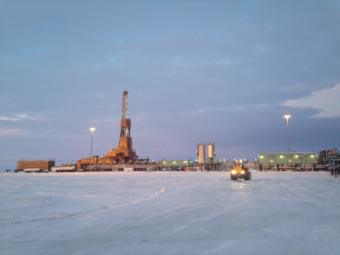
ConocoPhillips’ CD5 drill site in January 2017 (Photo by Elizabeth Harball/Alaska’s Energy Desk)
As global oil prices have soared following Russia’s invasion of Ukraine, there’s been cause for a lot of optimism in projections for Alaska’s mostly oil-driven state revenue.
But prices and production are at play in the revenue equation. So with oil above $100 a barrel, some Alaskans have wondered: Will oil companies now be drilling for more oil here?
Not likely, says longtime oil industry observer Larry Persily, who’s worked and reported on oil and gas issues in Alaska for decades.
Persily says the two main Alaska projects under development — Oil Search’s Pikka field and ConocoPhillips’ Willow project — were already in the works, and he hasn’t seen any other large projects that would go forward because of recent high oil prices.
Listen here:
The following transcript has been lightly edited for clarity.
Larry Persily: I don’t see where today’s high prices, last month’s high prices, next month’s high prices are really going to change anything for Alaska production. There’s such a long lead time in Alaska to bring a project to production, it costs so much money, there’s so much risk. You can’t drill up here 365 days a year, like you can in Texas or offshore Gulf of Mexico. You’re also restricted in that it’s very expensive to develop up here, as opposed to hooking up your drilling rig to the back of a pickup truck and driving somewhere in North Dakota or Texas. So you need more oil. You need a bigger oil find here to pay the cost. You need more time to develop it.
And the other thing working against Alaska, which has nothing to do with Ukraine or high prices, is more and more shareholders, companies, investors, lenders, financial firms, insurance companies are distancing themselves from investing in fossil fuel, coal, but particularly Arctic oil and gas. They just don’t want the push back on the headlines that say, “Oil major puts money into Arctic.” It’s not an attractive headline these days.
Casey Grove: I guess I understand there are the projects in the works. But in general, if a producer is making more money, do they then have more money to explore and potentially develop things in the future?
Larry Persily: Right, because a company’s capital budget, their spending on long-term projects, is going to be dependent on how much cash they have. But also it’s going to depend on the outlook for the future and what other prospects they have. I was just in Calgary last week for an oil and gas conference, and people were talking about this a lot, that the question for investors, for oil and gas companies is, “OK, high prices today, a lot of demand today, but do I put a lot of money, billions of dollars, into something that may not be producing till 2026, 2027, ’28? And something that’s going to have to produce for a long time to pay back my investment in my profits? Is the demand going to be there? Or will the world, because of high energy prices, accelerate the transition to renewables?” If you think that acceleration, that energy transition, is going to come sooner because of high prices, maybe you’re a little skittish in investing money in long-term projects, you look for smaller projects, more easily developable projects, such as in Texas, for example, where you can get in and get your money out before the world changes on you.
Casey Grove: And then one other thing I need to ask you about is President Biden’s order last week to release oil from the Strategic Petroleum Reserve. Does that decision have any relevance to Alaska, either on production or I guess the the price of oil?
Larry Persily: No, it has no impact on Alaska’s production. Oil Search and Conoco are going to make their decisions, their corporate investment decisions, on their projects, regardless of Biden drawing this down. I guess what Alaskans may see from the drawdown of a million barrels a day from the U.S. Strategic Petroleum Reserves starting next month for six months, if it succeeds in lowering prices at the pump for gasoline and diesel, Alaskans will — I don’t know if the word is “enjoy” — but Alaskans will benefit from that just like everyone else in the country, and that’s really why the president did it. If you put that much more oil into the U.S. market, maybe it will help hold down or drive down gasoline prices a bit, but we don’t know that yet.
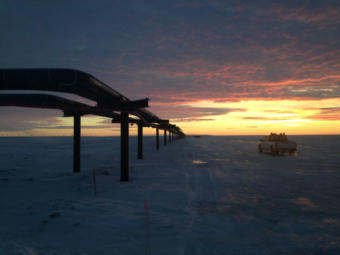
Pipelines stretch toward the horizon in the National Petroleum Reserve-Alaska. (Elizabeth Harball/Alaska’s Energy Desk)
Conservation groups are cheering the Biden administration’s decision not to appeal a judgment that reversed approval for Willow, the ConocoPhillips’ plan to develop five drilling sites in the National Petroleum Reserve-Alaska.
The Biden administration initially defended the Willow approval, but Tuesday was the deadline for an appeal and the government didn’t file one. Nor did ConocoPhillips.
Jeremy Lieb, an attorney in the Anchorage office of Earthjustice, said Willow doesn’t fit with the Biden administration’s climate goals.
“We’re pleased to see that the administration has recognized that at this point and is not continuing to defend the plan in court on appeal,” he said.
Willow is a big priority for U.S. Sen. Lisa Murkowski. The Biden administration’s initial defense of the project was seen as an overture to her, as she is one of the few Senate Republicans who might vote for some of Biden’s priorities.
Interior Department spokeswoman Melissa Schwartz didn’t say why the government didn’t file an appeal.
“The matter has now been remanded to the BLM,” she said in an email. “In light of the court’s decision, we are reviewing to determine next steps.”
If the Bureau of Land Management decides to do another environmental review to comply with the judge’s order, environmental groups hope the agency scraps the project or imposes more restrictions.
A ConocoPhillips spokeswoman says the company remains committed to the project.
“ConocoPhillips is not appealing the court’s earlier decision because we believe the best path forward is to engage directly with the relevant agencies to address the matters described in the decision,” she said by email Thursday.
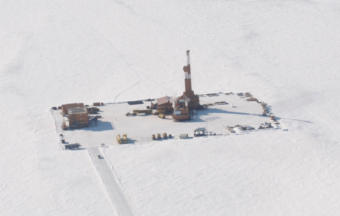
An aerial view of one of the exploration pads and wells that ConocoPhillips drilled during the 2018 exploration season at its Willow prospect. (Judy Patrick Photography/ConocoPhillips Alaska)
The Biden administration has reversed course and is now defending a decision to allow the Willow project, a major oil drilling development in the National Petroleum Reserve-Alaska.
The position was made public Wednesday when the Justice Department filed a legal brief opposing environmental groups in their legal challenge to the project.
It’s a rare moment of unity between the Democratic administration and Alaska’s all-Republican congressional delegation.
U.S. Sen. Lisa Murkowski said the decision is good for jobs and good for American energy production.
“So for all the right reasons, the administration came to the right conclusion, and it was the conclusion that we had been arguing vigorously for,” she said.
Environmental groups filed a legal challenge last year to ConocoPhillips’ Willow plan, which calls for drilling five wells in the NPR-A and building hundreds of miles of pipelines and ice roads. The groups say the Trump administration didn’t fully consider the environmental impacts.
At its peak, Willow is expected to produce more than 100,000 barrels of oil per day.
The Biden administration’s decision to fight the environmental lawsuit turns everything on its head.
Interior Secretary Deb Haaland broke the news to the Alaska congressional delegation on Tuesday. Just last year, as a congresswoman, Haaland wrote then-President Trump’s Interior secretary objecting to the Willow project. She and other House Democrats said the development would damage nesting areas for endangered birds and cause lasting impacts to caribou.
U.S. Sen. Dan Sullivan is usually highly critical of the Biden administration. In his annual address to the Legislature this month, he talked about doing battle against the administration, among other war metaphors. He said then that the Biden administration has an “anti-Alaska agenda.”
But Thursday, in a call with Alaska reporters, Sullivan praised the olive-branch approach.
“I think having an open relationship where you can reach out to cabinet officials and have frank discussions where they listen, certainly doesn’t hurt our state’s opportunities,” he said.
Sullivan said Haaland told him the administration’s support goes beyond defending the previous administration’s permitting decisions in court.
“I asked her, ‘Are you going to continue to, you know, expeditiously process the additional permits and requirements that will, obviously, be part of this Willow project?’” Sullivan recounted. “And she said yes.”
The administration’s decision to defend Willow has environmental groups feeling betrayed.
Kristen Miller, acting director of Alaska Wilderness League, said President Biden has shown “bold” and “visionary” leadership in the fight against climate change.
But, Miller said in a written statement, “the Willow project is the poster child for the type of massive fossil fuel development that must be avoided today if we’re to avoid the worst climate impacts down the road.”
Alaska Wilderness League, one of the plaintiffs in the Willow lawsuit, will continue to fight the project, she said.
Close
Update notification options
Subscribe to notifications
Subscribe
Get notifications about news related to the topics you care about. You can unsubscribe anytime.