Archives for:

"Willow project"

Alaska House votes unanimously to support Willow oil project

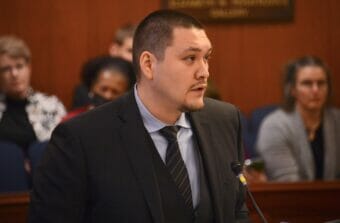
Rep. Josiah Patkotak, I-Utqiagvik, speaks in favor of House Joint Resolution 6, the resolution in support of the Willow oil project, on Monday, Feb. 20, 2023, at the Alaska State Capitol. The resolution passed 36-0. (Photo by James Brooks/Alaska Beacon)

The Alaska House of Representatives voted unanimously Monday to support Alaska’s largest potential oil and gas development in decades.

The House’s 36-0 vote on a resolution supporting the Willow project is largely ceremonial but could help sway the Biden administration as the Department of Interior prepares a final record of decision on the project. Four lawmakers had excused absences.

The federal government’s decision could come as soon as March 6, and members of Alaska’s congressional delegation have urged legislators to put themselves on the record in support. In speeches at the State Capitol this month, Rep. Mary Peltola, D-Alaska, and Sen. Dan Sullivan, R-Alaska, urged lawmakers to pass a resolution in support of Willow.

The state Senate could take up the resolution as early as Wednesday, but a Friday vote is more likely, said Senate President Gary Stevens, R-Kodiak.

Sen. Lisa Murkowski, R-Alaska, is scheduled to address the Legislature on Wednesday and is expected to amplify the call to action on Willow.

Members of the Alaska Federation of Natives are scheduled to travel to Washington, D.C., next week in order to lobby for support for the project, which is opposed by environmental groups.

When it entered office, the Biden administration set an ambitious goal: halving American carbon dioxide emissions from 2005 levels by 2030.

According to environmental impact statements published by the federal government, if the oil produced by Willow is burned, it would create 260 million metric tons of carbon dioxide, more than counteracting the Biden administration’s actions through March last year, the Center for American Progress said.

That group, and the environmental law firm Earthjustice, are among those that have called for the Biden administration to limit or cancel Willow.

ConocoPhillips Alaska, the project’s developer, originally requested permission to drill for oil from five sites in the National Petroleum Reserve, a swath of federal land on the North Slope southeast of Utqiagvik.

The Bureau of Land Management has said it is likely to approve three sites, with an option for a fourth at a future date.

If the government limits drilling to two sites, Willow would no longer be economically viable, Erec Isaacson, the president of ConocoPhillips Alaska, told Bloomberg in December.

Monday’s resolution says the Legislature supports “Alternative E,” the proposal with three (and possibly four) drill sites.

“A further delay in approval or construction of the Willow project undermines the values and benefits of the project to the state and its residents and is not in the public interest,” the resolution states, adding that the federal government should “maximize the area available for oil and gas leasing and development within the National Petroleum Reserve in Alaska while conserving and protecting valued fish, wildlife, subsistence, and cultural resources.”

If developed, Willow is expected to generate between $5 billion and $9 billion in production tax revenue to the state of Alaska during its lifetime, the Alaska Department of Natural Resources estimated in 2019.

That estimate, based on oil at $60 per barrel, is older but still the best publicly available figure, ConocoPhillips lobbyists said. The North Slope Borough and local communities also would receive billions in royalties and property tax payments.

Rep. Josiah Patkotak, I-Utqiagvik, represents the region in the Alaska Legislature and said that revenue is necessary in order to both transition the region to renewable energy and to sustain subsistence hunting and fishing.

He noted that most North Slope leaders support the project.

“This isn’t unanimous, but it’s a majority of the leadership within our area,” he said.

He said Monday’s resolution took into account the concerns of all 40 lawmakers in the state House.

“It speaks to the fact that Willow, and development in general, is critical to making sure we have the funding to be able to pursue renewable energy projects wherever possible,” he said.

Biden administration can’t have it both ways by shrinking Willow project, Murkowski says

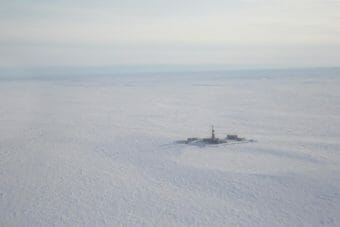
An aerial view of one of the exploration pads and wells that ConocoPhillips drilled during the 2018 exploration season at its Willow prospect. (Judy Patrick Photography/ConocoPhillips Alaska)

Alaska’s U.S. senators warn that half measures won’t suffice as they campaign to get federal approval for ConocoPhillips’ Willow drilling project in the western Arctic.

Sen. Lisa Murkowski told reporters Tuesday that the Biden administration may try to reduce the plan to two drill sites to ensure that it won’t be economically viable.

“So in effect, (they will) be able to have it both ways: The project doesn’t proceed – satisfies the environmental community – but they can say, Well, we approved it,” she said. “That is not acceptable. That cannot happen.”

ConocoPhillips originally proposed five drill sites west of the community of Nuiqsut, in the National Petroleum Reserve-Alaska.

Conoco’s Willow oil and gas prospect is located in the northeastern corner of the National Petroleum Reserve-Alaska. (Image credit Bureau of Land Management)

The Bureau of Land Management has recommended an option that includes three drilling sites, or about 219 wells. But BLM’s parent agency, the Interior Department, immediately issued a statement saying it wasn’t required to approve that preferred alternative.

Sen. Dan Sullivan interprets that as a signal that Interior wants to curtail the project.

The online press conference was arranged through a public relations firm working for Voice of the Arctic Iñupiat , a pro-development advocacy group funded by the Arctic Slope Regional Corporation and the North Slope Borough. The group’s president, Nagruk Harcharek, said the 24 member organizations represent the leadership of the region.

“Our organization passed the resolution unanimously to support the Willow project, which is clear that there’s majority consensus on the North Slope,” he said.

National environmental groups oppose Willow. They say the project would threaten wildlife in the area and that the fuel produced will accelerate climate change. Other opponents include the city and tribe of Nuiqsut. They’ve written a letter opposing Willow, while Kuukpik, the village corporation of Nuiqsut, supports the drilling project that the BLM selected as its preferred alternative.

Peltola’s hiring of former Republican legislator sparks outrage among some Alaska progressives

Then-Rep. Josh Revak watches Gov. Michael Dunleavy unveil his latest budget proposal on Wednesday, February 13, 2019, in Juneau, Alaska. (Photo by Rashah McChesney/Alaska’s Energy Desk)

Fury and confusion arose from Alaska Democrats — some of them, anyway — over Congresswoman Mary Peltola’s announcement last week that she’s hired a Republican to be her state director. Not just any Republican but former state legislator Josh Revak, who got top marks from the right-wing Alaska Family Action in his last campaign.

While some liberals have grumbled over Peltola’s support of development projects like ConocoPhillips’ Willow drilling proposal and the Ambler mining road, hiring Revak as state director really struck a raw nerve.

“I was outraged, I got to tell you,” said Elstun Lausen, a longtime Anchorage Democrat. “And my outrage is shared by many, many supporters of the good congresswoman.”

Peltola is a Democrat who pitched herself to voters as a moderate willing to work across the aisle. It was effective as a campaign strategy but now some members of the coalition that elected her — people she’ll need to win upcoming elections — wonder if they backed the wrong candidate.

On social media and at an Alaska Democratic party meeting in Juneau last weekend, progressives complained that Revak is too much. They don’t like his stance against legal abortion. They worry he’ll impose his agenda on Peltola. Some question his loyalty to her. Revak himself ran for the U.S. House seat last year. Some wonder if he is building himself up to beat Peltola next year.
Peltola’s Deputy Chief of Staff Anton McParland thinks otherwise.

“In this position I have a great deal of respect for Josh, that he is able to set aside his own personal politics, and advocate for the concerns of Alaskans on this front,” McParland said. “He’s committed to doing that. I believe that he will.”

McParland said Revak has relevant experience as a legislator and a congressional aide to the late Congressman Don Young and Sen. Dan Sullivan. And as McParland describes it, the position of state director isn’t one that makes policy. It’s mostly about constituent services.

Revak declined to be interviewed for this story.

Democrat Tom Begich served with Revak in the state Senate. He said Revak came into the Legislature a partisan but moderated his style and became an ally to Democrats.

“Well, he assisted us in tabling the transgender sports ban. So I think that that in and of itself, during a political season — that’s a pretty bold move that speaks to a more moderate perspective,” said Begich, who did not seek reelection last year.

Begich can recite a long list of issues that he says Revak helped Democrats with.

“He worked with us on all of our budget issues that we brought to the floor, including things like food bank; blood bank; expansion of teacher, public health, and public safety housing,” Begich recalled. “(He) voted with us on many of those (and) voted against some of the more extreme members of his own caucus numerous times.”

Begich thinks Peltola was smart to hire Revak, in part because he’s a decorated combat veteran.

“Veterans can talk to him and feel comfortable in that process,” Begich said, adding that hiring a Republican for that role “defines you as an open-to-anyone member of Congress, which I think is critical in a state that has managed, so far, to avoid the level of polarization in the lower 48.”

And, Begich said, there are pragmatic, political benefits for Peltola to improve her outreach to Alaska Republicans.

The dilemma for her future campaign team will be how to reach to the right without further alienating her Democratic base.

Sen. Sullivan stresses Willow drilling project, military spending in annual address to Legislature

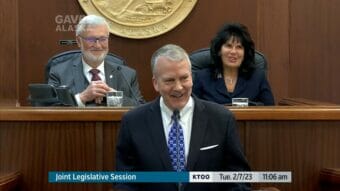
U.S. Sen. Dan Sullivan addressed the Alaska Legislature on Tuesday, Feb. 7, 2023 at the state Capitol in Juneau. (Gavel Alaska screen capture)

U.S. Sen. Dan Sullivan on Tuesday urged the Alaska Legislature to use its collective power to support the Willow project, ConocoPhillips’ big Arctic drilling proposal.

“Close to 200,000 barrels a day. Seventeen billion in revenues for the feds, for the state, for the North Slope Borough,” he said, reciting the predicted results of the project. “Highest environmental standards, and lowest greenhouse gas emissions of any major project like this in the world, and broad-based support from so many Alaskans, particularly the Alaska Native leaders.”

But, Sullivan said, the battle over the project will be “ferocious” over the next month, while the Biden administration decides whether to green-light the proposal.

That’s because environmental advocates fiercely oppose the project. So do the city and tribe of Nuiqsut, the nearest village. They say the project will endanger wildlife and a subsistence lifestyle while accelerating climate change.

Sullivan, in his annual address to the Alaska Legislature, asked state lawmakers to pass a resolution supporting Willow.

His speech focused on the traditional Alaska complaints of a heavy-handed federal government and the hopes that the state will prosper through resource extraction and military spending.

“Since I’ve been in office, we have secured billions in military construction for Alaska, and that is continuing,” he said. “This of course has enhanced America’s national security. But it’s also been a great way to strengthen our economy and increase job growth and Alaska. “

Sullivan blamed the Biden administration for restraining resource development in Alaska, which he calls a “war on Alaska.” He also blamed the national media, which he complained are biased against Willow. Journalists, he said, don’t recognize that most Alaska Native leaders support the project.

“Yeah, you can always find one or two people, who you can quote, (who are) against it,” he said in a press conference after his speech.

On the drive to get new icebreakers for the U.S. Coast Guard, Sullivan promised that one is coming. And, he said, it will be homeported in Juneau due to his work behind the scenes.

“Every now and then you can leverage things, like confirmation or promotions of Coast Guard officers, and that’s what I did,” he told legislators. “Said we’re not moving forward on any more promotions in the Coast Guard until we get this study of where you’re going to put the icebreaker in our state.”

But money to buy the next icebreaker, a relatively small commercial ship that’s already built, was cut at the last minute from the federal spending bill last year.  Sullivan told reporters that he’s heard the money was diverted for border security, which Sen. Lisa Murkowski has said as well.

Alaska Congresswoman Mary Peltola will also make a speech to the Alaska Legislature this month, followed by Murkowski.

BLM proposes allowing ConocoPhillips to drill most of its Arctic Willow project

An aerial view of one of the exploration pads and wells that ConocoPhillips drilled during the 2018 exploration season at its Willow prospect. (Photo courtesy of Judy Patrick Photography/ConocoPhillips Alaska)

The Bureau of Land Management announced Wednesday that it is inclined to allow ConocoPhillips to develop Willow, the company’s proposal for oil drilling on federal land in the Arctic, near the village of Nuiqsut.

The agency suggests trimming the proposal from five drill sites to three. That would mean roughly 219 wells, some 32 fewer than the company asked for.

The recommendations are in a planning document, called a final supplemental environmental impact statement.

A map of the North Slope showing Willow's drill sites
This map from the Bureau of Land Management shows the site of the Willow development on the North Slope of Alaska. Willow’s drill sites are marked by squares. (Bureau of Land Management image)

The BLM’s parent agency, the Department of Interior, now has 30 days to issue a decision. Interior immediately emailed a statement pointing out that it still has the power to block Willow.
“The Department has substantial concerns about the Willow project and the preferred alternative as presented in the final SEIS, including direct and indirect greenhouse gas emissions and impacts to wildlife and Alaska Native subsistence,” the statement says.

Alaska’s congressional delegation, the governor and many North Slope leaders support Willow, saying it will bring needed jobs and revenue.

Environmental groups call the project a “climate bomb.”

“This would be the largest single oil drilling project proposed anywhere in the U.S., and it is drastically out of step with the Biden administration’s goals to slash climate pollution and transition to clean energy,” Earthjustice attorney Jeremy Lieb said in an emailed statement.

The city and tribe of Nuiqsut also oppose the development.

Oil and gas jobs slow to bounce back to pre-pandemic levels

Cook Inlet oil platforms are visible from shore on Dec. 13, 2016 near Kenai, Alaska.
Cook Inlet oil platforms are visible from shore on Dec. 13, 2016 near Kenai, Alaska. (Photo by Rashah McChesney/Alaska’s Energy Desk)

Employment in Alaska’s oil and gas sector is still lagging in 2022, according to an October report from the Alaska Department of Labor.

Jobs have been slow to recover across many industries since the COVID-19 pandemic began. The report said Alaska lost about 26,270 jobs in 2020.

But oil and gas — which is tied to roughly 1 in 5 jobs in the Kenai Peninsula Borough, according a 2021 report from the Kenai Peninsula Economic Development District — is having an especially hard time bouncing back. The industry lost over 2,046 jobs in 2020 and then another 1,489 in 2021.

“I would’ve expected that employment would’ve recovered more than it has so far,” said Neal Fried, an economist with the State of Alaska.

Fried said last month that even though oil prices have been relatively high and companies have more money to spend, it hasn’t been followed by a big surge in activity.

He said that’s partly because the state’s industry is very project oriented. There’s often a longer lag time between changes in oil prices and new investment than there may be elsewhere.

“And some of it’s just been reluctance of investment,” Fried said. “And that’s nationally, and internationally. That’s not just in Alaska. It’s just been more accentuated in Alaska than it’s been elsewhere”

Even when there are new oil and gas projects, like those offshore in Cook Inlet and a potential project in Willow, those projects often create temporary jobs, not permanent ones, according to the department’s report.

Still, Alaska is gaining some jobs in the industry — just slowly. The report estimates the state will see an additional 2,000 oil and gas jobs by 2030, which would bring the industry to just above its pre-pandemic levels.

Meanwhile, the Gulf Coast Region of Alaska, which includes the Kenai Peninsula, saw an overall rate of job growth of just over 3 percent from Aug. 2021 to Aug. 2022, according to the state’s report.

Site notifications
Update notification options
Subscribe to notifications