
Adelyn Baxter

Digital Content Director, KTOO

"I help inform KTOO listeners, viewers and readers by finding creative ways to bring our content to our audience wherever they are."

Governor declares emergency for Alaska Native languages

Gov. Bill Walker holds up the signed Administrative Order 300 surrounded by Alaska Native language advocates. (Photo Adelyn Baxter/KTOO)

Gov. Bill Walker signed an administrative order Sunday in Juneau officially declaring a linguistic emergency for Alaska Native languages.

The order recognizes the threat faced by indigenous languages and takes steps to revitalize them by directing state agencies to work more closely with tribal partners and use traditional place names on state signs.

Language advocates from across Alaska gathered Sunday at the Juneau Arts and Culture Center to celebrate a milestone in indigenous language revitalization.

The signing ceremony for Administrative Order 300 took place at a welcome reception for the First Alaskans Institute’s Social Justice Summit.

Central Council of Tlingit and Haida Indian Tribes of Alaska President Richard Peterson was one of several Southeast Alaska Native representatives who welcomed attendees.

“If you live in Juneau, you hear a lot of what Dr. Soboleff had said and you hear this a lot and it’s true: when we know who we are, we don’t hurt ourselves,” Peterson said. “When we know our language and our cultures, we don’t hurt ourselves.”

Peterson described his own experience struggling with addiction growing up in Kasaan, experiencing some of the issues young people deal with in Native communities around the state.

“You carry shame,” he said. “But it was always my culture where I was able to let go of shame and know who I am.”

Leaders like Peterson hope that Administrative Order 300 will help communities across the state reconnect with their culture in a meaningful way.

In a report this year, the Alaska Native Language Preservation and Advisory Council warned that all 20 officially recognized Alaska Native languages are at risk of extinction by the end of this century.

The order requires state commissioners to designate a tribal liaison responsible for producing a plan to better collaborate with Alaska Native partners.

It specifically directs the commissioner of the Department of Education and Early Development to work with partners to promote indigenous languages in public education.

The administrative order also directs the state to use traditional Alaska Native place names on public signage going forward.

The order came about following April’s passage of House Concurrent Resolution 19, sponsored by Ketchikan Rep. Dan Ortiz.

That resolution urged Gov. Bill Walker to declare a language emergency for Alaska Native languages.

“You know there’s not a lot of times I stand up in front of a microphone and thank the Legislature and I certainly do on this,” Walker said Sunday.

He applauded the work of groups like the First Alaskans Institute and the many individuals who testified and worked on behalf of language revitalization.

“You can talk all you want, but somebody has to be the doer. And that’s really what today is about, is we celebrate the many doers that made this happen,” Walker said.

He also acknowledged the role the state of Alaska played in undermining and discouraging the use of indigenous languages in previous generations.

“I know we need to celebrate where we are, but boy, if you don’t reflect on where you’ve been, it really is only part of the discussion, part of the celebration,” Walker said.

Of the Alaska Native languages addressed by the order, one has already lost its last native speaker.

The last fluent speaker of Eyak died 10 years ago, according to Native language preservation council.
Kids can cast their votes in Juneau mock mayoral election

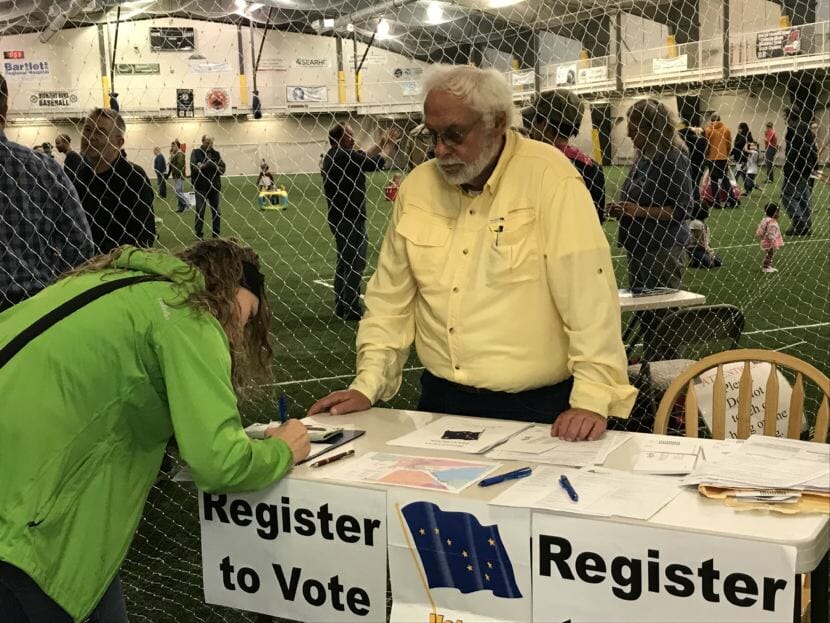
AEYC Board member Dave Newton registers a voter at an event in August. (Photo courtesy of AEYC)

Parents looking for a way to engage their children in Juneau’s local election can take advantage of a Kids Vote event this weekend and next.

The Southeast Alaska Association for the Education of Young Children is sponsoring the event Saturday afternoon at the Mendenhall Mall Annex. The event will be happening this Saturday, Sept. 22, and next Saturday, Sept. 29, from noon-2:00 p.m.

According to AEYC Executive Director Joy Lyon, parents can take advantage of the early voting station there while their children cast ballots in a mock mayoral election.

“We really want to make it easier for families with young children to vote and we know they’re very busy and it’s hard to make that time on the actual election day,” Lyon said. “So we have created this event that makes it really fun for kids to be part of that democratic process.”

Lyon said anyone under 18 is welcome to participate. There will also be snacks and prizes.

AEYC also sponsored a candidate night at Dimond Park Field House at the end of August for parents to bring their children to meet with candidates running in Juneau’s Oct. 2 municipal election.

Lyon said they will release the results after the Oct. 2 election to avoid giving away the outcome.

“Typically, where there are kids vote activities, they align very well,” she said. “They’re very predictive of the election.”

They also plan to hold a similar Kids Vote event in October for the state and federal elections.

Early voting for the local election lasts until Oct. 1. Adults can also vote at City Hall during normal business hours.

More information on when to vote, candidate profiles, information on the issues and more are available in the KTOO election guide at KTOO.org/elections

Candidates for local office discuss issues at League of Women Voters forum

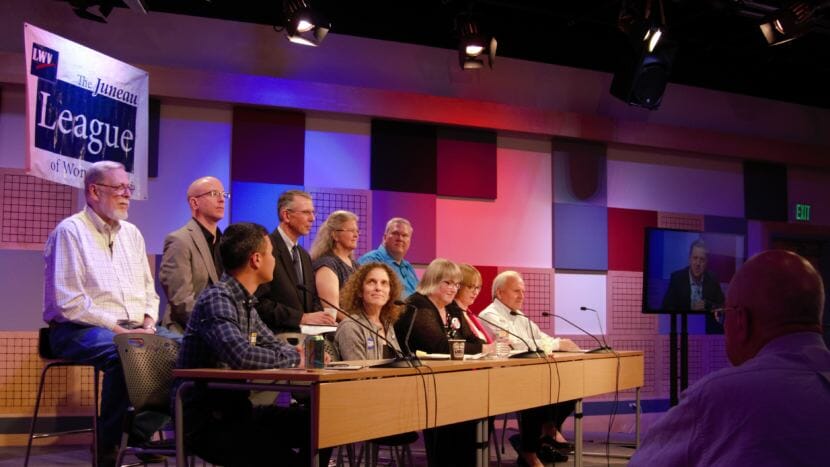
Juneau Assembly candidates on stage and a live audience @360 watch District 2 candidate Garrett Schoenberger's pre-recorded statement at the Juneau League of Women Voters Municipal Candidates Forum on Sept. 20, 2018. Back row from left to right: Loren Jones, Wade Bryson, Don Habeger, Michelle Bonnet Hale, Emil Mackey. Front row: Norton Gregory, Saralyn Tabachnick, Beth Weldon, Carole Triem and Tom Williams.
Juneau Assembly candidates on stage and a live audience @360 watch District 2 candidate Garrett Schoenberger’s pre-recorded statement at the Juneau League of Women Voters Municipal Candidates Forum on Sept. 20, 2018. Back row from left to right: Loren Jones, Wade Bryson, Don Habeger, Michelle Bonnet Hale, Emil Mackey. Front row: Norton Gregory, Saralyn Tabachnick, Beth Weldon, Carole Triem and Tom Williams. (Photo by Jeremy Hsieh/KTOO)

For this year’s League of Women Voters candidate forum, the nonpartisan civic organization partnered with KTOO and the Juneau Empire to broadcast live from @360.

Moderator Alyson Currey started things off with a reminder that early voting has already begun in Juneau’s Oct. 2 municipal election.  

“This year, there is one mayoral seat and four seats open for Assembly — one seat for areawide Assembly, one seat for District 1 and two seats for District 2,” Currey said. 

Juneau voters can vote for who will fill each one regardless of where they live.

The forum began with the three candidates running unopposed for school board. Topics ranged from teaching sexual consent in schools and addressing gun violence in schools.

For the Assembly portion, three out of four mayoral candidates were present, and all but one Assembly candidate.

Currey opened with a question about $250,000 allocated by the Assembly to explore a second bridge crossing to Douglas Island.

All of the candidates seemed to support the concept and the potential development prospects North Douglas might provide.

Answers varied more widely on a question about “the road” and whether Juneau should look into alternative plans to extend its road system up the Lynn Canal.

Most candidates said the road would offer economic growth and make Juneau a more attractive option for people, but several pointed to the state’s budget deficit and argued that the declining Alaska Marine Highway System deserves more attention.

Several candidates brought up their support for better access to affordable child care, an issue that almost wound up on the local ballot. The Assembly ended up rejecting the ballot measure, as well as two others.

The Assembly portion lasted nearly two hours. Candidates also addressed questions on red flag gun laws, climate change, vacancies in the police department and the growth of cruise ship tourism.

In his closing statement, incumbent Assembly member Loren Jones, who is running unopposed, said candidates have done all they can. Now it’s up to voters.

“You have to go vote, you have to take 10 people with you to vote. If you can, get a hundred people to vote,” Jones said. “The thing you have to do, your job now, is to vote. We’ve done ours.”

To hear candidates full answers, you can watch the entire candidate forum below and find more municipal election coverage online. 

Downtown intersection renamed to reflect Juneau’s rich culture

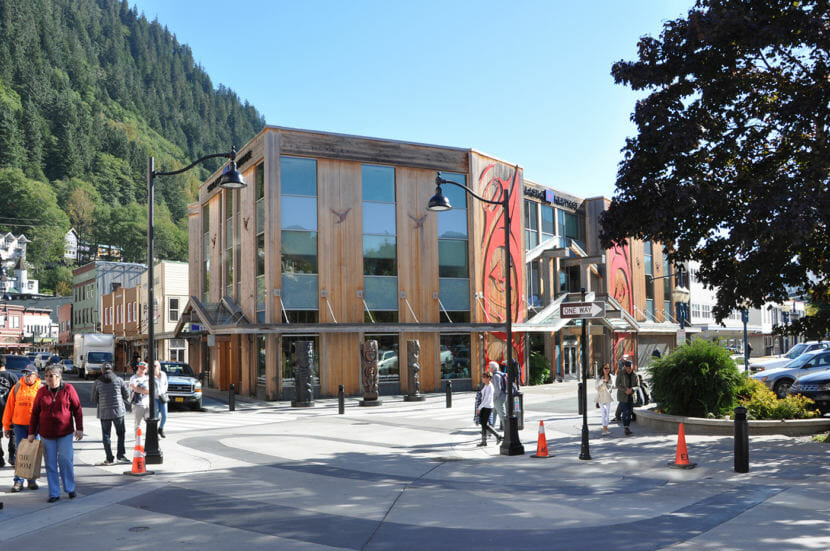
The intersection at Seward and Front Streets downtown. (Photo courtesy of Sealaska Heritage Institute)
The intersection at Seward and Front streets downtown. (Photo courtesy of Sealaska Heritage Institute)

The downtown intersection of Front and Seward streets has been named Heritage Square, paying homage to Juneau’s cultural history.

The Juneau Assembly approved the name unanimously on Monday with a resolution.

Sealaska Heritage Institute recently installed three bronze house posts on the intersection’s southeast corner.

SHI President Rosita Worl said she wants the new name to represent pride in every culture, not just that of Alaska Natives.

“The name Heritage, in my mind, also implies that we could also recognize the multicultural populations that we have in Juneau which I think makes Juneau rich. Plus our mining history,” Worl said.

This summer, the City and Borough of Juneau collaborated with local artists to redesign the intersection in a way that incorporates formline design and traditional Alaska Native values into the sidewalk and crosswalks.

SHI also plans to create a Native arts campus in the parking lot of the Sealaska Corp. building across the street.

Worl said they are working with architects to finalize the drawings for what that campus will look like.

The institute’s goal is to establish Juneau as the nexus of Northwest Coast Art, the style practiced by cultures indigenous to the region.

“All of these efforts are moving us to the realization that we can make Juneau the Northwest Coast Arts capital, as the economic engine for our region,” Worl said.

Worl said she expects signs with the intersection’s name to go up at some point in the future.

Real estate experts to advise on the future of downtown Juneau waterfront property

Bob Janes, far right, asks community members in favor of the Alaska Ocean Center to raise their hands at an informational meeting with Alaska Mental Health Trust on Sept. 18, 2018. (Photo by Adelyn Baxter/KTOO)

More than two years after it was put on the market, the future development of a downtown waterfront property remains undecided.

The Alaska Mental Health Trust owns the parcel, and now the state entity has contracted a team of real estate experts to help them decide what to do with it. But the City and Borough of Juneau and would-be developers are losing patience.

A panel of professionals from the Urban Land Institute, an international organization that advises on land use management, met with community members on Tuesday morning at Tracy’s Crab Shack off Egan Drive. The panel was in town to help the Alaska Mental Health Trust Authority decide what to do with this property.

“In the end, they do come up with a report that helps us at the Trust Land Office understand, what are different scenarios of what could be used on the property?” Wyn Menefee, executive director of the Trust Land Office, told the crowd.

About 10 percent of Alaskans are beneficiaries of the trust, which funds services for people with mental illness, developmental disabilities, traumatic brain injuries and memory loss.

To do that, the trust invests revenue from a variety of land holdings in and outside of Alaska. One of those properties is a vacant lot known as the subport.

Not everyone is happy to hear the trust has contracted outside consultants.

Bob Janes is president of the non-profit Alaska Ocean Center, one of the groups hoping to develop the land. He said he was not invited to speak to the panel and only heard about the informational meeting at the last minute.

“Actually I had a trip planned to Glacier Bay and I flew back today just to be here for it,” Janes said, “because I think it’s important for these consultants to understand the point of view of the community.”

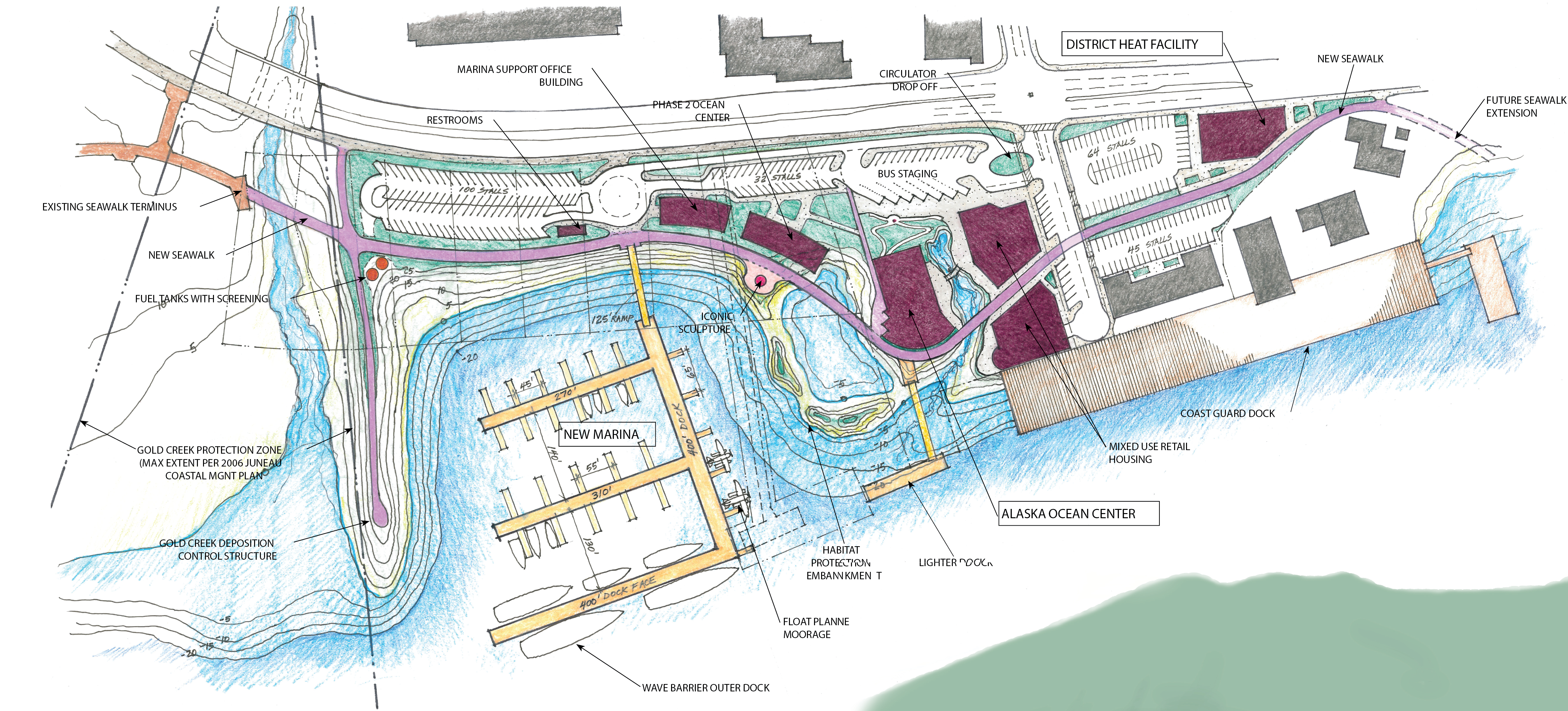
The Alaska Ocean Center wants to build a marine education and research center on Juneau’s waterfront.

They partnered with local developer Doug Trucano, who made an above-market offer to buy the subport property for $3.2 million in 2016. He plans to build a small cruise ship harbor on the site as well.

Conceptual plans for a future “Juneau Marina District” would include a yacht marina, berth for small cruise ships and the Alaska Ocean Center on land that includes a 2.8-acre parcel owned by the Alaska Mental Health Trust. (Courtesy of MRV Architects)

“So we’re working together. But our offer has been with the Mental Health for two and a half years, as has his,” Janes said.

The trust’s Executive Director Mike Abbott said the trust does not have a deadline for determining what to do with the subport. While he wants to see the land developed soon, he said they also want to explore every option.

“If there’s a longer term strategy that makes more sense and that will be more lucrative for the trust in the long term, then we can wait for that as well,” Abbott said.

The trust has been dealing with the outcome of a legislative audit that found it violated state statute by investing in commercial real estate and operating with a lack of transparency.

At Monday’s Juneau Assembly meeting, City manager Rorie Watt put it plainly.

“There’s a strong case that they have been a poor manager of their public mission, and I don’t say that lightly,” Watt said.

The city has tried repeatedly to encourage the trust to sell the land.

Watt said the city will send a letter this week urging it not to draw the sale out any longer.

“It befuddles me that an organization that is a land trust, that’s mission is to raise funds for the social service programs, has gone to such great length to avoid sale of a parcel of land at above market value,” Watt said.

Abbott said he knows there’s strong local support for the Alaska Ocean Center and that people don’t want to see the process drawn out for years. He also said he’s spent more time working on this particular site since he started a year ago than any of the trust’s other land holdings across the state.

“We’re going to be very transparent with the community about what we’re considering and why we’re considering it,” Abbott said. “But we will be making a decision that is looking out for the interest of our trust beneficiaries.”

Abbott said they expect the Urban Land Institute panel to give the trust preliminary feedback at the end of the week. Their written recommendation is expected five to six weeks after that.

Editor’s note: This story has been updated to correct the first name of developer Doug Trucano. An earlier version of the story incorrectly identified him as Bob Trucano. 

Juneauites call on Murkowski to vote no on Kavanaugh nomination

Juneauites concerned about the nomination of Brett Kavanaugh to the U.S. Supreme Court hold signs and listen at a rally outside Dimond Courthouse on Tuesday. (Photo by Adelyn Baxter/KTOO)

Ralliers outside the Dimond Courthouse downtown Tuesday evening called on Sen. Lisa Murkowski to vote “no” on the nomination of Brett Kavanaugh to the United States Supreme Court.

Murkowski holds a crucial vote in the Senate and has not yet stated how she plans to vote on the nomination. Sen. Dan Sullivan has said he plans to vote yes.

Former Juneau Assembly member Kate Troll opened the rally by listing the concerns several groups have with the conservative judge’s nomination.

“Did you notice his name ends in a ‘nah’? So it’s ‘nah, nada, no way’ do we want a threat to the sovereignty of our indigenous people, or to a woman’s right to control her own body?” said Troll. “Kavanaugh is also a threat to workers on the job.”

About 50 community members waved homemade signs. Representatives from the Alaska branch AFL-CIO and Alaska Native community also spoke.

Nancy Barnes performed a Tsimshian song with several other women to mark the occasion. She said she found Kavanaugh’s past statements regarding Native American interests and Native Hawaiians concerning.

“Every organization that I know of, including the Alaska Federation of Natives, have come out against the nomination of Kavanaugh,” Barnes said. “So we are here urging Sen. Murkowski: you’re our senator. Please vote no.”

Organizers said similar rallies were taking place in Fairbanks and Anchorage this week.

Earlier Tuesday, the U.S. Senate Judiciary Committee postponed a vote on Kavanaugh’s nomination later this week. That came after allegations from a woman who said Kavanaugh tried to sexually assault her at a party in the 1980s.

Site notifications
Update notification options
Subscribe to notifications