Alaska Beacon

Alaska Beacon is part of States Newsroom, a network of news bureaus supported by grants and a coalition of donors as a 501c(3) public charity. Alaska Beacon maintains editorial independence. Contact Editor Claire Stremple for questions: info@alaskabeacon.com. Follow Alaska Beacon on Facebook, Bluesky and Twitter.

Alaska Republican Senator Shelley Hughes resigns to pursue gubernatorial campaign

Sen. Shelley Hughes, R-Palmer, walks out of the Senate chambers on Saturday, Aug. 2, 2025. (Photo by James Brooks/Alaska Beacon)

Sen. Shelley Hughes, R-Palmer, resigned from the Alaska Senate on Friday to pursue her gubernatorial candidacy, according to a news release from her campaign.

Her resignation follows that of fellow Senate minority caucus member Mike Shower, who represented Wasilla and resigned at the end of last month to focus on his run for lieutenant governor.

Senate President Gary Stevens, R-Kodiak, confirmed he received Hughes’ resignation letter Friday.

Hughes’ resignation was expected. She told the Alaska Beacon in October she planned to resign in time for her replacement to be in place before the legislative session begins in January.

“My constituents, they’ve been my peeps all these years. I want to make sure that they have representation from the get-go,” she said on Friday afternoon.

Gov. Mike Dunleavy will select her replacement from among a number of nominees to be selected by Republican party officials in her district. Republican Senators must confirm his choice before that person is seated.

Hughes’ replacement must be a Republican and meet the state Constitution’s requirements to hold office.

Hughes said she expects that Rep. Cathy Tilton, R-Wasilla, will be among the nominees for her seat because Tilton has already filed to run for senator in the district. If Tilton were appointed, the governor would then have to select someone to fill the empty House seat.

Hughes was initially appointed to her seat in 2012 by then-Gov. Sean Parnell, which she credits, in part, to the fact that she was already running.

“I think that when a candidate does that, that shows real interest,” she said.

She said she does not expect her departure to cause significant changes because her district reliably produces “reasonable conservative” lawmakers.

Hughes is one of 12 Republicans and 14 total candidates that seek to be elected governor in 2026. Gov. Mike Dunleavy is termed out and cannot seek reelection.

Hughes said she has fond memories of her time in the Capitol.

“It’s a big change, stepping into the gubernatorial race,” she said. “You know, there are unknowns with that, but I have tremendous peace about this. I really did feel that my chapter was closing in the Senate.”

She represented her district for 12 years.

Tribes and environmental groups sue to stop road planned for Alaska wildlife refuge

Brant fly over the water on Sept. 28, 2016, at Izembek Lagoon in Izembek National Wildlife Refuge. The refuge supports the entire Pacific population of black brant, a species of goose.
(Kristine Sowl/U.S. Fish and Wildlife Service)

Three tribal governments and several environmental groups sued the Trump administration on Wednesday to try to block a land trade that would allow a road to be built through a national wildlife refuge in southwestern Alaska.

The land swap, approved by the U.S. Department of the Interior last month, would open up a section of the Izembek National Wildlife Refuge.

Supporters argue that the road is needed to connect the community of King Cove, home to about 750 people, with a legacy military airstrip that can accommodate jets. That would give King Cove’s residents access to safer medical evacuations if needed. Opponents say the proposed road — to run 18.9 miles in total, most of that within what is currently refuge land — would damage world-class bird habitat that is in the heart of the refuge.

Wednesday’s challenges came in three lawsuits filed in U.S. District Court in Anchorage. All assert that the land trade and road development pose dire threats to migratory bird populations that use Izembek’s wetlands, including species with Endangered Species Act listings, and to the wider ecosystem. All say the trade and planned road violate the Alaska National Interest Lands Conservation Act and other federal laws.

The three lawsuits have their individual characteristics as well.

One of them, filed by tribal governments in the Yukon-Kuskokwim Delta villages, focuses on threats to traditional subsistence hunters who depend on the birds that use Izembek’s wetlands. The tribal plaintiffs are the Native Village of Paimiut, Native Village of Hooper Bay and Chevak Native Village.

“Izembek’s eelgrass wetlands are a lifeline for emperor geese, black brant and other birds that feed our families and connect us to Indigenous relatives across the Pacific,” Angutekaraq Estelle Thomson, traditional council president of the Native Village of Paimiut, said in a statement. “Trading away this globally important refuge for a commercial corridor devalues our lives and our children’s future. We are joining this lawsuit because defending Izembek is inseparable from defending our subsistence rights, our food security and our ability to remain Yup’ik on our own lands.”

The Center for Biological Diversity, an environmental organization, is also a plaintiff in the case.

A second lawsuit, filed by Friends of Alaska National Wildlife Refuges, Wilderness Watch, the Alaska Wilderness League and the Sierra Club, puts a special focus on the process used to achieve the land swap and what it may mean for all wildlife refuges.

“Trading the ownership of refuge lands that Congress designated for conservation is a terrible precedent for the privatization of public lands. Building a road will have tremendous impacts on fish and wildlife habitat and could also greatly increase both disturbance and sport hunting pressure on vulnerable species,” Marilyn Sigman, president of Friends of Alaska National Wildlife Refuges, said in a statement.

The third complaint, filed by Defenders of Wildlife, puts a focus on the wider environmental impacts.

Green eelgrass appears at low tide in the vast wetlands of Izembek Lagoon, at the edge of Izembek Refuge. (Kristine Sowl/USFWS)

The planned road enabled by the land trade would “result in incalculable and irreversible damage” to myriad wildlife species, including marine and land mammals as well as migratory birds, that lawsuit says. The lawsuit alleges that the land deal violates both the National Wildlife Refuge System Improvement Act and the federal Wilderness Act.

“Under the Trump administration, the Interior Secretary entered into an illegal deal done in the darkness of a government shutdown: a sellout of one of our country’s largest and most pristine wildlife refuges and wilderness areas,” Jane Davenport, a senior attorney in Defenders of Wildlife’s Biodiversity Law Center, said in a statement. “Our treasured public conservation lands belong to all Americans. Defenders of Wildlife will stand up in court to hold this administration to account for recklessly and unlawfully trading them away.”

The Izembek Lagoon area, where the road is planned, holds the largest single stand of eelgrass in the world and the largest bed of seagrass along the North American Pacific Coast, according to the U.S. Fish and Wildlife Service. The entire Pacific population of black brant, a type of goose, uses the refuge’s lagoon area, feeding on the eelgrass. The refuge and its eelgrass support several other bird and mammal species; about half the world’s emperor geese use the refuge as a migratory stopover, according to biologists.

A Department of the Interior spokesperson declined to comment Wednesday on the lawsuits.

Last month, however, Interior Secretary Doug Burgum touted the land exchange and planned road as long overdue.

He spoke about the project during an event called “Alaska Day,” a gathering in Washington with Gov. Mike Dunleavy and the state’s three-member congressional delegation. The Izembek land exchange was one of the pro-development Alaska actions announced at the event.

“It just seems preposterous to me that somehow, it’s taken 40 years for us to put people first,” Burgum said at the event. “Because I know one thing as a governor of a state: You can actually do things like build 18 miles of gravel road and still take great care of wildlife.” Burgum was North Dakota’s governor before being appointed as Interior secretary.

The land trade he approved would convey a little less than 500 acres of refuge land, most of it designated wilderness, to the Native-owned King Cove Corp. The corporation would give 1,739 acres of its land to the U.S. Fish and Wildlife Service to be added to the refuge, and the federal government would also pay the corporation for the land.

The idea of a road linking King Cove to the World War II-era military runway at Cold Bay dates back decades. The legal and political battle over the proposal has also been long. Some of the plaintiffs in the new cases were plaintiffs in previous lawsuits over proposed land trades. The dispute was being considered by the 9th Circuit Court of Appeals, but that court in 2023 determined that the case was moot and dismissed it because the Biden administration was not pursuing the plan endorsed by the first Trump administration.

Green eelgrass appears at low tide in the vast wetlands of Izembek Lagoon, at the edge of Izembek Refuge. (Kristine Sowl/USFWS)

New lawsuit seeks to block revived bear-culling program in Western Alaska

A brown bear stands in in shallow water in front of two bunches of tall grasses.
A brown bear stands in water in Katmai National Park on Sept. 27, 2022. A new lawsuit has targeted a revived predator control program that aims to boost Mulchatna caribou herd numbers by killing bears in a portion of the herd’s range. (T. Carmack/National Park Service)

The state’s latest plan to kill bears in part of Western Alaska to try to boost a flagging caribou population has drawn a new legal challenge.

Environmental groups on Monday filed a lawsuit in state Superior Court that seeks to strike down the Alaska Board of Game’s July approval of a controversial predator control program in the part of the state used by the Mulchatna caribou herd.

The lawsuit, filed by the Alaska Wildlife Alliance and the Center for Biological Diversity, is the latest step in a legal and political battle over state efforts to increase the herd size. It names the board, the Alaska Department of Fish and Game and the department’s commissioner as defendants.

The lawsuit argues that the revived program approved by the Board of Game suffers from many of the same flaws that were in the previous program. That program had been approved by the board in 2022 but was overturned by court rulings earlier in the year that resulted from a previous lawsuit filed by the Alaska Wildlife Alliance.

Two state judges found that the program, under which 186 brown bears, five black bears and 20 wolves have been killed since 2023, violated the elements of the Alaska constitution.

Monday’s lawsuit says the new predator control program is largely the same as the old one and it continues to violate the Alaska constitution’s requirement for sustained yield of natural resources. For Alaska, the principle of sustained yield holds that renewable resources should be managed so that they can exist indefinitely.

There are two ways that the sustained yield requirement is violated, according to the lawsuit.

The board, when it approved the predator control plan presented by the Alaska Department of Fish and Game, “failed to take a hard look at brown and black bear population data” for the targeted area, thus failing to properly consider impacts to those populations, the lawsuit said.

And the plan has no end point, meaning there is no trigger for suspension of predator control if bear populations drop below a minimum threshold deemed necessary for their sustainability, the lawsuit said.

“The Board of Game gave the Alaska Department of Fish and Game the authority to aerially shoot any bears of any age across 40,000 square miles until 2028, with no population data or cap on the number of bears killed,” Nicole Schmitt, executive director with the Alaska Wildlife Alliance.

She noted that the southeast border of the targeted area is only 3 miles from Lake Clark National Preserve, 30 miles from Katmai National Park and 50 miles from McNeil and Brooks Falls, sites that are world-famous for the large numbers of brown bears that gather there to fish for salmon. Meanwhile, the western border reaches two national wildlife refuges, “which means this program threatens bears who move across vast stretches of public lands,” she said.

Cooper Freeman, Alaska director at the Center for Biological Diversity, called the program “a disgraceful misuse of public resources and a betrayal of the trust Alaskans place in their wildlife managers.”

“There’s no excuse for the state of Alaska to be gunning down bears from helicopters,” Freeman said in the statement.

The commissioner of the Alaska Department of Fish and Game defended the program, though he did not specifically address the claims in the new lawsuit.

“ADF&G is committed to all users of the herd in rebuilding this population, which has been identified as important for providing high levels of human consumption under state statute and regulation,” Commissioner Doug Vincent-Lang said in a statement.

Vincent-Lang said “intensive management,” or IM, has shown to be helping the caribou herd. Intensive management is the term Alaska wildlife managers use for predator-control programs.

“There is strong evidence that neither disease nor nutrition are preventing this herd from recovering. Department predator removal efforts in the Mulchatna caribou herd IM program are administered to reduce wolf and bear populations in small, defined areas for short periods of time, to enhance caribou calf survival and to increase herd abundance,” Vincent-Lang said in his statement. “Predation has been isolated as the limiting factor preventing the herd from growing, and predator removal is increasing calf survival—we know that now—and we have seen increased calf survival as a result of our past IM efforts.”

The Mulchatna caribou herd crashed in recent decades, and there is heated debate about the cause.

The herd peaked at about 200,000 animals in 1997, when it provided up to 4,770 caribou for subsistence hunting in the region’s communities, according to the Department of Fish and Game. But the population crashed after then and is now estimated at about 16,000 animals, according to the department. Hunting has been closed in recent years.

State wildlife officials argue that predation by bears and wolves on caribou calves is the reason for the decline. The department has stated a goal of boosting the herd to a size ranging from 30,000 to 80,000 animals, enough to support resumption of hunting.

Backers of the Mulchatna predator control program have included the Alaska Federation of Natives, which passed a resolution in 2023 that supported the program because the organization says it is necessary to ensure food security in that part of the state.

But critics of the program, including some veteran Alaska wildlife biologists, argue that other factors caused the herd’s population crash. Among the cited factors is a change in habitat, driven by long-term warming, that makes the region less supportive of lichen-eating caribou and more favorable to moose and other animals dependent on woody plants. Migratory tundra caribou herds around the Arctic have suffered similar problems, with overall population declines of 65% in the past two to three decades, according to the 2024 Arctic Report Card released by the National Oceanic and Atmospheric Administration.

The Board of Game and Department of Fish and Game have lost past court fights over Mulchatna predator control.

Aside from having judges rule that the earlier program was unconstitutional, one of the judges found in May that the department acted in bad faith by continuing to conduct aerial shooting this spring even after the program was declared legally void.

Alaska extends disaster declaration for west coast storms

U.S. Army National Guard CH-47 Chinook aviators, assigned to the 207th Aviation Troop Command, Alaska Army National Guard, transport Alaska Organized Militia members and supplies to Kwigillingok, Alaska, Nov. 6, 2025, while supporting Operation Halong Response efforts.
U.S. Army National Guard CH-47 Chinook aviators, assigned to the 207th Aviation Troop Command, Alaska Army National Guard, transport Alaska Organized Militia members and supplies to Kwigillingok, Alaska, Nov. 6, 2025, while supporting Operation Halong Response efforts. (Spc. Ericka Gillespie/U.S. Army National Guard)

Gov. Mike Dunleavy signed an extension of the state’s disaster declaration on Saturday to continue emergency response and recovery efforts following the Western Alaska storms, including the remnants of Typhoon Halong.

The original disaster declaration signed on Oct. 9 was set to expire on Sunday.

“The 30-day extension will enable recovery efforts to continue unencumbered so that the maximized amount of work can be completed before the onset of the winter freeze up in the region,” according to a statement from the governor’s office.

The governor requested concurrence from leaders of the Alaska State Legislature and was met with support.

“I am in complete agreement on the 30 day extension and appreciate the Governor’s amended Disaster Declaration,” said Alaska State Senate President Gary Stevens, R-Kodiak, in a statement.

“It’s been a yeoman’s job by everyone, and I’m very impressed by the dedication and the amount of time put in,” said Alaska Speaker of the House Rep. Bryce Edgmon, I-Dillingham.

He said the extension is necessary. “It just makes good sense,” he said. “In a race with freeze-up and making as much progress as possible to get local residents back in their homes, if that is possible, in this very short amount of time that’s available.”

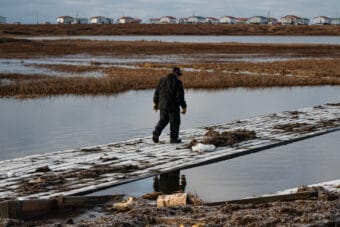
The disaster recovery effort on the Western Alaska coast is still underway, almost a month after a series of fall storms damaged or devastated coastal villages and displaced thousands of residents, primarily in the Yukon-Kuskokwim Delta region. Recovery operations are focused on restoring critical infrastructure, including water, power, communications, and emergency home and boardwalk repairs, according to an update on Friday from the Alaska Division of Homeland Security and Emergency Management.

The state’s disaster response effort is coordinating with federal agencies, regional tribal organizations, non-profits and local partners. The Trump administration announced a federal disaster declaration for Alaska on Oct. 22, promising a 100 percent cost share for the state’s relief efforts for 90 days, through January, according to the governor’s office.

The Alaska Division of Homeland Security and Emergency Management did not respond to a request for a cost estimate of the disaster relief effort to date, on Monday.

As of Friday, the most recent division update, the state has received 1,400 applications for state Individual Assistance and 719 applications for assistance from the Federal Emergency Management Agency. Applications are still open.

Officials, advocates say date rape drugging difficult to confirm, but an ongoing issue in Alaska

a drink
Commonly known date rape drugs are GHB and Rohyprol, or “roofies,” which are tasteless and odorless. But any kind of sedative can be used, like muscle relaxants, sleeping aids and anesthetics like Ketamine. (John Joh/Wikimedia Commons)

Content warning: The following story contains references to violence and sexual assault. 

Date rape drugging, or roofying, is the use of any sedative, usually mixed with alcohol, to incapacitate a victim and facilitate a sexual assault. While anecdotal stories of suspected roofying circulate around Alaska, cases and culprits are difficult to confirm.

Alaska Chief Medical Officer Dr. Robert Lawrence said that’s partially due to the nature of the crime.

“Many of these medications actually their mechanism, tragically, is memory loss,” he said. “One of your neighbors will have been assaulted, and know that an assault has occurred, but have no memory of how or when or what led up to it, just because of the way that the substance itself works. So that’s the reality of the situation that we’re in,” he said.

Substances can vary and are metabolized quickly in the body. GHB or Rhohyprol, most commonly identified as date rape drugs, are tasteless and odorless. They can cause intense inebriation, dizziness, memory lapses and pain, especially when mixed with alcohol, and are used to facilitate sexual assault.

The state does not track reports of suspected drugging or a drug facilitated sexual assault, according to officials with the Alaska Department of Public Safety and Department of Health. Lawrence explained that’s due to several reasons, but does not reflect the seriousness of the issue.

“We’re talking about sexual assault in Alaska, which is a very serious problem across the whole state. And then when you add to that the element of people using a sedating or incapacitating drug in order to make it more likely that someone could be assaulted, it becomes even a more serious issue,” he said.

He said the main reason the state does not track drug facilitated sexual assault is that data collection is variable. He said incidents are both medical and legal, so information can be reported to different agencies. State agencies are limited by whether a victim decides to report to authorities and when, and whether substances are detected in their systems. “Sometimes the medical record will include that, and sometimes not. And so the absence of that data doesn’t mean that there’s not still a problem,” he said.

Homer Police Department Lieutenant Ryan Browning says the department receives calls from the community periodically to report suspected roofying.

He said they received several calls in September, and one before Halloween weekend.

“Nothing concrete…and they were all very well after the fact,” Browning said. “And one of them was almost a week later, the other one was several days (later). People reporting that they suspected they were drugged at a bar, just based on how they woke up the next morning… typically it’s, ‘I don’t remember. I was at a bar. I was drunk, and I woke up feeling like I got hit by a truck.'”

When officers notice an uptick, the department will post an alert on the Homer Police Department’s Facebook page. He urged the public to remain aware, look out for friends, take note of suspicious individuals and any unwanted or inappropriate attention, and make a report if necessary.

“I’m a big proponent of ‘you are your first responder,’ right, and keeping yourself protected and safe as much as you can, and looking for signs and things like that when we’re out doing things and having fun,” he said.

Browning said none of the recent calls resulted in a reported sexual assault in Homer.

Criminal penalties can vary, Browning said, from criminal mischief charges of intending injury or tampering with food or beverages in an attempt to injure which are felonies. Misconduct involving a controlled substance like GHB is also a felony.

Sexual violence widespread in Alaska

Sexual violence is widely prevalent in Alaska. According to the 2020 Alaska Victimization Survey, the most recent data for Alaska, roughly 58% of Alaskan women had experienced intimate partner violence, sexual violence or both in their lifetime.

Current data is limited, but Alaska Native women experience the highest rates of violence and victimization. According to the Indian Law Resource Center, Alaska Native women have reported rates of domestic violence ten times higher than the rest of the United States.

In 2024, the rate of rape in Alaska was over three times the national average, according to available data by the FBI. That year, the FBI recorded 908 instances of rape statewide, or 122.5 per 100,000 people, compared to 37.3 per 100,000 people in the United States.

Only about one third of sexual assaults nationally are reported to law enforcement, according to an analysis by RAINN, the Rape, Abuse and Incest National Network, the nation’s largest anti-sexual violence organization. That’s due to a variety of reasons, including a fear of retaliation, belief it was a personal matter, or that police would not or could not do anything to help.

Women are disproportionately harmed by sexual violence, but men and LGBTQ+ populations are assault survivors as well. Most assaults, an estimated 60%, are perpetrated by someone known to the victim, according to RAINN, and 30% by a stranger.

Advocates offer resources and support, urge public awareness

Leslie Scroggin is an advocate and shelter manager at South Peninsula Haven House, a domestic violence shelter in Homer, and a member of the regional Sexual Assault Response Team.

“People typically, consistently seem to feel a sense of guilt over it,” she said. “I’ve heard people say things like it was careless of them to go out after work and to go drinking, or that they should have known better, or that type of thing. And it’s also a pretty disheartening experience, because it’s something that is just completely beyond their control… they don’t even have any sort of capacity to have any control over it.”

Scroggin said while public awareness is important, the larger issue is interrupting and addressing predatory behavior and the crisis of violence against mostly women.

“It’s the individuals that are causing harm that really need to be addressed, and they’re the ones that should be taking responsibility,” she said. “And obviously, we should always do whatever we can to protect ourselves. But that shouldn’t be something that we’re just constantly doing all the time.”

Scroggin said she has seen a rise in anecdotal reports of roofying in the summer months with increased tourism, but every situation is unique. She said people should seek medical care if they need it, and can make a report anonymously.

“The forensic nurse can do a sexual assault kit anonymously, and basically that just looks like collecting evidence and then putting it into a kit that is assigned a case number, but no one’s name will be attached to it,” she said. “So then they basically will just have that evidence there, and if the person who it got collected on should decide, you know, in three months, or even a couple of years that they would like to report then, then that will be available to them.”

Scroggin said the sooner a victim completes a sexual assault kit after an incident the better, but they have up to a week.

In Valdez, Tina Russell is a direct services coordinator with Advocates for Victims of Violence, Inc. a non-profit advocacy group and domestic violence shelter serving Valdez and the Copper River Basin region. She said she also notices an uptick in suspected date rape drugging in the summer months with more tourism and the fishing season, but has not seen any confirmed cases.

She says alcohol-related cases are more typical. “People under the influence of alcohol in a high amount, and then being taken advantage of to where they felt like they really didn’t give consent. And so they’ll come and talk to us about it, and or the hospital will call,” she said.

Russell said their organization is part of an unofficial sexual assault response team at the hospital in Valdez, and advocates, nurses and the local police department have training to respond and provide support to survivors, whether they choose to make an official report or not. “There’s so many different reasons that people don’t report,” she said. “You know, all of our statistics are so under-reported.”

Lawrence, as the chief medical officer, said Alaskans should know the risk, and look out for each other, both to prevent harm and to support people going through these experiences.

“All of us can be involved in the lives of people in a way that prevents individuals from being alone,” he said.

“All of us can be there as a neighbor or for someone who has suffered an assault,” he said. “I think that’s one of the most important things for people to have when they’ve suffered rape or sexual assault, is for there to be a caring adult who is there to walk with them through the process. That’s one of the most protective factors afterwards.”

If you or someone you know has experienced sexual assault, resources are available: 

Alaska Division of Elections begins reviewing petition to repeal election reform law

“I voted” stickers are seen on display in the headquarters offices of the Alaska Division of Elections in Juneau on Tuesday, Nov. 12, 2024. (Photo by James Brooks/Alaska Beacon)

State elections officials have begun reviewing signatures gathered by people opposed to Alaska’s system of open primary elections and ranked-choice general elections to determine whether a repeal ballot measure will appear before voters in 2026.

Alaskans enacted the state’s existing elections system via a ballot measure in 2020, and a repeal measure last year failed by only 737 votes out of 320,985 cast.

Proponents of the repeal vowed at that time to renew their effort and began gathering signatures in February to force another vote.

Based on state law and the number of people who voted in the 2024 statewide election, repeal supporters needed to collect signatures from at least 34,099 registered voters, including a certain minimum number in at least 30 of the 40 state House districts.

This week, supporters of the repeal measure said they were submitting more than 48,000 signatures to the Alaska Division of Elections for review.

If the repeal petition is deemed to have enough signatures, it would go before voters in either the 2026 primary or the 2026 general election, depending upon the length of next year’s state legislative session.

If voters approve the measure in 2026, all three components of the 2020 ballot measure would be repealed.

That would have three main results. Financial donors to political campaigns would be able to conceal their identity by contributing to a political nonprofit, which could donate money to causes on their behalf.

The 2020 law, currently in effect, requires campaigns to disclose the “true source” of their money.

The second effect would be the repeal of the state’s open primary system, in which all candidates, regardless of political party, run in the same race. Under the current law, the top four vote-getters in a given race advance to the general election.

If that is repealed, political parties would be able to determine the rules for deciding which of their candidates advance to the November general election.

The third change is to general election. Instead of voters being allowed to rank all candidates in order of preference, voters would be able to choose only one candidate, and the candidate with the most votes would win.

One other ballot measure, which would reimpose a limit on financial donations to political candidates, has already been certified and is slated for the 2026 ballot.

Two other ballot measures remain in the signature-gathering process. One would decriminalize several psychedelic substances, and the other would reinforce the state’s existing prohibition on noncitizen voting.

Backers of those measures must gather sufficient signatures before the start of the January legislative session in order to force a vote in 2026.

Site notifications
Update notification options
Subscribe to notifications