Alaska Beacon

Alaska Beacon is part of States Newsroom, a network of news bureaus supported by grants and a coalition of donors as a 501c(3) public charity. Alaska Beacon maintains editorial independence. Contact Editor Claire Stremple for questions: info@alaskabeacon.com. Follow Alaska Beacon on Facebook, Bluesky and Twitter.

Sullivan votes to block Senate measure intended to preempt American bombing of Venezuela

Alaska Republican U.S. Sens. Lisa Murkowski and Dan Sullivan.
Alaska Republican U.S. Sens. Lisa Murkowski and Dan Sullivan. (Alaska Beacon file photos)

Alaska’s two U.S. senators split on a vote that would have allowed the U.S. Senate to take up a resolution that sought to prevent President Donald Trump from unilaterally ordering the bombing of Venezuela.

Fifty votes were needed in the Senate to take up the resolution, but only 49 senators — all the Senate’s Democrats, plus Republican Sens. Lisa Murkowski of Alaska and Rand Paul of Kentucky — voted in favor of the procedural action needed to force a vote.

Sen. Dan Sullivan joined a majority of Senate Republicans and voted against taking up the resolution, which was sponsored by Sen. Tim Kaine, D-Virginia.

Thursday’s vote, and the split decision by Alaska’s senators, was similar to a vote that took place last month, when the Senate declined to consider a resolution intended to curtail America’s killing of suspected drug dealers without trial.

Since September, the United States has killed 67 people aboard boats in both the Caribbean Sea and the Pacific Ocean, according to tallies kept by the New York Times and CNN. There have been 16 known military strikes since Sept. 2, each targeting a boat that the U.S. government claims was carrying drugs.

It is illegal for the U.S. military to intentionally kill civilians who are not actively taking part in hostilities against the United States.

In October, Murkowski joined Paul and all but one of the Senate’s Democrats in voting to take up a resolution intended to curtail the strikes. Sullivan joined the rest of the Senate’s Republicans, and Pennsylvania Sen. John Fetterman, D-Pennsylvania, in voting to support the strikes.

Since that vote, Trump has said that he has authorized covert CIA operations in Venezuela and is considering military strikes against the country, which is governed by dictator Nicolás Maduro.

The U.S. military has positioned large numbers of soldiers and aircraft near Venezuela’s coastline, possibly in preparation for attack.

In a statement after Thursday’s vote, Murkowski said she has “been briefed multiple times and reviewed classified documents that provide insight into the administration’s factual justification” for attacking Venezuela.

“Even with this additional context, I do not believe their case has met the standard of clarity and rigor that Congress needs to fully evaluate the legality and scope of these operations,” she said.

Devyn Shea, a spokesperson for Dan Sullivan, said by email after the vote, “In both Democrat and Republican administrations, Senator Sullivan has consistently voted against limiting the authority of the President as Commander-in-Chief to protect the national security interests of the country.”

Sullivan “believes that under Article II of the Constitution, President Trump as Commander-in-Chief has the authority to defend our homeland from Venezuelan narcoterrorists, just as President George H.W. Bush did when he ordered the full military invasion of Panama in 1989 to remove the drug-trafficking dictator Manuel Noriega,” Shea said.

Alaska opens two special hunts to aid Southwest Alaska residents affected by typhoon

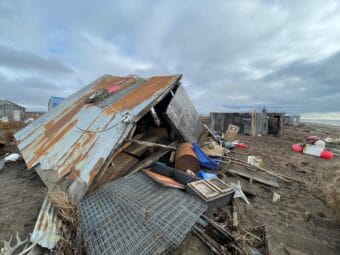
The village of Kipnuk, largely submerged by the remnants of Typhoon Halong, is seen from the air on Oct. 12, 2025. Alaska Air National Guard rescue personnel conducted search and rescue operations there, and the Alaska Division of Homeland Security and Emergency Management has worked with the Alaska Organized Militia and the U.S. Coast Guard in the response. (Photo provided by the Alaska National Guard)

On Wednesday, the Alaska Department of Fish and Game will open an emergency moose hunt in Southwest Alaska, near the town of Quinhagak, in order to help victims of ex-Typhoon Halong, which devastated communities in the Yukon-Kuskokwim delta last month.

It’s the second emergency hunt that Fish and Game has opened to help storm victims refill their freezers before winter deepens, and it’s only the latest example of how Alaska state agencies have helped in unlikely ways after last month’s disaster, which killed at least one person and displaced hundreds.

Elsewhere, officials from the Alaska Department of Education and Early Development have been coordinating new schools for evacuees who needed to move to Bethel or Anchorage.

The Alaska Department of Environmental Conservation has been helping wrangle fuel tanks set adrift in floods. Workers from the Division of Forestry and Fire Protection have been helping muck out homes, remove debris and deliver supplies to villages alongside the Alaska Department of Transportation and Public Facilities and the Alaska National Guard.

In Anchorage, hundreds of miles away from the villages hardest hit by the storm, about 20 employees of the state-owned Alaska Housing Finance Corporation worked for weeks to find long-term shelter for hundreds of Alaskans who lost their homes in the disaster.

On Monday, state and city officials in Anchorage said they had closed the last mass shelters being used by evacuees because everyone had found hotels or apartments suitable for long-term use.

“This isn’t something we normally have done,” said AHFC CEO/Executive Director Bryan Butcher on Oct. 22 of the push to help evacuees find housing. “There have been different times … that people have reached out to us and asked for assistance, and we try to help when we can.”

Butcher said AHFC employees spent time checking for available state-owned housing and tried to connect evacuees with available apartments and housing across the state.

“We’ll play whatever role we need to play,” he said in late October. “And at this point, it’s just the gathering of units and then trying to help kind of piece it together so it makes the most sense and has the least amount of disruption.”

At the Department of Fish and Game, Ryan Scott is the director of the Division of Wildlife Conservation, which oversees hunting practices and issued the emergency hunting order this week.

“Our staff has been in communication with the communities, plus people who evacuated to town. And you know, I’m very proud of them, but I’m super thankful that we could help out where we could,” he said.

Scott said the department frequently gets requests for emergency hunts, but they’re only allowed in places where the population of prey animals is large enough to support them.

While the two emergency hunts in Southwest Alaska are intended to help people affected by the disaster, any state resident can participate if they meet the guidelines.

The food generated by the hunt may even be able to help people who evacuated from the area; Alaska has a system of proxy hunting that allows someone to hunt on behalf of someone else who is elderly or disabled.

In addition, evacuees may be able to take advantage of winter hunts or small-game hunts, or other subsistence activities, Scott said.

“We get into this type of work not only for the wildlife resources, but across the board it’s about the people too, you know? And then whatever we can do to help Alaskans, that’s what we want to do.”

The number of debt collection cases in Alaska state courts is soaring, following national trends

A sign with an arrow pointing right toward Nesbett Courthouse and an arrow pointing left toward Boney Courthouse.
A sign directs visitors to either the Nesbett Courthouse or Boney Courthouse in downtown Anchorage on August 31, 2022. (Valerie Kern/Alaska Public Media)

Every morning, Alaska’s court system publishes an updated list of new civil lawsuits filed across the state during the past week.

And every morning, that list is dominated by debt collection cases, newly filed by credit card companies, debt collection firms or businesses seeking repayment. On Tuesday, of the 115 listed cases, 84 were for debt collections.

In the first nine months of 2022, the court system saw 1,869 debt collection cases filed. Every year since then, the number has risen. Through the first nine months of this year, there were 3,447, almost double the figure filed in 2022.

“It’s pretty wild, the rise of them,” said attorney Stacey Stone, who practices in Alaska and is familiar with the issue.

Alaska isn’t alone in the upward trend — nationally, the number of collection lawsuits is rising after an ebb during the COVID-19 pandemic emergency.

January Advisors, a national data consulting firm that noted the rising trend in August, concluded that multiple factors may be driving it.

During the COVID-19 emergency, many Americans received financial aid that helped them pay down debt and build savings. Those programs have now ended, and American consumer debt is now at record highs, according to figures published by the Federal Reserve Bank of New York.

The number of people who are behind on their credit card payments is also on the rise, the Federal Reserve Bank of St. Louis reported earlier this year, and the number of car repossessions is rising.

Automated software programs also are making it easier for companies to more easily file large numbers of debt collection cases.

In June, the National Center on State Courts concluded that easier access to generative AI software is likely to increase filings in contract cases, like debt collections.

Typically, a credit card company or medical provider will try first to get payment on an overdue bill directly. But if a bill still goes unpaid, many companies will deem the debt uncollectable. At that point, they sell the rights to the debt to a collections company.

The sale means the company with the unpaid bill will get at least some money, and then it becomes the collections company’s job to try to recoup the debt and earn money for itself.

Court filings in Alaska and elsewhere indicate that debt collection companies are filing more cases in an attempt to collect on the unpaid debts they’ve bought.

Two researchers with The Pew Charitable Trusts, in a September analysis, said that can have significant consequences for regular people.

People who are sued for consumer or medical debt rarely hire attorneys, they noted, and in many cases, people may not even be aware that they are being sued.

The Debt Collection Lab — a research group that includes Princeton University — found that in Oregon, private collection agencies filed the bulk of lawsuits on behalf of credit card companies, health care providers and utilities.

Only four percent of debt defendants responded to the cases filed against them, and as a result, Oregon courts awarded default judgments in favor of the debt collectors in almost seven of 10 debt cases filed between 2017 and 2023.

Data on the result of Alaska cases was not immediately available, but a preliminary examination of court dockets and filing patterns by the Alaska Beacon shows that the trends in Alaska are similar to those in other states.

A frequent filer in Alaska courts, a national debt-buying company called LVNV Funding, increased its filings by 350% in a handful of states between 2019 and 2024, January Advisors found.

In Connecticut, the top 10 most frequent filers in debt cases accounted for more than 80% of all debt cases filed in that state last year, January Advisors found, indicating that the most frequent filers are stepping up their aggressiveness.

“More people are defaulting on their debt right now because people are living paycheck to paycheck for various reasons, so I think you do have an organic process happening, but also there’s an aggressive process happening that’s uncharacteristic,” Stone said.

In Alaska, even a state representative has faced a debt-collection lawsuit whose details appear typical of the kinds of cases being filed here.

On Oct. 27, a debt collection firm known as Jefferson Capital Systems filed suit in Anchorage District Court against Rep. Jamie Allard, R-Eagle River.

According to the complaint, Allard took out a loan from Celtic Bank in 2023 and didn’t fully repay it. Celtic Bank subsequently transferred the debt — just $1,075 — to Jefferson Capital, which filed the lawsuit.

The attorney who filed the lawsuit didn’t respond to a request for comment.

Allard didn’t know about the suit until she was contacted by the Alaska Beacon, which was already writing this article.

“Oh my God; I had no idea what this was about,” she said.

Stone is Allard’s attorney and said cases like these seem to come out of left field. She said they tend to be filed in bulk, and as a result, they may be inaccurate, especially when a case is filed by a third-party firm that has purchased debt from another source.

Allard has an attorney; most Alaskans named as defendants in a debt-collection case don’t have that, according to a review of online court records.

Unlike in criminal cases, the state is not required to assign someone an attorney.

In most instances, that leaves the defendant to represent themselves or to seek help from a group like the Alaska Legal Services Corporation, a nonprofit that provides legal help to many Alaskans in civil lawsuits.

Maggie Humm, the corporation’s director, said it doesn’t have enough funding to take on every request for help that it receives, but it is seeing a surge in the number of requests for help on debt collection cases.

From 2022 through 2024, “there was a 61% increase in applications for all consumer protection matters,” which includes debt collections, said Humm.

Though the group hasn’t closed out this year, Humm said the number of people seeking help is about the same as last year.

If an Alaskan doesn’t respond to a debt collection lawsuit and a court issues a default judgment on behalf of a debt collection agency, a judge could order the garnishment of part of their income.

“Here in Alaska, we know that collectors file more cases because we have the Permanent Fund dividend … and they can garnish a percentage of it if they get a default judgment,” Humm said.

A court order also might allow a debt collector to go after someone’s checking account, other assets or — in the case of a member of the military — their military pay.

Humm said Alaskans who receive a legal complaint for debt collection should do their best to respond. She suggested they ask for help from the corporation, or get other help via online resources.

In September, the New York Times analyzed the surge of debt collection lawsuits and noted that part of the reason for the surge is that people don’t bother to defend themselves in court.

A court defense may make someone less attractive as a target, the Times found, and if more people defended themselves, debt collectors might begin seeing lawsuits as an unprofitable way to do business.

Correction: This article has been updated to note that an analysis was performed by The Pew Charitable Trusts, not The Pew Research Center. 

Alaska Supreme Court contemplates the limits of tax exemptions for religious camps

Case files for a legal matter referred to the Alaska Supreme Court are seen on Tuesday, Feb. 6, 2024, in Juneau.
Case files for a legal matter referred to the Alaska Supreme Court are seen on Tuesday, Feb. 6, 2024, in Juneau. (James Brooks/Alaska Beacon)

The five members of Alaska’s highest court heard arguments last Thursday in a long-running dispute between the operators of a Christian camp and the Fairbanks North Star Borough about whether or not the camp qualifies for an exemption from local property taxes.

Though the dispute involves only a single camp in Fairbanks, the justices’ ruling could redraw the limits that decide when religious groups’ operations qualify for tax exemptions in Alaska.

In court, an attorney representing the borough and one representing the camp’s operator, Victory Ministries of Alaska, said the key question is whether Camp Li-Wa was used exclusively for charitable purposes during 2021.

The borough and Victory Ministries disagree on other years’ taxes, but only one dispute was escalated to the Supreme Court.

The borough contends that because Victory Ministries operates a Christian Bible camp for only two months during the year, it should not be able to claim tax-exempt status for the remaining 10 months of the year, or on buildings not used by the camp.

In arguing its case, the borough submitted advertising material published by Victory Ministries that described the camp as “currently one of the finest retreat locations in the Interior of Alaska” and said it was advertised for vacations, recreation and other profitable purposes, not just charity.

The borough also submitted financial documents obtained from Camp Li-Wa, suggesting that the camp was used more for commercial, profitable purposes than charitable ones.

Victory Ministries fought back, saying that the camp operates at a deficit, and — among other arguments — that paying users are not required to be nonprofit groups, and that charity can involve self-care and pleasure.

In 2024, a Fairbanks Superior Court judge ruled in favor of the borough, causing the defendants to appeal to the Supreme Court.

In part, the operators of Camp Li-Wa argue that the borough and superior court “erred by improperly limiting what constitutes ‘charitable activity’ in violation of the state constitutional protections.”

Janella Kamai, attorney for Victory Ministries of Alaska, told the justices that while Camp Li-Wa may offer programs like horseback riding for a fee, “The fun activities, it’s just a sideline. The purpose is to provide the churches, the schools, with a place for them to host their own spiritual retreats and community events.”

She said the camp’s mission applies even if someone who isn’t religious comes to the camp. “You have to understand that Victory operates to both evangelize and proselytize. Evangelism means they’re going to bring people onto the campus so that they can introduce them to the concepts of Christian camping, introduce them to Camp Li-Wa, so if they want to know more, they can,” Kamai said.

In many cases, the camp is being used as a religious retreat, she said.

Ehren Lohse, the attorney representing the Fairbanks North Star Borough, said that under the borough’s definitions, a retreat isn’t a charitable activity.

“A retreat, by definition, is time away from your other work. So they may be doing charitable and religious work at their normal places,” he said of camp users, “but when they’re having a retreat, that can happen anywhere.”

Justice Dario Borghesan said that raises a problem for the justices: There’s no way to know whether camp users were engaging in religious activity or taking a break.

“I’m just not sure how ultimately this gets resolved,” he said.

The court took the case under consideration at the end of Thursday’s hearing and will issue a written order at a future date.

Cut off from their jobs at home, Alaska typhoon evacuees have alternative income options

Regina Qussauyaq Therchik, manager of workforce and shareholder development at Calista Corporation, shows information on a laptop on Oct. 29, 2025, to Stephanie and Carl Anaver of Kipnuk. Therchik was among the Calista representatives participating in a workshop at the William A. Egan Center in Anchorage that connected evacuated Yukon-Kuskokwim residents with temporary employment and job-training opportunities. The Anavers have been staying in Wasilla with a relative since being evacuated from their home region. The Egan Center has been serving as a temporary shelter and assistance hub for the hundreds of Yukon-Kuskokwim residents flown to Anchorage after their villages were devasted by the remants of Typhoon Halong. (Photo by Yereth Rosen/Alaska Beacon)

For wage-earning Alaskans who were displaced by the remnants of Typhoon Halong, a powerful storm that lashed the western coast of the state earlier this month, qualifying for one special type of federal assistance could be a cinch.

The U.S. Department of Labor’s Disaster Unemployment Assistance program provides financial benefits to people who cannot perform their normal jobs because of disaster interference. One qualification for the benefits — $153 to $370 per week for up to 27 weeks, according to the Alaska Department of Labor and Workforce Development — is an inability to reach normal worksites.

Among the hundreds of Yukon-Kuskokwim region residents who were evacuated by military flights to Anchorage, nearly 500 miles to the east of their home villages, those that held wage-earning jobs in their home villages easily meet that requirement.

Beyond that weekly benefit, many evacuees will need to earn income over what might be a prolonged period away from home. To meet that need, companies and government agencies are seeking to place evacuees in temporary jobs and training programs.

At the forefront of those efforts is Calista Corporation, the Alaska Native corporation for the Yukon-Kuskokwim region. It has a series of programs underway to help displaced residents find work and training.

Cleanup and recovery work is a logical opportunity for people from storm-damaged villages, said Thom Leonard, Calista’s vice president for corporate affairs. But there are some obstacles to starting those recovery jobs.

“One of the challenges is: When are they going to go, and where are they going to stay if they are able to go back to the villages?” he said. Villages that lack power, water and other basic services might not yet be able to house the people who would do the cleanup and recovery work to make those villages habitable again, he said. “It’s kind of a chicken-and-egg situation,” he said.

Bradley Cupluaraq Lake, a workforoceo and shareholder development specialist with Calista Corporation, holds up a brochure on Oct. 29, 2025, with information about the program. Calista is the regional Native corporation based in the Yukon-Kuskokwim region. Lake was one of the Calista representatives at the William A. Egan Center in Anchorage helping shareholders who have been evacuated to Anchorage from villages ravaged by the remnants of Typhoon Halong. Calista and other organizations are coordinating efforts to place evacuees in temporary employment or job-training programs. (Photo by Yereth Rosen/Alaska Beacon)

Calista’s construction and environmental services subsidiary, Calista Brice, has been enlisted in the disaster response and is hiring people from affected villages, Leonard said.

More generally, Calista and other partners held a career workshop on Wednesday for evacuees at the William A. Egan Civic and Convention Center in Anchorage, and more such events are planned. Through those events, Calista’s workforce and shareholder team, which operates a year-round program, is connecting displaced residents with job-training opportunities.

Calista has also offered temporary office space to tribal governments from Kipnuk and Kwigillingok, the coastal villages most heavily hit by the storm. The Kipnuk tribal government has taken Calista up on that offer, Leonard said.

Among the individuals getting help from Calista at the Egan Center on Tuesday were Carl and Stephanie Anaver of Kipnuk.

Stephanie inquired about the possibility of working as a home health care aide for her aged sister, and Carl was seeking a building maintenance job similar to the work he was doing at the Kipnuk Clinic. Regina Therachik, manager of Calista’s workforce shareholder development program, counseled them in Yup’ik.

Anchorage was not their first choice for a relocation spot, Stephanie Anaver said. “I wanted to stay in Bethel. But since Bethel was full, they brought us here,” she said in a brief interview.

Rather than staying in Anchorage, the couple has made a temporary home in Wasilla with a family member, she said.

The time in Southcentral Alaska is shaping up to be a period of limbo for the couple. Exactly when the couple will return to Kipnuk, or even if that is possible, is unknown, Stephanie said.

“If they relocate Kipunk to higher ground, yeah, I’ll go back to Kipnuk,” she said.

State attorneys attempt to preserve legal limit on who can provide an abortion in Alaska

Alaska Supreme Court Justice Jude Pate, right, asks a question during oral arguments in a case concerning correspondence education allotments, on June 27, 2024, in the Boney Courthouse in Anchorage. (Photo by Andrew Kitchenman/Alaska Beacon)

On Wednesday, the Alaska Supreme Court heard arguments in a legal case that will determine whether or not the state of Alaska may restrict abortion care to licensed physicians.

Since 2019, attorneys representing Planned Parenthood of the Great Northwest, Hawaii, Alaska, Indiana and Kentucky, have been challenging a state law setting out that restriction. They argue that advanced practice clinicians should be permitted to provide abortion care, even though they are not licensed physicians.

The law, enacted in 1970, has been partially suspended since 2021, which has allowed advanced practice clinicians to perform abortions. In 2024, Alaska Superior Court judge ruled in favor of Planned Parenthood, continuing the suspension.

The state of Alaska, which opposes Planned Parenthood’s interpretation of the law, appealed to the Alaska Supreme Court in hopes of restoring the law’s effectiveness.

The deciding issue may be whether strict scrutiny applies in the case. Under strict scrutiny, the government bears the burden of proving that a law is constitutional.

In 2024, Alaska Superior Court Judge Josie Garton ruled that strict scrutiny does apply, which contributed to her determination that limiting abortion services to state-licensed physicians violates the Alaska Constitution.

In written briefs to the Supreme Court this year, attorneys representing the state have argued that Garton’s ruling was mistaken; attorneys representing Planned Parenthood have argued in favor of the strict scrutiny determination.

If Garton’s decision on strict scrutiny is overturned, the rest of her decision could follow, and advanced practice clinicians would no longer be legally able to provide abortion care in Alaska.

In Alaska, abortion rights have generally been protected since 1997 by the Alaska Supreme Court’s interpretation of the state’s constitutional right to privacy.

Since then, subsequent editions of the court have repeatedly held that abortion care is health care and thus protected by the right of Alaskans to keep medical decisions private.

Attorney Laura Wolff, representing the Alaska Department of Law, argued Wednesday that the physician-only abortion law doesn’t violate the constitutional right to privacy because few people have been affected.

“The privacy clause analysis requires a significant impairment,” she told the justices. “Not a modest, not a medium, a moderate, a significant impairment, in order to even trigger the privacy clause.”

Attorney Camila Vega, arguing for Planned Parenthood, said some of the group’s clients have been able to access care more often because they no longer have to wait for a doctor to be available.

She said that it would be a mistake for the Supreme Court to require that a minimum number of patients be affected in order to violate the constitution.

“This court has never before required evidence about a threshold number of individual patients to strike down a law, and we would urge the court not to do so here,” she said. “The evidence … shows that since the injunction in this case, patients have been better able to access medication and aspiration abortion. They’ve been doing so for the last four years, and so we respectfully request that the court affirm the order.”

National and local groups filed friend-of-the-court briefs in support of Planned Parenthood. Standing Together Against Rape, an Alaska group, argued that restricting access to abortion care would harm abuse victims and survivors of sexual assault.

The national groups argued that advanced practice clinicians are able to provide safe and effective abortion care, and there’s no difference in outcomes between their care and care provided by doctors.

Planned Parenthood has also argued that even if the Alaska Constitution’s privacy amendment does not apply in this case, the abortion-doctor law would violate the constitution’s equal protection clause.

That clause states “that all persons are equal and entitled to equal rights.”

Restricting abortion patients to doctor treatment alone deters them from getting treatment, Vega said.

“For example, if the state offered marriage appointments twice a week, but it said that for same-sex couples, you could only get a marriage appointment once a month, that is a clear equal protection violation,” she said.

The state argued in writing that it has a valid interest “in ensuring that these procedures ending fetal life are performed ethically, professionally, and under a uniform standard,” and because of that reason, the Alaska Legislature intended abortion to be regulated to a higher standard.

At the end of Wednesday’s arguments, Chief Justice Susan Carney said the case will be taken under consideration, with a written order to be published at a future date.

Site notifications
Update notification options
Subscribe to notifications