Alaska Beacon is part of States Newsroom, a network of news bureaus supported by grants and a coalition of donors as a 501c(3) public charity. Alaska Beacon maintains editorial independence. Contact Editor Claire Stremple for questions: info@alaskabeacon.com. Follow Alaska Beacon on Facebook, Bluesky and Twitter.
Alaska Republican governor candidate Charlie Pierce is seen in an undated photo published by the Alaska Division of Elections. (Handout photo)
The Kenai Peninsula Borough paid $267,000 to settle a pair of workplace complaints alleging bullying and discrimination by Charlie Pierce, the borough’s departing mayor and a Republican candidate for governor. Only one of the settlements has been previously disclosed to the public.
The previously undisclosed settlement involved a $117,000 payment to former Kenai borough human resources director Kim Saner, who left the borough last year.
According to the text of the settlement, Saner wrote a complaint to the borough’s lead attorney and Pierce’s chief of staff in December, alleging “illegal acts” related to Saner’s employment with the borough.
Saner’s last name is redacted from the agreement, but his first name and title were not redacted, allowing him to be identified.
As part of the agreement, Saner agreed to “withdraw and rescind any allegations of bullying related to (his) employment with the KPB” and to withdraw a request that he speak publicly about the issue.
Another clause of the agreement requires it to remain confidential and for Saner to refrain from speaking about it publicly.
Brown sued the Borough in 2019, alleging that she was fired by Pierce after she told him that she had been diagnosed with a fatal case of cancer.
The borough settled the lawsuit later that year, after both sides went through a mediation process.
Reporters at multiple news agencies are investigating an alleged third workplace complaint involving Pierce and a borough employee. Multiple records requests have failed to yield information about that alleged action.
Pierce and members of the Kenai Borough Assembly have repeatedly declined to answer questions about the rumored complaint. Borough employees also have declined to discuss the issue or confirm the existence of the complaint.
In response to questions about the complaint, Borough Attorney Sean Kelley said there are no signed agreements, but he confirmed that the borough did conduct a confidential investigation earlier this year about an unspecified human resources issue.
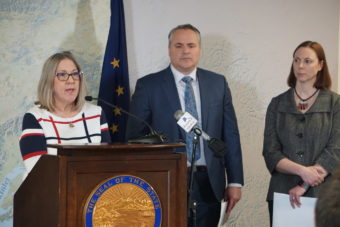
Anne Sears speaks at Gov. Mike Dunleavy’s June 28 news conference about the state budget. Sears recently retired for a second time after a five-month stint as Alaska’s special investigator for cases of murdered and missing Indigenous people. (Photo by Yereth Rosen/Alaska Beacon)
After five months on the job, Anne Sears is no longer Alaska’s investigator for missing and murdered Indigenous people with the Alaska State Troopers. When the Department of Public Safety hired her in April, the position was the first of its kind in the state. Now, the critical role is unfilled.
In late August, Sears “decided to go back into retirement to spend more time with her family,” according to Austin McDaniel, communications director for the Department of Public Safety.
“The Alaska State Troopers are currently working to identify and hire a new MMIP Investigator for this critical role. The investigation of missing persons and murder cases involving Alaska Natives is a top priority for the State of Alaska,” McDaniel wrote in an email Tuesday. The political website the Alaska Landmine first reported the news.
McDaniel said the department intends to fill the position as soon as possible. As MMIP investigator, Sears was tasked with working on unsolved cases across the Alaska State Troopers’ area of responsibility. The position works closely with trooper investigators and criminal intelligence analysts within the Alaska Bureau of Investigation.
Sears’ work
Sears’ last day on the job was Sept. 2. In her five months on the job, McDaniel said Sears worked on several cold cases, “including the murder of Arnoldine Simone Hill from 2020 and other significant cases.”
Sears also spent time traveling and speaking with community groups, Alaska Native communities and associations, and speaking to family members of missing or murdered indigenous people, according to McDaniel.
There are no subordinate staff associated with the position, but the next MMIP investigator will likely work with a tribal liaison on outreach and engagement.
“With the FY 2023 budget, the Governor and Alaska Legislature provided DPS with funding for a Tribal Liaison within the Alaska State Troopers,” wrote McDaniel.
Need for investigators continues
Kaax’kwei Leona Santiago said there needs to be more than one person in the state working on missing and murdered Indigenous people cases.
“I don’t think one person can do that job. There is a need for more than one person,” Santiago said.
Santiago is part of the Central Council of Tlingit & Haida Indian Tribes of Alaska’s Violence Against Women Task Force and helped organize the Missing and Murdered Indigenous People rally held in front of Alaska State Capitol in May, which Sears spoke at. Santiago hopes the position is filled quickly.
“It’s a position that’s very important to Alaska. We have very many murdered and missing women and people, even young, young teenagers,” Santiago said.
Across the country, thousands of cases of missing and murdered Indigenous people are unsolved and many go unreported. Of states with the highest number of missing and murdered Indigenous women and girls cases, Alaska is fourth, according to a report by the Urban Indian Health Institute. Anchorage ranks third in top 10 cities with the highest cases. The Centers for Disease Control and Prevention listed murder as the third- leading cause of death for American Indian or Alaska Native women in 2016.
Sears originally came out of retirement to be the state’s MMIP investigator. She spent 22 years in law enforcement and was the first Alaska Native woman hired to be an Alaska state trooper. She worked as one in Palmer, Galena, Nome, Fairbanks and Kotzebue, and retired in October 2021.
She started the MMIP investigator job April 4. In May, she said she felt very fortunate to have been asked to take on the job.
“Being in law enforcement for 22 years, being an Indigenous woman, being born and raised in the state of Alaska, having lived all over Alaska growing up, then working all over Alaska as a state trooper and being in public service for 30 years has kind of all culminated in this one position, this one purpose, this one issue. I feel very fortunate that I was asked to take this on and privileged to have been asked to take this on,” she said.
Council report due in October
As the MMIP investigator, Sears was part of the 11-member Governor’s Alaska Council on Missing and Murdered Indigenous Persons. The council, which started meeting earlier this year, is tasked with delivering a final report to the governor by Oct. 15 that provides recommendations for improving interagency cooperation on missing person protocols, improving public safety in tribal communities that have no law enforcement presence and ways to improve investigations.
At a council meeting on Tuesday, Sears’ name was called in the meeting roll call. No one replied. About 20 minutes into the meeting, council member Sam Vandergaw mentioned Sears’ departure from the position.
“I don’t know if it’s been announced already, but Anne Sears is no longer working with us. She decided she wanted to remain retired, so that’s what she’s doing,” said Vandergaw, who is an assistant attorney general.
Council Chair Valerie Chadwick implied that Vandergaw’s comment was the first she had heard of Sears’ departure. She included that among several concerns related to the council’s work.
“And now I’m hearing about Anne leaving. So I’m seeing if anybody else has been feeling kind of lost as I’ve been feeling lost,” Chadwick said.
Chadwick asked the council’s support staff how the council moves forward with noticing the governor that there’s now a vacancy left by Sears’ departure.
According to McDaniel, Department of Public Safety Commissioner James Cockrell “holds the seat that Investigator Sears had on the Governor’s Council on Missing and Murdered Indigenous Persons. Commissioner Cockrell will resume attending these critical meetings and working with the council on their final report.”
Sunrise over Thomsen Harbor in Alaska. Mt. Edgecumbe, Sitka Ranger District, Tongass National Forest, Alaska. (Forest Service photo by Jeffrey Wickett)
The U.S. Department of Agriculture has made its final funding decisions in a $25 million program to support local organizations in Southeast Alaska, officials said on Tuesday
The Southeast Alaska Sustainability Strategy, announced last year, has now made commitments to over 30 local and regional partners for 70 locally driven projects, Agriculture Secretary Tom Vilsack said in an online announcement event.
“These projects and investments, I think, reflect our common commitment to acknowledging, respecting and honoring Indigenous ownership and stewardship, the knowledge, the values, the priorities,” Vilsack said. “I think it also reflects our commitment to a community-driven investment strategy that reflects the input from local folks. It reflects the local knowledge and priorities and certainly puts a premium on collaborative relationships.”
The strategy is being undertaken by two agencies of the Department of Agriculture — the U.S. Forest Service’s Rural Development division and Natural Resources Conservation Services. It is intended to help the region transition from past reliance on large-scale timber harvests in the 16.7 million-acre Tongass National Forest, which encompasses most of Southeast Alaska.
Of the $25 million in project funding, about half will be managed by tribal and Indigenous organizations, for purposes that include arts and cultural support, enhancement of food security and support for cultural use of forest products.
“This is the first time in my 27 years as an elected person that I’ve actually seen this level of local decision-making,” Peterson said in the online event. “So often, we see decisions made at a national level that really don’t fit. We’ve got to shoehorn them in. And this is happening at the local level. It’s really refreshing.”
The other half of the funding is for projects aimed at boosting infrastructure, community economic development and natural resource management.
That includes workforce development projects to help young commercial fishermen and to enhance mariculture operations, said Robert Venables, executive director of the Southeast Conference, a regional economic development organization. Many of the opportunities “will help the next generation not just find a job but be the job-makers,” Venables said.
The Southeast Alaska strategy is a new way of doing federal government business that can be replicated in other regions of the nation, Vilsack said.
“It’s a model that creates a real powerful partnership where the resources of the federal government are directed in a way that local folks understand and can help to direct,” Vilsack said. “I’m excited about the potential for this model to be expanded, to continue to be expanded in other mission areas of the USDA.”
Related to the sustainability projects is the Forest Service’s decision, announced last year, to restore the federal protections to the Tongass under what is known as the Roadless Rule. The 2001 Roadless Rule largely bans timber harvesting in areas currently without roads, thus preserving old-growth stands. Under the Trump administration, Alaska was exempted from the Roadless Rule.
The decision to reinstate the protections in Alaska has attracted over 110,000 public comments, which must be fully reviewed before the Biden administration completes its final rulemaking, Vilsack said at the news conference.
The final rule is expected by the end of the year, he said.
“I recognize that this may not have happened as quickly as some would like. But I am committed to getting this done to conserve this important resource,” he said. “I hope folks understand that we do have to follow through the process. We have to be respectful of the people who took time and energy to provide comments so that the record is as complete and as strong as it possibly could be in order to defend the decision that we’ve made to restore the protections of the 2001 Roadless Rule.”
Gail Fenumiai, director of the Alaska Division of Elections, laughs with Brian Jackson, election program manager, on Wednesday, Aug. 31, 2022, at division headquarters in Juneau as they prepare to reveal the results of Alaska’s first ranked choice election. (Photo by James Brooks/Alaska Beacon)
The Alaska Division of Elections on Friday certified the state’s Aug. 16 special general election for U.S. House, confirming Democrat Mary Peltola as the winner.
Peltola will be sworn in as Alaska’s lone U.S. representative later this month after defeating Republican candidates Sarah Palin and Nick Begich III.
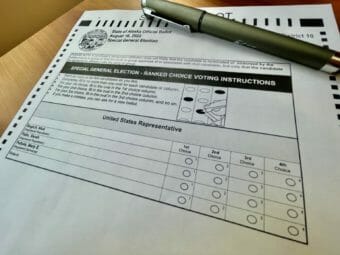
Though elections officials are still compiling statistics from the vote, political advisers, pollers and independent observers say there are five early lessons from Alaska’s first ranked choice election:
Ranked choice voting mostly worked
In results shared by the Division of Elections only 295 people cast ballots that couldn’t be counted for at least one candidate, including write-ins. That’s less than 0.2% of all votes.
This figure represents only “overvotes,” ballots with marks that couldn’t be counted. Some people also cast blank ballots.
“Clearly, people understood how to mark the ballot effectively,” said Chris Hughes, policy director of the Ranked Choice Voting Resource Center, a national nonprofit devoted to informing the public about ranked choice voting.
“The overall (overvote) rate was honestly one of the lowest I’ve ever seen,” Hughes said.
That’s an indication that education campaigns by the division and by Alaskans for Better Elections — a nonprofit that encourages ranked choice voting — were successful.
A poll commissioned by the nonprofit found that 95% of voters reported receiving instructions on how to use ranked choice voting, and 85% of voters said it was simple.
We won’t know until next week how many of Palin’s voters and Peltola’s voters picked a second candidate, but more than 80% of Republican candidate Nick Begich’s supporters picked at least one additional candidate.
“Which is pretty solid, especially for the first time using ranked choice voting,” Hughes said.
About 6% of voters ranked only one or two candidates and had all of their options eliminated, creating what are known as “exhausted” ballots.
In some cases, that was because the voter didn’t like the remaining options. In others, it may have been because of confusion or out of protest, but it’s impossible to judge how many people fell into each category.
Tom Anderson of Optima Public Relations ran some of Palin’s advertising campaign and is working with some conservative legislative candidates.
“From the circles that I work within, they did not like the system, even if they were benefactors of it,” he said.
Ivan Moore of Alaska Survey Research, said his numbers indicate conservative Alaskans dislike ranked choice voting by a 6-1 margin, while moderates and progressives support it.
The election didn’t run perfectly. As many as seven rural communities may have had their ranked choice ballots excluded from the final result because they failed to arrive in Juneau by mail. Elections officials have said they will use express mail for the November general election.
And two rural polling places didn’t open at all on election day. In those cases, poll workers didn’t show up, and no one told election administrators until the day after.
Begich voters decided the result
Immediately after learning of her defeat, Palin blamed ranked choice voting, and some other Republicans followed suit.
Observers say her failure to sway Begich supporters was to blame.
“Mary didn’t win because of ranked choice voting. Mary won in the final equation because she was running against Sarah Palin and people didn’t like Sarah Palin,” Moore said.
Matt Larkin runs Dittman Research, which runs polls for Republicans in Alaska and said Palin is disapproved of by many voters, which explains why about half of Begich supporters voted for Peltola or no one at all after he was eliminated.
“I definitely think more Republicans chose not to rank than was expected,” said Sara Erkmann-Ward, a Republican consultant who tried to convince conservatives to rank multiple candidates.
Had more Begich supporters turned their second-choice votes in favor of Palin, she would be on her way to Washington, D.C., instead of Peltola.
Political parties had less influence
Begich was the preferred candidate of the Alaska Republican Party, which endorsed him while largely shunning Palin. Despite that support, he finished third among the three candidates and was the first eliminated.
The party also ran a “rank the red” campaign to encourage Begich and Palin supporters to rank the other as their second choice, but too few Republicans followed party instructions to give Palin the win after Begich was eliminated.
It’s premature to say the “rank the red” campaign failed, Larkin said, but “it’s probably clear that it could have worked better than it did.”
Erkmann-Ward, who worked on the campaign, said the outcome is “a natural outcrop” of the fact that political parties have been “kind of sidelined” throughout the election, not just in ranked choice voting.
The state’s new electoral system allows up to four candidates, regardless of party, to advance through the primary election.
In a special election like this one, that was particularly important because the state’s former laws allowed a political party to pick its special-election candidate without a primary election.
In this case, the Republicans may have picked Begich, and the Democratic establishment may have picked someone like Christopher Constant, who had significant early support from Anchorage party officials but faded as Peltola gained popularity in the primary campaign.
In future elections, the top-four primary means Republicans or Democrats may advance to November without party support, giving independent voters options that party leaders may disapprove of. In this election, that was Palin.
Niceness matters
In the runup to the election, Palin and Begich traded barbed comments in an attempt to sway Republican voters toward their side. Observers say that may have been counterproductive, with Palin’s comments alienating the Begich supporters she needed to win.
“I think that maybe one of the lessons learned on the Republican side coming out of this is that ranked choice really cannot work the way you want if two members of the same party are really heavily attacking one another,” Larkin said.
Peltola was on the sidelines of that intra-party conflict and maintained good relations with Palin throughout the campaign.
Peltola, a former state legislator, had a reputation for courtesy even before this year’s campaign, and one Alaska Public Media article described her attitude and reputation as a “superpower.”
Anderson said he believes that made a difference.
“She was untouchable because of her courtesy. I think people didn’t even want to go there,” he said.
He doesn’t expect that approach to last. Because Peltola won in August, she will be a target for both Palin and Begich in November, he said.
“I think the gloves are going to come off,” Anderson said, and added that he doesn’t think Palin and Begich will “make up” before the next election.
November will be different
Even if the candidates’ campaign styles may not change before November, pollers, observers and advisers say August’s results shouldn’t be directly applied to November.
Turnout is expected to be much higher in November than August, and moderate voters are more likely to participate.
Larkin used a football analogy, saying that any changes campaigns make now are akin to “halftime adjustments,” now that all sides have seen each other in action.
In addition, the November U.S. House election will include a fourth candidate, Libertarian Chris Bye, who could add a new wrinkle even though he received less than 1% of the primary-election vote.
It’s also a mistake, Larkin said, to think that August’s U.S. House results mean much for the statewide U.S. Senate or governor races.
“The composition of each field will create its own ‘weather,’” Larkin said.
And even with all the things we now know about ranked choice voting, the sheer uncertainty of a political campaign means almost anything can happen in the next two months.
“It’s Alaska politics. Heck, we could have an asteroid hit between now and then,” Erkmann-Ward said.
The main entrance to the University of Alaska Southeast campus in Juneau. (Photo by Bridget Dowd/KTOO).
The University of Alaska Southeast has started its search for a new leader with Chancellor Karen Carey set to retire at the end of this academic year. The search committee recruiting the next chancellor put out a job description Thursday. Applications and nominations for initial review are due Oct. 30, though the recruitment will remain open until filled.
The UAS chancellor will be paid a salary roughly between $200,000 to $250,000 plus benefits, according to Keni Campbell, UAS public information officer and executive assistant to the chancellor. The final amount is negotiated with the University of Alaska system president.
Carey will have served three years as UAS chancellor when she retires June 30, 2023. She initially started as interim chancellor in July 2020 when Rick Caulfield retired. Later that year in November, she was promoted to the role permanently.
The chancellor serves as UAS’s chief executive officer, and is appointed by and reports to University of Alaska President Pat Pitney. UAS has campuses in Juneau, Ketchikan and Sitka. The chancellor’s established office is located on the Juneau campus.
According to the UAS chancellor search webpage, the chancellor “must possess solid budgetary and management skills and experience as well as a strong disposition to advocate with the Board of Regents, UA President, fellow UA Chancellors, and state government officials.”
Following the Oct. 30 deadline for the initial review of candidates, the nine-member committee will identify semi-finalists the week of Nov. 14 with semifinalist interviews happening virtually the week of Dec. 5. According to the recruitment timeline, a finalist will be forwarded to Pitney the week of Dec. 12. She is expected to select the next chancellor this spring.
UAS has about 2,000 students and roughly 170 full-time and part-time faculty members. Most students are from Alaska with close to 50% from Southeast Alaska.
“We are a small yet diverse multi-campus regional university, dedicated to increasing Alaska Native representation throughout our programs and operations,” search committee co-chair Jennifer Ward said in a press release. Ward is an associate professor of library and information sciences.
Other members of the search committee are retired UAS Chancellor John Pugh, Dean of Arts and Sciences Carin Silkatis, UAS Sitka Campus Director Paul Kraft, UAS Sitka Academic Advisor Katie Sill, Assistant Professor of Maritime Studies Mike LaBarge, Associate Professor of Alaska Native Studies X’unei Lance Twitchell, UAS Juneau Campus Advisory Council Sander Schivens and Executive Director Juneau Economic Development Council Brian Holst.
Mary Peltola, Democratic candidate for U.S. House, speaks at an event in Juneau on Saturday, Aug. 13, 2022. (Photo by James Brooks/Alaska Beacon)
Alaska Twitter lit up after Democratic candidate Mary Peltola won the special general election to fill the remainder of Don Young’s term as Alaska’s U.S. House Representative. Democrats and progressives were excited about Peltola representing Alaskans, and some Alaska Native people were also happy about her win due to a different kind of representation.
Sharon Dayton from Kaltag said of “all the candidates that have come and gone, Mary’s the first one that I felt spoke directly to me.”
That’s what led her to tweet: “I have never felt excited about or supported a political candidate ever. Is this what representation feels like?”
I have never felt excited about or supported a political candidate ever. Is this what representation feels like? Way to go @MaryPeltola
For Dayton, representation means someone who understands what it’s like to live a rural life, “what it’s like to have to go fishing; it’s not just, ‘I should go fishing,’ or, ‘I feel like going fishing,’ but it’s part of who you are.” Peltola understands this, Dayton said.
Peltola, who’s Yup’ik, will be the first Alaska Native ever to serve in Congress. She grew up on the Kuskokwim River in Kwethluk, Tuntutuliak, Platinum, and Bethel, and started commercial fishing with her father when she was six. Peltola spent 10 years representing Bethel in the Alaska House of Representatives and helped rebuild the Bush caucus, a non-partisan coalition of lawmakers representing areas off the road system.
Dayton is Koyukon Athabascan. The biggest issue for her is the lack of fish on the Yukon River.
“It’s something that I grew up dependent on, that it would always be there,” she said. “It also affects our whole ecological system, and we’re going to be facing harder times in the rural areas because of the lack of fish.”
Dayton said what the trawling industry is doing to Alaska directly impacts her, her kids, and her grandkids.
“And so Mary is the first person that’s addressed this and that spoke to me right there, and that’s the reason I voted for her. Someone who understands what it’s like to depend on the water and on the land to live,” she said.
Anchorage resident David Ket’acik Nicolai said he’s heard people describe seeing their own representation, whether in media, movies, or government, but the idea had never landed with him. Until Wednesday.
“After they hit the tabulate button or whatever it was, my wife and I were jumping up and down. We gave each other a kiss. We were cheering. Yeah, it was a good afternoon,” Nicolai said.
A half hour later, he tweeted: “It’s cliche but it’s a fellow Yup’ik who won. Someone like me. That means something to me.”
Nicolai said he and his wife, who’s white, are happy that their daughters “can also see that representation.”
“My 8-year-old Annabelle, when I told her that there’s somebody who’s just like us who’s going to represent us in Congress in Washington D.C. her face lit up and she got a big smile on her face and she said, ‘Really?’ So that was also pretty special, too,” Nicolai said.
He’s excited that Peltola can expand people’s worldviews in D.C.
“For the first Yup’ik person to be elected to a nationwide office, and to carry everything that she knows and has experienced, and help make nationwide decisions with that mindset — for that to be happening for the first time ever is pretty great,” he said.
Soldotna resident Nikki Corbett said she’s known Peltola her whole life. Corbett is originally from Bethel and grew up around Peltola and her family.
Peltola’s win is “amazing,” Corbett said, “because it’s somebody from our region, from the Kuskokwim, who grew up on the Kuskokwim fishing and being at fish camp and, you know, living the subsistence lifestyle, as well as being successful in her career.”
On Wednesday, Corbett tweeted: “This win for @MaryPeltola is a win for all of us who grew up in rural Alaska. Us fishcamp kids. Us kusko kids. The future just got that much brighter.”
Besides Peltola being someone who had the same upbringing and background, Corbett said Peltola’s campaign embodied Yup’ik values.
“She ran a very Yup’ik campaign and by Yup’ik campaign, I mean, as Yup’ik, we’re very humble, we’re kind, we don’t tear people down,” Corbett said. “Her approach with her campaign was so graceful and it was so nice to see that and a lot of those values are what we grew up with in our Yup’ik culture.”
Peltola’s win means a lot to Corbett – “As a Yup’ik, I feel recognized,” she said – and it means a lot to future generations.
“I feel like the future for my children and my grandchildren and for rural Alaska, for a lot of us who come from small communities – it just got so much brighter,” Corbett said. “I feel like she’s breaking down the walls for the future and I’m just excited for what’s to come for the next generations following Mary.”
Close
Update notification options
Subscribe to notifications
Subscribe
Get notifications about news related to the topics you care about. You can unsubscribe anytime.