State Government Reporter, Alaska Public Media & KTOO
State government plays an outsized role in the life of Alaskans. As the state continues to go through the painful process of deciding what its priorities are, I bring Alaskans to the scene of a government in transition.

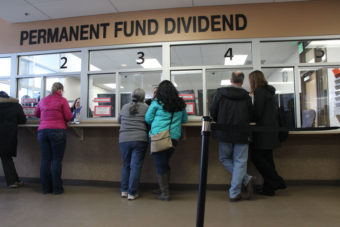
Alaskans file their Permanent Fund dividend applications in downtown Anchorage in March 2016. (Photo by Rachel Waldholz/Alaska Public Media)
A bill to restructure Permanent Fund earnings and cut fund dividends died in the House Finance Committee today.
The bill is the cornerstone of Gov. Bill Walker’s plan to bring stability to state government finances.
But six of the 11 committee members voted against sending the bill to a vote by the full House.
The bill stumbled over concerns that voters wouldn’t accept cuts if the legislature doesn’t make other changes. Republican members want to further reduce the size of government, while Democrats want to further cut tax credits to the oil and gas industry.
Anchorage Republican Lance Pruitt voted against the bill. He said he doesn’t want to spend fund earnings without ensuring they won’t fuel more government.
“That’s why people are scared about us doing this … we’re going to put our hand in the cookie jar and we’re never going to pull it out!” Pruitt said.
Dillingham majority-caucus Democrat Bryce Edgmon said the state has no other options for closing the $3 billion-to-$4 billion annual deficit. He urged Walker to make another attempt to build public support. Without a PFD reduction, Edgmon is concerned the state will spend all fund earnings and eliminate dividends.
“In my district, you know, I’ve got a lot of people who support this and I got a lot of people who support income taxes,” Edgmon said. “But as I look around the table here, and I talk to a lot of my colleagues, there’s other parts of the state where that support doesn’t exist. “
Committee Co-Chairman Fairbanks Republican Steve Thompson voted to advance the bill, arguing that Walker will soon call the legislature back into another special session. The current special session will end by Tuesday. But it’s not clear whether any votes will change in another session — closer to the August primary and November general election in which votes to cut dividends could be used against them.
Permanent Fund dividends would still be cut, but not as much, under a new version of a bill to restructure fund earnings.
The House Finance Committee introduced a new version of Senate Bill 128 today.
Dividend checks would drop by about $500, instead of the $1,000 cut included in the Senate’s version of the bill.
After two years, the dividend would depend on the price of oil. It’s currently projected to fall to $1,000 per year. But it would rise to as much as $2,000 again if oil prices reach $130 per barrel.
Rep. Les Gara, D-Anchorage, plans to vote for the bill.
“I understand those people who have a hard time voting for this given that so much is still being paid to oil companies in corporate subsidies,” Gara said. “On the other hand, I have a fear that every one of these bills that we see in the future is just going to get worse. But a main feature is that the dividend has a chance to grow much larger than all of the prior versions of this bill.”
In addition, the new bill lessens the impact of a limit to combined state revenue from earnings and the oil and gas industry. In years with high oil revenue, more money could be spent on the state budget.
As a result of the changes, the bill would draw less money from fund earnings to reduce the state’s deficit.
Some House members say the changes make the bill worse. North Pole Republican Tammie Wilson says any cut to PFDs should be put to a referendum.
“Without a vote of the people, it’s never the right time” to cut PFDs, Wilson said. “We need to go out and we need to ask them. They need to participate in this discussion, and then we need to follow their will.”
Gov. Bill Walker has called the bill the centerpiece to his plan to make the state budget more sustainable.
It’s not clear whether the bill will have enough votes to pass the full House, and it may face a higher hurdle in the Senate.
Gov. Bill Walker talks to reporters at his temporary offices in Juneau, June 15, 2016. (Photo by Jeremy Hsieh/KTOO)
At a press conference in Juneau Wednesday, Gov. Bill Walker said he understands the position of legislators who are hearing from constituents who are opposed to cuts to Permanent Fund dividends.
“I share with them the struggle they found themselves in. I found myself in exactly the same struggle,” Walker said. “And when I looked at the options available to us, there were no other options.”
No options, he noted, other than legislation that would draw roughly $2 billion annually from Permanent Fund earnings to pay for the state government budget. This would close most of the state budget deficit, which is more than $3 billion.
Walker has been talking with House members over Senate Bill 128, which would use a portion of Permanent Fund earnings, in looking for a compromise that would meet his goal of providing a sustainable source of state funding.
But many Alaskans aren’t happy with the concept. During public testimony Tuesday, House Finance Committee members heard an earful from residents who don’t want cuts.
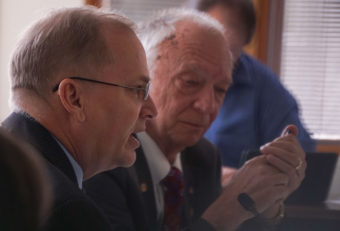
Metlakatla resident Brittany Christiansen said she doesn’t understand why she’s facing a potential $1,000 dividend cut.
“I do not want it to be taken away,” Christiansen said. “I was wondering why are they cutting people’s PFDs.”
Walker predicted lawmakers will feel even more heat from constituents if they don’t act. That’s because continued deficits would exhaust state savings and end dividends.
“(If) we don’t make any changes associated with the Permanent Fund, you know, the heartfelt comments on a reduction will be even more heartfelt and challenging if it goes to zero. And that’s what we’re trying prevent from happening,” Walker said.
A combination of Minority caucus Democrats and conservative Republicans have expressed the deepest reservations over the bill. Rep. Les Gara, D-Anchorage, said he’d like to see a bill with a smaller dividend reduction this year. He would prefer that the state first make deeper cuts to oil and gas tax credits.
“I see a devastating dividend cut and a devastating, bad plan coming out if there is no compromise,” Gara said.
The House Finance Committee may vote as soon as Thursday after members spent Wednesday huddled in small groups and one-on-one meetings discussing the bill. The legislature’s special session is scheduled to end Tuesday, but Walker suggested he would soon call them back if they don’t pass the bill.
House Finance Committee co-chairs Mark Neuman, R-Big Lake, and Steve Thompson, R-Fairbanks, in committee at the Bill Ray Center on Monday. (Photo by Jeremy Hsieh/KTOO)
Public testimony leaned against Gov. Bill Walker’s proposal to draw on Permanent Fund earnings to pay for state government.
Of more than 120 Alaskans who testified Tuesday, about 60 percent opposed the bill, which would cut dividend checks in half this year.
Opponents said lawmakers should explore other options, like deeper cuts to spending or oil and gas tax credits.
Fairbanks resident Aaron Lojewski noted an estimate by Institute for Social and Economic Research economists that a dividend cut would cost Alaskans more income in the short term than other budget options.
“You guys here, if you approve this, would be approving the most harmful way to fill the deficit,” Lojewski said. “So I strongly urge you not to.”
Others, like Nancy Hendrickson in Kenai, were more blunt.
“No, no, no, don’t take my money,” she said. “My money – I don’t want you taking it.”
But others said the bill would shore up state finances and the dividends in the long run.
Juneau resident Xochitl Lopez-Ayala said the bill may not be the solution, but is a step in the right direction.
“I support Senate Bill 128 because, being a recent homebuyer, as well as head of household, I look forward to a stable Alaskan economy,” she said.
The bill that would cut Alaskans’ Permanent Fund dividend checks in half this fall faces a tough legislative test this week. While the Senate passed its version of the bill, Senate Bill 128, the House version, House Bill 245, may not make it through the House Finance Committee. Lawmakers from both ends of the political spectrum are raising concerns with the measure.
The bill would allow the state to draw $1.7 billion from Permanent Fund earnings to pay for state government. It’s the centerpiece of Gov. Bill Walker’s plan, intended to bring fiscal stability to state government and the economy.
It would work like an endowment, with about 5 percent of the fund going toward the state budget each year.
Rep. Cathy Muñoz (R-Juneau) in her office before the start of the 2016 legislative session. (Photo by Jennifer Canfield/KTOO)
Rep. Cathy Muñoz, R-Juneau, said the bill would help the state’s economy by stabilizing government and bolstering the state’s credit rating.
“It’s very important that we sustain our services, and that we provide a reliable and predictable source of revenue for state services,” she said.
Muñoz also says the bill would protect Permanent Fund dividends. That’s because if the state doesn’t close its deficit, it would exhaust the fund earnings account that pays for dividends in roughly six years.
But it’s hard to make that case to Alaskans, who are facing a cut from what was expected to be about $2,000 this fall to $1,000 under the bill.
Many residents have been making their voices heard since the Senate passed its version of the bill on June 6, calling on House members to oppose the cut.
That’s sharpened opposition that’s coming from both conservative Republicans and minority-caucus Democrats.
Rep. Scott Kawasaki, D-Fairbanks, opposes the bill. Before reconsidering his position, Kawasaki would like to see Walker press the legislature to make deeper cuts to tax credits to North Slope oil producers.
“I have some real troubles, especially in light of the oil tax subsidy bill that passed, which is hundreds of millions of dollars,” Kawasaki said. “It’s hard for me to go back to my constituents and justify cutting their PFD, just to pay for those oil tax subsidies.”
Andy Josephson, D-Anchorage, would like to see the bill amended to lift a limit on the combined amount of revenue from fund earnings and the oil and gas industry. The limit wouldn’t adjust for inflation, which could sharply limit government spending over time.
“I’m not going to support a bill that has a spending cap that would change the way historically we’ve done business when we look at the budget each year,” Josephson said. “That is, we have an ongoing debate about the ability to fund certain programs and the need for those programs.”
But some conservative representatives oppose the bill for a different reason. They say the legislature hasn’t gone far enough to cut the size of government to justify reducing PFDs and drawing money from fund earnings.
Lynn Gattis, R-Wasilla, is among the finance committee members who oppose the bill.
“It’s not about Alaskans not willing to pay their way, but it’s more about Alaskans saying: ‘The moment we backfill it, there will not be the will to continue the necessary cuts,’” she said.
The House Finance Committee is scheduled to hold a hearing on the bill Tuesday morning, with public testimony scheduled for 5 p.m. If the bill does make it out of committee, other representatives like David Talerico, R-Healy, will have to weigh in.
Talerico said the bill presents a real dilemma.
“It’s very difficult for every legislator to think about changing the structure of the Permanent Fund,” Talerico said. “But I’m also very concerned with our credit rating as a state.”
While lawmakers are hearing from constituents opposed to the bill, Walker administration officials – as well as officials with groups that support the bill like the AFL-CIO – are also reaching out to them.
When the legislature passed the budget last week, state workers thought they were in the clear. No need for pink slips. If they hadn’t passed a budget, the state would have been required to send layoff notices to all of its employees–just like they did last year.
State workers remain in limbo until Gov. Bill Walker signs the budget. (Photo by Lisa Phu/KTOO)
There’s only one problem – the legislature hasn’t officially sent the budget to Gov. Bill Walker. And until that happens, state workers are still in limbo.
As executive director of the largest state workers union in Alaska — American Federation of State, County and Municipal Employees Local 52 — Jim Duncan is concerned that the legislature hasn’t sent the budget bill to Walker. And until that happens, Walker can’t sign it and workers can’t be 100-percent sure they’ll have jobs come July 1.
“I surely hope they’re not holding it to play a game with the governor, to put pressure on him,” Duncan said.
Duncan said the longer the legislature waits, the less time Walker will have to decide whether to sign the measure.
“The delay in transmitting the budget does cause some concern,” Duncan said. “And it could be part of the administrative process – it’s just taking time on the legislative branch. Or it could be a strategy on the part of the legislature to wait until the final moment – the final days of June.”
It’s a little-known quirk of state law that bills don’t automatically go to the governor to be signed. Either the Senate president or the speaker of the House decides when it will land on the governor’s desk.
In the case of the budget, it’s up to House Speaker and Nikiski Republican Mike Chenault. He said there’s no particular reason why the bill hasn’t been transmitted. But he said state workers shouldn’t be worried.
“We haven’t got around to it yet,” Chenault said. “There’s no foul play expected. There’s nothing sinister going on. It’s just part of the legislative process. It just hasn’t been a big priority. We’ve been working on oil tax legislation and other things. And, you know, the employees won’t get laid off tomorrow if the budget doesn’t get sent to the governor tomorrow, so there’s no concerns there.”
A spokesperson for Walker reiterated that the legislature passed a fully funded budget and pink slips won’t go out to state workers, but didn’t directly address the delay.
Close
Update notification options
Subscribe to notifications
Subscribe
Get notifications about news related to the topics you care about. You can unsubscribe anytime.