State Government Reporter, Alaska Public Media & KTOO
State government plays an outsized role in the life of Alaskans. As the state continues to go through the painful process of deciding what its priorities are, I bring Alaskans to the scene of a government in transition.
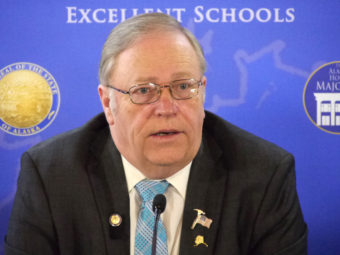
Rep. Mike Chenault, R-Nikiski, at a House Majority press availability in February. (Photo by Skip Gray/360 North)
Whether the legislature will take action in the special session remains uncertain. The House is divided over whether or not to try to overturn Gov. Bill Walker’s vetoes of Permanent Fund dividend money or other budget items. And it’s not clear whether there’s enough votes to pass any of the bills Walker called them into the session to consider.
House Speaker Mike Chenault, R-Nikiski, said he and his colleagues are asking different questions about what the House can actually do.
“Is there some way – any way – that we can go forward with any of the legislation that the governor’s proposed?” Chenault said. “Or are we just continuing to spin our wheels and just spend more state money on a futile effort?”
Walker has proposed six bills, most related to possible new taxes. One would restructure Permanent Fund earnings to pay for state government on a more sustainable basis.
The newest addition is a bill aimed at removing potential obstacles to prosecuting sex trafficking that advocates say resulted from a new criminal justice reform law.
The House is scheduled to hold another floor session Wednesday as it seeks a way to move forward.
Alaskans are already starting to feel the effects of state budget cuts, from shorter court hours to last minute local budget negotiations.
For example, Friday afternoons used to be busy times for court-appointed advocates for children, since courts tried to resolve issues ahead of the weekend. But not anymore. Starting July 1, state courts began closing on Fridays at noon to save money.
Margie McWilliams works in Juneau as a guardian ad litem — or advocate — and is concerned.
“It impacts the children I advocate for, just because they’re children, and it slows down the resolution of issues in their cases,” she said. “So, from my perspective, it’s really making a difficult problem even worse.”
McWilliams’ clients are among those impacted by the more than $800 million in cuts to the state operating budget. But they aren’t the only ones.
Department of Corrections employees and inmates will be reshuffled when one of the facilities closes.
Drivers could be in for rough times when some Department of Transportation maintenance stations are shuttered, delaying repairs and causing roads to deteriorate faster. Live near a low-traffic road? Those might be impassable for several days if there are back-to-back snow storms.
And Gov. Bill Walker’s vetoes reduced the Child Support Services Division by a half million dollars, so the division will close its Juneau and Wasilla field offices.
State fiscal policy analyst Brian Fechter said this is similar to other cuts that reduce the number of staff positions and thus government’s availability to provide services.
“A lot of it just goes back to longer lines and greater backlogs,” Fechter said. “For instance, the Child Support Services veto – that’s less capacity in their Division – potentially, longer wait times for any services they provide to people.”
On the bright side, the budget cuts aren’t expected to lead to many pink slips for state workers. While state officials project that the budget will lead to 309 fewer positions, Fechter said the number of layoffs will be much lower.
“It’s our philosophy to avoid a pink-slip layoff wherever possible,” Fechter said.
Instead, the Walker administration will aim to leave vacant positions unfilled and give those workers whose positions are eliminated enough notice for them to find new jobs.

But that’s just state government jobs. The cuts will also ripple through Alaska’s economy. A study by the University of Alaska Anchorage’s Institute of Social and Economic Research said $235 million in cuts to state agency budgets could cost – directly and indirectly — more than 2,000 jobs statewide. Add in Walker’s veto of half the money for the Permanent Fund Dividend, and more than 4,000 jobs could be lost.
But economist Gunnar Knapp, the study author, said pointing out the negative consequences of the dividend reductions and budget cuts isn’t enough. Knapp said critics of the cuts must consider the alternatives.
The question is not, ‘What don’t you like?’” Knapp said. “The question is, ‘Well, what would you do?’ And that is the discussion we’re eventually going to have to get to.”
That’s the discussion the legislature is supposed to have during the newest special session this month. They may consider new tax packages and other ways to pay for state government. But in the meantime, local governments are scrambling to figure out their own unexpected budget gaps caused by the state budget cuts.
Matanuska-Susitna Borough Mayor Vern Halter said the loss of more than $5 million in state school debt reimbursement will be a challenge to make up.
“I am totally disappointed in Juneau, period,” Halter said. “They cannot seem to do their business in a good fashion. And then pass it on to municipalities and boroughs, is what they’re doing.”
Mat-Su isn’t the only borough struggling with this question. Communities across the state are trying to figure out how to cover the $30 million in school debt reimbursement they no longer have covered.
Alaska Public Media’s Ellen Lockyer contributed to this report.
A small group rallies in Capitol Park asking legislators to pass a long-term fiscal plan. (Photo by Mary Uyanik/360 North)
Legislators returned to Juneau on Monday for the fifth special session since last summer. And lawmakers were greeted by a group of 20 protesters who want them to close the state’s budget shortfall.
The protesters chanted: “Act now! Pass a fiscal plan!”
But it’s not clear if there are enough votes in the House to pass a bill to restructure Permanent Fund earnings to pay for state government. Several proposals to raise taxes on industries or introduce a new state income or sales tax may have even less support.
Sen. Mia Costello, R-Anchorage, and Lesil McGuire, R-Anchorage, chat after the Senate’s opening special session floor session Monday. (Photo by Rashah McChesney/KTOO)
The legislature also may not be able to muster the three-quarter majority needed to overturn Gov. Bill Walker’s veto of half of this year’s Permanent Fund dividend money. The veto essentially cuts dividends in half.
Walker said the House should follow in the steps of the Senate and pass the Permanent Fund legislation. He noted that he’s taken the unpopular steps of cutting PFDs and delaying oil and gas tax credits.
“As a result of that, I expect them to come back and finish up what I would call the lighter lifting associated with fixing Alaska’s fiscal situation,” Walker said.
The House took a long break Monday afternoon, as members of the Republican-led majority met to decide their next step. The Senate is scheduled to meet again Friday.
Mary Uyanik of 360 North contributed to this report.
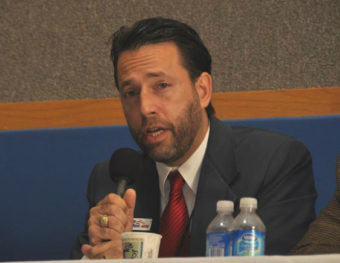
Joe Miller backs the effort. He was the runner-up in the 2010 U.S. Senate campaign and 2014 Senate Republican primary.
In explaining why he supports ousting the governor, Miller cited Walker’s veto of half of Permanent Fund dividend funding.
“Cutting the people’s money before really much substance in anything else; the fact he misrepresented what he was going to do when he ran for office; you know, basically his devotion to basically the crony capitalist interests as opposed to the people’s interests, I think, fall squarely within the recall parameters,” Miller said.
State law provides for four grounds for recall: lack of fitness, incompetence, neglect of duties or corruption.
The recall application must have nearly 29,000 signatures to start the formal recall petition process. The petition then must gather roughly 70,000 signatures in 180 days before the recall would be placed on the ballot.
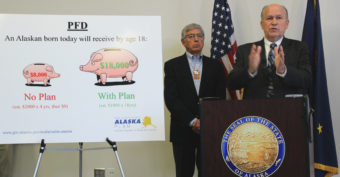
For his part, Walker said in an emailed statement that he respects the recall organizers’ right to voice their objections to his budget vetoes. But it doesn’t sway his decision on how to address the state’s fiscal challenges. He added that the Permanent Fund dividend will go to zero in four years without significant changes.
There have only been two successful recalls of governors in U.S. history: North Dakota Gov. Lynn Frazier in 1921 and California Gov. Gray Davis in 2003, when Arnold Schwarzenegger replaced Davis.
Correction: Joe Miller was misquoted in an earlier version of this story. He said “crony capitalist interests” not “crony capitalist centrists.”
Legislators from both parties criticized Walker’s actions.
Fairbanks Republican Rep. Steve Thompson said delaying road construction work will cost a lot of jobs.
Anchorage Democratic Sen. Bill Wielechowski said he’d like to see the legislature override the PFD decision. Three-quarters of the 60 legislators must agree to successfully override any of the vetoes.
“The real losers today are working Alaskans, who are really going to suffer,” Wielechowski said. “A family of four is going to lose over $4,000 from this action. And I think there are better ways to do it. I’m surprised the governor took this action and I’m going to encourage fellow legislators to override this veto. ”
Nikiski Republican House Speaker Mike Chenault said it’s not clear whether there will be enough votes for override Walker’s vetoes in the special legislative session beginning July 11.
“It might have been nicer if early on, at the beginning of session, he would have came in with a smaller budget than what they originally proposed, so, you know, we’ll look at it, determine what’s the right thing to do and try to accomplish that,” Chenault said.
Rachel Waldholz of Alaska’s Energy Desk contributed to this report.
Original story | 1:39 p.m.
Gov. Bill Walker announces line-item budget vetoes at the Atwood Building in Anchorage on Wednesday. Lt. Gov. Byron Mallott is also pictured. (Photo by Rachel Waldholz/Alaska’s Energy Desk)
Gov. Bill Walker cut Permanent Fund dividends Wednesday to $1,000 per person, about half the projected amount. The cut was one of a series of reductions that Walker made to lower the state’s budget by $1.5 billion.
Walker said he made the changes to reduce the amount of savings the state must spend to cover the budget. And he said he cut dividends to preserve PFDs into the future. The state is on track to exhaust its savings in four years without cuts.
He said he’ll take the blame for reducing dividends. He expressed hope that this will make it easier for lawmakers to approve his long-term fiscal plan for state government.
“What I’ve tried to do is take away from them the risk that they may suffer … at the polls, so that’s off the table,” Walker said. “And any excuses now – it’s just pure politics.”
Walker vetoed $1.29 billion from the budget. The cuts include a $58 million reduction to schools, including shifting $30 million in bond reimbursement to local schools. The state will delay $430 million in oil and gas tax credits into future years. The University of Alaska will see a $10 million cut.
In addition to the vetoes, Walker delayed $250 million in road and bridge repairs. And he shut down two megaprojects: the Knik Arm bridge and the Susitna-Watana dam.
Walker said the state can’t balance its budget only through cuts.
“We’re not cutting our way into prosperity,” he said. “We’re using the only tools we have available to us to do all we can to reduce the deficit.”
Walker signed the operating, mental health and capital budgets for the fiscal year that starts Friday. He also signed a bill that will restructure oil and gas tax credits, but not by as much as he wanted.
Jahna Lindemuth was named Alaska’s attorney general by Gov. Bill Walker. (Photo by Graelyn Brashear/Alaska Public Media)
Gov. Bill Walker announced Tuesday that Jahna Lindemuth will be Alaska’s next attorney general.
She replaces Craig Richards, who resigned abruptly last week.
Walker has announced four new cabinet members since mid-April. The vacancies began in February, when the education and natural resources commissioners resigned.
Walker praised Lindemuth’s professional success. He also pointed to her commitment to the state as a lifelong Alaskan, and as someone who’s done pro-bono work with the law firm Dorsey & Whitney on cases like the Fairbanks Four. That was the case of three Alaska Native men and a fourth Native American man who were convicted in a 1997 murder and were released last year after a judge vacated their convictions.
“Her passion for Alaska is really what I was struck by,” Walker said.
Lindemuth, an Anchorage resident, said her work on the Fairbanks Four case is among the most meaningful she’s done in her life. She also says she’s committed to justice for all Alaskans and it’s important to keep in mind that there are real people affected by every legal decision.
“I really am truly honored to be a part of that case,” she said. “I truly believe in the innocence of those four men and I’m really happy that they’re out of prison now and enjoying life like the rest of us.”
Walker considered Lindemuth for the Supreme Court seat that he named Susan Carney to in May. Lindemuth has represented Cook Inlet Region Inc., Arctic Slope Regional Corp. and ConocoPhillips Alaska.
Lindemuth stayed away from saying what her priorities would be as attorney general. She said it’s too soon – Walker only contacted her about the job late last week, after Richards resigned.
Gov. Bill Walker speaks, with Jahna Lindemuth, Andy Mack, Michael Johnson and Walt Monegan behind him.(Photo by Graelyn Brashear/Alaska Public Media)
Walker also introduced three other cabinet members who he’d previously announced: Natural Resources Commissioner Andy Mack, Public Safety Commissioner Walt Monegan, and Education Commissioner Michael Johnson.
Mack comes from private equity fund PT Capital. Monegan is a former public safety commissioner and was most recently the acting corrections commissioner. And Johnson served as Copper River School District superintendent in Glennallen.
Mack said the state should be playing offense in making plans for projects like the proposed natural gas line.
Alaska Public Media’s Graelyn Brashear contributed to this report.
Close
Update notification options
Subscribe to notifications
Subscribe
Get notifications about news related to the topics you care about. You can unsubscribe anytime.