
Andrew Kitchenman

State Government Reporter, Alaska Public Media & KTOO

State government plays an outsized role in the life of Alaskans. As the state continues to go through the painful process of deciding what its priorities are, I bring Alaskans to the scene of a government in transition.

Legislative openings entice big spending on primaries

Cash Money
Three races for open seats have drawn a quarter of all spending by state legislative candidates ahead of the primary election Tuesday. (Creative Commons image by Moritz Wickendorf)

State legislators who aren’t running for re-election have created openings drawing big spending ahead of the primary election Tuesday.

A quarter of all spending by legislative candidates has been in just three races for open seats, but it isn’t clear whether those who’ve spent the most will be able to convert that into votes.

Source: Alaska Public Offices Commission, as of Aug. 10, 2016. (Illustration by Lakeidra Chavis/ KTOO)

The races to replace Anchorage Republican Lesil McGuire and Democrat Johnny Ellis in the Senate have drawn the most spending this year.

Republicans Natasha Von Imhof, Rep. Craig Johnson and Jeff Landfield are running to replace McGuire. Von Imhof has spent more than any other candidate this year, $131,000.

Von Imhof has been able to draw financial support from many individual donors, she said.

She attributes that to both her positions on putting state spending on a sustainable footing and the contact she’s had with many Alaskans through her work on the Rasmuson Foundation board and through commercial lending.

“I’ve visited many of the industries that fuel our state’s economy, including visiting mines,” Von Imhof said. “I’ve been on oil rigs, I have been on cruise ships, fishing vessels. I’ve seen the timber industry at work.”

Through Tuesday, her campaign spent twice as much as Johnson, $37,000, and Landfield, $29,000, combined.

While Johnson said spending is always a concern, he feels good, based on face-to-face contact with constituents.

“As I go door to door, I haven’t seen the negatives, and quite frankly, I haven’t seen $130,000 worth of spending out of Natasha,” Johnson said. “I mean, we’ve got a week left, and I don’t know where she spent her money.”

Johnson added that there will still be plenty of spending in the next week, so the snapshot of spending through Tuesday is incomplete.

Landfield is spending his money more efficiently than the other two candidates, he said.

“I have my Make Alaska Great Again hats, which are kind of a Trump parody gimmick – and people love those,” Landfield said. “And I got these really unique signs up in Anchorage that are really different.  I mean, everything about my campaign is different. So I can spend a dollar and, for Craig or Natasha – especially Natasha – they have to spend probably $5.”

The second most expensive race is between Democrats Tom Begich and Ed Wesley, to replace Sen. Johnny Ellis.

Begich said his many years of community involvement led to individuals contributing to his campaign.

“Many of those are folks that have not given at all in the past and have worked with me, whether it’s neighborhood work, or whether it’s some justice work I’ve done, or just general work I’ve done in communities in the past,” Begich said.

Wesley is concerned about the amount of spending in the primary. He’s spent the seventh-most of any statehouse candidate, but only a little more than half of his opponent. He said he’s turned down money from labor unions and other groups.

“Special interest money has created fear and greed in the legislature, and has an undue influence on our legislature,” Wesley said.

The Republican primary race to replace Anchorage Rep. Mike Hawker is the fourth most expensive race. That race pits Ross Bieling against Jennifer Johnston.

Other expensive primary races have major implications for the future of state finances. The third-most expensive race is the Republican primary between Representative Jim Colver and challenger George Rauscher, both of Palmer.

The Colver-Rauscher race has been at the center of more than a third of all independent expenditures in favor or opposing candidates this year. It’s fueled by labor unions and corporations. When independent expenditures are added to campaign spending, the challenger Rauscher has benefitted more than the incumbent Colver.

Overall campaign spending on legislative races is up slightly from the same point in the last election, when the race for governor was at the top of the ballot.

Public workers receive similar compensation to those in private sector

State and local government workers receive similar compensation to priv-ate-sector workers, according to an Institute of Social and Economic Research report. State Office Building. Aug. 5, 2016.(Photo by Andrew Kitchenman/KTOO)
State and local government workers receive similar compensation to private-sector workers, according to an Institute of Social and Economic Research report. (Photo by Andrew Kitchenman/KTOO)

State and local employees in Alaska are paid less than private-sector workers, but benefits make up the difference, according to a new study from the University of Alaska Anchorage’s Institute of Social and Economic Research.

Public workers earned 8 percent less than those in the private sector, but total compensation was about the same, since public employees have better benefits.
Mouhcine Guettabi, an economics assistant professor, was an author of the study.

“This notion that public-sector employees are either over- or undercompensated, broadly speaking, really doesn’t hold, because – depending on which occupation you look at – you find different findings,” Guettabi said.

Higher-income workers in the public sector received less total compensation than similar private-sector workers. Lower-paid public workers had more compensation than those who worked for private employers, because they had better benefits.

Legislators proposed a bill, HB379, this year that would have stopped the pay increases that state workers receive every year or two based on experience and performance evaluations.

While the legislature didn’t pass the bill, it may be introduced again next year.

Putting downward pressure on state workers’ pay could make it more difficult to recruit and retain them, depending on the job, Guettabi said.

“It does give us a window into how difficult it is to implement freezes across the board that may affect certain types of recruitment a lot more than others,” he said.

The study was based on U.S. Census data from 2009 to 2013.

Since then, Alaska’s economy has been hurt by a downturn in oil prices. But Guettabi said that if the public sector gained an advantage since then, it could lose it during the next upturn.

“In six months, if the situation in Alaska improves dramatically, the private sector can restore benefits, can improve compensation,” he said. “The public sector tends to be a lot slower in doing so.”

A separate part of the study found that when private-sector workers move into government jobs, they receive similar compensation.

The study didn’t look at non-resident, federal, nonprofit or self-employed workers.

An Institute of Social and Economic Research report found public and private-sector workers receive similar pay. (ISER graphic)

Ahead of primary, House ‘Musk Ox’ incumbents counter bipartisan chatter

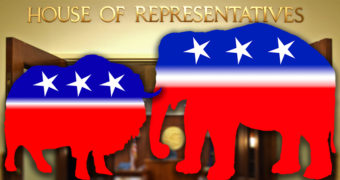
(Illustration by Jeremy Hsieh/KTOO with modified Creative Commons images by Ronald Woan and Wellcome Images and background photo by Skip Gray/360 North)

Republican primary challengers in some races for seats in the Alaska House of Representatives fear that Republican control is threatened by members of their own party.

It’s important for majority-caucus Republicans to maintain party discipline, the challengers said, but some lawmakers said focusing on constituents’ needs can conflict with the party line.
There are two groups talking about the possibility of a bipartisan coalition: primary challengers who don’t want it to happen and Democrats who do.

The one group that isn’t raising the idea is the so-called “Musk Ox Caucus,” a group of six Republicans and Democrats who opposed using Permanent Fund earnings to pay for the budget last year, and advocated for cutting oil and gas tax credits this year.

Two Musk Ox incumbents are facing Republican primary challengers. George Rauscher of Palmer is challenging Rep. Jim Colver. Homer Mayor Beth Wythe is challenging Rep. Paul Seaton.

Both challengers say they’re concerned about incumbents switching from the Republican-led House majority to a bipartisan coalition.

Republicans haven’t been able to count on Seaton to support party-backed positions, Wythe said.

“I am concerned that if a person is running under a party affiliation, they should at least represent the values of the party they’re aligned with,” she said.

Another candidate opposing Seaton, John Cox of Homer, also opposes having a bipartisan coalition, although he said he isn’t focusing on the issue.

“A bipartisan coalition of course would wind up wanting to implement taxes – that’s not what we need,” Cox said. “We need tax cuts.”

It’s way too soon to talk about a bipartisan coalition, Seaton said. He hasn’t been in any discussions to form one.

Lawmakers should put their constituents’ interests first, he said. But he also noted that he usually votes with his party. He voted the same way as House Speaker Mike Chenault on all but four of 115 bills that passed the past two years, he said.

“You have to take an independent review of each of the bills that you have before you and make a decision based on … what the constitution is, and what your basic philosophy is and what … your constituents tell you,” Seaton said.

The House majority currently has 22 Republicans and four Democrats, while the minority has 12 Democrats and an independent.

Eagle River Republican Rep. Lora Reinbold doesn’t belong to either caucus.

While Colver may not always vote with party leadership, he said he wants to stay in the Republican-led caucus.

“I have no plans and, no, I’m not going to join a bipartisan coalition,” Colver said.

Colver first described the group of lawmakers as Musk Ox last year, when he and five others opposed a move by majority caucus leaders to use Permanent Fund earnings to pay for the budget, without negotiating a budget with the minority caucus.

The nickname refers to how the animals form a circle for protection, and Colver said they were protecting the Permanent Fund. They gathered again this year to seek cuts to oil and gas tax credits.

Colver said corporations are behind accusations of disloyalty. The Accountability Project is an Alaska group that’s putting money into efforts to defeat Colver and Seaton. The Alaska Dispatch News reported that the Accountability Project is funded by the Washington, D.C.,-based Republican State Leadership Committee, which receives donations from corporations.

“The accusation that I’m going to organize with anyone other than the House Republican majority — that’s just a false and misleading cover-up for this mischief to bring in this tons of corporate cash from Outside,” Colver said.

Colver opponent Rauscher and many other Republicans are concerned about a bipartisan coalition. If one formed, then it would have a small majority and would likely be ineffective, he said.

“It could be an obstructionist coalition, more than it would help,” Rauscher said.

One of the Accountability Project-funded groups is named Conservatives for George Rauscher. Rauscher said that while he knows leaders of the group, he isn’t coordinating his campaign with it.

Talk about a bipartisan coalition isn’t confined to races with incumbents.

Republican Rep. Shelley Hughes of Palmer is leaving her seat to run for Senate. One of her possible successors, Richard Best, said he’s concerned his opponent, Palmer Mayor DeLena Johnson, would join a bipartisan coalition.

“I actually have great fears of that,” he said. “I’ve been on Palmer City Council for 11 years and six of those have been with my opponent, and to nail down a position sometimes is kind of difficult.”

Johnson plans to join a Republican-led majority, and not a bipartisan coalition, she said. She added that she often can’t figure out where Best stands.

“To me, it’s just obvious what I would be doing,” she said. “I’d be working for my constituents. I’m a Republican. They’re going to elect me as a Republican, and I’ll work with the Republican leadership to, you know, to try to solve the problems that we have before us.”

Legislative caucuses won’t formally organize themselves until after the Nov. 8 general election.

The primary elections are Aug. 16.

Democratic leaders seek bipartisan coalition in backing challengers

State Democratic Party officials are backing challengers to two Democrats who caucus with the Republican-led House majority. The challengers and party officials say this will increase the chances for a bipartisan coalition.

There’s a long history of rural legislators joining majority caucuses, regardless of the party. In the House, four Democrats from northern and Western Alaska have joined the Republican caucus since 2009.

This year, Benjamin Nageak of Barrow and Bob Herron of Bethel are facing challengers backed by other Democratic House members and state party officials.

Casey Steinau
Democratic Party Chairwoman Casey Steinau (Photo courtesy Alaska Democratic Party)

Party Chairwoman Casey Steinau said electing Dean Westlake of Kotzebue, who’s challenging Nageak, and Herron’s challenger Zach Fansler of Bethel would increase the chance of a bipartisan coalition in the House.

“That’s how things get done and how we work together,” Steinau said. “Being who you are, but still, reaching across the aisle and doing it as a group, as the coalitions do in Juneau. I think that the bipartisan coalition that was there for years was very effective in getting legislation passed, and I’d like to see that happen again.”

While both legislative majorities have members from both parties, they generally don’t describe themselves as bipartisan coalitions, and only include rural Democrats.

The Senate was led by a bipartisan coalition that included substantial numbers of both Democrats and Republicans from 2007 to 2012.

Gov. Bill Walker has been unable to get most of his fiscal plan through the Legislature, despite support from some minority-caucus Democrats and moderate Republicans. Now Democratic leaders want to grow this grouping into a majority. A fundraiser for Westlake and Fansler on Monday in Anchorage will be co-hosted by former U.S. Sen. Mark Begich, as well as nine House members, among others.

Westlake said the public sees the Legislature acting in an increasingly partisan way, and this hasn’t benefited rural voters.

At one time, the Bush Caucus was strongest, and probably the best thing for Alaska. The caucus wasn’t split on party lines, instead Alaskans took the party mantle off, and working together for the betterment of state as a whole.

But Nageak sees the work he’s done as co-chairman of the House Resources Committee as being in the tradition of powerful rural legislators of the past, such as Al Adams.

“I think what they’re trying to do is minimize what we  – the Bush Caucus – are doing with the majority,” Nageak said.

Nageak said an oil and gas tax bill, House Bill 247, that he supported was scrutinized more than any other bill in recent years. And he said it will benefit the residents he represents. This is the second straight election in which Westlake is challenging Nageak. Nageak won in 2014 by 131 votes of more than 2,000 cast.

Herron said Democratic leaders have focused on the times when he voted with the majority, rather than the issues where he opposed the Republican leadership. He cited his bucking the majority on the last major overhaul of oil and gas taxes in 2013, and his opposition to ending the last special session after a week.

But Herron said rural legislators have served their constituents well by staying in the majority. He said this year is the first time he’s aware of that any party is backing primary opponents to incumbents who followed this tradition.

“Urban Democrats want this guy (Fansler) to win so that they can take care of their constituents – and he’s helping them,” Fansler said. “That’s where I have an issue with this whole thing.”

But Democratic Chairwoman Steinau said the official party organization plan since at least 2014 has said the party won’t support legislators who don’t caucus with the party.

And Fansler said Herron has continued to support the majority caucus at a time when rural Alaska isn’t benefiting from the policies it’s pursuing.

“If you look at the incumbent’s voting record, it’s pretty much lockstep with what the majority kind of votes and, you know, I personally think the agenda that they’re pushing is not an agenda that’s helpful to my district,” Fansler said.

The possibility of a new bipartisan coalition in the House may become clearer on the primary day, Aug. 16.


Bill giving control to schools boards over sex education becomes law

A bill that puts local school boards in charge sex education will become a law, after Gov. Bill Walker decided against vetoing it Thursday.  House Bill 156 requires that school boards approve any sex education curriculum, as well as any teachers who aren’t employed under a contract with schools.

The bill also allows parents to opt their children out of any lesson. It also gives parents the right to review sex education curriculum and teachers’ credentials. And it bars the state from requiring school districts to administer standardized tests for two years, unless the federal government threatens to withhold money.
Walker said in a prepared statement that his decision was a close call.

Alaska has the highest level of state spending, but that’s not the whole story

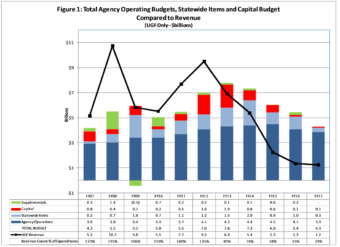
This chart shows state spending and revenue over the past 11 years. It was prepared by the Alaska Division of Legislative Finance.

One of the issues dividing Alaska’s legislators is the level of state spending. Some lawmakers want to continue to cut spending before considering introducing or raising taxes, or making long-term cuts to  Permanent Fund dividends. Others are concerned about the loss of services and the effect on the state’s economy from deeper cuts.

Some House members said the spending level is too high, before they ended an abbreviated special session in mid-July. Their comments ranged from Anchorage Eagle River Republican Rep. Lora Reinbold, who said, “The biggest threat to the Permanent Fund and to the dividend is big government,” to Wasilla Republican Rep. Wes Keller, who said, “Alaska has a spending problem. We have a huge spending problem.”

There’s some evidence to back up assertions that Alaska has a high level of spending. As recently as 2013, Alaska spent 38 percent more per resident than any other state on combined state and local spending, according to the nonprofit Tax Policy Center.

In just state spending, Alaska spent more than twice as much per resident in 2014 than all but 11 other states.

In three broad categories, education, higher education and corrections, Alaska spent the most per resident. It also was second in public assistance (after Massachusetts) and transportation (after North Dakota). And it was seventh in Medicaid spending.

But focusing on state spending doesn’t tell the whole story. That’s because many states require local government to provide services that Alaska’s state government provides.

Demographics and policy choices also play a role, according to Brian Sigritz, director of state fiscal studies for the National Association of State Budget Officers in Washington.

“Overall, there’s definitely a lot of variations in what states spend money on, and how much state support goes to various different areas of the state budget.”

And things have changed dramatically in the past four years. The portion of the state budget controlled by the legislature has dropped by 45 percent, while the amount spent on state agencies has fallen by 10 percent. These drops were even more dramatic if you account for population growth and inflation.

But even with these changes, the amount of proposed state spending directly controlled by the Alaska Legislature was projected to be nearly 25 percent more per person than any other state in the current fiscal year, based on data compiled by the National Association of State Budget Officers and census population estimates.

There are also factors unique to Alaska. That’s what Walker pointed to when asked why state spending was the highest per capita.

“It’s not very complicated as far as on a per-capita basis, we’re the largest state in the union – one-fifth of the entire United States and we have … one of the smallest populations,” Walker said. “We’re spread all over the state and so … on a per-capita basis, Rhode Island versus Alaska, you’re going to see a significant difference.”

Economist Gunnar Knapp, who recently stepped down as director of the University of Alaska Anchorage’s Institute for Social and Economic Research, said the state’s large amount of natural resources, unusually high healthcare costs, and  the challenge of providing services to isolated, low-income communities contribute to higher spending.

“It’s not a simple question to say: ‘Oh, because we spend more than other states, we must be wasteful,’ ” Knapp said.

But Knapp also said  the oil and gas revenue that used to flow into the state’s coffers – and that bounced back after previous recessions – is staying low. This puts Alaska’s government in a new position – being forced to decide whether residents will accept lower spending in areas like education or lower PFDs or higher taxes.

“Really, for the first time since oil started flowing, we’re going to face that question in a big way, where we’re going to realize that we’re going to have to make hard choices,” Knapp said.

The primary election in three weeks, and the general election in November, may provide a signal from voters about what they want the legislature to do.

Site notifications
Update notification options
Subscribe to notifications