State Government Reporter, Alaska Public Media & KTOO
State government plays an outsized role in the life of Alaskans. As the state continues to go through the painful process of deciding what its priorities are, I bring Alaskans to the scene of a government in transition.
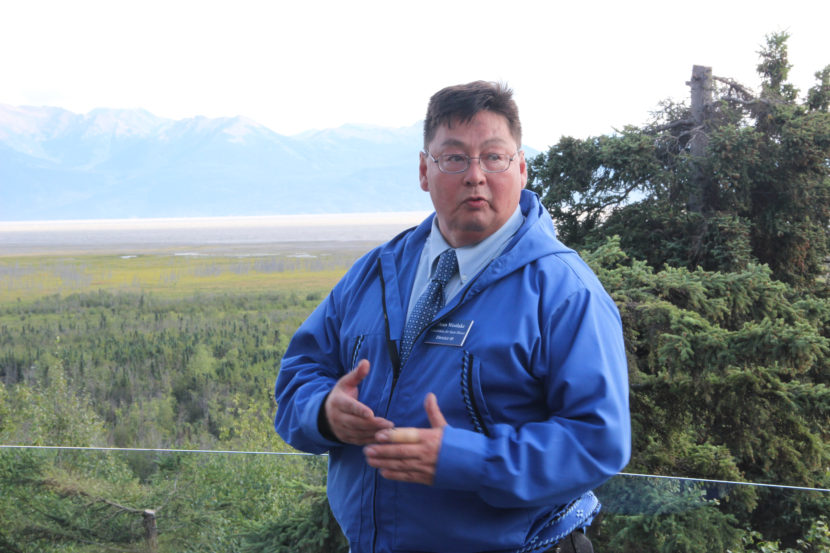
Dean Westlake has a four-vote lead over Rep. Benjamin Nageak. (Photo by Rachel Waldholz/Alaska’s Energy Desk)
The Democratic primary results for the District 40 House seat grew closer Tuesday.
Dean Westlake remains ahead of incumbent state Rep. Benjamin Nageak, but Westlake’s lead was cut to four votes, from 21. The district includes North Slope and Northwest Arctic boroughs, as well as nearby precincts in the the Unorganized Borough.
The state election review board certified the results in Juneau, adding absentee ballots and adjusting other returns. Nageak picked up 17 votes, while Westlake’s total didn’t change. Westlake leads, 819 votes to 815.
Nageak or 10 qualified voters have five days to ask for a recount. The state pays for any recounts in elections where the margin is 20 or fewer votes.
Nageak has caucused with House Republicans. Alaska Republican Party Chairman Tuckerman Babcock criticized the Division of Elections for certifying the results. He cited irregularities in how the election was conducted in some precincts.
“It’s an absurdity that the review board or the Division of Elections director can claim that they can certify who actually won that election,” Babcock said.
But Division of Elections Director Josie Bahnke said she wanted to certify District 40 to resolve a potential recount sooner.
Nageak has hired Seattle-based lawyer Timothy McKeever to advise him. McKeever said a recount request is likely. Westlake couldn’t be reached for a comment.
Much of the concern has focused on the results in Shungnak, where voters were allowed to vote in both the Republican primary and in the primary for all other parties.
Westlake received 47 votes in Shungnak, compared with three for Nageak. Westlake lost one vote while Nageak gained one in Shungnak as a result of the election review.
Private clubs that allow people to consume marijuana in exchange for a fee are illegal, according to Alaska Attorney General Jahna Lindemuth.
She issued an opinion Wednesday that also said offering marijuana samples to paying patrons may violate state criminal law that bars distributing marijuana without a valid commercial license.
The state Marijuana Control Board has authorized retail marijuana stores to allow marijuana consumption on their premises.
Social clubs are like any other place of business where marijuana consumption is not allowed by law, Lindemuth said.
Department of Law spokeswoman Cori Mills reinforced the point.
“If that place is not a licensed retail marijuana store, consuming marijuana there is unlawful,” Mills said.
The ballot question that Alaskans approved in 2014 allowed the state to tax and regulate marijuana retailers. But it banned the public use of marijuana, and Lindemuth said social clubs are public places like other unlicensed businesses.
Mills said a person who operates a social club that provides marijuana samples would be violating the law if they receive a fee.
“Without a license from the Marijuana Control Board, a person may not possess more than 1 ounce of marijuana, or transfer marijuana for any sort of payment,” she said.
Lindemuth issued the opinion in response to a request from Chris Hladick, the commissioner of the Department of Commerce, Community, and Economic Development.
Clubs have either started or are planned in Anchorage, Fairbanks and Homer, but the opinion appeared to put those clubs in doubt.
One business that’s sure to be affected by the ruling is Pot Luck Events, a marijuana/cannabis club in Anchorage that’s been open for about a year and a-half, since March 2015.
In that time, the club has charged dues for access to an events space where members can use and trade cannabis.
The club has had a murky but diplomatic legal relationship with state and local officials.
Though the owners couldn’t be reached for comment, Lance Wells, Pot Luck’s attorney, said he’s still “digesting” the ruling and can’t say yet what it means for his client.
How the opinion will be enforced will be determined by local police, state troopers and the Marijuana Control Board, like other marijuana laws, Mills said.
Alaska Public Media’s Zachariah Hughes contributed to this report.
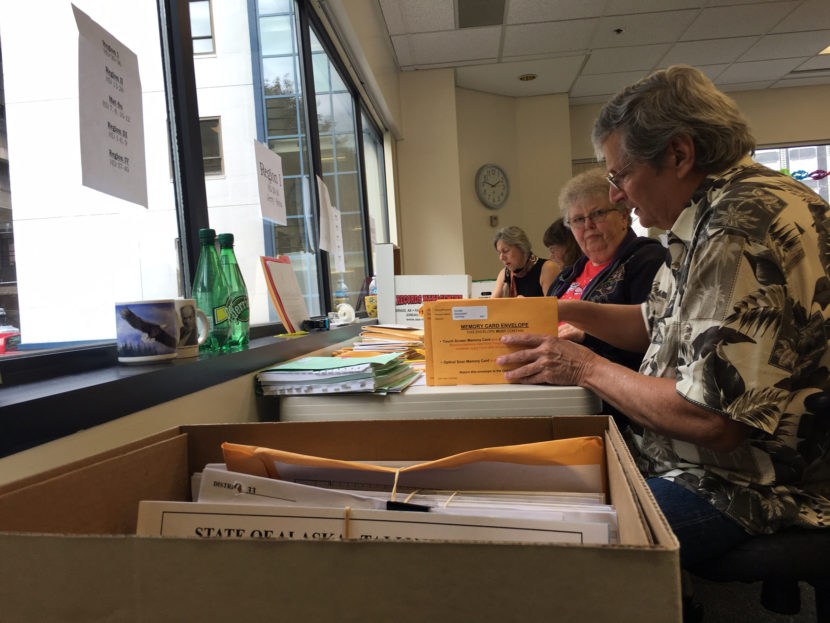
Election review board members sort through election materials at the Division of Elections office in Juneau on Tuesday. (By Andrew Kitchenman/KTOO)
The Alaska Division of Elections is still working to certify the results of the House race for the district that includes North Slope and Northwest Arctic boroughs.
Division director Josie Bahnke said on Tuesday afternoon that the division’s office in Juneau was waiting for the ballots to be mailed in from four precincts in District 40: Selawik, Browerville, Anaktuvuk Pass and Ambler.
Bahnke had said the election review board was aiming to certify the results on Monday, but that action is delayed until the division receives all of the ballots.
Bahnke still expects to certify the results by Friday.
“Right now, it’s just a matter of the mail service,” Bahnke said.
Dean Westlake leads incumbent Representative Benjamin Nageak by 21 votes, according to the last vote count.
The trailing candidate or 10 qualified voters will have five days after the review is completed to ask for a recount.
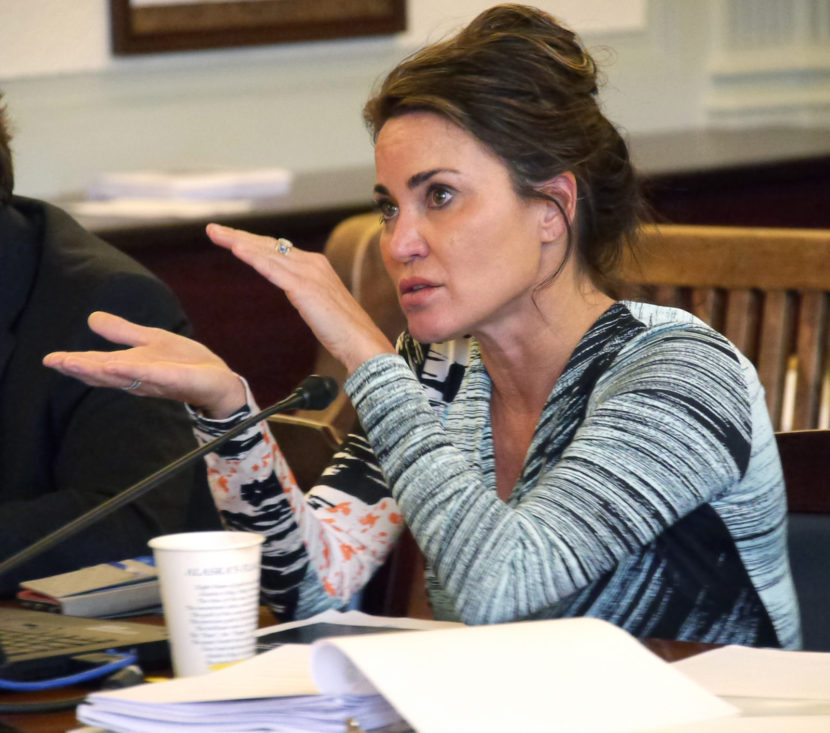
Sen. Lesil McGuire, R-Anchorage, testifies about a bill in March. She says the Division of Elections should delay certifying the results of the primary. (Photo by Skip Gray/360 North)
Legislators called on state elections officials Monday to delay certifying the results in a district that covers North Slope and Northwest Arctic boroughs. Those calls are based on concerns about how the recent primary election was handled in some precincts.
But Division of Elections director Josie Bahnke said a state election review board would certify the results for District 40 today, because of the closeness of the race there.
At a Senate State Affairs Committee meeting in Anchorage, Anchorage Republican Sen. Lesil McGuire said the Division of Elections should correspond with the U.S. Department of Justice about federal Voting Rights Act concerns.
“If this is certified and the person it is certified in favor of ultimately does not prevail in a future special election, or future audit, I think the impact on voter morale and confidence (would be) devastating,” McGuire said.
Legislators focused on three precincts:
In Shungnak in District 40, voters were allowed to vote in both the Republican primary and in the primary for all other parties, in violation of state law.
In Newtok in District 38, there was a discrepancy between the number of ballots counted and a separate tally that election officials wrote down. State officials said this was a data entry error, and didn’t affect the ballots.
And in Chefornak in District 38, a somewhat similar discrepancy occurred.
The difference between the candidates in District 38 is too large to be affected by the precincts in question.
In District 40, a recount is likely and any change could affect the outcome. Dean Westlake of Kotzebue was leading incumbent Rep. Benjamin Nageak of Barrow by 21 votes, before the certification.
The division’s core mandate is to ensure that every qualified voter has a meaningful opportunity to cast a ballot and have his or her vote count, Bahnke said.
In Shungnak, the election official didn’t attend election training.
State law doesn’t penalize those who miss training.
“We as a division, really need to do a better job educating our voters about the two-ballot system,” Bahnke said.
Some residents who attended the meeting at the Anchorage Legislative Information Office said they’re concerned about the results.
Luke Welles of Barrow said he wanted to vote in the open-ballot primary for Democrats and other non-Republicans, but election officials told him and other Republicans that they could only cast a questioned ballot in the open-ballot primary.
“It seemed as if the Republicans were being – the focus was on not letting them vote the open ballot in this situation,” Welles said.
Senate President Kevin Meyer, an Anchorage Republican, questioned whether it’s appropriate to certify the results.
“How do you certify an election that was not legal?” Meyer asked.
Alpheus Bullard, a lawyer for the legislature, said that if a challenge to the District 40 election results occurs, it’s not clear what the outcome would be.
“It’s a violation of our statutes and what ballots need to be provided,” Bullard said. ” I don’t know whether the necessary bias is there, or what a court would find. This is not a situation the specifics of which have been addressed by an Alaska court before.”
The defeated candidate or 10 local residents can request a recount within five days of the completion of the state review. It’s not clear what day the review will be finalized.
As of late Monday afternoon, the review committee was still meeting.
Correction: An earlier version of this story misspelled Luke Welles’ name. The current version of this story corrects the error.
The seiner Jaime Marie sails past other fishing vessels at City Pier 2 in Kodiak on June 6, 2013. (Creative Commons photo by James Brooks)
The Commercial Fisheries Entry Commission will keep most of its functions for now, after commission supporters fought to protect it from losing certain functions to the Alaska Department of Fish and Game.
The commission controls the number of licenses in commercial fisheries to ensure their economic health and stability. An audit last year found the state could save up to $1.2 million dollars by consolidating the commission’s administrative functions in Fish and Game.
Walker said he unfortunately bypassed public engagement in an effort to find cost savings through Administrative Order 279.
Kodiak salmon fisherman Bruce Schactler said he’s pleased Walker issued a moratorium on the order.
“Well, I think it’s a great thing,” Schactler said. “It’s a very governor-like thing to do – to want to involve everybody and to acknowledge that, you know, maybe something got missed.”
An earlier Department of Fish and Game report found a backlog of applications to the commission for permits, with some cases taking more than 15 years to complete. The audit suggested that the state make the three full-time commissioners part-time positions, and hire a full-time executive director to manage daily operations.
Many commercial fishermen have praised the agency for the speed with which it handles annual permit renewals.
And Petersburg gillnetter Max Worhatch said the commissioners continue to do worthwhile work.
“I do feel strongly that CFEC is something that should be protected,” Worhatch said.
Fisherman Robert Thorstenson sued to block the administrative order. While a Superior Court judge ruled in favor of the state government in July, Walker decided he wanted more public input before moving forward.
Fish and Game Commissioner Sam Cotten said the state will engage stakeholders this fall on how to find cost savings at the CFEC.
“Some things are probably going to be pretty easy to agree on,” Cotten said. “For example, I think, even the commissioners last year agreed that they should – could go to part-time. And so that would be a big cost saving. And then the second issue is what kind of administrative functions could we combine with the department so that we could save money and avoid duplication.”
He said the state will begin the engagement process soon.
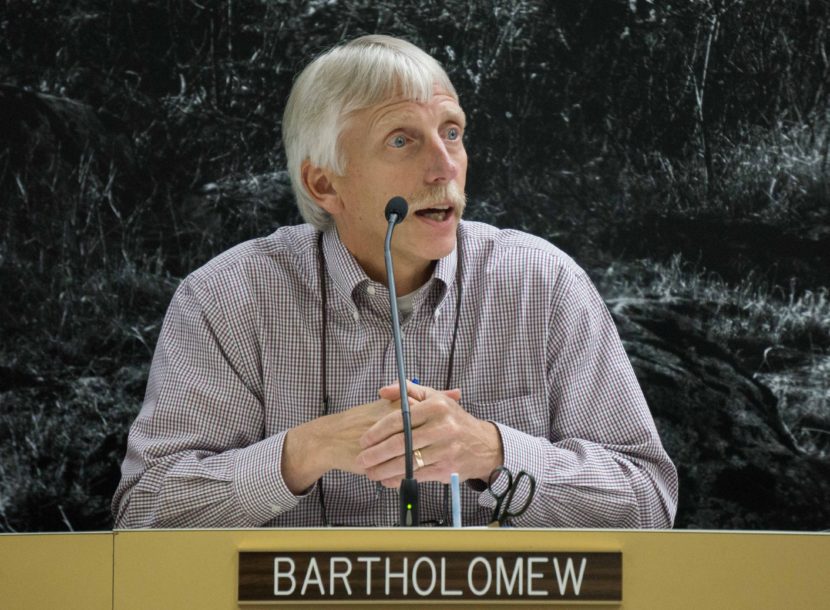
Juneau finance director Bob Bartholomew projected the city would lose $1 million in sales tax revenue from residents having lower Permanent Fund dividends. (Photo by Jeremy Hsieh/KTOO)
Local governments in Alaska that charge a sales tax could have millions of dollars less in revenue this year.
That’s because their residents will have less money to spend than the last few years because of lower Permanent Fund dividends this fall.
Some municipalities, like the City and Borough of Juneau, are preparing for the indirect hit.
Juneau finance director Bob Bartholomew projected Gov. Bill Walker’s dividend reduction of about half will cost the city.
“We had estimated that the reduction of the dividend from $2,000 per person to $1,000 per person would cost us … at the high end about a million dollars of lost sales tax revenue,” Bartholomew said.
That’s out of $44 million of total sales tax revenue that the city projected.
Juneau is one of 107 municipalities in the state that collects sales taxes. These communities raised a total of $233 million in sales tax revenue two years ago. So, if Bartholomew’s projections are applied to the entire state, then there would be $4 million to $5 million less coming in.
Bartholomew said it’s challenging to estimate how much less money residents will spend. In part, that’s because having less money to spend could lead residents’ behavior to change.
“It could have a ripple effect of just overall reduction in spending that exceeds the pure loss of dollars, just because of the overall just psychological impact on spending,” he said.
Walker has said the dividend reduction was necessary in order to shore up the state’s finances in the long run. Without the cut, Walker said PFDs could disappear entirely in two years, as the state exhausts Permanent Fund earnings.
Each municipality is handling the sales tax effect in its own way.
Kenai Peninsula Borough Mayor Mike Navarre said the borough has never analyzed how residents spend their dividends.
The borough based its projection for sales tax revenue on last year’s spending, and hasn’t made adjustments based on the veto.
“Sometimes it’s difficult to predict exactly what the impacts are going to be,” Navarre said. “In this case … we have proximity to Anchorage, so some people will buy bigger items in Anchorage because they don’t have sales tax, or because they’re going up there to shop anyway.”
Navarre has a separate concern about how the PFD cut will affect tax revenue.
The borough set its property tax due date to occur after residents receive dividend checks.
Navarre said borough officials will be keeping a close eye on whether residents will struggle to pay their taxes on time if they have less money because of lower dividends.
Other municipalities are taking a wait-and-see approach to falling sales tax revenue.
In Unalaska, city manager Dave Martinson said he has looked at the issue, but decided against lowering the city’s revenue estimates.
“We’re going to take an approach that says we will watch it as we go through the year, to determine whether or not there is something we would need to take to our council,” Martinson said.
Municipal governments were affected by other changes Walker made in his late-June vetoes.