Andrew Kitchenman

State Government Reporter, Alaska Public Media & KTOO

State government plays an outsized role in the life of Alaskans. As the state continues to go through the painful process of deciding what its priorities are, I bring Alaskans to the scene of a government in transition.
National podcaster discusses data and Alaska political climate

FiveThirtyEight podcast host Jody Avirgan discussed political data and Alaska politics. (Photo courtesy of Jody Avirgan)

National political podcast host Jody Avirgan and his wife recently visited Juneau, marking Alaska as the 50th state to which he’s traveled.

Avirgan, who hosts the FiveThirtyEight sports, culture and politics podcast called “What’s the Point,” accepted an invitation from Andrew Kitchenman, KTOO and Alaska Public Radio Network politics reporter, to discuss the Alaskan political climate on Friday, August 19.

***

Andrew Kitchenman: I’m Andrew Kitchenman, the state government and politics reporter for KTOO and the Alaska Public Radio Network, in the KTOO studio today with Jody Avirgan, who does the podcast “What’s the Point” for FiveThirtyEight, which is a sports, politics and culture —

Jody Avirgan: Yeah, it’s kind of weird mix of data journalism.

Kitchenman: — data-focused journalism site, owned by ESPN. We’re interested in Jody’s thoughts on how data is being used in politics and his thoughts on the relevance for politics here in Alaska. And “What’s the Point” addresses how data is used in politics and through that, he’s done a series of podcasts on the history of data in politics, where he’s talked to a mix of academics and journalists. So, Jody, could you tell me a little about what your podcast and what you do?

Avirgan: Sure, so I work at FiveThirtyEight, which as you said, is a data journalism site. So, the show “What’s the Point” is about how data affects our lives. Data affects almost every part of our lives. We also have an elections podcast, which I host as well. And so that’s really honed in on what’s happening in the election right now. So between those two shows, and then obviously all of the writing that happens on the site – especially by my boss Nate Silver, who a lot of people may know – we try to take a little bit more of an analytical approach to all kinds of journalism – as you mentioned, sports, culture and politics – but obviously right now,  the election.  It’s a whole thing, so we’re pretty focused on that.

Kitchenman: So through this series of podcasts you’ve done on the history of the use of data in politics, what’s been most striking to you?

Avirgan: Well, there’s two things. One is the notion of the way that data’s been used by politicians to maybe get elected for president, goes much further back than I kind of expected. I think there’s this notion out there that Obama in 2008, was this data revolution, and he had this huge data team. And certainly, that campaign made huge advances, but in reporting this out, I learned about efforts in the 1860s to get voter rolls, target voters, gather information about specific voters – and that’s the other kind of thing that really comes through for me – and I think is very relevant to this election – which is that campaigns need to be efficient and one of the ways to be efficient about who they’re going to target is through the use of data. And so that’s ultimately the goal, is, you know, there’s a lot of money in elections but not that much. And so campaigns need to use their resources efficiently and, in order to figure out, OK, who are the voters who are going to actually tip this election – and there’s a million reasons why only certain voters get a chance to tip an election — but once you’ve identified them, you know, how do you use data to identify them and then target them and get them on your side?

Kitchenman: You’ve asked some pointed questions of your guests about some potential dangers that, by such a narrow focus on these specific demographics or subsections of the electorate, that the politics or campaigns are maybe ignoring other people who aren’t engaged in the political process.

Avirgan: Yeah, I mean, we’d like to think that every voter in America matters equally, right? But the fact of the matter is, that kind of every level of our system, starting from, you know, the Electoral College, or the primary process, all the way up through the way money gets allocated and the way that swing states kind of have this outsized proportion – it just inevitably means that certain voters are more powerful than others. You know, we’re sitting here in Alaska – I don’t know that much about Alaska politics, but I do know that no one is fighting over Alaska in this presidential campaign. And that’s for, you know, a bunch of sort of baked-in reasons. And you’d like to think that a voter in Alaska matters as much as a voter in Ohio, or Florida, or North Carolina, but the fact of the matter is, it isn’t.

Kitchenman: Nate Silver has shown in the last couple presidential election cycles that polling data can be very accurate, when you use it correctly, in projecting the outcomes of elections. And maybe campaign professionals may have known that for a long time, but I think he’s really helped the general public and journalists understand that better, so there’s been a huge focus on polling. But then there’s some states where we don’t benefit from a huge amount of polling. What are your thoughts about a state like Alaska?

Avirgan: Yeah, so, we have this forecast on our site, right? You go to the forecast. You can see all the states we project, which states we think are going to go in which direction. I mean, obviously the election’s still about three months away. In some states – the Ohios, the Floridas, the North Carolinas, there’s five polls a week, going on. Right now, on our forecast, the last poll in Alaska, and the only poll that gives us any information about Alaska, was conducted in January (a second poll was conducted in June and just released). It’s just a state that is not – doesn’t have a heavy amount of polling about it. One, for the reasons that we were just discussing – that it’s not considered a swing state, and pollsters are the same way. Channelling them: ‘Why would I go to a state that doesn’t quote-unquote matter, and invest all sorts of resources to do a poll, when I would rather do a fifth poll in Ohio than a first poll in Alaska?’ And the other thing is that polling is often – good polling is often done by universities, news organizations, that a well-funded, because this stuff is expensive. And so, when you have a state that has less of a population, fewer, sort of population-density centers, fewer huge universities, you’re just going to end up with less of that infrastructure.

Kitchenman: So, if you go to this forecast, for the last couple weeks, Alaska’s been running at about a 75 percent chance that Donald Trump is going to win, under the polls-only forecast. So, considering there’s just that one poll, can you give us a sense as to what else goes into that formula?

Avirgan: Yeah, so the other stuff that goes into that is historical data, I mean, Alaska is a state that has consistently been red, and so you can make some assumptions there. But, historical data, precedent, is, like, something that has basically been thrown out the window dozens of times this election so far. So it is interesting to see what happens. And if you think about a state like Alaska, the thing that I think FiveThirtyEight will when we look at Alaska, we’ll start to think about is the role of Gary Johnson, right? Because it is an idiosyncratic state. You know this better than I do, it’s a state that has all sorts of different demographics and interest groups and someone like Gary Johnson could make a big impact in this state. Montana is another state that I think is sort of analogous to Alaska in  many way, from an electoral perspective. Montana is the state Gary Johnson did the best in, other than his home state of New Mexico in 2012. You could see that happening in Alaska this year, and then all of a sudden, I mean, if we’re talking about a Clinton landslide, a scenario in which she wins just an unprecedented number of states – including somewhere like Alaska – it’s probably because Gary Johnson is pulling like 10, 15, maybe more, percentage of the vote.

Kitchenman: Anything for this election cycle state out as particularly interesting, from a data perspective?

Avirgan: I guess there’s this big question of, like, how effective are the polls, right? Because we missed the Donald Trump phenomenon, as did almost everyone else. And that was because we were thinking in these other – you know, the polling is just one element. You use polling alongside historical data, kind of what you know about the way that parties operate, about the way that elections operate, and then you kind of make your best guest. If you had looked just at the polls, and blindly looked just at the polls, Donald Trump led in the polls from basically the day he announced all the way through the time he got the nomination in the primary. But there’s other factors that go into it that led us to be skeptical of Donald Trump. So that to me is one of the big questions of the many big and weird questions is, like, what is the state of polling, you know? Because there’s been a couple good cycles, these last few. But it’s a really hard enterprise. And especially as fewer people are answering their phones. They haven’t figured out how to do good polling online – it’s just becoming harder and harder to know how good is polling, and I think this election will kind of teach a lot of lessons towards that.

Kitchenman: It seems like at the very time the consciousness of how accurate polling has been – and maybe it went through a period that it was underplayed by the media almost that, not individual polls, the media’s always jumped on individual polls –

Avirgan: Right.

Kitchenman: But the sort of aggregation of polls that Nate Silver does and FiveThirtyEight does – it seems like at the very time that the media and the public are becoming conscious of it —  there are these new dangers  that polling can’t be done as accurately as it traditionally has been.

Avirgan: Yeah, polling is definitely a part of the conversation in a way that wasn’t the case 10 years ago and frankly I think Nate is partly responsible for that. Donald Trump loves to talk about polls – I mean, certainly, when he’s up in the primary, he talked about polls nonstop.  And now, the other interesting phenomenon is that he’s down in the polls, you’re seeing a lot of questions about polling, questioning the methodology, this talking of skewing polls and so forth. And, you know, I think that’s sort of dangerous, because when polls are done right, they’re a really good way, and empirical way, to get a sense of the electorate. And the more you undercut that, the more it just takes away the notion that we can be rational about this and really get a sense for what people are thinking.

***

In the audio version, there’s more about what brought Avirgan to Alaska, the 50th state he has  visited. And he described the experience he and his wife had getting stuck while hiking and being rescued.

Voters in one village were allowed to cast ballots in both primaries

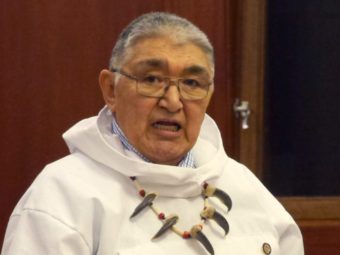
Rep. Benjamin Nageak, D-Bethel, during debate on the creation of Indigenous Peoples Day, April 1, 2016. (Photo by Skip Gray/360 North)

The result of Tuesday’s Democratic primary for House District 40 remains in doubt.

There also are concerns over how voters in the Northwest Arctic village of Shungnak were able to cast ballots in both the Republican primary and in the primary for Democrats and others.

According to the Alaska Dispatch News, Shungnak precinct chairwoman Evelyn Woods says she mistakenly allowed 52 voters to cast ballots in both primaries.

Dean Westlake is challenging Barrow Rep. Bennie Nageak in the Democratic primary; in 2014, Westlake lost the race by 131 votes. Photo: Rachel Waldholz/Alaska's Energy Desk
Dean Westlake is challenging Barrow Rep. Bennie Nageak in the Democratic primary; in 2014, Westlake lost the race by 131 votes. (Photo by Rachel Waldholz/Alaska’s Energy Desk)

Dean Westlake is ahead of Benjamin Nageak by five votes in the district, which covers the North Slope and Northwest Arctic boroughs, as well as three precincts in the Unorganized Borough.

Election officials continue to count absentee ballots and will review questioned ballots.

State Division of Elections director Josie Bahnke said a state review will examine the statewide results – particularly those in Shungnak.
“We’re still getting to the bottom of it,” Bahnke said. “We’re considering this to be a huge training issue for us going into the general, and one we will address meaningfully and promptly.”

Shungnak was one of six precincts in northern and western Alaska that didn’t report their results until well into Wednesday – many hours after they were supposed to be reported under state election procedures.

Bahnke noted that no voter in Shungnak was allowed to vote twice in the Democratic primary. The number of Democratic voters was similar to previous primaries, but there were more than four times as many Republican voters in the village.

Forty-eight Shungnak residents voted for Westlake, while only two voted for Nageak.

It could be at least several weeks before the winner in District 40 is clear.

The deadline for absentee ballots mailed before the election to arrive by mail is Aug. 26. And the Division of Elections anticipates it will take another week to certify the results.

There’s a good chance there will be a recount, since the trailing candidate or a group of voters in an election this close can request a recount paid for by the state.

The recount request deadline is five days after the state review of the results.

Low-turnout primary could lead to five House incumbents losing

A poll watcher helps Newtok resident Bosco John, 27, vote during Tuesday's election. It was the village's first time using a digital machine. (Photo by Mareesa Nicosia, The 74)
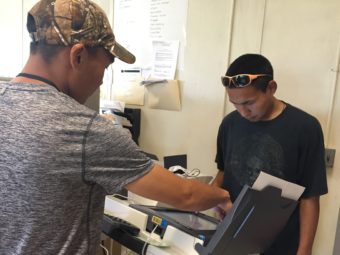
A poll watcher helps Newtok resident Bosco John, 27, vote during Tuesday’s election. It was the village’s first time using a digital machine. (Photo by Mareesa Nicosia, The 74)

Alaskans ejected as many as five incumbents from the House in the primary Tuesday. And they also rejected two House members who tried to move up to the Senate.

But not many people showed up to vote: It was the lowest turnout for a primary in state history.

Three Republican incumbents and two Democrats who caucused with the Republicans trailed their opponents in a primary that drew only 15 percent of voters, not counting outstanding absentee ballots.

House Majority Leader Charisse Millett attributed both incumbents’ headwind and the lowest-ever turnout to the same factor – low oil prices that have hurt Alaska’s economy and the state budget.

“When you are in a deficit, I think … it’s depressing,” Millett said. “People want  to get and vote for, you know, candidates that are upbeat, and it’s hard to be upbeat in this environment.”

A lack of highly competitive statewide races also contributed to the low turnout.

Millett, who was unopposed, said it was a tough year to run for re-election.

“People are looking for someone to blame for the falling oil prices and … a sitting legislator is an easy target,” Millett said.

It’s not yet clear how the primary will affect the balance of power in the Legislature.

If the current totals hold up and Republicans continue to hold the majority, then they will have to do so with two fewer Democrats joining them — Bob Herron of Bethel was defeated by Zach Fansler, and Benjamin Nageak of Barrow trails Dean Westlake of Kotzebue (by five votes).

Casey Reynolds, who edits the political blog The Midnight Sun, said this year’s special sessions kept incumbents in Juneau and away from their districts. With the apparent losses of Herron and Nageak, he sees the chances of a bipartisan coalition increasing.

“A bipartisan organization is more likely today than it was before the election,” Reynolds said. “And the general election is going to be very important. It’s really going to be the deciding factor on this one.”

One Republican who showed a willingness to cross party lines lost.

George Rauscher defeated Republican Rep. Jim Colver in a district that sprawls from Valdez through parts of Palmer to Big Delta.

Business groups targeted Colver after he voted to reduce oil and gas tax credits.

Other incumbents who lost include Wes Keller of Wasilla, defeated by David Eastman, and Bob Lynn of Anchorage, defeated by Chris Birch.

Rauscher had said Colver was likely to join a bipartisan coalition with Democrats, though similar comments aimed at other candidates didn’t succeed.

In Palmer, Richard Best lost after making a similar charge against DeLena Johnson. And Homer incumbent Paul Seaton won, despite, he said, being subjected to disturbing and unfounded charges..

“It was the most negative campaign I’ve ever seen on the lower peninsula,” Seaton said.

State Republican Party spokeswoman Suzanne Downing said the party has room for improvement in turning out voters in the November general election.

“Every single district could improve their voter turnout, and I think as a party we’re going to work a lot harder on that for the general,” Seaton said.

Rep. Lora Reinbold won the Republican nomination for her seat. (Photo by Anne Hillman/Alaska Public Media)

The only legislator who isn’t a member of either caucus – Eagle River Rep. Lora Reinbold – was re-elected. The Republican caucus expelled her in 2015 after she refused to support a caucus-backed budget. She says she wants to rejoin the caucus and work with them to set their principles for the next term.

“And alls I’m asking is that we stick with those principles,” Reinbold said. “And that’s why it’s really important, the team that we send down there. And we’re just hoping that we’re lock-in-step and stay under the umbrella of our principles.”

While most competitive races were in the House, the state’s most expensive race was in an Anchorage Senate district, where Natasha Von Imhof defeated Rep. Craig Johnson and Jeff Landfield.

Another representative, Lynn Gattis of Wasilla, was defeated by David Wilson in her attempt to move up to the Senate. Rep. Shelley Hughes succeeded in winning the Republican nomination to succeed Sen. Bill Stoltze.

Tom Begich defeated Ed Wesley to be the Democratic nominee to succeed Sen. Johnny Ellis in his Anchorage district. Forrest McDonald defated Roselynn Cacy for the Democratic nomination to face Von Imhof.

In the House, Jennifer Johnston defeated Ross Bieling, who ran the best-funded House primary campaign, to be the Republican nominee to succeed Rep. Mike Hawker in Anchorage. Gary Knopp defeated three opponents to be the Republican nominee to succeed Rep. Kurt Olson in the Kenai Peninsula. And Don Hadley deated Lisa Vaught to be the Republican nominee to face Democratic Rep. Ivy Spohnholz in Anchorage. Colleen Sullivan-Leonard will be the Republican nominee to succeed Gattis in Wasilla. And incumbent Republican Representatives Dan Saddler, Liz Vazquez, Lance Pruitt, David Talerico and Mark Neuman defeated challengers.

The state Division of Elections still has to count absentee and questioned votes, and the results will remain unofficial until they’re certified in early September.

Anne Hillman of Alaska Public Media and Shahla Farzan of KBBI contributed to this report.

Absentee and early voting numbers suggest low primary turnout

absentee early voting polling place
Election official Hali Denton runs a polling place for early and absentee voters in the State Office Bulding on Monday. She said it’d been a slow day. (Photo by Jeremy Hsieh/KTOO)

Alaskans vote Tuesday in primaries to determine the party nominees for U.S. Senate and House, as well as for the state legislature.

The numbers of Alaskans that have already voted suggest there will be low turnout.

“Our early and absentee in-person voting that started on Aug. 1 … have observed lower numbers than usual,”said Josie Bahnke, director of the state Division of Elections. “In addition, the volume of absentee by-mail ballots when compared to previous presidential primary election years is also down.”

In the last presidential election year primary in 2012, about 13,000 Alaskans requested absentee ballots. This year, that number was down by about a third.

“That could be from a number of things, namely, the fact that there is no ballot measures on the ballot this year,” Bahnke said.

Four Republicans and two Democrats are running for U.S. Senate, while four Republicans, three Democrats and two Libertarians are running for U.S. House.

In the state legislature, the major parties have five contested primaries in the Senate and 17 in the House. Those primaries could impact the future levels of state services and spending, because some candidates have expressed willingness to work with Gov. Bill Walker to enact elements of his fiscal plan, while others oppose the plan.

Polls are open Tuesday from 7 a.m. to 8 p.m.

Reinbold to repay per diem payments after rival raises concern

Rep. Lora Reinbold, R-Eagle River, listens as the Alaska House of Representatives adopts a Committee on Committees report stripping her of membership on all but one committee, March 16, 2015. It was a consequence of breaking a majority caucus rule by voting against the operating budget on March 12. (Photo by Skip Gray/360 North)
Rep. Lora Reinbold, R-Eagle River, listens in 2015 as the Alaska House of Representatives removed her from committees as a consequence of breaking a majority caucus rule by voting against the operating budget. (Photo by Skip Gray/360 North)

Rep. Lora Reinbold, R-Eagle River, is planning to reimburse the state for $948 she received in per diem payments while she was on a four-day vacation.

Reinbold’s Republican primary opponent Crystal Kennedy raised concern about the expenses.

All legislators were automatically paid $237 per day during the extended regular session this year.

According to the Legislative Affairs Agency, Reinbold told staff she had not been aware she had received the money, and that she would repay it.
Reinbold was removed from the Republican-led majority caucus last year, after she voted against a caucus-supported budget bill. Kennedy said she will join the caucus.

Senator says lawsuit is likely if corporation doesn’t fully fund dividends

Sens. Anna MacKinnon, R-Eagle River and John Coghill, R-North Pole, chat during the fifth special session of Alaska's Legislature in the last two years on July 11, 2016 in Juneau, Alaska. (Photo by Rashah McChesney/KTOO)
Sen. Bill Wielechowski, D-Anchorage, talks after a floor session in July. He is seeking to have full Permanent Fund dividend checks this fall. (Photo by Rashah McChesney/KTOO)

Anchorage Democratic Sen. Bill Wielechowski wants the Alaska Permanent Fund Corporation to defy Gov. Bill Walker’s veto roughly halving this year’s dividends.

If the veto stands, then Wielechowski said he’s likely to sue to force the state to fully pay Permanent Fund dividends this fall.

Walker didn’t have the authority to veto PFD funds, Wielechowski said. In a letter sent Wednesday to Permanent Fund Corporation chief executive officer Angela Rodell, Wielechowski cites a state law that says the corporation shall transfer an amount set by a formula for dividends.

“You just simply can’t veto a statute, regardless of what appropriation is made or not,” Wielechowski said.

If it stands, then Walker’s veto will reduce the dividend from what was projected to be slightly more than $2,000 per person to $1,000. Walker said he took the step to prevent the state from exhausting all Permanent Fund earnings in the next two years, and that the veto would actually preserve PFDs into the future.

Wielechowski cites a 1994 Alaska Supreme Court decision that ruled Permanent Fund earnings go directly into the earnings reserve account.

From there, state law says half the annual deposit is distributed in PFDs.

“They very clearly said this is an automatic transfer,” Wielechowski said. “So, I think the case law is clear. The interpretation of the statute is clear. And they’ve got an obligation to transfer the full funds.”

A Permanent Fund spokeswoman referred questions to the state Department of Law. Department spokeswoman Cori Mills said the state constitution requires that all annual state spending – including dividends – is subject to the governor’s veto.

“It’s been the Department of Law’s longstanding opinion that dividends do require an appropriation, just as … any other money that is spent in the state,” Mill said. “And that’s because of the constitution’s requirement … that the legislature appropriates money. The governor then has the line-item veto power.”

Mills added that the 1994 Supreme Court case didn’t focus on Permanent Fund dividends.

if the Permanent Fund Corporation doesn’t agree to transfer the full amount, Wielechowski said that he and others would likely sue over it.

“I think there’s a  high likelihood that it’ll happen,” Wielechowski said. “I’m not going to say it with a 100-percent certainty, but I’ll just say there’s a high likelihood that there will be a lawsuit.”

Mills said the administration is prepared to defend its position, and the Permanent Fund Corporation’s position, to only transfer what was provided after Walker’s veto.

“We’d rather not get involved in a lawsuit, but that’s his right as well as any other citizen’s right,” Mills said.

Dividends are scheduled to be distributed on Oct. 6.

Site notifications
Update notification options
Subscribe to notifications