Andrew Kitchenman

State Government Reporter, Alaska Public Media & KTOO

State government plays an outsized role in the life of Alaskans. As the state continues to go through the painful process of deciding what its priorities are, I bring Alaskans to the scene of a government in transition.

Walker vetoes bills allowing lawmakers on gas pipeline board, insurers to use credit scores

Gov. Bill Walker 2016 06 19
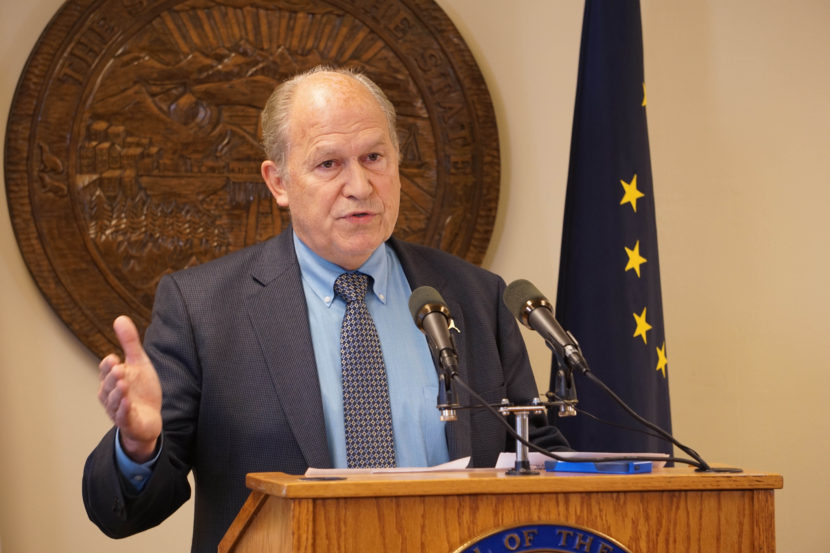
Gov. Bill Walker talks with reporters in his temporary offices in Juneau in June. (Photo by Jeremy Hsieh/KTOO)

Gov. Bill Walker vetoed two bills this week that would have allowed legislators to serve on the board overseeing gas pipeline development, and insurers to use credit scores to adjust rates.

The gas line bill would have added three legislators as non-voting Alaska Gasline Development Corp. board members.

Senate Bill 125 sponsor Sen. Mia Costello, an Anchorage Republican, said Walker missed an opportunity to be transparent.

“This is the most important project that the state of Alaska will face in our future,” Costello said. “And as a lifelong Alaskan and a parent of young children, I’m very concerned that the legislature is being told that we’re shut out of listening in to discussions.”

But Walker said in a letter that the Alaska Constitution prohibits legislators from serving on the AGDC board. He said that’s because legislators can’t hold multiple offices — and it would violate the separation of powers between the executive and legislative branches.

Acting Attorney General James Cantor said in a formal opinion that he found legislators sitting as non-voting members on four other state boards – in a way that runs counter to the constitution.

These boards oversee the Alaska Aerospace Corp., Knik Arm Bridge and Toll Authority, the Alaska Seafood Marketing Institute, and the Alaska Commission on Postsecondary Education.

Walker spokeswoman Grace Jang said it’s too soon to say what, if any, actions he will take regarding these boards in response to Cantor’s opinion.

A lawyer for the legislature wrote in a memo that the bill – and lawmakers’ role as non-voting board members — may not violate the Constitution.

Senate President Kevin Meyer, an Anchorage Republican, said the $45 billion to $65 billion project would benefit from legislative involvement.

“With the governor now talking about going alone on the gas pipeline, certainly you would want the appropriating body – the body that’s holding the purse – as involved and in the know as possible,” Meyer said.

Separately, the insurance bill the governor vetoed would have ended Alaska’s status as the only state that forbids insurers from considering members’ credit histories when they renew their car or homeowners insurance policies.

Supporters said Senate Bill 127 would benefit most people in the state.

But Walker said the credit ratings are notoriously unreliable and would hurt consumers, especially low-income ones. He also said those who’ve experienced unemployment or identity theft face hurdles in seeking protection from the bill’s effect.

These vetoes were Walker’s third and fourth ever, other than partial budget vetoes.

(Corrected the number of legislators that would’ve served as non-voting Alaska Gasline Development Corp. board members to three.)
Legislative working group could resolve thorny problems

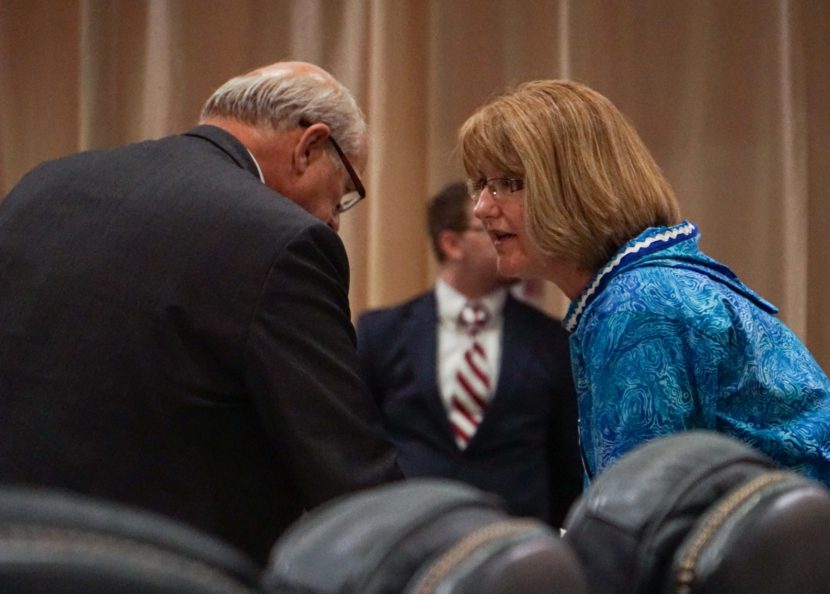
Alaska Senate Majority Leader John Coghill, R-North Pole, and Sen. Anna MacKinnon, R-Eagle River, chat during a break in the floor session, July 18, 2016. (Photo by Jeremy Hsieh/KTOO)
Alaska Senate Majority Leader John Coghill, R-North Pole, and Sen. Anna MacKinnon, R-Eagle River, chat during a break in the Senate’s last floor session on Monday. (Photo by Jeremy Hsieh/KTOO)

The Alaska Legislature has adjourned, but that doesn’t mean lawmakers’ work is done for the year. They’re considering bringing a small group of legislators together to work on agreements on major unresolved issues, which could set the foundation for another special session or the next regular session.

Eagle River Republican Sen. Anna MacKinnon said she’d like to see members of all legislative caucuses work on solutions on a limited number of issues.

MacKinnon said Gov. Bill Walker presented so many ideas as part of his fiscal plan that legislative progress stalled.

“He keeps putting too many shiny objects in the water – that’s my term – on all of the different pieces of legislation and so it creates these factions that are in opposition to one of the pieces,” she said. “Whether it’s revenue, whether it’s reform, whatever it is, there’s just too many things to look at, and everyone’s trying to leverage everything.“

For example, the working group could consider the overall level of state spending and changes to Permanent Fund earnings. MacKinnon said the group could hold public meetings to gauge Alaskans’  priorities. She also would like to reach an agreement that would allow oil and gas tax companies to receive money this year that Walker has delayed.

But MacKinnon expressed concern about the number of tax proposals Walker’s made. They include introducing either a personal income tax or a sales tax, as well as increases to the motor fuel, alcohol, mining, commercial fisheries and tobacco taxes.

“You have to respect all views,” MacKinnon said. “And so I certainly want someone who’s in opposition to what we want to do – or what the governor presented as ideas to go forward. And so I think there needs to be a balance of both those that might want something to happen and those that are opposed to something happening.”

Walker’s administration supports the idea of a working group. Revenue Commissioner Randall Hoffbeck said members of the governor’s team would like to be involved as much as possible.

“We think it’s a great idea,” Hoffbeck said. “I think the more the legislature is involved in the process from the beginning, I think the more willing they’re going to be to move the bills in the end.”

Hoffbeck said adding new revenue should be part of the discussion to prevent deep cuts in government services.

“One person’s shiny object is another person’s treasure,” Hoffbeck said. “There are some people that may or may not engage in the conversation if those other items aren’t there. And so, it’s going to be a balance. And I think it’s something that, as they work through the issue, I think they’ll find … the balance that they’re comfortable with.”

The working group concept also got a warm reception from the leaders of the minority caucuses in both chambers.

House Minority Leader Chris Tuck, an Anchorage Democrat, said the idea is similar to two minority-caucus proposals earlier this year – a caucus of the whole and a ways and means committee. He said he’s glad that MacKinnon is “coming on board.”

Fellow Anchorage Democrat and Senate Minority Leader Berta Gardner also said she’s interested.

“I have proposed similar things and I’m very happy to participate, any time, any place,” Gardner said. “I look forward to it. I think we need to do this.”

House Speaker Mike Chenault, a Nikiski Republican, said it would be important for a working group to consider how each geographic area of the state is affected by any changes.

“I think that’s something that the House would want to join in, and try to figure out … is there a way on any of these issues we can move forward?” Chenault said, adding that the goal would be “to try to build some consensus on how you would put that particular plan in place, and what it affects.”

MacKinnon said she’ll probably approach the leaders of each caucus with a more detailed proposal within a couple weeks.

And she said she doesn’t expect the group to start meeting until after the Aug. 16 primary. Its proposals would be considered in either a special session after the November election, or in the regular session in January.

Senate ends special session with talk of deficit and deeds

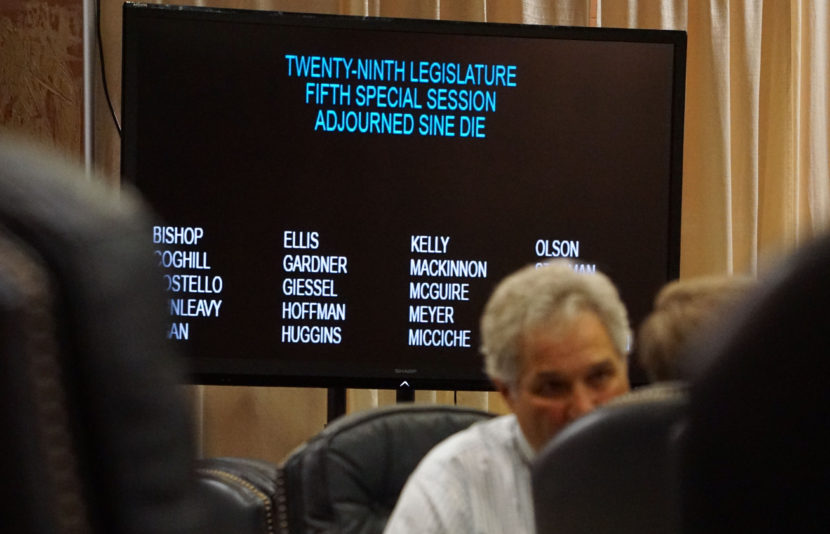
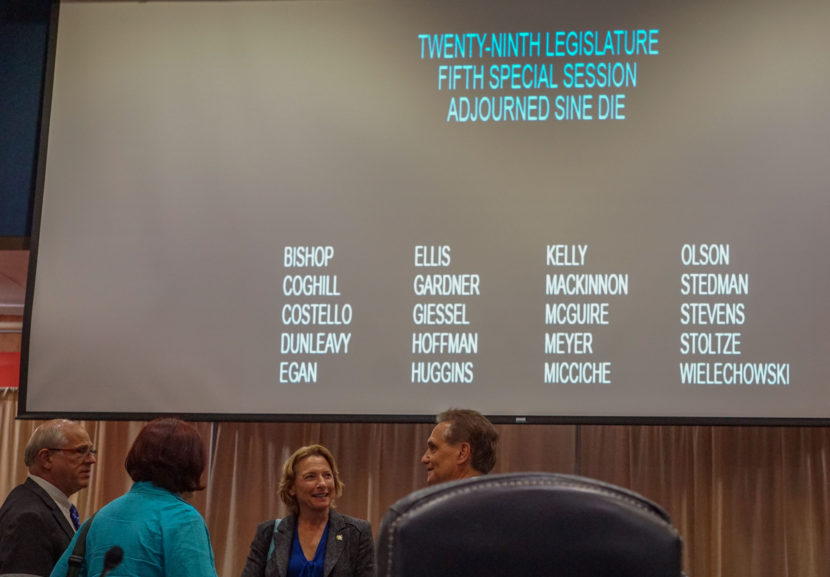
Sens. John Coghill, R-North Pole, Berta Gardner, D-Anchorage, Cathy Giessel, R-Anchorage, and Kevin Meyer, R-Anchorage, chat after adjourning sine die, July 18, 2016. (Photo by Jeremy Hsieh/KTOO)
Sens. John Coghill, R-North Pole, Berta Gardner, D-Anchorage, Cathy Giessel, R-Anchorage, and Kevin Meyer, R-Anchorage, chat after adjourning sine die on Monday. Sine die is a Latin phrase meaning “without appointing a day to resume.” (Photo by Jeremy Hsieh/KTOO)

Three days after the House’s adjournment, the state Senate has also gaveled out, ending the latest special session in Juneau. In closing remarks, senators differed over how successful the body was in addressing the state’s legislative challenges this year.

Senate Minority leader Berta Gardner, D-Anchorage, eulogizes the 29th Alaska Legislature's fifth special session, July 18, 2016. (Photo by Jeremy Hsieh/KTOO)
Senate Minority leader Berta Gardner, D-Anchorage, eulogizes the 29th Alaska Legislature’s fifth special session. (Photo by Jeremy Hsieh/KTOO)

Democratic Minority Leader Berta Gardner of Anchorage said she was disappointed the legislature couldn’t agree on a comprehensive fiscal plan.

“It requires moving places where we … might have thought we would never go, and it’s what we had to do here,” Gardner said. “And we all knew that coming in, but we didn’t. And so to say I’m disappointed feels inadequate.”

For the third year in a row, Alaska’s government is projected to spend more than $3 billion more than it collects in revenue. At this rate, Gov. Bill Walker has warned the Constitutional Budget Reserve will be exhausted in two years, potentially leading to steep cuts in government services.

But members of the Republican-led majority say more attention should be paid to areas where the legislature passed bills. Sen. Anna MacKinnon, a Republican from Eagle River, pointed to agreements on Medicaid and criminal justice reform, as well as changes to Power Cost Equalization and community revenue sharing.

“The Senate and the other body, the minority and the majority, House members in the majority and minority, moved huge pieces of legislation,” MacKinnon said.

Although they might reduce spending by significant amounts in the future, neither the Medicaid nor corrections bills are expected to save much this year.

Sens. Pete Kelly, R-Fairbanks, and Charlie Huggins, R-Wasilla, linger after the Senate adjourned sine die, July 18, 2016. (Photo by Jeremy Hsieh/KTOO)
Sens. Pete Kelly, R-Fairbanks, and Charlie Huggins, R-Wasilla, linger after the Senate’s adjournment. (Photo by Jeremy Hsieh/KTOO)

Fairbanks Republican Sen. Pete Kelly notes that the Senate passed its version of the state budget a month earlier than in previous years. The Senate also passed a bill restructuring the Permanent Fund earnings, a measure Walker sees as the centerpiece to a long-term fiscal plan.

But Kelly shied away from pointing blame at the House for opposing the Permanent Fund bill. He said constituents across Alaska rejected the legislation.

“Doing the job sometimes means that we just say no to these brilliant ideas  that come out of the governor’s office or out of the Senate or the House,” Kelly said.

The special session could have lasted as long as 30 days, but it ended in a week.

The Senate Resources Committee is still scheduled for a meeting Tuesday to discuss the plan of development for Prudhoe Bay oil. Walker may call another special session, but if so, it would likely occur after the November election.

House adjourns unproductive special session

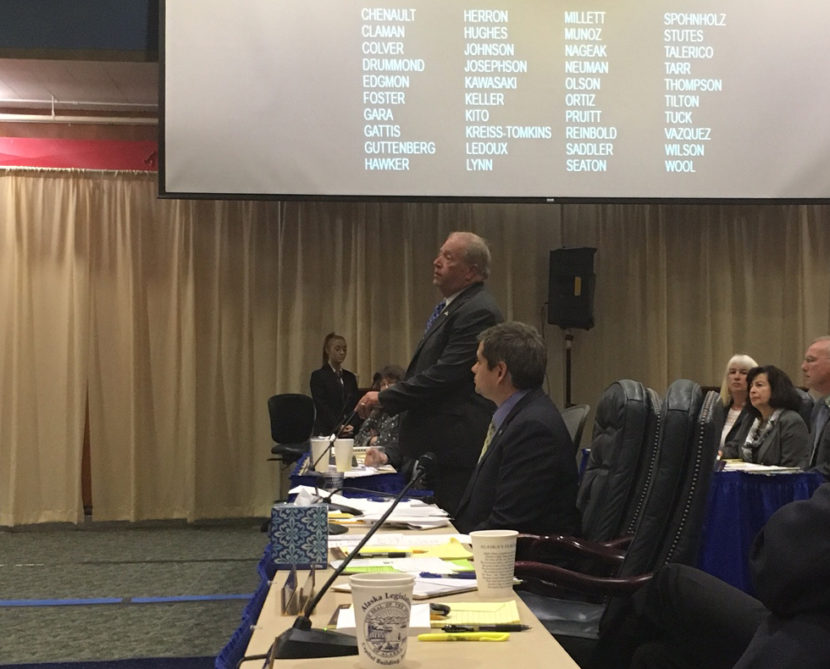
House Speaker Mike Chenault makes a rare floor speech to end the special session on July 15, 2016. (Photo by Andrew Kitchenman/KTOO)
House Speaker Mike Chenault makes a rare floor speech to end the special session. (Photo by Andrew Kitchenman/KTOO)

The House ended its special session Friday, having taken no actions in the five days since it began.

House Speaker Mike Chenault, R-Nikiski, said the legislature already considered the Permanent Fund restructuring and tax increases that Gov. Bill Walker asked them to pass.

“Staying here for another 30 days is not going to resolve the revenue issues before us,” Chenault said. “We have discussed ad nauseam all the different proposals and I cannot see any significant changes within the time allotted for this special session.”

The Senate declined an invitation from the House to meet to consider overriding Gov. Bill Walker’s budget vetoes.

Senate President Kevin Meyer, R-Anchorage, said there wasn’t enough support to reach the 45 votes needed to override the vetoes. They include a reduction in Permanent Fund dividend funding that’s expected to cut dividends in half this fall, to $1,000 per person.

“When we looked at all of the variables, all of the pros and cons, we just felt it was best to not accept the invitation to meet for the purpose of overriding the vetoes,” he said.

The last House floor session was filled with speeches on the state’s fiscal crisis. The debate could foreshadow the position candidates take in the Aug. 16 primaries and Nov. 8 general election.

Anchorage Republican Rep. Craig Johnson attacked Walker’s PFD funding veto.

“This time, Walker’s reached into the pocketbooks of every man, woman and child in Alaska and – in my opinion – stolen $1,000 from each of them,” said Johnson, who’s running for a seat in the Senate.

Anchorage Democratic Rep. Les Gara expressed concern that Walker administration projections of budget cuts could play into the hands of opponents of a fiscal plan.

“I think what he did was he told people who want major cuts, ‘Take no action and you get the cuts that you want,’ ” Gara said.

Juneau Republican Rep. Cathy Munoz said Walker did the right thing by issuing the vetoes, even if she didn’t agree with all of them.

“I think the governor demonstrated a great deal of courage in his actions,” she said.

Eagle River Republican Sen. Anna MacKinnon said she’s interested in working with Walker’s administration and all four legislative caucuses on a task force that would consider a couple of the major issues that have stalled in the legislature.

Chenault also expressed interest in the idea.

The Senate could vote to adjourn when it meets on Monday.

Walker administration projects deep cuts to government, schools if legislature doesn’t act

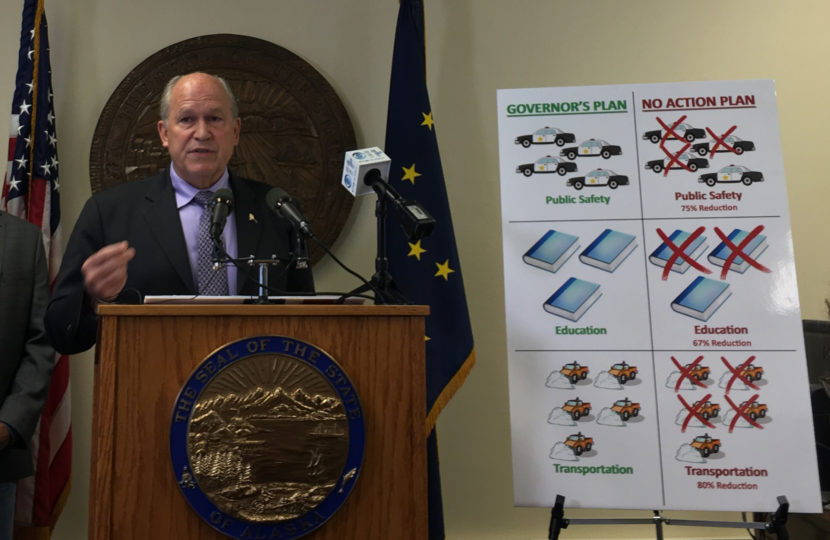
Gov. Bill Walker talks about the potential effects of the Legislature not passing his fiscal plan, in Juneau on July 14, 2016. (Photo by Andrew Kitchenman/KTOO)

In two years, the state would slash services, jobs, and the support it gives to local schools and communities if the legislature doesn’t take action on a plan to fund state government, according to Gov. Bill Walker’s administration.

Walker said that if legislators don’t pass his fiscal plan, which includes restructuring the Permanent Fund and adding new taxes, they’ll be choosing that scenario as the state’s future by default.

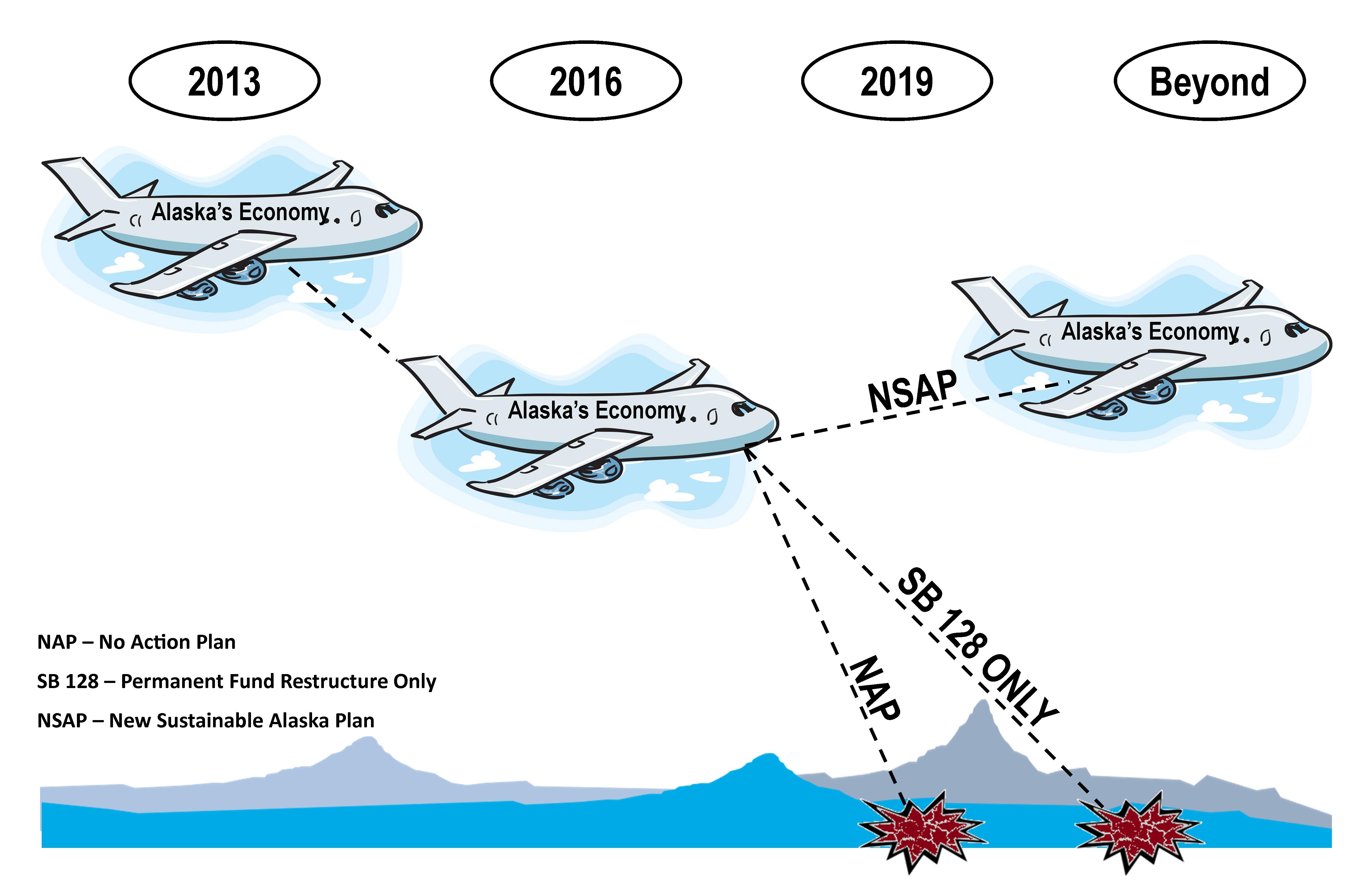
“I asked for other plans,” Walker said. “If there’s a better plan, please bring it to us. And no plan came forth. But actually, you know, the other day, on a flight to Fairbanks, it really struck me that there really is another plan. And that’s the no action plan.”

State budget director Pat Pitney said the no action plan would cut funding to state agencies from more than $4 billion to only $1.5 billion, creating a dire situation.

“These aren’t amounts of money the state could see a real future in,” Pitney said.

Pitney said it would be like running a 21st century Alaska with roads and infrastructure on a budget from the 1960s — It’s not possible.

But Pitney also said that only passing Senate Bill 128 wouldn’t be enough to provide the government services and school aid that Alaskans are used to. SB 128 restructures the Permanent Fund and use that money for operating costs. If the state only does that, many state agencies would see a 25 percent cut in funding.

“With just a modest amount of tax revenue we can maintain those services, we don’t have to push the costs onto communities,” Pitney said.

While Walker wants to spark the legislature to act, it hasn’t worked.

When he spelled out what could happen with future budgets, he said that as Alaskans become familiar with who supports the no action plan, they’ll be better informed about who should represent them in Juneau.

House Majority Leader Charisse Millett, R-Anchorage, questioned this tactic.

“I think it’s unfortunate that that’s the way the governor chooses to work with the legislature,” Millett said. “When you’re trying to push a fiscal plan, I think the last thing you want to do is threaten folks with campaigns.”

And some legislators didn’t feel threatened by the possibilities, they embraced them. Wasilla Republican Rep. Lynn Gattis said she’d like to see the scenario with deep cuts.

“In my district, when I went back home, those folks are saying, ‘Cut the budget,’ and certainly that’s what this does,” she said. “So, I don’t think these are dire circumstances.”

Alaskans reacted with concern to an administration report on projected state government spending cuts.

At the Glenn Alps trailhead in Chugach State Park, Sara and Reed Supe looked through a list of potential cuts to state government if the legislature doesn’t find new revenue sources. They noted that if lawmakers do nothing, the budget for the Department of Fish and Game and the Department of Natural Resources — which includes many parks — would drop by 85 percent.

“You’d never get to go hunting. Or fishing. I think this is what people up in Alaska live here for,” Sara Supe said.

The Supes said they’d happily pay more for fishing licenses and park fees to help that problem, but they see the projected cuts to education as too damaging — schools would have thousands fewer teachers and some university campuses would close

Palmer resident Linda Lozanoff said it’s time for the legislature to pick a path.

“I really appreciate Gov. Walker’s efforts to take them to task, make them work hard and make decisions,” she said.

But she said everyone in the state, including schools, needs to do their part and accept some cuts. She gave an example — after her recent divorce, her income fell by two-thirds.

“If  I was able to do it, I think the state can do it,” she said.

Alaska Public Media’s Anne Hillman contributed to this report.

Legislature may try Friday to override budget vetoes, dividend cut

2008 PFD Check
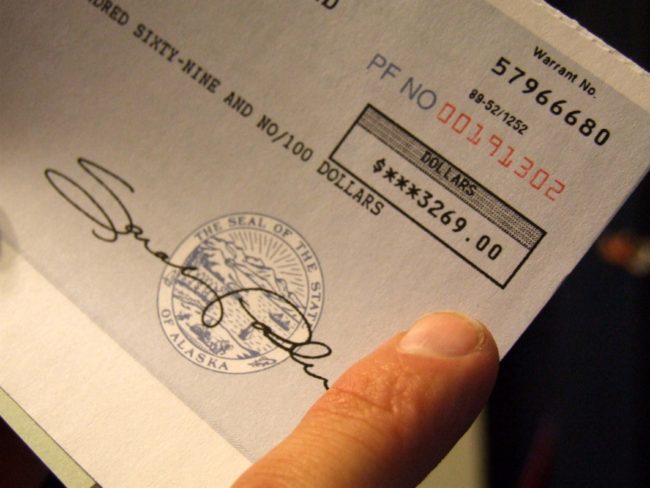
An Alaska Permanent Fund Dividend check from 2008. (Creative Commons photo by Travis)

The fate of the estimated $1,000 Permanent Fund Dividend cut could be decided on Friday.

That’s the day the House has invited the Senate to meet in Juneau to determine if they’ll override Gov. Bill Walker’s budget vetoes.

Walker vetoed $1.29 billion in spending. He also delayed $250 million in transportation projects.

Rep. Charisse Millett, R-Anchorage, wraps up debate on House Bill 44, also known as "Erin's Law," in the Alaska House of Representatives on Saturday. (Photo by Skip Gray/360 North)
Rep. Charisse Millett, R-Anchorage, speaks last year. (Photo by Skip Gray/360 North)

House Majority Leader Charisse Millett, R-Anchorage, said if the Senate accepts the invitation, there could be override votes on each of the 41 separate items that Walker vetoed.

“Obviously, the Permanent Fund (dividend) and the oil tax credits and the education money and probably the school debt reimbursement are some of the ones that would rise to the top,” Millett said of items that could see overrides. “Those items are in the budget because someone had a constituency for it and it passed.”

The PFD cut was the biggest veto. It may also be the cut that the legislature is most likely to override. It’ll take three quarters of the legislature – 45 of the 60 lawmakers – to vote to reverse any of the items.

House Minority Leader Chris Tuck, D-Anchorage, said there’s a lot of interest in overriding vetoes, but there may not be enough votes on any one item.

“I have a sense that there are desires to have veto overrides on all of the items that have been vetoed. And it’s going to be different groups of people that are going to support one thing over another thing,” Tuck said. “But I’m not sure if there’s going to be 45 votes.”

Friday is the constitutional deadline for overriding the vetoes.

Site notifications
Update notification options
Subscribe to notifications