State Government Reporter, Alaska Public Media & KTOO
State government plays an outsized role in the life of Alaskans. As the state continues to go through the painful process of deciding what its priorities are, I bring Alaskans to the scene of a government in transition.
Marijuana sales are expected by February, according to Cynthia Franklin, director of the Alcohol and Marijuana Control Office. (Creative Commons photo by Brett Levin)
Alaska’s top marijuana regulator said Wednesday that pot will be on sale by February. But industry advocates expressed frustration it’s taken nearly two years since voters approved the sales.
And legislators said they’d like to see the state allow marijuana consumption in private clubs. Some lawmakers would also like state officials work to improve marijuana businesses’ access to banks.
Alcohol and Marijuana Control Office Director Cynthia Franklin told state legislators that marijuana testing should begin within weeks.
“I believe that by the time we arrive at February of 2017, we will have stores that are operating; we will have product manufacturers that are making products, which have been individually approved by this board – which is a tremendous amount of work; we will have testing facilities that are testing; and we will have a lot of cultivation facilities growing a lot of legal marijuana in Alaska,” Franklin said.
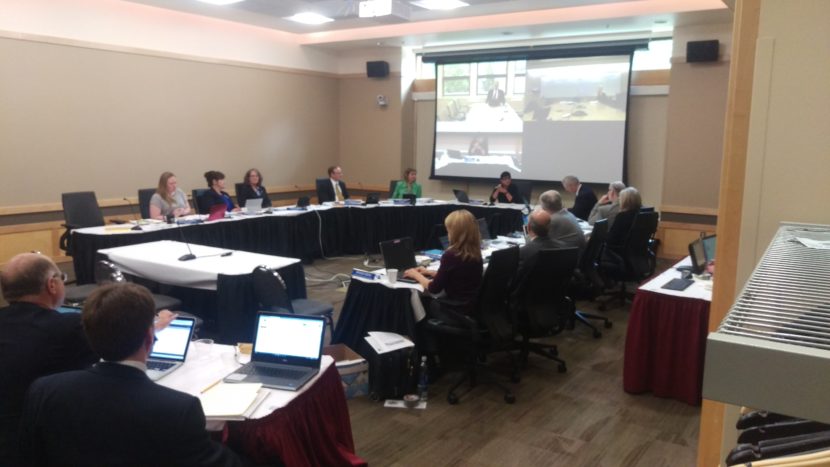
She spoke at a joint meeting of the House and Senate Judiciary committees at the Legislative Information Office in Anchorage.
Lawyer Jana Weltzin says her marijuana business clients are paying to rent property, but they’re not receiving revenue.
“It has been two years, and I’m getting to the point where some of my clients have been paying rent for a really long time,” she said.
Franklin said her office has been affected by having too few staff members for the amount of work it’s required to do.
Another obstacle for marijuana businesses is banking. Division of Banking and Securities Chief Examiner Patrice Walsh said Congress must change the law before banks will accept marijuana business customers.
“Right now, the Division of Banking and Securities is not aware of any bank or credit union in our state that is willing to bank marijuana businesses at this time, because the businesses are illegal, under federal law,” Walsh said.
But Anchorage Republican Sen. Lesil McGuire said she’d like to see the state work with federal regulators to make it easier for banking for marijuana businesses to advance. She noted a memo from former Deputy U.S. Attorney General James Cole said the federal government would take a hands-off approach to marijuana in states that legalized it.
“States who have legalized this have an obligation to set up regulations that provide security and authority and a clear path for banks – lending institutions – in that state to secure a legal pathway for lending,” McGuire said.
Lawmakers also questioned Attorney General Jahna Lindemuth on her recent opinion that marijuana consumption is illegal in private clubs. They disagreed with her opinion that these clubs are public spaces. The ballot question that legalized marijuana said it would be illegal to consume in public. Legislators raised the possibility that state law could be changed to allow marijuana in clubs.
The Alaska Department of Revenue is seeking to stop people from wrongfully claiming Permanent Fund dividends. The department has launched a new program that will audit applications this month.
Deputy Revenue Commissioner Jerry Burnett said the administration has been interested in using a national database provider to check whether dividend applicants actually live in other states.
The state will pay LexisNexis, a company that maintains a national database of public records, $650,000 to check the residency of dividend applicants this year and next. State officials chose LexisNexis in part because the company has the largest database of its kind.
“If in fact their databases are correct … and sometimes they are; sometimes they’re current, sometimes they’re not – if someone’s registered to vote in another state, it’s going to show up,” Burnett said.
The state will ask people who appear to live in other states for more information. Those who don’t reply won’t receive dividends this year.
“If there’s a mistake in those records, we want to hear from the people and get those records corrected,” Burnett said. “And this shouldn’t affect anyone who has appropriately and honestly applied for a Permanent Fund dividend.
Burnett said if the program is effective, it could be expanded to audit other government benefits.
“You’d run it against Medicaid-eligible people and people for other state-type benefits, too,” he said.
The state currently has an audit program for dividend applicants, but it doesn’t check as wide-ranging sources as it can through LexisNexis. Burnett said the state doesn’t have a reason to believe the number of people wrongly seeking dividends has increased in recent years.
Dividends will be distributed beginning on Oct. 6.
This story has been updated and expanded with comment from Jerry Burnett.
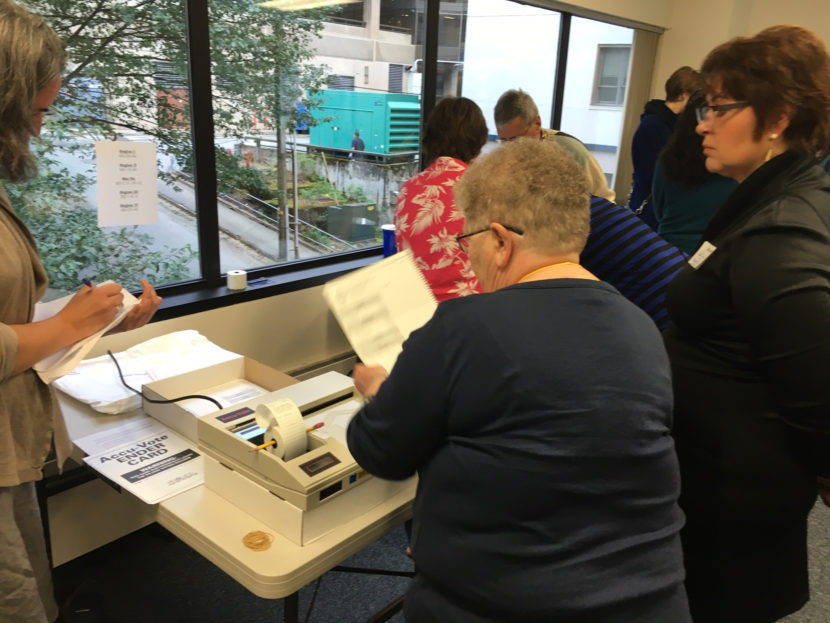
An election official feeds ballots into an optical scanner while observers watch on Monday. (Photo by Andrew Kitchenman/KTOO)
Barrow Rep. Benjamin Nageak says he isn’t conceding the Democratic primary to Dean Westlake of Kotzebue.
“I haven’t conceded anything,” he said.
That’s despite the fact that Westlake’s lead doubled Monday from four to eight votes over Nageak in final results in the closely watched recount. District 40 covers the North Slope and Northwest Arctic boroughs, as well as three neighboring precincts in the Unorganized Borough.
What remains to be seen is whether Nageak will challenge the results in court, and — if so — whether that will change the outcome.
But Nageak declined to say whether he’d challenge the results legally, and referred further questions to his attorney, Seattle-based election-law specialist Tim McKeever.
In the recount, Westlake added six votes to his total, reaching 825, while Nageak gained two votes, to reach 817.
Westlake gained two votes from ballots that the computer scanner initially failed to count, while Nageak gained one.
In addition, Westlake gained three votes from questioned ballots from Ambler that were received after the Division of Elections certified the results.
And both candidates gained one vote each from Kivalina, where some voters mistakenly cast ballots in both the Republican primary and in the primary for all other parties.
Nageak caucuses with the Republican House majority.
Republican officials are concerned about the handling of ballots in the village of Shungnak. Voters were wrongly given ballots for both the Republican primary and the primary for all other parties.
Westlake received 47 votes in Shungnak and Nageak received three.
In addition, some Republicans in the North Slope Borough and elsewhere have said election officials didn’t allow them to vote in the Democratic primary, or required them to file questioned ballots.
Nageak said he’s concerned about it.
“I have a lot of Republican friends in the district also, especially here in the North Slope, and I’ve heard they were turned down … with their ballots,” he said.
The Democratic primary is open to all voters.
Katherine Pfeiffer was observing the recount in the elections office in Juneau for the Democratic Party. Amid Division of Elections staff hovering over ballots, optical scanners and printouts, she said she was impressed.
“I think it was very well-organized,” she said. “The election staff was very congenial, very helpful, answered people’s questions: a very transparent process.”
Nageak’s observers deferred comment to Nageak.
Friday is the deadline for an election challenge to be filed in Superior Court.
Walker said in a letter to House Speaker Mike Chenault that there’s no evidence that some areas are unheard, and that it’s important for board members to respect each area.
He also opposed a provision that required residents to live in an area for two years before joining the board, saying it isn’t consistent with Alaska’s embrace of personal freedom.
Bill sponsor Wasilla Republican Lynn Gattis said she doesn’t agree with Walker’s reasoning.
“Boy, that’s a lot of BS, and you could go ahead and put that on the radio,” Gattis said. “Because I think the bottom line is, the fact that we do have very different regions. That’s why we elect representatives from those different regions. They bring a different flavor to the table.”
Election review board members work to certify the primary results at the Alaska Division of Elections office in Juneau on Aug. 30. (By Andrew Kitchenman/KTOO)
There will be a recount Monday of the Democratic primary results for the House district covering the North Slope and Northwest Arctic boroughs.
Division of Elections Director Josie Bahnke said the recount will take place in Juneau.
“We’ve got staff and state review board members that will be counting the ballot using four optical scan units,” Bahnke said. “So, both candidates have been informed and are allowed to have one observer at each unit.”
Nageak said he’s hopeful about the recount.
“If it came to be that it was, you know, positive for my campaign, I think it would be great,” Nageak said. “We’ll never know until we do it. I mean, it’s only four votes.”
Republican officials have raised concerns about the handling of ballots in the Kobuk River village of Shungnak. Voters were wrongly given ballots for both the Republican primary and the primary for all other parties.
Westlake received 47 votes in Shungnak and Nageak received three, according to the certified results.
Nageak has hired election law attorney Timothy McKeever to advise him. Nageak said all options are on the table for pursuing a legal challenge to the results.
“There’s a lot of stuff that happened during the election, not only in my area but … a lot of places in the state,” Nageak said.
Some Republicans in the North Slope Borough and elsewhere have said they weren’t allowed to vote in the Democratic primary, or were required to file questioned ballots.
The Democratic primary is open to all voters.
Bahnke didn’t provide a timeframe for when the recount would be completed.
An undated photo of William “Willie” “Iggiagruk” Hensley, who served as a state representative, a House majority leader and a state senator on and off in the ’60s, ’70s and ’80s. Hensley represented his home region of northwest Alaska. (Photo courtesy Alaska State Library Portrait File)
The outcome of the disputed primary contest between Rep. Benjamin Nageak and Dean Westlake is uncertain. Whoever wins, it may unsettle what’s been a unique tradition in Alaska politics.
Democratic legislators have a long history of joining Republican-led legislative majorities.
To understand why Alaska is so different, it pays to go back to the 1960s. Democrats had dominated Alaska, but a resurgent Republican Party disrupted that. Regional divisions prevented a single party from forming a legislative majority, so they turned to partners across the aisle.
Willie Hensley is a Democrat who caucused with members of both parties in the House and Senate in the 1960s, ‘70s, and ‘80s, representing Kotzebue and the North Slope. He said rural legislators were able to accomplish much during periods of bipartisan politics – they worked to allow village children to attend locally controlled schools, improve rural access to affordable power, and build local housing authorities.
“Partly because we were able to put ourselves in a position of influence with these various coalitions, that enabled a lot of that to happen,” Hensley said.
Rural lawmakers became powerbrokers in the legislature. For example, in 1981, then-Rep. Al Adams of Kotzebue led a mid-session revolt in which rural Democrats joined with Republicans to switch control of the House. And every Republican-led House majority since then has had at least one Bush Democratic caucus member.
But by the late 1990s, Bush legislators had become fragmented, with members split between the majority and minority caucuses. Mary Sattler represented Bethel from 1999 to 2009, and chose not to caucus with the majority.
“My focus was really on building the Bush Caucus back up to where it had been in the ‘70s and ‘80s,” Sattler said.
Sattler says that even minority-caucus rural lawmakers were able to build relationships that led to capital projects in their districts.
“One of the kind of hallmarks of rural legislators – you know, it’s a lot like rural Alaskans, where we tend to be very non-confrontational,” Sattler said. “We much prefer governing with consensus. And being confrontational and combative doesn’t work really well if you’re from a small town and intend on living in a small town.”
The rural lawmakers have faced challenges in recent years to maintain their influence. Alaska’s population is increasingly urban, which means fewer rural seats in the legislature.
And as the drops in oil prices and production have shrunk the state’s capital budget, rural lawmakers haven’t been able to bring home as many state dollars to villages with small economies.
Now it’s the Republican Party that usually leads in state politics. And all four Democratic House members from northern and western Alaska have caucused with the Republicans since House Speaker Mike Chenault invited them to join in 2008. Chenault said this has allowed the caucus to include a broader range of voices.
“It made our caucus stronger, because at that point in time, we represented all areas of the state, from Barrow to Nome to Adak to Ketchikan, and all areas in between,” Chenault said. “And it made us a better caucus, in our opinion.”
Rep. Nageak’s predecessor, Reggie Joule, said that after having spent 12 years in the minority, he chose to join the majority in 2008. He said this gave rural lawmakers a say in the budget, including the capital budget.
Rep. Reggie Joule stands to ask the House to support a bill he sponsored during a floor session in Juneau, April 5, 2012. (Photo courtesy Alaska House Majority)
“You know, I tried throwing rocks before and sometimes we were quite effective,” Joule said. “But when you’re inside the tent, you can make your case inside the tent on what’s important, and still stay true – I think – to many of the values that you hold dear.”
Voters generally have re-elected rural Democratic legislators who crossed party lines, and they have faced few primary challenges from other Democrats.
That pattern changed this year, with state Democratic leaders supporting Dean Westlake over Nageak, as well as Zach Fansler in his successful bid to unseat Bethel Representative Bob Herron.
Joule said the extended and special legislative sessions cut into the time that the incumbents had to fundraise and campaign. He says this made it difficult for them to dissuade challengers, like rural Democrats have in the past.
“At one point when the Democratic Party would try to assert itself in rural races, I think the Bush Caucus did a pretty good job of keeping people out of those races – but we would go right to people and have a direct conversation with them,” Joule said.
Former University of Alaska Southeast political scientist Clive Thomas said it appears that the party is more willing to assert itself in challenging rural Democrats who break with the party.
“They definitely I think are saying enough is enough in that regard and they’re trying to do something about it,” Thomas said.
Thomas said the drop in the capital budget may be causing the changed approach.
“Maybe now there’s no capital money, capital budget, there’s nothing in it for the Democrats to keep quiet about it,” Thomas said.
It isn’t just Democrats who are challenging sitting legislators who cross caucus lines. For the first time since Chenault invited the Bush Democrats to join the House majority, one Bush Democrat is facing a Republican challenger. Dillingham Representative Bryce Edgmon is challenged by William Weatherby, who’s receiving support from state Republican leaders.
Opinions are split over whether the primary challenges and increased competition will lead to long-term changes in how rural Democrats choose to caucus. But as Democrats aim to build a bipartisan coalition that would include moderate Republicans, it could have an effect on the next legislature.
Close
Update notification options
Subscribe to notifications
Subscribe
Get notifications about news related to the topics you care about. You can unsubscribe anytime.