Andrew Kitchenman

State Government Reporter, Alaska Public Media & KTOO

State government plays an outsized role in the life of Alaskans. As the state continues to go through the painful process of deciding what its priorities are, I bring Alaskans to the scene of a government in transition.

Democratic and nonaffiliated legislative candidates top Republicans in post-primary fundraising

dollar bill money macro
(Creative Commons photo by peasap)

Democratic and independent candidates critical of the majorities in the State Capitol have raised more in campaign donations than Republicans since the primary.

Political leaders interpreted the latest campaign finance reports in widely divergent ways.

House Minority Leader Chris Tuck, D-Anchorage, watches a floor session Tuesday, May 31, 2016 in Juneau, Alaska. Members of the minority broke a stalemate on the state's operating budget and joined the majority in a vote to draw from the state's savings to solve budget issues. (Photo by Rashah McChesney/KTOO)
House Minority Leader Chris Tuck, D-Anchorage, watches a floor session in May. He says the campaign finance report reflects the public’s rejection of current legislative majorities. (Photo by Rashah McChesney/KTOO)

Democratic leaders said the campaign reports filed Monday show that donors are rejecting how the legislature approached the state budget this year.

“I think it just speaks volumes of how the public is starting to realize who’s really at fault with the mess we’re in in Juneau,” House Minority Leader Chris Tuck said.

But Alaska Republican Party Chairman Tuckerman Babcock said the disclosures put a spotlight on a different issue: how candidates who are running as nonaffiliated are actually working with Democrats.

“The vast majority of the so-called non-affiliated candidates are completely affiliated,” Babcock said. “They’re simply trying to figure out a way to pull one over on the voters.”

Fundraising can be crucial in determining whether the public learns about candidates through TV and radio commercials, as well as through mailings.

Republican candidates raised $580,000 since Aug. 7, while Democrats raised $476,000 and nonaffiliated candidates raised $201,000.

Tuckerman Babcock was elected chairman of the Alaska Republican Party (Photo by Josh Walton)
Tuckerman Babcock, chairman of the Alaska Republican Party, said unaffiliated candidates are coordinating with Democrats. (Photo by Josh Walton)

Vincent Beltrami raised the most of any single candidate over the past two months. The nonaffiliated Anchorage Senate candidate raised $95,000, while incumbent Anchorage Republican Cathy Giessel raised less than half that. However, Giessel has more than twice as much cash on hand as Beltrami.

Babcock said labor leader Beltrami’s fundraising points to labor’s interest in maintaining state spending.

“There’s a massive coordination going on with the labor unions to funnel money into … the races, particularly into Beltrami’s race,” Babcock said.

Tom Begich is an Anchorage Democrat who’s running unopposed for the Senate. He said Beltrami’s fundraising success reflects discontent with the status quo.

“The campaign that seems to be doing very, very well is in fact Vince Beltrami’s nonpartisan campaign. That’s a clear rejection of Cathy Giessel and her level of leadership,” he said.

North Pole Republican Sen. John Coghill raised more than $20,000 more than Democratic challenger Luke Hopkins over the last two months. And Juneau Republican Rep. Cathy Muñoz raised the most of any House candidate – and more than three times as much as Democratic challenger Justin Parish.

The fundraising indicates which races are drawing the most attention and are likely to be competitive.

The incumbent Democrat facing an opponent whose raised the most funds is Anchorage’s Bill Wielechowski. He was out-fundraised by Republican Kevin Kastner after the primary.

Other than the Muñoz-Parish race, the other House races that saw the most fundraising are between:

  • Democratic Rep. Harriet Drummond and Republican challenger Mike Gordon to represent the Spenard area in Anchorage;
  • Democratic Rep. Jonathan Kreiss-Tomkins and Republican challenger Sheila Finkenbinder to represent Sitka;
  • Republican Rep. Lance Pruitt and Democratic challenger Harry Crawford to represent Basher and East Anchorage; and
  • Democratic Rep. Matt Claman and Republican challenger Marilyn Stewart to serve West Anchorage.

Political observers note there’s still plenty of time for the fundraising gap to change before the election.
Pew report sees Alaska ahead of other states in its ‘sovereign wealth fund’

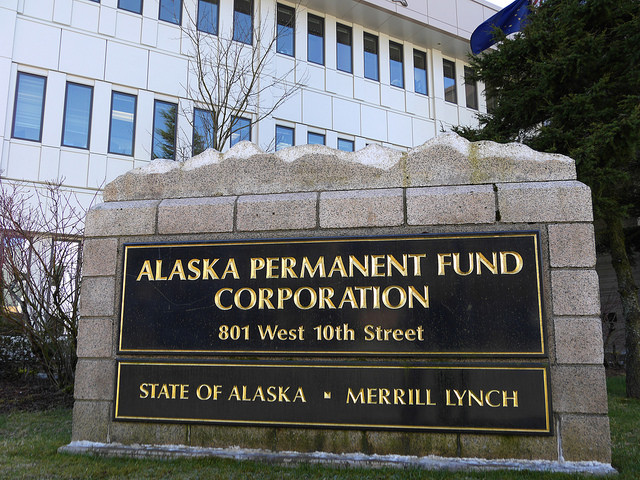
The Alaska Permanent Fund Corp.'s exterior sign, March 14, 2016. (Photo by Skip Gray/360 North)
The Alaska Permanent Fund Corp.’s exterior sign. A Pew Charitable Trusts report found the fund is ahead of those of other states. (Photo by Skip Gray/360 North)

A national report said other states can learn from the example of the Alaska Permanent Fund as they seek to grow their own funds built from natural resource extraction.

The Pew Charitable Trusts focused on seven states that have funds from extraction revenue, which the report describes as “sovereign wealth funds.” According to Pew, Alaska is one of only two state funds whose purpose is well-defined by state law. And the report found that it’s one of three states that doesn’t allow withdrawals from the fund principal.

Brenna Erford helped write the report and manages Pew’s work on state budget policy.

She praised the foresight Alaska officials and voters had when they established the fund in 1976.

“It’s an outstanding example of a government that had the opportunity to establish one of these funds when the oil industry in Alaska was really just starting up – at least starting up in earnest,” after the Prudhoe Bay oil discovery, she said.

Erford praised Alaska’s history of inflation-proofing the fund, and the fact that the Alaska Permanent Fund Corp. board and managers are somewhat protected from political pressures. She noted that the public board meetings and open financial records are more transparent than the operations of sovereign wealth funds in other countries.

The report doesn’t make recommendations on whether states like Alaska should draw from their funds’ earnings to support annual government budgets. Erford noted  Gov. Bill Walker’s plan to use fund earnings for the budget would be within the legislature’s legal mandate.

“I think that the question for Alaskans is, what do they think the future – in terms of natural resources and the Alaskan economy – what does that look like?” Erford said.

Erford said whether to draw from fund earnings depends on whether Alaskans believe oil and gas revenue will stay low or will increase.

The other states with funds are Montana, New Mexico, North Dakota, Utah, Wyoming and West Virginia. In June 2015, the Alaska Permanent Fund had nearly $53 billion, while the other six funds held $16 billion combined.

The report is part of a broader effort by Pew to help states address the volatility that comes from various sources of state revenue, including volatile energy prices.

S&P may lower Alaska’s credit rating if state sells pension bonds

Standard & Poor's said it could lower Alaska's credit rating if the state sells pension obligation bonds. (Creative Commons photo by eflon)
Standard & Poor’s said it could lower Alaska’s credit rating if the state sells pension obligation bonds. (Creative Commons photo by eflon)

Standard & Poor’s announced Friday it expects to lower Alaska’s credit ratings if the state government sells bonds to pay for public-worker pensions.

Gov. Bill Walker’s administration plans to sell up to $3.3 billion in these bonds. An analyst for the credit rating agency said the bond sale would sharply increase the state’s debt burden. It also would lower the state’s capacity to issue debt in the future. And the bond sale adds to the risk to the state’s budget if investment returns are lower than the cost of the bonds.

Traders use credit ratings to assess risk. Lower ratings generally translate into the state paying more to bond holders.

The three credit rating agencies differ in their response to the state’s plans. Moody’s and Fitch rated the pension obligation bonds themselves one notch below the state’s overall rating, which it didn’t change.

State Revenue Commissioner Randall Hoffbeck said the state plans to move forward with its plan to approach potential bond purchasers.

“We’re going to see how the market responds,” Hoffbeck said. “And then based on what kind of market response we get and the, you know, S&P statement that they’re going to downgrade us, we’ll make an ultimate decision. We’ll weigh the pros and cons and decide whether to go forward or not.”

S&P did point out that the state benefits from having budget reserves that are two and a half times its annual budget. And it has the potential to close its budget gap by drawing on Permanent Fund earnings, according to a statement from analyst Gabriel Petek.

The state is obligated to pay public workers $6 billion more in future pensions than it has in assets. Lawmakers – including Wasilla Republican Sen. Mike Dunleavy – have said the bond sale is too risky.

But Hoffbeck has said the bond sale could be the best way to close the pension funding gap.

“We’re going to have two, I think, good responses from the rating agencies, one not-so-good response,” he said.

Hoffbeck has said that the state could close the sales the week of Oct. 31.

Judge reverses House District 40 primary, gives Nageak a two-vote edge

Rep. Benjamin Nageak speaks on the House floor, Jan. 21, 2014. (Photo by Skip Gray/Gavel Alaska)
Rep. Benjamin Nageak speaks on the House in 2014. Superior Court Judge Andrew Guidi’s decision puts Nageak two votes ahead of Dean Westlake in the House District 40 Democratic primary. (Photo by Skip Gray/360 North)

A judge on Thursday reversed the outcome of the Democratic primary for the House district that includes the North Slope and Northwest Arctic boroughs.

Superior Court Judge Andrew Guidi ordered the Division of Elections to certify that incumbent Benjamin Nageak of Barrow won the primary over Dean Westlake of Kotzebue by a two-vote margin.

The outcome of the primary could determine who organizes a House majority. While both are Democrats, Nageak caucuses with the Republican-led House majority, and Westlake said he’ll caucus with the Democrats.

The decision reverses the outcome of a recount, which had Westlake winning by eight votes.

Nageak, who is the co-chairman of the House Resources Committee, expressed relief.

“I’m pleased by the court’s result and hopeful it will be sustained during the appeal to the Supreme Court,” Nageak said. “I’m sure that’s where it’s going to go. And I hope this decision will result in improvement of training.”

The outcome hinges on the Kobuk River village of Shungnak, where local election officials wrongly allowed 50 voters to cast ballots in both the Republican primary and in the “ADL”  primary for the Alaska Independence, Democratic and Libertarian parties.

Westlake led Nageak in Shungnak, 47 votes to three, after the recount but before the decision.

Judge Guidi decided to subtract votes, based on the average number of Shungnak residents who voted in Republican primaries over the past 10 years.

Guidi subtracted 12 votes based on the idea that they would have voted Republican. He took away 11 votes from Westlake in Shungnak, as well as one from Nageak. He also decided that election officials wrongly allowed both candidates to gain one vote from Kivalina in the recount.

Westlake, who was out fishing, couldn’t be reached for comment.

His lawyer Thomas Amodio said no votes should have been subtracted.

“In our view, all of them qualified,” he said. “None should be disenfranchised. There’s no evidence that any of them would have voted in anything but the ADL primary. Especially with a very contested, close race.”

Amodio argues that the competitive Democratic House race gave Republican voters more of a reason to cross over in the primary than they had in previous years, when there were more competitive Republican statewide races.

Amodio says Guidi’s decision effectively disenfranchises voters in a village that’s 95 percent Alaska Native.

“By his calculations, he’s casting those aside,” he said. “You know, he’s the judge. He gets to decide that. Now, the Alaska Supreme Court gets to decide whether he was right or wrong.”

Under Guidi’s decision, the final outcome would be 815 votes for Nageak, 813 for Westlake.

The winner will take the seat, since there are no general-election opponents.

Nageak said the small margin reinforces the importance of every voter.

“Every vote counts,” he said. “We’ve been saying that for years. And it was borne out.”

Lt. Gov. Byron Mallott, who oversees elections, said in a statement that officials are “disappointed that the Superior Court ruled that a poll worker error in Shungnak was sufficient to change the outcome” of the primary.

He added that they want “absolute clarity” on the issues involved and will follow whatever measures the Supreme Court deems appropriate to secure a fair election.

Division of Elections Director Josie Bahnke has said the division will use this year’s primary experience to improve how the state trains election workers.

The Supreme Court asked lawyers for Nageak, Westlake and the state to file briefs by Saturday, Oct. 8.

Oral arguments will be Wednesday, Oct. 12.

And the Court is expected to rule by Oct. 14, to give elections officials enough time to distribute ballots for the Nov. 8 election.

Walker weighs whether to extend Juneau Access Road

A sign at the end of Glacier Highway, near where the Juneau Access Road extension would be built. Gov. Walker is weighing whether to back the project.Oct. 4, 2016. (Photo by Andrew Kitchenman/KTOO)
A sign stands at the end of Glacier Highway, near where the Juneau Access Road extension would be built. Gov. Walker is weighing whether to back the project. (Photo by Andrew Kitchenman/KTOO)

Forty miles north of downtown Juneau, the Glacier Highway reaches a point that’s like nowhere else in any similar-sized city in the mainland of North America: the end of a road system.

This "End" sign is worse for the wear after being shot by numerous visitors to the end of Glacier Highway. Oct. 4, 2016. (Photo by Andrew Kitchenman/KTOO)
This “End” sign is worse for the wear after being shot by numerous visitors to the end of Glacier Highway. (Photo by Andrew Kitchenman/KTOO)

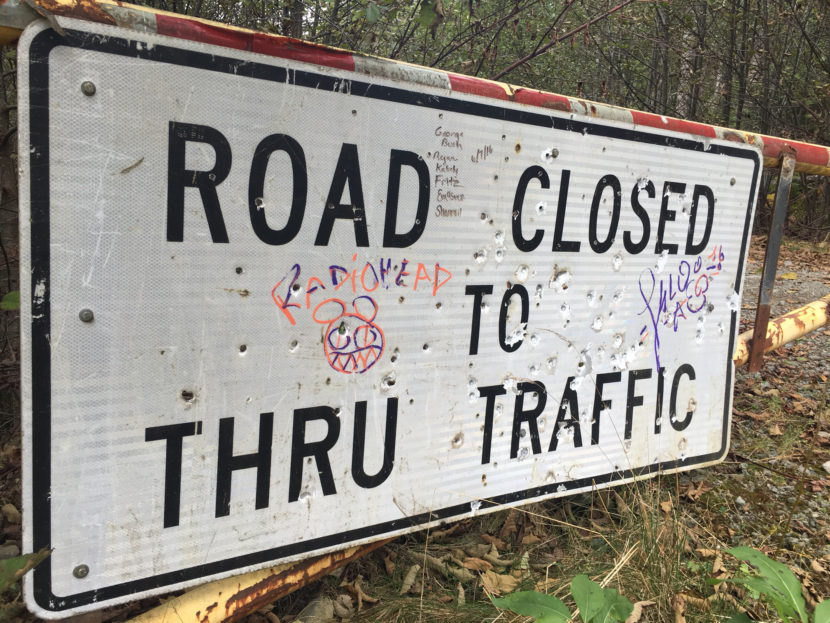
Nearby, a yellow, bullet-pocked sign that once read “End” is no longer legible.

For Gov. Bill Walker, the question is whether this spot should continue to be the road’s end.

Walker is facing a major decision on one of Alaska’s oldest and controversial megaproject ideas: whether to extend Juneau’s main road 48 miles closer to Haines and Skagway.

Walker shut down two megaprojects this year: the Knik Arm bridge and the Susitna-Watana dam.

He said on Sept. 30 he weighed his options on the Juneau Access Road during a recent flight from South Korea.

“I am not leaning in any particular direction at this point,” Walker said.

The steep mountains that border Lynn Canal have prevented Juneau from being connected to other roads.

In 2006, state and federal officials announced plans to design and build the road extension, which would take it to the Katzehin River.

The Southeast Alaska Conservation Council, or SEACC, successfully sued to block the decision.

A federal judge found that the state hadn’t considered reasonable alternatives.

The route the state previously supported is estimated to cost $574 million, of which the state would pay roughly 9 percent.

Walker’s currents options were laid out in a 2014 state-funded analysis put together by the Juneau-based consultants Milton Barker and the McDowell Group.

They range from doing nothing to building the road to Katzehin, to building a separate road extension on the Haines side of the Lynn Canal.

Barker said the analysis isn’t the final word.

“I can explain how the benefit-cost ratios were derived and what they mean,” Barker said. “But how to weigh those in selecting projects for funding is a decision that rests with the state and federal government.”

This is a stretch of Glacier Highway. Gov. Walker is facing a decision on whether to extend the road. Oct. 4, 2016. (Photo by Andrew Kitchenman/KTOO)
This is a stretch of Glacier Highway. Gov. Walker is facing a decision on whether to extend the road. (Photo by Andrew Kitchenman/KTOO)

Listing the pros and cons of the project is a well-rehearsed activity for those who’ve been engaged in the battle over it through the decades.

On the pro-side: The federal government is bearing the vast majority of the capital costs. And extending the road would cut hours in travel time to Haines and Skagway compared with current ferry travel.

But the anti-road side notes the road would cross a long series of avalanche chutes, which would block traffic in the winter and add high maintenance costs.

The 2014 analysis found that none of the options would bring the state more in user benefits than they would cost.

It found the extension to Katzehin would only bring in 28 cents of user benefits for every dollar of combined federal and state spending.

If only the state spending is considered, then it would bring 85 cents of user benefits for every dollar.

Economic consultant Gregg Erickson recalled telling Walker’s transition team in 2014 that the state could save money by killing megaprojects like the road.

“The one I focused on was to end those megaprojects that really don’t pencil out under any calculus in terms of the benefits they would provide to Alaska,” he said.

Erickson remembered being asked at the transition team conference whether it would be politically difficult.

“My answer was, ‘Well, that’s what political courage is all about.’ And I recall Gov.-Elect Walker nodding knowingly,” Erickson said.

Former state Transportation Commissioner Dick Knapp said the road extension will be worth it.

“There are a lot of socioeconomic benefits,” Knapp said. “And they include basically binding together the Southeast, by tying at least three communities together.”

Barker noted that the analysis he did with the McDowell Group didn’t consider other factors, such as the effects on economic development and the environment.

SEACC Deputy Director Emily Ferry said she’s concerned the road extension will crowd out funding for the Alaska Marine Highway System.

“Pretty much that will be the one and only project we will get in the region. And there are a lot other needs,” she said.

Ferry also questioned whether the road extension would truly improve access.

“Driving through 36 avalanche chutes, five tunnels and an incredibly dangerous road, doesn’t necessarily increase our access and it certainly does not make travel safer,” Ferry said.

The state-funded analysis found one alternative to doing nothing that would provide more user benefits than it would cost the state: extending the road a much shorter distance along Berners Bay. If federal money is included, then the costs exceed the benefits.

Transportation Commissioner Marc Luiken said early last year the state risked reimbursing the federal government as much as $27 million, according to the Alaska Dispatch News.

It’s not clear if Walker will announce a decision this year, but he’s actively considering it.

Correction: An earlier version of this story misstated that one road option would extend it to Berners Bay. The road already reaches Echo Cove, which is part of Berners Bay. Additionally, the story had understated the length of the proposed extension. It would be about 48 miles closer to Haines and Skagway, not 28 miles. 

Risky debt? Walker admin wants to sell $3.3B in bonds to close pension gap

Gov. Bill Walker’s administration wants to borrow money to pay for public workers’ pensions by selling up to $3.3 billion in what are known as pension obligation bonds.

But the plan is drawing concern from lawmakers, who say it may be risky.

Alaska’s government is obligated to pay public workers $6 billion more in future pensions than it has in assets.

State Revenue Commissioner Randall Hoffbeck said the best way to close that gap is to sell pension obligation bonds.

During a Senate Finance Committee meeting Thursday, Hoffbeck said the state would pay less than 4 percent interest per year for the bonds.

Revenue Commissioner Randall Randy Hoffbeck 22 16
Revenue Commissioner Randall Hoffbeck at a press conference in Juneau in January. (Photo by Skip Gray/360 North)

“Your returns are not within your control, but your cost of debt is,” Hoffbeck said. “And we have historically low costs of debt.”

The bonds are essentially low-interest debt. The state would use that money to invest. If investment returns are higher than the bonds’ rate, then the state would save money.

A 2008 law allows the administration to issue the bonds without legislative approval. But the legislature would have to decide to spend the money to pay off the bonds.

Wasilla Republican Sen. Mike Dunleavy questioned why the administration planned to sell the bonds at a time when the legislature is out of session and in the middle of an election campaign.

Sen. Mike Dunleavy, chairman of the Senate Labor and Commerce committee, listens during a meeting of the committee, Feb. 18, 2014. (Photo by Skip Gray/Gavel Alaska)
Sen. Mike Dunleavy listens to legislative testimony in 2014. He’s raising concerns about state plans to issue pension obligation bonds. (Photo by Skip Gray/Gavel Alaska)

“Many times we as individuals do more due diligence on buying a toaster than we do on such money movements at such a magnitude that we do in the state,” he said. “It doesn’t make any sense to me.”

Hoffbeck said the timing is due to low interest rates. And he cautioned against waiting any longer, since interest rates have risen since earlier in the summer. If legislators say they won’t appropriate the money, the state may not find buyers for the bonds, Hoffbeck said.

Dunleavy asked for more time to weigh the proposal.

“There’s some that say that just by having this discussion, will cause uncertainty among those dealing with the bonds — and the interest rates may go up,” he said. “My response to that is: There should be scrutiny. And anyone that’s not asking the questions that are in a similar position that I am, they need to be asking the questions.”

Pension obligation bonds have drawn criticism nationally. The Government Finance Officers Association says they involve considerable investment risk. It recommends against state and local governments issuing the bonds, since investing the money may not earn more than the bond payments.

Association Director Stephen Gauthier told the Senate Finance Committee the bonds have a history in recent decades of failing to benefit governments.

“They frequently fail,” he said. “Until 2009, most of them failed. Now, you know, there’s more winners than losers, but still it’s pretty risky business. And it often attracts governments who are in the least position to take those kinds of risks.”

The Department of Revenue projects that the state will save slightly more than a billion dollars over the 23-year life of the bond, if investments earn 7 percent.

Commissioner Hoffbeck says officials will answer more legislators’ questions the first week of October. Hoffbeck says if everything goes according to plan, the bonds will be priced the week of Oct. 24, with bond sales closing the week of Oct. 31.

Site notifications
Update notification options
Subscribe to notifications