Andrew Kitchenman

State Government Reporter, Alaska Public Media & KTOO

State government plays an outsized role in the life of Alaskans. As the state continues to go through the painful process of deciding what its priorities are, I bring Alaskans to the scene of a government in transition.
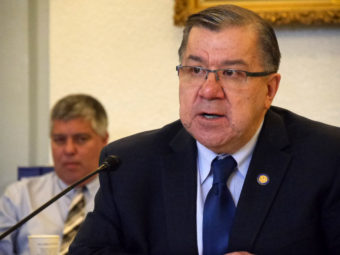
Senate committee introduces new bill to balance budget with Permanent Fund earnings

Much of the state government’s budget would be paid using the Permanent Fund’s earnings under a bill the Senate Finance Committee introduced Tuesday. It also would reduce Permanent Fund dividends, but could make them more stable for the future.

The bill could help move state government away from a decades-long dependence oil revenue.

Senate Bill 128, which is based on Gov. Bill Walker’s proposal, would pay about $2.5 billion from the Permanent Fund toward the budget, rising to $3 billion in eight years.

Sen. Anna MacKinnon, R- Anchorage on the floor of the Senate during debate about the state operating budget, March 14, 2016. (Photo by Skip Gray/360 North)
Sen. Anna MacKinnon, R- Anchorage, on the floor of the Senate during the budget debate in March. (Photo by Skip Gray/360 North)

It wouldn’t completely close the budget gap, but it would reduce state draws on the budget reserves enough that Senate Finance Committee Co-Chair Anna MacKinnon, R-Eagle River, believes it would put the state on sounder financial footing.

“I do think that we can come together on this portion, this leg of the journey, in helping the creditors that are watching Alaska,” she said. “I think this is a huge step forward. We diversify our revenue stream by almost 40 percent under this proposal.”

Dividend checks would be $1,000 for the next three years, and similar amounts after that. Walker has said that without changes to current law, the checks could disappear in as little as three years.

Legislative Finance Director David Teal says the bill would increase the state’s financial stability. The deficit would fall from more than $3 billion this year to less than $500 million in six years.

“The reserve balance is slightly lower but your deficit is so much lower that your glide path is much better under this bill than under the current status quo,” Teal said.

The bill is similar to other so-called “percent of market value” bills. It calls for 5.25 percent of the fund’s market value to be paid to the state. Of that payment, 20 percent would be devoted to dividends, with the rest going to the budget. In addition, about 15 percent of oil royalties would also support dividends.

Revenue Commissioner Randall Hoffbeck was cautiously positive toward the bill, saying that it gives the administration and Legislature something to work with.

“We have a mechanism now for using the earnings reserve,” he said. “And that’s a major step forward and we’re excited to start working on it.”

Wasilla Republican Sen. Mike Dunleavy said he thinks the latest bill shouldn’t be the final word on the state government’s finances. He wants a legal limit on spending.

“This is the opportunity to really take advantage of it and put some brakes on our desire to spend,” Dunleavy said. “I’ve probably heard a thousand different reasons why we should spend more money. Even though we’re at this point more than $4 billion less revenue than we’ve had in the past.”

MacKinnon says the bill is the results of months of work by legislative staff. She wants it to be something that will draw support in the Legislature and from Walker – without relying on an income tax.

“We’re looking for consensus in both bodies as well as with the administration,” MacKinnon said. “The idea is to stabilize Alaska’s income stream and protect Alaskans.”

The Senate Finance Committee plans to hold a hearing on the bill on Wednesday. Both houses have until the scheduled end of the session on Sunday to pass the bill.

Power Cost Equalization Fund could pay for community assistance

The Senate Finance Committee is looking to re-route money from the Power Cost Equalization Endowment Fund to replace the Community Revenue Sharing program that the state government started when oil prices were higher.

The concept arose from a concern over Senate Bill 210, which would reduce the amount that municipalities receive in revenue sharing. Without a source of revenue other than the state’s annual budget, this program – which legislators want to rename community assistance – would disappear.
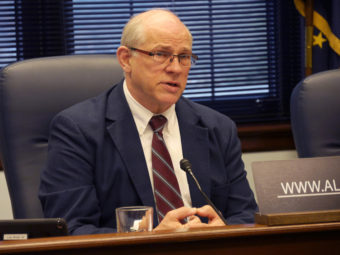
That’s where the second Senate Bill 196 comes in. The bill originally was written to use excess money from the Power Cost Equalization Endowment Fund to offset some of the state budget. But under a new version, this money would instead go to assist communities.

Sen. Mike Dunleavy, March 14, 2016
Sen. Mike Dunleavy, R-Wasilla, speaks during a floor debate last month. (Photo by Skip Gray/360 North)

Some legislators wanted to use more — if not all — of the fund this year. Wasilla Republican Sen. Mike Dunleavy asked why this isn’t happening.

“We’re experiencing a $4 billion hole. There’s a billion dollars in this fund,” he said. “Why wouldn’t we use this fund to at least backfill some of the deficit?”

However, under the latest versions of both bills, the $930 million PCE fund would continue to be used primarily for a program to help rural electric ratepayers. In years when the fund earns more than the roughly $40 million that’s needed for that program, up to $30 million would go to community assistance and up to $25 million would go to rural, bulk fuel and renewable energy programs.

Bethel Democratic Sen. Lyman Hoffman supports both bills. He doesn’t want to spend the PCE money all at once on the budget.

Hoffman said the fund could provide a lasting source for both power cost equalization and community assistance – as long as the main PCE fund remains intact.

That will help communities that have come to rely on revenue sharing while taking pressure off the state budget.

“If the dollars were taken, there would be a one-time use, and people in rural Alaska would end up paying substantially more in electric costs,”

But not all municipalities are happy about the change. Anchorage would receive $5.7 million in the coming year, which is $9 million less than the revenue sharing in the past. In future years, Anchorage would receive no more than $2.3 million.

Anchorage Mayor Ethan Berkowitz’s chief of staff Susanne Fleek-Green says it will cost residents more in taxes or reduced services. The municipal government had budgeted for a $5 million reduction, and must make up the gap.

Sen. Lyman Hoffman, D-Bethel, during a Senate Finance Committee meeting, March 29, 2016. (Photo by Skip Gray/360 North)
Sen. Lyman Hoffman, D-Bethel, during a Senate Finance Committee meeting on March 29. (Photo by Skip Gray/360 North)

“To counteract the effects of this legislation, the municipality will have to add to the additional burden being felt by property owners in the municipality,” she said. “This bill effectively is shifting an additional $4 million to property taxpayers in Anchorage, Eagle River, Chugiak, Girdwood and all other parts of the municipality.”

Under the latest changes, municipalities would receive $30 million in community assistance, compared with $50 million in Gov. Bill Walker’s budget.

Rural communities are largely protected from community assistance cuts. An extreme example is Aleutians East Borough, which receives nearly $10,000 for every one of the 39 residents who lives in unincorporated areas.

Every community with fewer than 500 residents would receive at least $400 per person in state assistance.

Alaska Municipal League Executive Director Kathie Wasserman says she’s can support using the Power Cost Equalization Fund for community assistance. But the reduced amount of aid – combined with a formula that benefits some place more than others – puts her in a difficult position.

“I’ve just had trouble with the formula that’s presently in place,” she said. “No matter which direction the Alaska Municipal League goes, whether to support the formula or not support, I throw a number of my municipalities under the bus, so that’s why we’re just not taking a position on the formula at this point.”

Both houses have until Sunday to act on the bills.

Correction: A previous version of this story misstated the amount Anchorage would receive under the legislation.


Senate passes criminal justice overhaul 16-2, sends it to House

A map of current community jails and DOC corrections facilities.

The state Senate voted 16-2 Saturday to pass a bill overhauling Alaska’s criminal justice system.

The bill would divert nonviolent offenders from prison toward alternative programs. It shifts the focus of bail from people’s ability to pay to the risk they present. It also creates a re-entry program in the Department of Corrections to help reduce recidivism. Senate Bill 91 also reduces sentence ranges and expands parole.

Sen. John Coghill, R-North Pole, at a Senate Majority press availability, March 21, 2016. (Photo by Skip Gray/360 North)
Sen. John Coghill, R-North Pole, at a Senate Majority press availability in March. (Photo by Skip Gray/360 North)

North Pole Republican Sen. John Coghill said the Alaska Criminal Justice Commission laid the groundwork for the bill.

“If less people are coming into jail reoffending, that’s less crime,” Coghill said. “And that’s what our aim is here. The aim here is not necessarily cost savings, but we can’t afford to do what we’re doing right now. So we’re kind of bumping up against the cost and the unacceptable returns on what’s going on in Alaska.”

The Department of Corrections forecasts the bill will save a lot of money — $90 million would be saved in the next six years by diverting people from prison. And potentially hundreds of millions in reduced social service costs since people will be working instead of being in jail.

Law enforcement unions and some victims’ rights advocates oppose the bill. They say it jeopardizes public safety and worsens victims’ trauma.

Chugiak Republican Sen. Bill Stoltze opposed the bill.

“I really think, in many aspects, this bill got too big to fail,” he said. “It could be several bills that were dealt with in different iterations.”

Supporters pointed to research showing that similar measures in other states have reduced the chance that people will re-offend.

Sen. Peter Micciche, R-Soldotna, supports the bill and said the current system makes low-level offenders better at being criminals while incarcerated, rather than being reformed. The bill would reinvest some of the savings toward social assistance programs, to help them succeed in finding work.

“What we’ve tried to do is provide intervention and reinvestment while they’re inside, and hopefully have these folks ready to succeed when they’re released. This is not the end. Although it’s a paradigm shift, we’ll be monitoring the success of the changes we’ve made and make sure it delivers the results that we expect it to see delivered.”

The House Judiciary Committee is scheduled to discuss the bill Monday, putting it on track for a vote by the full House later this week.


Permanent Fund bills to be a focus in session’s last days

Proposals to spend Permanent Fund earnings on the state budget will be a major focus of the legislative session’s final nine days.

Leading lawmakers say the outcome could be a combination of bills proposed by Gov. Bill Walker, Anchorage Republican Sen. Lesil McGuire and Anchorage Republican Rep. Mike Hawker.
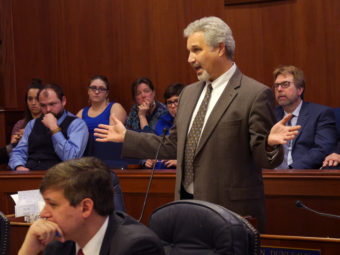
Sen. Lesil McGuire, R-Anchorage, explains Senate Bill 114 to the Senate Finance Committee, March 22, 2016. The bill reflects her vision for how the Permanent Fund and other state financial accounts should be managed. (Photo by Skip Gray/360 North)
Sen. Lesil McGuire, R-Anchorage, explains Senate Bill 114 to the Senate Finance Committee in March. The bill reflects her vision for how the Permanent Fund and other state financial accounts should be managed. (Photo by Skip Gray/360 North)

McGuire said it appears that majorities in both houses want to make lasting changes, which she says will strengthen the Permanent Fund for the future.

“It is a life-or-death situation that we do not leave the Senate without a plan that puts the state on a path toward closing the fiscal gap,” McGuire said.

McGuire said the state’s economic future depends on bringing certainty to the state budget. While she supports spending cuts, the senator says cutting much deeper would cost jobs and harm needed services.

“What you’re starting to see already is a chilling effect in the marketplace,” she said. “You have Alaskan residents, certainly in my district and other districts, talking about accelerating the sale of their homes, not making business investments in their capital spend.”

The particular elements of the final bill remain unclear. A major decision left still to be made is whether to include Walker’s plan to spend a set amount each year. McGuire and Hawker have instead proposed drawing 4.5 to 5 percent of the fund’s market value annually.

Either way, it will likely mean residents will see smaller Permanent Fund dividend checks in the future. But the governor has said that making no changes would be worse. That’s because the Permanent Fund earnings reserve could be exhausted in a few years, leaving residents with no dividends.

The House Finance Committee is scheduled to discuss Hawker’s bill, House Bill 224, Saturday, while the Senate Finance Committee is scheduled to discuss Walker’s Senate Bill 128. McGuire sponsored Senate Bill 114.

Senate passes concealed carry bill, 13-5

The Senate passed a bill Thursday to allow people to carry concealed firearms on University of Alaska campuses.

Sen. Pete Kelly, R-Fairbanks, debating the merits of his Senate Bill 174, April 7, 2016. The billl would deny the University of Alaska the authority to regulate the possession of guns and knives on campuses. (Photo by Skip Gray/360 North)
Sen. Pete Kelly, R-Fairbanks, debating the merits of his Senate Bill 174. The bill would deny the University of Alaska the authority to regulate the possession of guns and knives on campuses. (Photo by Skip Gray/360 North)

Bill sponsor Fairbanks Republican Sen. Pete Kelly says students would be safer if there were more guns on campus.
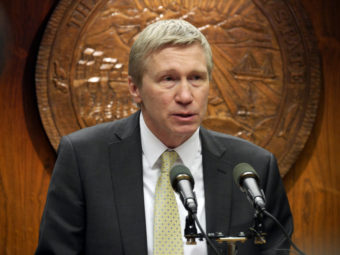
Kelly quoted professors from other countries who opposed the measure, Senate Bill 174.

“‘Well, if I’d have known this would be the case, I never would have taken this job,'” Kelly recalled them saying. “Or, ‘If this bill is enacted, I’m considering quitting.’ Now, almost everyone that heard that — good ol’ fashioned Americans — the same thought was going through our, their mind, because I talked to them later, and repeat after me: ‘Don’t let the screen door hit you in the …’ You know the rest of the phrase.”

University leaders asked legislators to amend the bill so the university maintained more of its ability to regulate guns. While Kelly agreed to some amendments, he opposed others.

Anchorage Democratic Sen. Berta Gardner opposed the bill. She noted that the late U.S. Supreme Court Justice Antonin Scalia recognized that firearm restrictions in schools and government buildings were legitimate.

“The University of Alaska is a government building. It’s also a school. The Alaska State Capitol is a government building. We ban weapons in this building,” she said. “Why do we think it’s incumbent upon us to not allow or trust the Board of Regents to regulate their buildings in the same way we regulate our own?”

The vote was 13-5. Majority caucus Senators Click Bishop of Fairbanks, Lyman Hoffman of Bethel, and Gary Stevens of Kodiak joined Juneau Democratic Sen. Dennis Egan and Gardner in opposing the bill.

The House Education Committee will hear the bill next.

Corrections officers union seeks retraction of review, opposes commissioner

Corrections Commissioner Dean Williams
Corrections Commissioner Dean Williams speaks to reporters after Gov. Bill Walker announced his appointment, Jan. 28, 2016. (Photo by Skip Gray/360 North)

The state corrections officers union wants Gov. Bill Walker to retract key sections of a report released last year that criticized Department of Corrections policies and some officers’ actions.

But Acting Corrections Commissioner Dean Williams says he’s moving forward, to address what he sees as needed changes to the department.

Brad Wilson, business manager for the Alaska Correctional Officers Association, says Williams defamed and slandered officers in an administrative review that Williams co-wrote in November.

“They’re innocent. They should never have been vilified in the press and in that report. They did not do the things that he said they did,” Wilson said, adding that officers’ and inmates’ safety is also at stake. “That report is basically saying that they did things wrong, but right now – today – they’re being ordered to do those exact same things.”

In the review, Williams and co-author retired FBI agent Joe Hanlon looked into deaths in jails and prisons. They found what Williams called a broken system, with numerous problems that contributed to four deaths they specifically examined. They also called for external reviews of deaths in corrections facilities. They said many policies were outdated, and solitary confinement was used too widely.

Wilson sent a letter to the governor Monday asking him to retract criticism of officers included in the review. He also released a 51-page rebuttal of the review that said that the officers correctly followed procedures.

“You can’t take one piece of information and twist and turn it,” Wilson said. “He was looking to make a name for himself. He was looking to do it on the backs of corrections officers that did nothing wrong. Nothing … It wasn’t close to what he said in the report. And now he’s the commissioner.”

For his part, Williams said he’s looking forward. He declined to defend details of the review.

“I could go point by point and say I just disagree,” Williams said. “I don’t think they are the facts. But the most important thing for me is to understand that wherever we were, we don’t have to stay there.”

Williams said he’s willing to work with anyone who wants to improve the department, including his critics. But he says they need to recognize that changes must be made. While he says the review wasn’t perfect, it’s time to move on.

“The review’s the review and we’re not – I’m not going back to do a second or third or fourth revision of it. That’s not the goal of it,” Williams said. “The goal now is going forward, for me.”

Wilson said it remains important for the union to have Walker retract the review findings. He says the union wants to clear the officers’ reputations. He says they’ve been criticized by family members of people who died in jails and have received threats.

“I am going to take any action that is necessary to make sure that the public knows that those officers did not commit a crime and they did nothing wrong and that they followed policy, as they were supposed to,” Wilson said.

The Legislature is considering whether to confirm Williams’ appointment. Wilson says he’ll probably ask lawmakers to vote against Williams, after hearing Williams defend himself in a House State Affairs Committee hearing this week.

Williams said it’s awkward for him to tell legislators how to work, but he said he wants to complete changes to the department.

“I think people have to vote their conscience, and understand where I’m going, or not,” Williams said, adding: “Anyone who’s spent five minutes with me, who can look into my face and see where I am at, knows I am going somewhere because I think that something needs to be done.”

The House State Affairs Committee sent Williams’ name to the entire Legislature for a confirmation vote.


Site notifications
Update notification options
Subscribe to notifications