Andrew Kitchenman

State Government Reporter, Alaska Public Media & KTOO

State government plays an outsized role in the life of Alaskans. As the state continues to go through the painful process of deciding what its priorities are, I bring Alaskans to the scene of a government in transition.
Crime reform bill due on House floor for debate Monday

House members will debate Monday whether to overhaul the state’s criminal sentencing laws. Supporters say the legislation will lower the risk of offenders returning to crime, but others are concerned that the bill goes too far in reducing penalties.

Senate Bill 91 is one of the most hotly debated bills of the session. It would allow law enforcement officers to cite low level, nonviolent offenders instead of arresting them. It also would focus prison beds on more serious and violent offenders and create a re-entry program within the Department of Corrections. But the House Finance Committee scaled back some of these changes. Committee members cited concerns from some victims’ rights advocates, who say the bill isn’t tough enough on offenders.

Sen. John Coghill, R-North Pole, at a Senate Majority press availability, March 21, 2016. (Photo by Skip Gray/360 North)
Sen. John Coghill, R-North Pole, in March. (Photo by Skip Gray/360 North)

Bill sponsor Sen. John Coghill, R-North Pole, said he remains hopeful the bill will become law. He emphasized the benefits of a pretrial program that would divert low-risk prisoners away from jail.

“We’re going to do risk-based assessments for the first time ever in pretrial. It’s still there,” after the committee changes, he said. “We’re going to allow them (to enter) diversion to programs for the first time ever, the way we’re doing it under a risk-based system.”

Coghill based the original bill on the recommendations of the Alaska Criminal Justice Commission. For example, the commission recommended raising the value of items that are stolen that require criminal charges, from $750 to $2,000. The House Finance Committee settled on raising the limit to $1,000.

But Finance Committee co-chairman Rep. Mark Neuman, R-Big Lake, was troubled by the possibility of letting thieves go because they stole less than $1,000 of valuables.

“It seems to me like we’re trying to make it so … a crook has a lighter sentence or gets off easier here, because of inflation. And I don’t like that,” Neuman said. “A crook is a crook.”

Alaska Public Defender Quinlan Steiner said that while the amended House and Senate bills would save less than the original legislation, the effects would still be positive.

“The bill, as I see it, will likely still result in significant savings that can be used to reinvest in programs that will reduce recidivism,” Steiner said.

Coghill said his original bill would have cut the state’s prison population by 21 percent, saving more than $400 million a year. He said the House Finance Committee substitute would reduce the prison population by roughly 8 to 10 percent.

The House is scheduled to debate and potentially vote on whether to pass or amend the measure on Monday. Coghill said he expects a debate over whether to require jail time for lower-level crimes. Another debate will likely focus on how much credit people in pretrial programs should receive, to reduce jail time.

Coghill said he welcomes the legislative debate over the bill.

“It just goes to show that when we’re making law, it gets down to specifics, and it’s not consensus-driven – it’s vote-driven,” he said.

The crime bill is the most significant bill left on the legislature’s agenda that’s not primarily focused on the budget.

Walker, industry leader differ on oil and gas tax credit bill

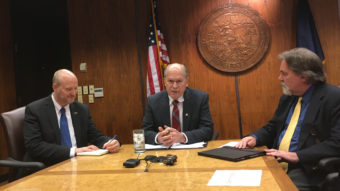
Gov. Bill Walker, flanked by Tax Division Director Ken Alper and Revenue Commissioner Randall Hoffbeck. Walker discussed oil and gas tax credits. (Photo by Andrew Kitchenman/KTOO)
Gov. Bill Walker, flanked by Tax Division Director Ken Alper (left) and Revenue Commissioner Randall Hoffbeck. Walker discussed oil and gas tax credits. (Photo by Andrew Kitchenman/KTOO)

Gov. Bill Walker voiced concerns about changes in the types of oil and gas companies that would benefit from state tax credits under a bill the House Rules Committee unveiled Tuesday.

The bill also received a cool reception from industry, but it may be the best chance to resolve one of the thorniest issues facing the state.

Walker said in a Capitol press availability Wednesday that he likes that there’s been movement in the Legislature on oil and gas taxes. But he’s concerned about some of the bill’s contents.

“We don’t want to be a situation where we’re pitting … producers against the independents, those that are coming in on the exploration side,” Walker said.

The bill would phase out a type of tax credit based on net operating losses. In addition, the bill scales back oil and gas tax credits at a slower pace than Walker has proposed.

“The longer we put this off, the longer we stay in this period of deficit spending,” Walker said.

While Walker would like to see the tax credits scaled back quicker, that doesn’t mean the bill satisfies the industry’s concerns. Alaska Oil and Gas Association President and CEO Kara Moriarty said scaling back tax credits will discourage oil and gas companies from investing in the state.

“If the State of Alaska changes the policy, we will respond accordingly,” she said.

Moriarty has said that an earlier version of the bill would particularly harm investment in Cook Inlet. The new version also would eliminate tax credits in Cook Inlet, but at a slower pace than the Senate bill, which Moriarty described as a “nuclear bomb.”

“The House Rules version is still a bomb,” Moriarty said, adding: “It may not be nuclear.”

Oil and gas industry expert Larry Persily said the criticism coming from both Walker and the industry reflects the issue’s contentiousness. Persily is an adviser to Kenai Peninsula Borough.

“It is clearly an attempt to try to find enough votes, because there’s not enough votes for any plan at the moment. And clearly, not enough votes for this one, either,” Persily said.

The governor’s bill would save the state up to $720 million more over the next two years than the House Rules version of House Bill 247. Walker says that if the oil and gas tax bill doesn’t include these savings, the state would have to come up with the savings somewhere else. Persily said the differences over the oil and gas tax issue are predictable.

“Getting into oil taxes, whether it’s credits or tax rates or minimums or deductions, you know, that is the big battle in Alaska,” Persily said.

Walker’s fiscal plan and the current bills either passed or being considered by the Legislature are nearly a billion dollars apart this year. Considering the governor and the Legislature’s majorities remain far apart on an income tax and other tax increases, it doesn’t look like the session will end any time soon.


Latest oil and gas tax credit aimed at gaining majority

The House Rules Committee Tuesday unveiled the latest attempt to rewrite tax credits for the oil and gas industry. The bill would save the state more money over the next three years than a previous version of House Bill 247. But the savings are much less than what Governor Bill Walker proposed.
However, the savings under the new version would grow beginning in 2020.

Rep. Lance Pruitt, R-Anchorage, during discussions about the state operating budget shortly before it was passed out of the House Finance Committee, March 9, 2016. (Photo by Skip Gray/360 North)
Rep. Lance Pruitt, R-Anchorage, during discussions about the state operating budget in March. (Photo by Skip Gray/360 North)

Anchorage Republican Rep. Lance Pruitt worked with others on the bill. He said the House could pass the legislation – something that it’s been unable to do with previous versions.

“I think the goal was to see if there something we could pass over to the Senate,” Pruitt said. “I mean, obviously, this was kind of at a deadlock, where it was.”

The bill would save the state up to $80 million in the fiscal year that starts in July 2017. Those savings would grow to be as much as $390 million in 2022.

Pruitt said the bill balances the interests of the state in reducing credits, with encouraging the industry to continue to invest. It also phases out credits more slowly than Walker proposes.

But Anchorage Democratic Representative Andy Josephson said he’s concerned with the bill. Josephson participated in legislative talks on the new version.

“We’re going to continue to look at spending close to a billion dollars a year on our total credit portfolio,” Josephson said. “I think that’s unsustainable and unaffordable.”

Even if enough members of the Republican-led House majority vote for the bill so it passes, it still faces a major hurdle. That’s because members of the Democratic-led minority caucus can block one of the principal ways that the state can pay for the budget – drawing from the Constitutional Budget Reserve. Democrats have said they won’t vote to spend money from the reserve if the state continues to pay out large oil and gas tax credits.

The tax credit issue has held up the Legislature from ending its session. An agreement could lead to several other major bills passing, including changes to the Permanent Fund and cuts to Permanent Fund dividends.

Senate president aims to finish session in Juneau

The Legislature didn’t take any actions Monday, as it began the second week after the scheduled end of the session. But Senate President Kevin Meyer said he’d like to see the session completed soon.

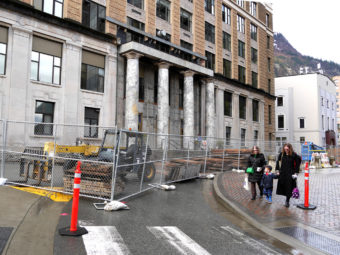
The street in front of the state Capitol was barricaded April 18, 2016, hours after the scheduled end of the regular legislative session. The street and the main entrance to the building were closed for planned renovations to the exterior of the building. (Photo by Skip Gray/360 North)

“In my mind … as long as we’re making progress, let’s just keep working,” Meyer said.

The biggest stumbling block for completing the session is finding agreement on changes to oil and gas taxes. Legislators also are considering major reforms to the state’s criminal justice and sentencing system. Lawmakers must finish work on the state budget and they’re weighing whether to draw money from Permanent Fund earnings to help pay for it. This could lead to smaller Permanent Fund dividends.
Meyer says the Senate will be ready to act on the budget and Permanent Fund bills once the House finishes its work on oil and gas tax credits.

It’s not clear how long the Legislature will remain in Juneau. Construction work has begun on the Capitol building.

The session was scheduled to end on April 17. Under the Constitution, the regular session can go until May 18. A special session could be held on the road system, but Meyer would like to see the Legislature finish in Juneau.

“Progress isn’t going as quickly as we’d hoped in the House,” Meyer said. “It’s my desire, and I think most of us in the Senate, is that since we’re in regular session, sessions are held in Juneau.”

Meyer and other legislators and staff members planned to visit different sites around Juneau to see if they could host the Legislature while the Capitol building is under construction. The construction is scheduled to intensify next week.

Centennial Hall Convention Center and the Bill Ray Center office building are potential sites for Legislative activities.

The House Finance Committee is planning to consider amendments to the criminal justice and sentencing bill Tuesday.


Committee to work out differences on bill drawing from rural power fund

The state House and Senate are trying to work out their differences over a bill that would draw money from the Power Cost Equalization Endowment Fund.

The $900 million fund subsidizes the high cost of electricity in rural areas. Because the state government has a $4 billion deficit, some lawmakers have suggested drawing money from the fund to pay for other state costs.

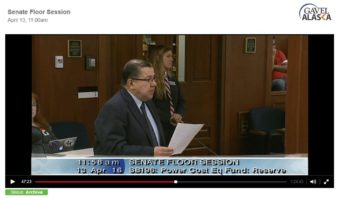
Sen. Lyman Hoffman, D-Bethel, speaks in support of Senate Bill 196 on April 13 in this screenshot from the Gavel archive.

Bethel Democratic Sen. Lyman Hoffman crafted a bill that would limit the draw from the PCE fund to years when the fund earnings are more than what’s needed for the power cost equalization program. This program costs about $40 million per year.

The Senate unanimously passed the measure, Senate Bill 196.

But the House made changes to the bill. These changes made it less likely that excess fund earnings would be redirected back into the fund.

Those changes concern Hoffman. When it was time for the Senate to decide Wednesday whether it would agree with the House’s changes, Hoffman spoke up.

“They changed the formula on how the excessive earnings will be distributed,” Hoffman said. “And I believe that that formula will potentially put the fund in jeopardy and want to go back and revisit the differences between what the Senate has done, which is a more sound approach to the fund.”

As a result, there will be a conference committee to rewrite the bill so that both houses can agree to it.

Hoffman will be the Senate chairman of the committee, which will also have Eagle River Republican Sen. Anna MacKinnon and Fairbanks Republican Sen. Click Bishop. The House members will be chairman Dillingham Democrat Bryce Edgmon, Eagle River Republican Dan Saddler and Fairbanks Democrat Scott Kawasaki.

The Legislature formed the conference committee on what was an otherwise quiet day in the Capitol.

Budget talks are quiet as Walker projects optimism

Progress on the state government budget has slowed to a crawl this week, but Gov. Bill Walker remains hopeful the Legislature will reach an agreement on an oil and gas tax bill that’s at the center of budget talks.

Walker says there are good ideas for reaching an agreement, including provisions in the Senate. That bill would end credits for small Cook Inlet producers. But the Senate version wouldn’t save the state as much as Walker’s proposal — a fact the governor noted on Monday.

“I thought it was pretty good,” Walker said of the Senate bill. “It’s pretty close to where we are and, you know, it’s not a matter of it has to be exactly my plan necessarily. But whatever we don’t do in that regard  — dollar-wise — we need to find that someplace else.”

Republicans lead large majorities in both of the Legislature’s chambers, but the House Minority has leverage. That’s because a three-quarters vote is needed to spend money from the Constitutional Budget Reserve.

Rep. Chris Tuck, D-Anchorage, takes questions from reporters April 19, 2016. Rep. Sam Kito III, D-Juneau, stands to his right. Reporters, front to back, are Liz Raines of KTVA, Becky Bohrer of the Associated Press and Andrew Kitchenman of Alaska Public Media and KTOO. (Photo by Skip Gray/360 North)
Rep. Chris Tuck, D-Anchorage, takes questions from reporters. Rep. Sam Kito III, D-Juneau, stands to his right. (Photo by Skip Gray/360 North)

House Minority Leader Rep. Chris Tuck said the Majority has to decide what it wants in an oil and gas tax package. Speaker Mike Chenault sent the House bill to the Rules Committee last week.

“We’re united in our side on what we want to see. But the reason why that bill got kicked back over to Rules is because it would have failed on the floor, and it would have failed for different reasons,” Tuck said.

“But it still would have failed.  We want to keep that alive. We want to keep things working. Chenault has, um, a lot of different characters in his caucus. He’s working it. He’s trying to come up with a solution. And we’re waiting to see what they’re going to agree to amongst themselves to see whether or not we’re going to agree to that.”

Members of the Republican-led House Majority caucus have been discussing oil and gas tax credits in private meetings.

Progress is being made on a separate area of the budget — one that will affect all Alaskans. The House Finance Committee is discussing a bill that would draw billions of dollars from the Permanent Fund earnings reserve. The bill also would cut Permanent Fund dividends in half.

The latest version of the Permanent Fund bill includes a provision that would limit fund spending on the government as oil revenues rise. Once oil revenues reach $3.1 billion, no money would be spent from the Permanent Fund.

House Finance Co-chairman Steve Thompson, R-Fairbanks, noted that if the Legislature doesn’t take any action on the Permanent Fund, the earnings fund would be exhausted in a few years. This would eliminate all dividends.

Walker said there’s common ground on the Permanent Fund issue.

“I think that’s moving along pretty well,” Walker said. “I don’t think we’re that far apart on that at this point. So, I think it’s getting much closer. I’m quite optimistic about that piece of it coming into play this year.”

Construction has begun on the Capitol building in Juneau. Only the finance and conference committees — as well as House Rules — are scheduled to meet Wednesday.


Site notifications
Update notification options
Subscribe to notifications