Andrew Kitchenman

State Government Reporter, Alaska Public Media & KTOO

State government plays an outsized role in the life of Alaskans. As the state continues to go through the painful process of deciding what its priorities are, I bring Alaskans to the scene of a government in transition.
Walker warns legislature against Permanent Fund earnings draw

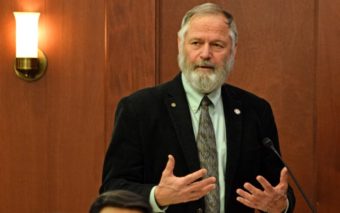
Gov. Bill Walker during a Q&A session for lawmakers with the Governor and key cabinet members to discuss legislator’s plans for reorganizing the Permanent Fund, April 20, 2016. (Photo by Skip Gray/360 North)
Gov. Bill Walker speaking to legislators about the Permanent Fund in April. (Photo by Skip Gray/360 North)

Gov. Bill Walker warned legislators Saturday that an option they’re considering to fund the state’s budget will harm the state’s economy and threaten Permanent Fund dividends.

Some legislators have raised the option of closing the state’s $4 billion budget deficit by spending Permanent Fund earnings.

In a letter to lawmakers, Walker said “he simply cannot accept” spending the earnings without a plan to balance the state’s budget. He said it would lower the state’s credit rating, which would increase borrowing costs. And Walker said the money for Permanent Fund dividends would be gone within four years if the legislature doesn’t adopt a sustainable budget.

The legislature could also close the budget deficit by drawing from the Constitutional Budget Reserve, if supporters of the CBR draw could get enough votes. This would require support from three-quarters of both chambers of the legislature.

In an interview on Friday, Walker said it remains important to him that a fiscal plan balance the budget by the fiscal year that begins July 2018. That’s been his definition of a sustainable plan since he unveiled his budget in December.

Read Walker’s letter here:

House passes oil and gas tax bill after rewrite on the floor

The House passed a far-ranging revision of Alaska’s oil and gas tax laws on Friday by a 25-12 vote.

The action came shortly after the House approved an amendment that rewrote the bill. The amendment passed with the minimum votes required, 21-16.

The last-minute changes include eliminating the ability for North Slope oil producers to deduct spending to reduce future taxes.

And tax credits to support Cook Inlet production would end more quickly than in the version of the bill passed by the House Rules Committee.

The amended bill also limited the number of years that new oil projects benefit from lower taxes. While the House Rules version would limit these “new oil” benefits to 10 years, the amended bill limits the benefits to seven years.

The upshot is that the amended bill would save the state much more money than the House Rules version over the next three years, but not as much as Gov. Bill Walker’s proposal would have.

For example, in the fiscal year ending in 2019, the amended bill would save the state roughly $225 million, the House Rules version would save $85 million, and Walker’s plan would save $465 million, according to a Department of Revenue analysis.

Rep. Paul Seaton, R-Homer, addresses the Alaska House of Representatives, March 23, 2015. (Photo by Skip Gray/360 North)
Rep. Paul Seaton, R-Homer, addresses the Alaska House of Representatives in 2015. (Photo by Skip Gray/360 North)

Amendment sponsor Homer Republican Rep. Paul Seaton said the bill would bring the state more money sooner and reduce long-term liabilities, while still supporting current projects.

The amendment drew support from a diverse coalition, including Seaton, North Pole Republican Rep. Tammie Wilson, and all 12 minority caucus members present.

“This is the way we should work together,” Seaton said of his work with Wilson on the amendment. He said they looked for areas of agreement and didn’t include areas where they disagreed, while drawing input from other legislators and industry.

Anchorage Republican Rep. Craig Johnson opposed the amendment and the bill, after having crafted the Rules Committee version. He said the revised bill left uncertainty in Cook Inlet tax policy.

“I believe this bill takes us back to the days of rolling brownouts,” in Southcentral Alaska, Johnson said.

Johnson also expressed concern that the bill would continue to pay tax credits. The Rules Committee version would have shifted toward tax benefits based on companies deducting lease expenditures.

The vote on the amendment was a rare occasion in which most majority-caucus members were on the losing side.

Seaton also said the amended bill addresses a concern Walker raised Friday. Walker said he wants the state government to have a say on which oil and gas projects are eligible for subsidies. Seaton said the bill accomplishes the goal by requiring companies to develop plans that would be approved by the state.

The bill heads to the Senate Finance Committee, which is scheduled to hold a hearing on it Saturday.

Walker wants approval over incentives for oil and gas projects

Gov. Bill Walker, March 21, 2016.
Gov. Bill Walker speaks in March. (Photo by Skip Gray/360 North)

Gov. Bill Walker said Friday that the state government must have a say in which oil and gas projects are eligible for tax incentives.

Walker said he’s concerned that the oil and gas tax overhaul being debated by the House doesn’t give the administration approval over incentives. He proposed adding this authority, but it wasn’t included in the current version of the oil and gas tax bill.

“It’s one of those things that just I think got out of hand,” Walker said in an interview. “And it was never intended to be, you know, a $700 million, $1 billion expenditure on something we have no say in. Can you imagine us … giving $700 million to any entity in Alaska and not having any say over what it is?”

Walker also pushed back against a different legislative proposal to draw money from Permanent Fund earnings to cover the state’s $4 billion deficit.
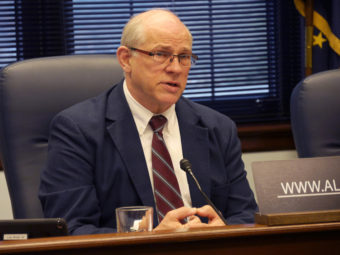
Sen. Anna MacKinnon, R-Eagle River, says she’d prefer the House approve drawing money from the Constitutional Budget Reserve. This requires three-quarters of the House to agree.

But MacKinnon said drawing from Permanent Fund earnings is the legislature’s last option if they can’t come to an agreement. This would take only a bare majority of both houses.

“The last option available to us should the minority not come together and support a three-quarter vote draw that’s necessary to access the Constitutional Budget Reserve … is to go after the earnings reserve to fund the budget,” MacKinnon said.

Walker stopped short of saying that he would veto a budget that draws on Permanent Fund earnings without a long-term fiscal plan. But he said he opposes such an approach.

“I’d be very troubled by that,” Walker said. “To their credit, (legislators) have certainly talked about that in the past as an option. And (it’s) not one that I would support at all. … We’re heading down a new path. We’ve never done that before, and I’m concerned about the precedent that that would potentially set.”

Walker said his budget proposal has the pieces the legislature needs to close the budget shortfall.

The House began debating amendments to the oil and gas bill – House Bill 247 – Friday.

Senate sends crime bill to Gov. Walker’s desk

John Coghill State of the State response
Sen. John Coghill, R-North Pole, speaks in January. (Photo by Skip Gray/360 Nort

The Senate voted 14 -5 Friday to approve a sweeping overhaul of Alaska’s criminal justice system. The action sends the bill to Gov. Bill Walker’s desk.

Senate Bill 91 would allow some low-risk nonviolent offenders to avoid jail time. It also would establish a new pretrial services program with a goal of reducing recidivism. And it would allow those in treatment programs to receive credit for time served instead of imprisonment.
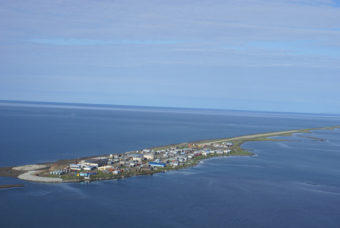
Bill sponsor Sen. John Coghill, R-North Pole, said the bill was driven by a consensus among members of the Alaska Criminal Justice Commission. He also said it draws on social science research. And Coghill said legislators will continue to make changes to the system.

Walker says he’s eager to review the bill.

Legislators turn down $7M request for rural school

Kivalina
Kivalina in August 2009. It’s a community of 400 with half of the community under the age of 18.(Creative Commons photo by Lt. Cmdr. Micheal McNeil/U.S. Coast Guard )

The Senate Finance Committee on Thursday voted against adding $7.2 million to funding for replacing the school in Kivalina. Gov. Bill Walker’s administration requested the additional funds.

The committee approved the capital budget for the coming year. The legislature would appropriate $77.5 million under the plan. The federal government would provide $1.3 billion.

But Golovin Democratic Sen. Donnie Olson was unsuccessful in adding more money for the school.

Olson said the money would settle an education lawsuit known as the Kasayulie case. The plaintiffs argued the legislature didn’t treat rural schools equally and the state wasn’t fulfilling its obligation.

“If there’s not a remedy to what goes on … the issue will only grow more complex and expensive,” Olson said. “It will become messy. It will become difficult to go and handle.”

The state initially planned to pay to renovate the school. But instead the state later agreed to pay for a new school in a different location. This would take the school away from the erosion that’s affecting Kivalina, which is on a barrier island near Kotzebue.

The administration and lawmakers differ over the right amount for the school. The legislature appropriated $43 million last year.  Eagle River Republican Sen. Anna MacKinnon said this satisfies the state’s obligation.

“For the last decade that we’ve argued about this issue – the adults have argued about the issue – the children of Kivalina have been in conditions that they should not be in,” MacKinnon said.

The committee passed an amendment proposed by MacKinnon saying that the legislature has met its obligation.

But the administration said the state should pay $7.2 million more.

State budget director Pat Pitney said that without the money, the state could be back in court.

“The highest risk the state faces is a lawsuit, and a reopening of all of the rural school funding inequality issues,” Pitney said.

The committee voted 4 to 1 against Olson’s amendment to add the additional Kivalina school money. It voted by the same margin in favor of MacKinnon’s amendment saying the legislature met its obligation.

The capital budget includes $12.5 million to purchase the Wells Fargo Bank building in Anchorage’s Spenard neighborhood to serve as a legislative information office. The state faces a potential lawsuit over leaving the downtown LIO.

Floor debate set to begin on oil and gas tax bill

The House could begin debate on the bill scaling back tax credits for oil and gas companies as soon as Friday.

The House Rules Committee released its version of House Bill 247 on Thursday.

Chris Tuck 2016 01 19
Rep. Chris Tuck, D-Anchorage, speaks at a press availability in January. (Photo by Skip Gray/360 North)

The bill doesn’t initially go as far as Gov. Bill Walker’s proposal to reduce tax incentives. But it would save the state a similar amount to Walker’s proposal, beginning in 2020.

Anchorage Democratic Rep. Chris Tuck said he will try to amend the bill. The bill gives priority for incentives to companies that hire Alaskans. But Tuck wants to include contractors and subcontractors as well.

Site notifications
Update notification options
Subscribe to notifications