State Government Reporter, Alaska Public Media & KTOO
State government plays an outsized role in the life of Alaskans. As the state continues to go through the painful process of deciding what its priorities are, I bring Alaskans to the scene of a government in transition.
State workers wouldn’t see pay hikes based on experience until oil prices rise sharply, under a bill introduced in the House on Monday.
House Bill 379 says that the Legislature plans to approve contracts with public employee unions that suspend step increases until after oil prices average $90 per barrel for a year.
While Gov. Bill Walker’s negotiates contracts with workers, the bill seeks to limit these contracts. Currently, workers receive step increases each of their first five or six years, then periodically after that.
Legislative leaders have been looking for ways to reduce the state budget as they weigh cuts to Permanent Fund dividends and oil and gas tax credits.
It was the only bill introduced Monday, the first day after the scheduled end of the legislative session.
The Legislature didn’t finish its work in time for the scheduled end of the session Sunday.
But it became clear that the largest stumbling block is how much and how quickly to scale back tax credits for the oil and gas industry.
Mike Chenault, Speaker of the House, Alaska Legislature, R- Nikiski, wields the gavel. (Photo by Skip Gray/360 North.)
House Speaker Nikiski Republican Mike Chenault said it’s a challenge to write a bill that the Republican-led House and Senate majorities can agree on – and that will gain support from the Democratic-led House minority.
“We’re having a hard time getting past the oil tax credit,” Chenault said. “We think that has to be the first piece that passes before we can get buy-in from the minority, or even our members going into closing out the budget and, also, all of the revenue measures.”
Minority caucus votes are needed if the Legislature draws on the state’s Constitutional Budget Reserve to close the budget deficit.
Lawmakers also didn’t resolve other major bills they debated this session.
This includes reconciling the House and Senate versions of the state government’s budget. The House proposed cutting the budget by $283 million, while the Senate would cut it by $345 million. The biggest difference between the two is that the Senate included $100 million in cuts that weren’t allocated to specific areas.
In addition, it’s not clear whether the Legislature will adopt new revenue measures.
Potential revenue sources include drawing money from the Permanent Fund, which depending on the plan adopted, could cause dividend payments to drop to $1,000. And another measure would tax mining, fisheries and gasoline.
Anchorage Democratic Rep. Chris Tuck said an oil and gas tax credit compromise could be based on a provision of a Senate bill that reduces oil tax credits for Cook Inlet production – as well as amendments proposed to a House bill that gained bipartisan support.
“What we don’t want to see happening is we don’t want to see Alaskans pulling money out of their pockets to give to the oil industry,” Tuck said. “We’re paying out more to the oil industry than we’re taking in production taxes. That’s just simply unacceptable.”
For his part, Chenault said the oil and gas tax credit bill is the linchpin. Once it’s resolved, the other pieces will come together. Those may include time limits on any tax increases – so that they will disappear if the economy improves and oil prices rise.
“When you get to the budget, we need to continue to try to reduce the budget where we can to drive the cost of government down where we don’t feel the need or have the need to tax Alaskans or tax Alaskans’ businesses in order to pay for government,” Chenault said. “So we need to keep our thumb on the size of the budget, keep downward pressure on that.”
The budget committees of both houses and the budget conference committee are scheduled to meet Monday.
The legislature on Friday narrowly approved former Fairbanks North Star Borough Mayor Luke Hopkins to serve on the board responsible for developing the Alaska gas pipeline.
Luke Hopkins. (Photo by Rachel Waldholz/APRN)
A joint session of both houses voted 31-27 to confirm Hopkins to the board. Gov. Bill Walker appointed Hopkins in November, after overhauling the board.
Fairbanks Democratic Rep. David Guttenberg said Hopkins’ experience is what the AGDC board needs. Hopkins is Guttenberg’s brother-in-law.
“Luke’s got a long history of getting things done — or trying to get things done — with the pipeline,” Guttenberg said.
Eagle River Republican Rep. Dan Saddler opposed Hopkins. He questioned whether the AGDC board is following the right direction. He referred to former AGDC President Dan Fauske’s ouster.
“The personnel changes in the staff and the board at AGDC give me cold comfort that the organization’s effort is to achieve the model which I believe is in the best interest of the state,” Saddler said.
The legislature also confirmed Dean Williams as the commissioner of the Department of Corrections. It voted by a wider margin to confirm Williams, 49-9.
Corrections Commissioner Dean Williams. (Photo by Skip Gray/360 North)
His appointment has been controversial. The corrections officers union opposed Williams. Union officials say an administrative review co-written by Williams was unfair to the officers.
But North Pole Republican Sen. John Coghill said Williams is the right man for making changes in the department.
“This is a job that is needed to be done for a lot of years, so I’m going to support him,” Coghill said.
Anchorage Democratic Sen. Bill Wielechowski said Williams’ review didn’t give the public an accurate view of officers’ work.
“This has severely, severely damaged the morale and the public’s impression of our correctional officers,” he said. “And the problem is a number of things in that review were seriously, seriously taken out of context.”
The legislature confirmed dozens of other appointments. The only person rejected was Hope resident Guy Trimmingham to the Board of Game. Opponents said his interest in sightseeing was inappropriate for a board that promotes maximizing wildlife for consumption.
The legislature is trying to close a $4 billion budget deficit this week. But a new report says the burden of closing the gap could fall too heavily on the poorest Alaskans.
If every element of Gov. Bill Walker’s fiscal plan is adopted, the 20 percent of Alaskans with the lowest incomes would lose nearly 10 percent of their income. The middle fifth of residents would lose about 4 percent. The top 1 percent of state residents would only see a 1.3 percent pay cut.
That’s according to a report by the nonpartisan Institute on Taxation and Economic Policy.
However, the results would be much more skewed if the state doesn’t adopt an income tax. In that case, low-income residents would still lose more than 9 percent of their income. Middle-income residents would lose 3.5 percent. But the highest income Alaskans would lose less than a quarter of a percent.
Diane Kaplan, president and CEO of the Rasmuson Foundation (at table facing camera) talks about the fiscal crisis in January. (Photo by Skip Gray/360 North.)
The Rasmuson Foundation commissioned the report. Foundation President and CEO Diane Kaplan said the report gives the legislature and the governor a chance to reflect on how their actions will affect different groups.
“We are concerned about how different approaches affect our poorest, most vulnerable citizens, as are members of the legislature, as is the governor, and that’s why they asked us to get this information for them,” Kaplan said.
The reason why the results affect different income groups in such different ways is that low-income residents rely much more on Permanent Fund dividends. They would see their checks cut in half by a proposal released by legislative finance committees this week.
Walker also proposed a lower income tax rate than any other state in the country – 6 percent of the federal income tax liability.
The new report found that there would be a more balanced effect if the state reduced dividends by $370 and set income taxes at 15 percent of residents’ federal tax liability.
Kaplan said the state needs a balanced approach.
“There are several different approaches that are reviewed in the report. We don’t endorse any one of them. We don’t condemn any one of them,” she said. “We say these are all good pieces of information for our elected officials to use as they come to a sound decision here before heading out of Juneau this year.”
Revenue Commissioner Randall Hoffbeck said Walker’s administration tried to be balanced, while setting the income tax at a level that wouldn’t be controversial.
They ruled out a statewide property tax because there’s scant information on some unorganized borough land, while a sales tax would also burden low- and middle-income residents and communities that already have their own local sales tax.
“When it came right down to it, we found that the income tax was the one that really fit the governor’s overall plan the best. In that the income tax is progressive. It hits the higher income taxpayers more. And that works in conjunction with a reduction in the size of the Permanent Fund dividend,” Hoffbeck said.
If being uncontroversial was the goal, it’s not clear Walker succeeded. Republican legislative leaders have resisted any income tax.
Eagle River Republican Rep. Dan Saddler asked Hoffbeck how Alaskans could be assured that once an income tax is introduced, the rate wouldn’t be raised.
The commissioner responded that Alaska has a history of eliminating the income tax when state revenue rose due to oil revenue. Alaska is the only state in the country with neither an income tax nor a statewide sales tax.
The House Finance Committee heard public testimony on Walker’s income tax proposal and the proposed Permanent Fund plan Thursday evening.
A legislative committee voted Thursday to cut the University of Alaska’s budget by $50 million.
The conference committee voted 5-1 to adopt the House version of the university budget, which cuts $35 million more than the $15 million cut proposed by Gov. Bill Walker.
The portion of the budget directly controlled by the legislature would be $300 million, as opposed to Walker’s proposed $335 million.
University leaders have said the deeper cut could eliminate up to 500 jobs and lead to tuition rising by as much as 15 percent.
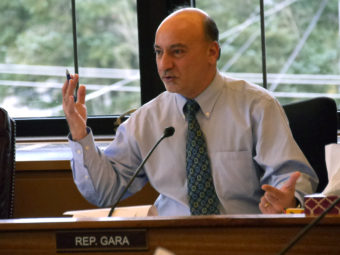
Rep. Les Gara, D-Anchorage, during discussions about the state operating budget in March. (Photo by Skip Gray/360 North)
Anchorage Democratic Rep. Les Gara said the cut would lead to young people leaving the state. It will also cost grants from private foundations. Gara is the committee’s only minority-caucus member.
Fairbanks Republican Sen. Pete Kelly said the cut is proof that in challenging times, everything is on the table.
The House spent six hours debating oil and gas tax credits Tuesday night. And they’re not done yet – lawmakers will pick up the bill again Wednesday.
The debate reveals a deep divide among lawmakers over how to respond to low oil prices – and the resulting state budget gap.
The debate on the floor came down to this: Should the state expect oil companies to pay taxes, even when prices are so low they might be losing money? And how quickly can the state scale back its cash support for smaller oil and gas companies?
For six hours, members of the Democratic minority offered amendment after amendment – but the divide wasn’t solely along party lines.
Rep. Paul Seaton, R-Homer, addresses the Alaska House of Representatives last year. (Photo by Skip Gray/360 North)
Homer Republican Rep. Paul Seaton broke with most of his caucus to propose more aggressively scaling back tax credits for oil production.
“I think we need to look at what we’re doing and the hole we’re digging in the budget with these tax credits, for not yielding any production, especially when there is basically zero production tax coming back,” Seaton said. “It’s hard to have production tax credits when there’s no production tax to offset it or ever retrieve that money back from.”
Other Republican House members say the bill as it’s currently drafted may go too far in taxing in the oil industry.
Big Lake Republican Mark Neuman says imposing a hard tax floor of 2 percent violates the trust of an industry that the state relies upon for long-term investment.
“We made commitments to industry,” Neuman said. “We should stand by those commitments. Because if we can’t, we’re saying that we can’t be trusted.”
Lawmakers pointed out that the state is scheduled to pay out $775 million in tax credits this year – which is about the same size as proposed cuts to the Permanent Fund dividend.
Juneau Democrat Sam Kito says it’s unfair to ask education and social services to take cuts while oil and gas producers are spared.
“At a time when we’re telling municipalities that we can’t maintain the revenue sharing program because we don’t have enough money, at a time we’re telling seniors we can’t maintain the senior benefits program because we don’t have enough money, we’re saying, ‘But we can’t change things for the oil companies,’” Kito said.
But Republican members note the industry has been laying off workers and has supported the state government for decades. And even if they pay no production taxes, oil companies continue to pay more than a billion dollars to the state, mostly in royalties.
North Pole Republican Tammie Wilson says it’s shortsighted for the state to raise taxes on an industry she described as its “bread and butter” when it’s already losing money.
“Maybe we need to change our attitudes, and be glad that they did invest here, and we are getting oil down the pipeline. Because I’m telling you guys, (if) that line goes down, we’re going to have real problems,” she said.
The bill’s fate remained unclear heading into the second round of debate Wednesday.
Close
Update notification options
Subscribe to notifications
Subscribe
Get notifications about news related to the topics you care about. You can unsubscribe anytime.