Andrew Kitchenman

State Government Reporter, Alaska Public Media & KTOO

State government plays an outsized role in the life of Alaskans. As the state continues to go through the painful process of deciding what its priorities are, I bring Alaskans to the scene of a government in transition.
With budget conference committee set, legislature enters home stretch

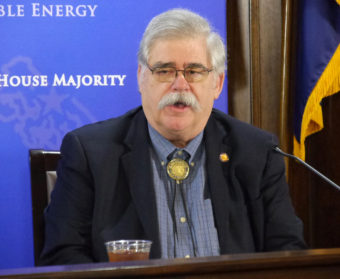
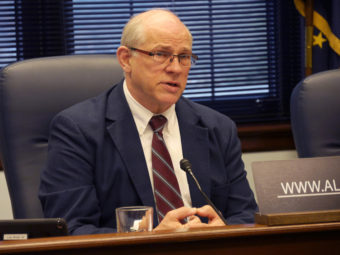
Rep. Mark Neuman, R-Big Lake, at a House Majority press availability, Jan. 22, 2016. (Photo by Skip Gray/360 North)
Rep. Mark Neuman, R-Big Lake, is one of six members of the budget conference committee. (Photo by Skip Gray/360 North)

State budget talks are entering their final phase. The House and
Senate have appointed members to a budget conference committee.

The committee will work out differences between the operating budgets
passed by both bodies.

The House budget would cut $283 million from the part of the
budget under the legislature’s control. The Senate would cut $345 million.

The biggest difference between the two budgets is that the Senate
includes $100 million in cuts that aren’t allocated to a specific
department. It’s not clear if the final budget will include this cut.
The legislature could find specific areas to cut, or ask Gov. Bill
Walker to make the cuts on his own.

The House members of the conference committee are the Republican
Finance Committee co-chairmen Mark Neuman of Big Lake and Steve
Thompson of Fairbanks, and Anchorage Democrat Les Gara.

The Senate members are Republicans Pete Kelly of Fairbanks and Anna MacKinnon of Eagle River, and Democrat Lyman Hoffman of Bethel.

Hoffman is a member of the majority caucus, so there will be no minority-caucus senators on the conference committee.

The minority-caucus Democrats lost their only member of the Senate Finance Committee in February, when Sen. Donnie Olson switched caucuses. The Democrats also lost their status as an official minority caucus, which entitles them to have a member on standing committees.

There legislature is scheduled to adjourn April 17.

As budget stopgap, Rep. Olson floats 35 percent PFD tax

Rep. Kurt Olson, a Soldotna Republican, developed a plan to tax Permanent Fund dividends back in February, but he didn’t introduce it at the time because he wanted to see how the debate over plans from Gov. Bill Walker and others unfolded.

Rep. Kurt Olson, R-Soldotna, at a House Majority press availability, Feb. 11, 2016. (Photo by Skip Gray/360 North)
Rep. Kurt Olson, R-Soldotna, at a House Majority press availability in February. (Photo by Skip Gray/360 North)

With less than two weeks left in the session, Olson decided it was time for House Bill 376, which would apply a 35 percent tax to dividends.
“It would have taken pressure off some of the other things had it been out there in February, which is about when we were done with the design and the modeling of it,” Olson said. “It would not been used for what I thought it should be used for, which is something to buy some time without being a permanent fixture.”

The tax would have raised $470 million last year, and Olson estimates it would bring in a similar amount this year. It would sunset after four years. Olson said this will allow the state enough time to find a long-term solution to the state’s budget problems.

Olson said legislative leaders are interested.

“We haven’t really looked for comments but the comments that have been made so far were interested,” he said. “Because it does have a certain, you know, simplicity to it. And it’s finite. I mean, you know what it’s going to be limited to.”

But members of the Democratic minority are giving Olson’s bill a cool response.

Fairbanks Rep. Adam Wool said the state should look for a long-term budget solution this year.

“It’s another kick-the-can bill,” Wool said. “I mean, it’s a quick grab of money out of the Permanent Fund that doesn’t really have any long-term sustainability. It’s a short-term fix, and I think it’s the wrong way to go.”

Olson said it’s important to note that his bill wouldn’t draw directly from the Permanent Fund, but from dividend checks. These checks would remain higher than under proposals by other legislators and by Walker.

The tax “did not come out of the corpus of the fund, it did not come out of the earnings reserve, and it did not come out of the (Constitutional Budget Reserve). It came out of the check as it was issued,” Olson said. “So, from that standpoint, we’re not raiding the Permanent Fund. We’re taking a modest amount of the check.”

The House Labor and Commerce Committee, which Olson chairs, introduced the bill on Monday. It was referred to the House Finance Committee.

Rep. Young calls for state support of Sturgeon appeal

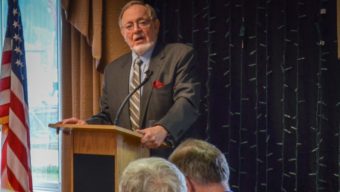
U.S Rep. Don Young speaks to the Capital City Republicans and Capital City Republican Women at the Prospector Hotel April 4, 2016. (Photo by Jennifer Canfield/KTOO)
U.S Rep. Don Young speaks to the Capital City Republicans and Capital City Republican Women at the Prospector Hotel. (Photo by Jennifer Canfield/KTOO)

Congressman Don Young called on Juneau Republicans on Monday to support legislative funding for John Sturgeon’s legal fight over operating a hovercraft in a national preserve.

Young also said that while he’s running for re-election, when the time comes for a successor, Alaskans should choose someone who’s young.
Young, 83, told the Capital City Republicans and Capital City Republican Women on Monday that it takes decades to build up seniority and effectiveness.

“Now, that’s something I want you to keep in mind. If you replace me someday, please get a younger person,” Young said. “Not that I have anything against mature citizens. I want you to know that. Just because you have to have someone that serves in the House for more than 25 years. And that’s a big dedication.”

Young said Congress is less effective than it once was. He said that’s because committee chairs have lost power.

“When I was chairman of transportation, I ran the Congress,” Young said. “I’m not braggin’ now, but I had 75 votes. I had Democrat votes, and I had Republican votes. They were loyal to the committee … if the speaker got frisky, and said, ‘You can’t do this, you can’t do that,’ I said, ‘You watch me.’”

Young used colorful language during his speech. He’s a former teacher, and he endorsed corporal punishment and criticized laws that prevent 15-year-olds from working.

“A lot of what we do is (done) incorrectly, as far as education goes. It’s requirements of the federal government to get the federal dollar,” Young said. “We’re hooked on this sugar tit, is really what it is. And we’re not educating our students. I will tell you. I don’t think I could teach today, because I can’t thump somebody.”

Young encouraged the audience to support state funding to back Sturgeon’s lawsuit. The U.S. Supreme Court recently handed Sturgeon a partial victory and sent his case back to the 9th Circuit Court of Appeals.

Young predicted that the federal appeals court won’t change its opinion, and the case will return to the Supreme Court.

Young spoke again in Juneau on Tuesday at a Native issues forum put on by the Central Council of the Tlingit and Haida Indian Tribes of Alaska.

Criminal justice bill amended to reduce benefits to sex offenders

Senators have amended a bill that would overhaul Alaska’s criminal justice system, taking steps to make it more difficult for those convicted of sex crimes to benefit from the bill’s provisions.

Senate Bill 91 is aimed at reducing recidivism, as well as the state’s prison costs. It would divert people charged with nonviolent offenses into alternatives to jail. And it would create a re-entry program to improve prisoners’ chances of success.

But victims’ rights advocates had raised concerns. The Senate Finance Committee amended the bill to make it harder for sex offenders to benefit. They wouldn’t be eligible for some of the reduced sentences available to other offenders.

Bill sponsor Sen. John Coghill, a North Pole Republican, said he understood why the changes were made.

Sen. John Coghill, R-North Pole, at a Senate Majority press availability, March 21, 2016. (Photo by Skip Gray/360 North)

“The Department of Law, the public defenders, the victims’ advocates group have all had a huge say in it,” Coghill said. “The police, who have to hold people accountable in a very, very dangerous circumstance — the way we deal with drugs — all came to the table, and I think, hammered out a better way of doing it than we’re doing it now.”

He added that he’s hopeful that the bill will make Alaska safer.

One amendment removed people found guilty of criminally negligent homicide from the group who would have their sentencing guidelines reduced. Some deaths resulting from drunk driving are examples of criminally negligent homicides.

But the committee voted 5-2 to drop another amendment that would require drug tests to receive public assistance.

Coghill said he believes the amendments increase the likelihood that the bill will become law, by addressing the concerns of its critics. He says alternative programs to jail will prove their value over time.

“Jail time is thought more highly of than some of the programs. And I think we just have to prove that – time over time – it’s going to show that programs can change some people’s behavior,” Coghill said. “But it’s also going to show that jail time is the way the public condemns certain issues. And I think that came very, very clear through the process.”

The Finance Committee could vote to send the bill to the full Senate as soon as Wednesday.

Legislators offer $32.5 million for Anchorage LIO

Anchorage LIO
The Anchorage Legislative Information Office, March 4, 2016. (Photo by Megan Ahleman)

The state government would buy the downtown Anchorage Legislative Information Office for $32.5 million under a recommendation the Legislative Council made Thursday.

It’s not a done deal. The council’s offer is about $1.5 million dollars less that what the building’s owners, operating as 716 West Fourth Avenue, LLC, have said they would accept.

Council Chairman Sen. Gary Stevens, R-Kodiak, said the offer is similar to the cost to move the office to the state-owned Atwood Building.

“The council said $32.5 million is the fair price, and we won’t go any higher than that, so it’s really now in the owner’s hands and he has to make that decision,” Stevens said of co-owner Mark Pfeffer. “Either he accepts that price or he doesn’t.”

The council voted 13-1 for the recommendation after meeting privately for two hours. The recommended price is the midpoint of two estimates that consulting group Navigant prepared for the state. Big Lake Republican Rep. Mark Neuman was the only no vote.

Pfeffer said the building cost nearly $37 million. He said the owners have accommodated the state’s requests.

Mark Pfeffer and Don McClintock
Mark Pfeffer, left, testifies on the Anchorage Legislative Information Office. Attorney Don McClintock accompanied him. (Photo by Andrew Kitchenman/KTOO & Alaska Public Media)

“Every time we have those requests, we try to solve the problem. And so far, we think we have every time,” he said. “If we can help achieve savings, we’re willing to do it.”

The owners recently turned down an offer similar to the council’s recommendation. But ownership representative Amy Slinker said they’re glad the council came to a decision.

Slinker said in a statement: “Now we have something to talk about. We are going to analyze it and get back to them soon.”

A Superior Court judge recently ruled the state lease for the building illegal, because the state didn’t open it up to competitive bidding.

Under the lease terms, the state would have paid twice as much for the LIO over the next 20 years as it would for the Atwood Building space.

Stevens said if the owners don’t accept the recommended offer, the state would move to Atwood. But he said buying the LIO would save the cost of moving — and it would end the litigation.

“This could wind up as very long, long litigation,” Stevens said. “And they’re to appeal the decision of the Superior Court, and that could really wind up being quite costly for all of us.”

The state will pay through July based on the terms of the invalidated lease.

Economist urges lawmakers to address deficit uncertainty

Institute of Social and Economic Research Director Gunnar Knapp presents possible economic effects of state budget proposals to the Houses Finance Committee, Feb. 25, 2016. (Photo by Skip Gray/360 North)
Institute of Social and Economic Research Director Gunnar Knapp presented possible economic effects of state budget proposals earlier this year. (Photo by Skip Gray/360 North)

What the legislature does in response to the state government’s $4 billion deficit could have big effects on Alaska’s economy, according to a leading economist.

Gunnar Knapp, director of the University of Alaska Institute of Social and Economic Research, told the Senate Finance Committee on Wednesday that uncertainty over the budget is a concern for the economy.

Knapp said closing the budget gap in one year could be too much, too fast. But it’s important for the state to have a plan, he said.

“If you can, in fact, reduce the uncertainty, then it makes more sense to implement … things over time,” Knapp said. “But there’s all the difference in the world between that and saying, ‘OK, we fixed 30 percent of the problem and we’ll, we’ll get back to you on what comes next.’”

Knapp said the state isn’t in recession yet, but appears to be heading into one. Job losses in the oil and gas industry, construction and state government have been offset by gains in health care and hospitality.

“I would say that regardless of what you do, I think it’s very unlikely that the recession we will be facing would be as severe or damaging as the 1980s recession,” he said.

Knapp said that’s because the economy is bigger, more diverse and less over-extended with borrowing and construction than it was in the 1980s.

Knapp urged lawmakers to focus on major issues, like making changes to Permanent Fund earnings and new revenue:

“My own instincts are that you can’t get there without new revenues,” Knapp said.

Gov. Bill Walker has proposed a personal income tax. Legislative leaders have so far resisted the proposal.

Fairbanks Republican Sen. Pete Kelly said he doesn’t want to raise taxes until the legislature has done more to cut the size of government.

“If we’re getting into the discussion of the things that begin to affect the flat-rate mechanic in my district, about whether he or she should pay taxes and start giving up the fruits of their labor,” Kelly said, “that has to be done later, after we have made sure everything else about government is on the table. Then we’ll start talking about the things that are on their table.”

Kelly questioned whether Knapp’s emphasis on having a state fiscal plan to reduce uncertainty was influenced by Gov. Bill Walker. In response, Knapp said he realizes lawmakers face difficult decisions, but he’s trying to stay out of the politics on either side of the issue.

Site notifications
Update notification options
Subscribe to notifications