Andrew Kitchenman

State Government Reporter, Alaska Public Media & KTOO

State government plays an outsized role in the life of Alaskans. As the state continues to go through the painful process of deciding what its priorities are, I bring Alaskans to the scene of a government in transition.
Walker says he’ll call special session if Legislature doesn’t approve new revenue

The Department of Revenue released a forecast today showing the state will bring in $800 million dollars less in oil revenue this year and next than the department projected in the fall.

Gov. Bill Walker discusses the annual state revenue forecast at a press availability, March 21, 2016. (Photo by Skip Gray/360 North)
Gov. Bill Walker discusses the state’s spring revenue forecast at a press availability, March 21, 2016. (Photo by Skip Gray/360 North)

Gov. Bill Walker said the 17-percent drop in the oil revenue forecast reinforces the importance of his fiscal plan. The plan would draw money from Permanent Fund earnings to pay for state government. It also would introduce an income tax and raise other taxes, while cutting state spending.

“It just underscores that the reason to make the shifts we have (in) the plan we’ve submitted — the New Sustainable Alaska Plan, with the Permanent Fund Protection Act,” Walker said, noting his goal of moving from 90 percent of state revenue from oil to 21 percent. “And also underscores the urgency of doing it yet this year.”

Walker added that putting a fiscal plan in place this year would reduce the uncertainty that surrounds the state’s future – as well as its ability to attract investors.

The governor says he’ll call a special session if the Legislature doesn’t pass any revenue measures this session.

Department of Revenue Commissioner Randall Hoffbeck, discusses the annual state revenue forecast at a press availability, March 21, 2016. (Photo by Skip Gray/360 North)
Department of Revenue Commissioner Randall Hoffbeck discusses the state’s spring revenue forecast at a press availability March 21, 2016. (Photo by Skip Gray/360 North)

Revenue Commissioner Randall Hoffbeck says the lowered forecast doesn’t call into question the basic elements of Walker’s fiscal plan.

“The Permanent Fund Protection Act actually models a range of oil prices through a 25-year period,” he said. “It assumes years of low oil price and years of high oil price. We had the staff go back to look to make sure this oil price environment was within the parameters of the assumptions. It was. And so this would not affect the draw under the Permanent Fund Protection Act.”

Soldotna Republican Sen. Peter Micciche acknowledges that the lower forecast will focus legislators’ attention on bills that would raise revenue.

“We have to have those other discussions about revenue,” he said. “We’ve cut deeply… over two years, we’ve cut about 17 percent in agency operations. This year alone we cut about $335 million.”

Oil and gas industry expert Larry Persily doesn’t blame the Department of Revenue for the incorrect forecast.

“It’s no one’s fault. It’s not like Alaska got it wrong last fall, with the Revenue Department forecast. Prices dropped further than most analysts expected and stayed lower longer than most analysts expected,” Persily said, adding that prices have increased some recently.

Persily said the governor is right to focus on moving state revenue away from volatile oil prices. But he said the state has a larger task as it tries to balance the budget.

“We have to accept we’re not the oil and gas state that we once thought we were, and we’re never going to be the oil and gas state that we once were,” Persily said.

“Because this isn’t just prices. This is production. We’re down three-quarters from the peak. And no one out there claims to have another Prudhoe Bay in their back pocket. So, it is going to be an adjustment for Alaska.”

Since both legislative houses passed their budgets in the past two weeks, they’ve started to focus on revenue-generating measures.

House bill would trim oil and gas tax credits, but less than Walker’s plan

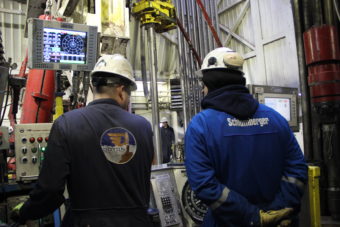
injection well at CD5 drill site
Two contractors monitor the drilling of an injection well at ConocoPhillips’ CD5 drill site on the North Slope. (Photo by Rachel Waldholz/APRN)

The House Resources Committee unveiled  on Saturday its version of House Bill 247, an overhaul of the state’s oil and gas tax credits.

The new version removes one of the key changes proposed by Gov. Bill Walker — raising the minimum tax paid by companies from 4 percent to 5 percent.

The bill would trim the amount of tax credits paid to companies operating in the Cook Inlet.
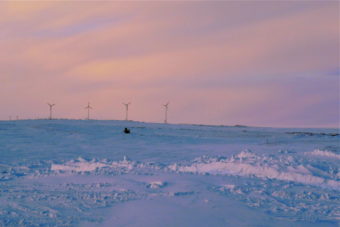
But Homer Republican Rep. Paul Seaton said the new version would leave credits for companies operating on the North Slope unscathed.

“It’s a huge budgetary expense and we’re talking about how we need to do budget cuts in here,” Seaton said of the legislature. “I see almost no budget cuts.”

But Rena Delbridge, an aide to Anchorage Republican Rep. Mike Hawker, said the sponsors of the new version were concerned about cutting credits deeper. Delbridge worked on the changes.

“The potential impacts to industry of immediate and dramatic changes, in order to resolve a short-term – hopefully short-term or intermediate-term – budget problem, could have fairly significant effects to our production in three years and in five years and in 10 years,” she said.

Walker had proposed eliminating credits based on how much companies spend on drilling and exploration. But he would have allowed companies to continue to get tax credits based on their operating losses.

The new version would scale back both types of credits – for spending and for losses — but wouldn’t eliminate either type.

Walker’s state budget proposal included $500 million from the tax changes. Until a fiscal analysis is complete, it’s not clear how much less the state budget would receive from the committee’s changes.

Ken Alper, state Tax Division director, said the changes will affect the state’s ability to balance its budget. He noted that eight other bills designed to raise revenue haven’t passed.

Walker’s expected to announce Monday that state revenue hasn’t been meeting forecasts, further deepening the budget problem.

The bill also would establish a legislative working group that would make recommendations on broader changes to the tax system for companies in the Cook Inlet and the area south of the North Slope known as “Middle Earth.”

These recommendations would be due in time for the next legislative session.

Lawmakers eye earnings of rural energy endowment to fund state budget

Wind turbines in Chevak
These four wind turbines in Chevak, pictured in March 2012, provide some renewable electricity to the village, but residents still pay high rates. (Creative Commons photo by Joseph)

Rural Alaskans can pay three to five times more for electricity than those in urban areas. That’s why the state launched the Power Cost Equalization Endowment Fund in 2000. It’s paid roughly $40 million annually to subsidize rural energy bills.

But some are questioning if the fund, now worth $900 million, should be committed to benefit only about one in nine Alaskans.

Senate Finance Committee Co-Chairpeople Anna MacKinnon and Pete Kelly discuss the budget. (Photo by Andrew Kitchenman)
Senate Finance Committee Co-Chairwoman Anna MacKinnon alongside Sen. Pete Kelly. (Photo by Andrew Kitchenman/KTOO)

Senate Finance Committee Co-Chairwoman Anna MacKinnon, an Eagle River Republican, said the state government could consider tapping the fund.

“You’ll see Power Cost Equalization come before us. There’s a billion dollars in that fund,” she said. “That billion dollars has been benefiting a selected group of Alaskans with Power Cost Equalization. But is that the highest and best use of those dollars now?”

MacKinnon is a sponsor of Senate Bill 196, which would rebudget fund earnings for other purposes. In years where fund earnings are greater than what’s needed for the Power Cost Equalization program, 60 percent of the excess earnings would go to the state government, 30 percent would go to renewable energy projects, and 10 percent would build up the endowment.

The fund lost money this year, so no excess money is available. It’s not clear whether MacKinnon and other lawmakers are looking beyond Senate Bill 196, to use the fund itself to help close the state’s budget shortfall.

Bethel Democratic Sen. Lyman Hoffman – another sponsor of the bill – sees Senate Bill 196 as a way to protect the fund’s principal while helping the state.

“So what we’re trying to do with this bill is to assure that during those high years, the fund only pay for its intended purpose – and if there are excess earnings, that those earnings be sent back to two different programs,” Hoffman said.

Rep. Bob Herron, another Bethel Democrat, said power cost equalization is fair to rural residents. He notes the endowment was started after the government paid for dams that provide power to cities.

Gov. Bill Walker wants to make sure that if changes are made to the fund, they’re considered along with his plan to close the budget shortfall. He wants to ensure everyone in the state shares the burden.

Walker expressed concern that the combined impact of Power Cost Equalization changes with Permanent Fund dividend changes would put too much of the burden on rural Alaskans.

“That’s why we have focused on a sustainable plan that is a broad-based plan, so that we take into consideration rural Alaska’s situation, which is unique versus urban Alaska,” Walker said. “We’ve tried to take all of that into consideration. That’s why one piece at a time doesn’t really work.”

The Senate Finance Committee heard testimony supporting Senate Bill 196 on Wednesday, but didn’t vote on the bill.

Alaska officials court Google’s driverless car industry

Google self-driving driverless cars
A row of Google’s self-driving cars spotted Oct. 2, 2015. (Creative Commons photo by Alan)

It may be awhile before ice road truckers become ice road computers, but one of Google’s top lobbyists was in Juneau on Thursday to talk about driverless cars.

Google state legislative affairs representative Ron Barnes wouldn’t commit to bringing autonomous vehicles to the Alaska anytime soon, saying Google’s engineers determine where the company tests its cars.

“We keep a list of places everywhere that might be somewhere we would need, but the engineering needs drive really where we go right now,” Barnes said. “And what new information do we need in order to make the software, make the cars more robust and their ability to handle driving scenarios.”

Barnes’ visit gave Fairbanks Economic Development Corp. project manager Jomo Stewart a chance to pitch the state as the ideal place for Google to test cars in cold weather conditions.

“Cold can be a real challenge, but it also can be an opportunity,” Stewart said, adding his agency promotes Fairbanks as “the most accessible, reliable and affordable place in the U.S. to do cold-weather testing.”

Palmer Republican Rep. Shelley Hughes said the state can be ahead of the curve in planning for driverless cars.

“There’s an opportunity. Right now, they have to work out how to manage those on ice and snow,” Hughes said. “I believe that if we can open the door to these kind of things – every bit and piece – that’s going to be a multi-billion dollar industry. If Alaska can just get a sliver of that economic pie, that will be good.”

Google’s driverless cars have driven more than 1 million miles on roads in California, as well as pilot projects in Austin, Texas, and Kirkland, Washington.

Legislators, Walker differ on how to pay for budget

As the state Legislature begins the final month of the session- one big question is looming: How are lawmakers going to pay for the budget?

Even with several hundred million dollars in cuts, the state has a more than $3 billion deficit to fill.

Members of the Republican-led Senate majority differ with Gov. Bill Walker on whether the state must permanently address all of its budget problems this year – and whether the state needs new taxes.
Much of the debate is focused on how far Permanent Fund earnings should be restructured to pay for government on an ongoing basis like Walker has proposed. Or, whether to just draw from the earnings reserve like the state has tapped the constitutional budget reserve in previous years.

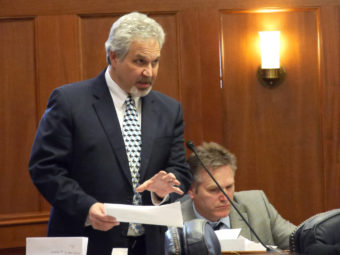
Sen. Peter Micciche, R-Soldotna, in the Senate during debate on the state operating budget, March 14, 2016. (Photo by Skip Gray/360 North)
Sen. Peter Micciche, R-Soldotna, in the Senate during debate on the state operating budget. (Photo by Skip Gray/360 North)

Soldotna Republican Sen. Peter Micciche said the government only has to close part of the budget gap this year. In part, that’s because it can expect higher returns from oil prices in the future.

He sees similarities between Alaska’s situation – having saved money in Permanent Fund earnings – and that of a family saving for college.

“Our child just graduated from high school and we’re saying, actually we’re not going to use that money that we’ve saved for the last 18 years for you,” he said. “We’re going to find some other way to pay for your college, but we’re not sure what it is right now. When you look at where we are financially, our child just graduated from high school, and it’s time to start thinking about how we’re going to use our sovereign wealth most effectively.”

Gov. Walker wants a long-term solution so that the revenue the state brings in this year will be stable in the future.

State Attorney General Craig Richards worked on the centerpiece of Walker’s plan – to change Permanent Fund earnings into a stable source of revenue. He said the state’s situation is more like a family facing retirement without its longtime source of revenue than a family paying for four years of college.

“Alaska lived for 30 years … off very generous petroleum revenues. Due to prices and production declines, we no longer can, so we’ve built up a huge savings account to essentially live off in the later years,” Richards said. “We’re at those later years, so to me, that’s why it’s all about you need to draw from your retirement assets in a sustainable manner because we need to live off of that money for a very long time.”

Walker also supports introducing an income tax, and increasing other taxes, to build a sustainable budget. But Republican leaders are skeptical of the need for more taxes. They do want to draw from the Permanent Fund earnings reserve and other savings accounts – but with less extensive changes than those proposed by Walker.

And Senate Budget Committee Co-Chairman Sen. Pete Kelly, a Fairbanks Republican, also wants to cut spending more.

He said “nothing happened” to government services after the state sustained nearly $400 million in cuts in the current budget year.

“That tells me, it was that fat. It was, at least, fat by $400 million in the day-to-day operations,” Kelly said, adding there will be a similar cut. “And you know what, it’s possible, I don’t think it’s likely but it’s possible that we’ll go too far. In which case, guess what, we can come back here next year and fix it.”

Anchorage Democratic Sen. Berta Gardner said she’s concerned that more cuts could destroy programs that would take time to rebuild. And she questioned Kelly’s statement that nothing happened after this year’s cuts.

“I would propose if he thinks that, he should talk to fishermen, he should talk with seniors, our lowest-income seniors, he should talk with students, and with teachers, who all are experiencing great changes in their world because of the cuts that we’ve made,” she said.

Gardner said an advantage of Walker’s approach is that it would affect all state residents – and nonresidents who make money in the state, in the case of the income tax.

She noted that the state is facing credit downgrades if it doesn’t address the budget shortfall, which will raise the cost for the state to borrow money.

Walker said he’s willing to work with legislators, but he wants that work to lead to a sustainable budget.

“Alaska deserves a conclusion this year. They deserve a product that’s finished this year,” he said. “So, we can do it. All the tools are there. All of the motivations are there. If we don’t, we know what the price is if we don’t. The price for kicking the can down the road is way too expensive for Alaska.”

Legislators expect to resolve how to pay for the budget toward the end of the legislative session.


Senate cuts $63 million more from budget than House

The Senate voted 16-4 Monday on a state government budget that goes $63 million deeper in cuts than the House budget.

That’s mainly because the Senate voted for $100 million in executive branch cuts that aren’t allocated.

Sen. Pete Kelly, R-Fairbanks, wraps up the discussion on the state operating budget shortly before it was passed out of the Senate, March 14, 2016. (Photo by Skip Gray/360 North)
Sen. Pete Kelly, R-Fairbanks, wraps up the discussion on the state operating budget shortly before it was passed out of the Senate. (Photo by Skip Gray/360 North)

Fairbanks Republican Sen. Pete Kelly said the Legislature can work out the specifics before the end of the session.

“This $100 million was mostly recognition of those kinds of structural changes — Medicaid reform is a pretty good example,” Kelly said. “Somewhere in the neighborhood of $31 million this year and … over $100 million each year after that.”

Before the vote, minority caucus Democrats proposed an amendment to eliminate the unallocated cut.

They also proposed restoring money for several different programs, including Permanent Fund inflation proofing, senior benefits and prekindergarten. They wanted to pay for some of these programs by reducing spending through cuts to oil and gas tax credits, and reducing spending on several stalled infrastructure projects.

All of the amendments failed.

Anchorage Democratic Sen. Berta Gardner said the state can afford to fund the education measures she included in one amendment.

“This amendment chooses education and Alaska’s children over projects that may once have been a great idea but that we simply can’t afford anymore,” Gardner. “The amendment restores pre-K education, Online With Libraries, the teacher mentor program, and the unallocated $10-million university cut.”

The cost of Gardner’s amendment would be offset by cuts to the Knik Arm Crossing, the Susitna-Watana hydroelectric dam, and the Ambler mining district road.

Eagle River Republican Sen. Anna MacKinnon said it would be wrong to use cuts in spending on construction projects to pay for budget items that will pop up every year.

“We have tough decisions to make, and I appreciate scrubbing the budget and looking at one-time funding to fulfill re-occurring costs, but it’s just not the way to do business,” MacKinnon said. “You do not take one-time money, and invest it in re-occurring costs. It just means we’re going to face the same battle next year.”

The two houses will resolve the differences between their versions of the budget through a conference committee. The Senate bill includes $25 million more for the University of Alaska. But it would cost less than the House in other areas, including $8 million less for Health and Social Services and $7 million less for transportation.

Before the conference committee is assigned, both Houses will consider major changes to oil and gas tax credits and the Permanent Fund, as well as the Medicaid and criminal justice overhauls.


Site notifications
Update notification options
Subscribe to notifications